






Sorbose Analysis Service
Sorbose is a six-carbon ketohexose with the chemical formula C6H12O6 and is one of the stereoisomers of fructose. It is relatively rare in nature and is usually produced through the biological oxidation of sorbitol by Acetobacter or Gluconobacter species. Sorbose is an important intermediate in the industrial production of vitamin C (ascorbic acid). Due to its unique structural characteristics and metabolic pathways, sorbose holds significant importance in fermentation industries, pharmaceutical synthesis, food science, and carbohydrate metabolism research.
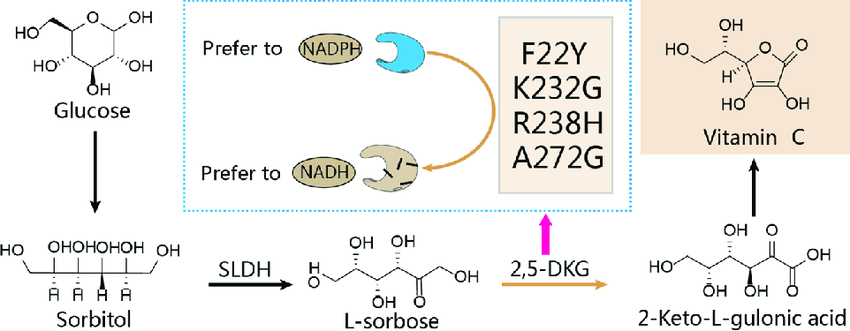
Chen, X. et al. Chem Rev. 2018.
Figure 1. Schematic of Vitamin C Biosynthetic Pathway
In the fields of food and pharmaceuticals, sorbose is widely used in sweetener synthesis, antioxidant preparation, and metabolic pathway analysis. In microbial metabolism studies, its production and degradation pathways reveal key mechanisms of carbon source utilization. In chemical and biocatalytic applications, the structural characterization and concentration control of sorbose directly affect reaction yield and product purity.
Equipped with advanced analytical platforms, MtoZ Biolabs provides a high-resolution and high-sensitivity sorbose analysis service that covers the entire process from qualitative identification and quantitative determination to structural characterization and physicochemical property analysis, helping clients fully understand the chemical nature and metabolic characteristics of sorbose while providing reliable data support for research and industrial production.
Services at MtoZ Biolabs
1. Component and Purity Analysis
High-performance liquid chromatography (HPLC) and gas chromatography (GC) are used for rapid qualitative and purity analysis of sorbose. Combined with refractive index detection (RID) or evaporative light scattering detection (ELSD), this method effectively distinguishes sorbose from structurally similar monosaccharides such as fructose, glucose, and sorbitol, ensuring accurate and reliable results.
2. Quantitative Analysis
External or internal standard methods combined with LC–MS/MS or HPLC are applied to accurately quantify sorbose content. This analysis is suitable for fermentation liquids, food ingredients, and chemically synthesized samples, featuring excellent reproducibility and a wide linear detection range, making it ideal for process monitoring and product quality evaluation.
3. Molecular Structure and Isomer Characterization
High-resolution mass spectrometry (MS) and nuclear magnetic resonance (NMR) are employed to analyze the molecular structure, stereochemical configuration, and isomeric ratios of sorbose. By examining the chemical shifts of carbon-hydrogen bonds, mass spectral fragmentation patterns, and glycosidic linkage types, the conformation and molecular composition of sorbose can be comprehensively elucidated.
4. Functional Group and Bond Type Confirmation
Fourier transform infrared spectroscopy (FTIR) is used to detect characteristic functional groups in sorbose such as hydroxyl, carbonyl, and ether bonds, and to identify molecular bonding and hydrogen bond interactions. Raman spectroscopy is used to analyze vibrational modes and crystalline structure differences, which helps assess the structural integrity and chemical modification of the sample.
5. Physicochemical Properties and Structural Stability Evaluation
Light scattering, viscosity measurement, and thermal analysis techniques are used to evaluate the solution behavior and structural stability of sorbose. These analyses provide insight into its physicochemical characteristics under varying environmental conditions such as temperature, pH, and solvent composition, offering valuable data for studies on food processing, fermentation control, and storage stability.
6. Impurity and Byproduct Detection
The sorbose analysis service also employs GC–MS and LC–MS/MS platforms to identify trace impurities and degradation byproducts, ensuring product consistency and data reproducibility. This capability is particularly useful for quality control in vitamin C production and bioconversion processes.
Analysis Workflow
1. Sample pretreatment: Remove salts, filter, dilute, or purify according to sample characteristics
2. Component detection: Separate and quantify major components using HPLC or GC systems
3. Structural confirmation: Characterize molecular structure and isomers using MS and NMR
4. Spectral validation: Analyze functional groups and molecular vibrations using FTIR and Raman spectroscopy
5. Data integration and report generation: Cross-validate multi-platform results and produce comprehensive qualitative and quantitative reports
Service Advantages
1. Multidimensional Characterization Methods
MtoZ Biolabs integrates chromatography, mass spectrometry, spectroscopy, and nuclear magnetic resonance into a multi-angle analytical system that provides complementary verification across all stages from quantitative detection to structural characterization.
2. High Sensitivity and High Resolution Platform
Using Orbitrap and TripleTOF high-end mass spectrometers, MtoZ Biolabs can detect trace amounts of sorbose and its isomers with precision, ensuring accuracy and reproducibility in complex samples.
3. Customized Analytical Solutions
Based on research objectives such as process monitoring, carbohydrate metabolism studies, or product quality control, MtoZ Biolabs offers flexible and tailored analytical strategies, including sample pretreatment design, method selection, and customized reporting.
Applications
✔️ Vitamin C production process studies: Monitoring sorbose yield and byproduct formation during bioconversion
✔️ Fermentation metabolism research: Analyzing dynamic changes in sorbose during microbial carbon metabolism
✔️ Food and functional ingredient analysis: Evaluating sweetness regulation and thermal reaction properties of sorbose in food systems
✔️ Chemical and catalytic reaction studies: Tracking conversion efficiency of sorbose in redox processes
✔️ Quality control and batch consistency testin:g Verifying sorbose product purity and structural stability
Sample Submission Suggestions
1. Sample type: Solid powder, liquid solution, or fermentation broth is acceptable.
2. Sample purity: Recommended purity ≥85 percent. For crude extracts, please provide the extraction method information.
3. Sample amount: Solid samples ≥5 mg, Liquid samples ≥500 μL with concentration ≥1 mg/mL.
4. Storage conditions: Store at low temperature and avoid light. Dry ice or cold-chain shipping is recommended.
5. Supplementary information: Provide sample source, treatment method, and analytical purpose to develop an appropriate testing plan
MtoZ Biolabs will provide testing confirmation and pretreatment guidelines after receiving samples to ensure smooth analysis.
Deliverable
1. Qualitative and quantitative analysis report of sorbose
2. Complete chromatograms and raw data files
3. Molecular structure model and functional group validation results
4. Description of analytical methods and result interpretation
5. Optional follow-up scientific data support and consultation services
MtoZ Biolabs relies on multi-technology platforms and a professional scientific team to provide high-standard sorbose analysis service for clients worldwide, supporting both scientific research and industrial applications. Whether you focus on vitamin C production, food formulation development, or metabolic pathway studies, MtoZ Biolabs can offer systematic, traceable, and customized analytical solutions. Contact us to obtain personalized analytical services that make your research and product development more precise and efficient.
How to order?




