






Single Domain Antibody vs Nanobody: Method Selection and Research Use Cases
Quick Answer
For most research programs, nanobody and single domain antibody are not perfectly interchangeable. Single domain antibody is the broader category: an antigen-binding reagent built from one variable domain. Nanobody usually refers more specifically to a camelid VHH derived from a camelid heavy-chain-only antibody. That difference matters when your team needs to define the scaffold, discovery source, reformatting path, validation scope, or sourcing language before starting assay work.
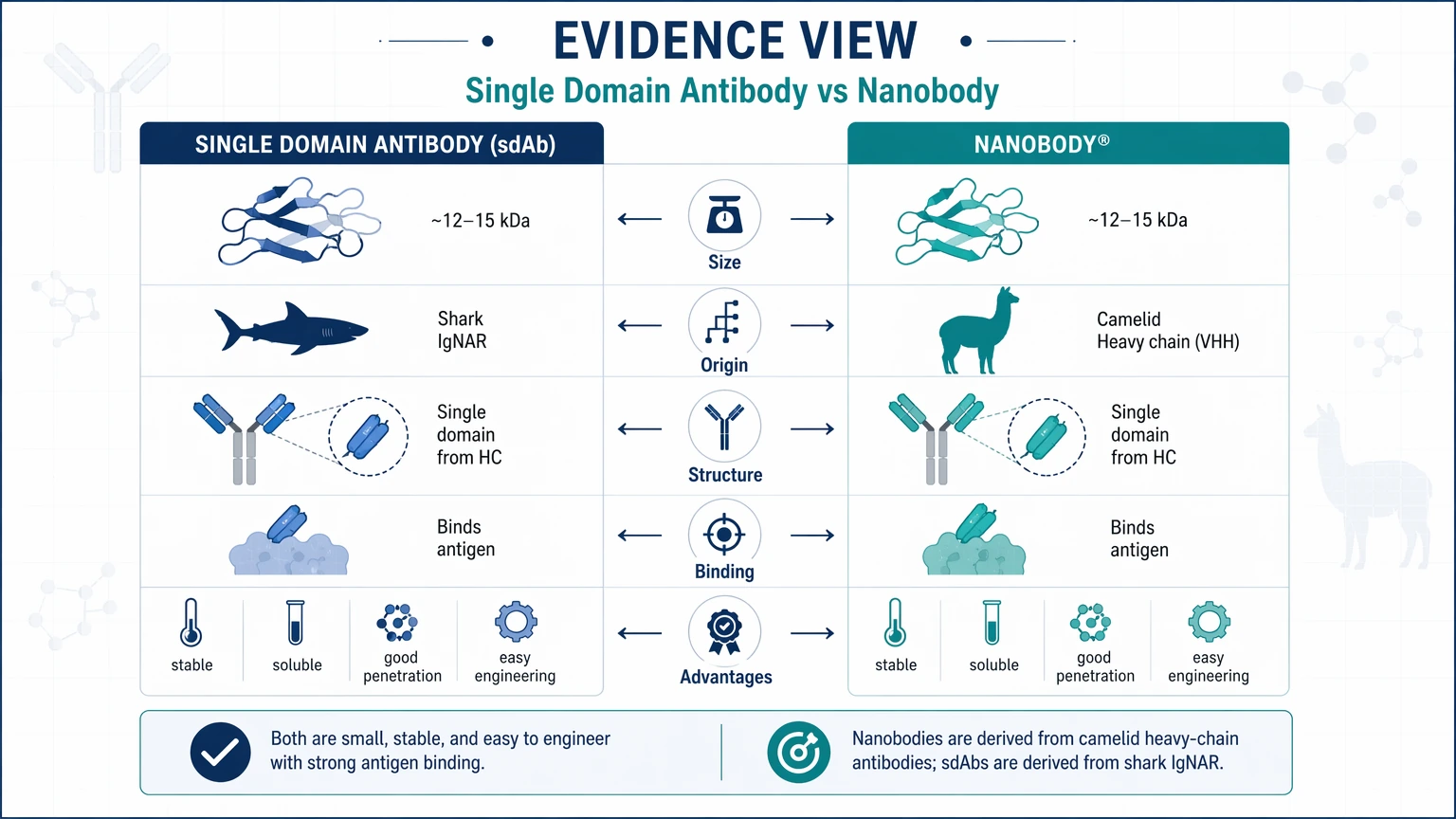
If your project simply needs a compact binder for a recessed epitope, a membrane protein target, an imaging probe, or a multivalent design, the broader single domain antibody category may be enough. If your team specifically needs a VHH scaffold for partner alignment, prior datasets, or sourcing constraints, “nanobody” is the more precise term. In practice, the better choice comes from scaffold identity, affinity, kinetics, specificity, developability, and assay compatibility data rather than shorthand naming.
Why This Comparison Matters for Research Teams
Teams often use “nanobody” informally to mean any small antibody-derived binder. External partners, CROs, assay scientists, and IP teams may use the term more narrowly. That mismatch can create avoidable problems during project scoping:
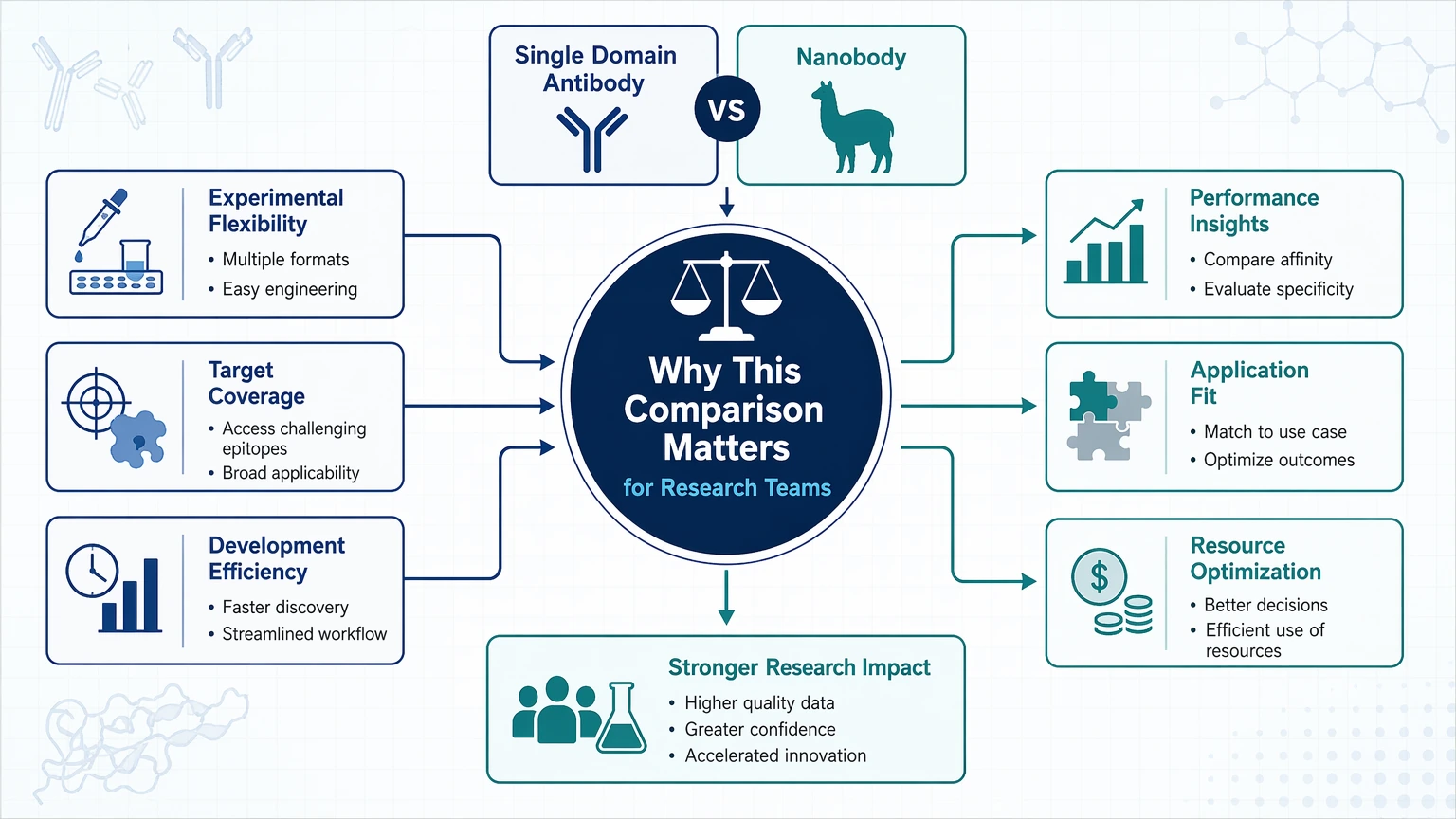
- discovery plans may start from the wrong scaffold assumption
- expression and purification plans may not match the intended construct
- assay teams may request the wrong validation package
- sourcing discussions may imply a camelid-derived route when that was not required
- reformatting into Fc-fused, bispecific, or imaging constructs may introduce behavior that was never tested in the original format
For antibody engineering and translational assay groups, the practical question is straightforward: what binder format are we selecting, and what data show that it fits the intended workflow?
What Is a Single Domain Antibody?
A single domain antibody is an antigen-binding reagent in which one antibody variable domain carries binding activity, rather than the paired heavy- and light-chain arrangement found in conventional antibodies. For platform selection, the term is useful because it describes a structural and functional class, not just a source label.
In research planning, that broader category helps teams compare candidates by measurable properties such as:
- access to sterically restricted or recessed epitopes
- behavior against a membrane protein target
- tolerance to reformatting
- recombinant expression in the intended host
- suitability for monovalent, bivalent, Fc-fused, or multivalent architectures
- compatibility with SPR, BLI, ELISA, flow cytometry, and imaging workflows
This category can include camelid-derived binders, but it is not limited to camelid VHH scaffolds. When a project brief says “single domain antibody,” the next question should be which scaffold is actually in scope and whether the source is fixed or flexible.
What Is a Nanobody?
A nanobody usually refers to a VHH variable domain derived from a camelid heavy-chain-only antibody. In research and commercial usage, the term often carries more information than size alone. It usually signals a defined biological origin, a familiar framework architecture, and an established engineering history across many binder-development and assay settings.
That narrower meaning is helpful when a team needs:
- camelid VHH-derived discovery specifically
- continuity with prior VHH datasets
- a recognized scaffold class for partner communication
- construct designs built around expected VHH behavior
In those cases, “nanobody” communicates a specific scaffold expectation rather than a general request for a small binder.
Confusion appears when “nanobody” is used as a generic synonym for every single-domain format. That shortcut is common, but it can blur differences in source material, sequence review, developability screening, and analytical planning.
Single Domain Antibody vs Nanobody: Are They the Same?
The most accurate short answer is:
- Nanobodies are generally a subset of single domain antibodies in common research usage.
- Not all single domain antibodies are nanobodies.
So the two terms overlap, but they do not always mean the same thing.
The table below summarizes the main planning implications for the method choice.
| Comparison Point | Single Domain Antibody | Nanobody |
|---|---|---|
| What does the term describe? | A broader one-domain antibody binding format or scaffold class | Usually a camelid VHH subtype within that class |
| Does it define source? | Not necessarily | Usually yes, camelid-derived |
| Does it imply VHH framework features? | No | Usually yes |
| When is the term most useful? | Early platform selection or source-flexible briefs | When VHH specificity matters for discovery, sourcing, or communication |
| Can the wording affect service scoping? | Yes, if scaffold options are open | Yes, if VHH-derived material is required |
Use these differences to align the analytical method with the biological question and validation plan.
For readers comparing single domain antibody vs nanobody, the real issue is usually not semantics alone. It is whether the project requires a specific VHH-derived scaffold or whether a broader single-domain strategy is acceptable.
Key Differences That Matter in Research Planning
1. Scaffold definition and source
If your team needs a binder from a camelid immune library or a VHH-centered synthetic discovery route, “nanobody” is the correct technical signal. If your goal is broader—for example, identifying any single-domain binder that can reach a conformational epitope or fit a compact imaging construct—then “single domain antibody” keeps the brief open to additional scaffold options.
This decision affects discovery inputs early. Library design, sequence acceptance criteria, candidate ranking, and comparative analytics all change when the scaffold assumption changes.
2. Construct design and reformatting behavior
A candidate that binds well as an isolated domain may not behave the same way after reformatting into:
- Fc fusions
- tandem repeats
- albumin-binding extensions
- multivalent constructs
- bispecific formats
- labeled imaging probes
Teams should not assume that a compact binder will retain the same affinity, kinetics, solubility, or expression profile after format conversion. That caution applies to VHH-derived nanobodies and to the broader single domain antibody category.
3. Assay compatibility
Small binders are often attractive when steric access is limited, but assay format still determines what data are meaningful.
- In SPR or BLI, immobilization strategy can shift apparent ka, kd, and KD.
- In flow cytometry, receptor density and avidity can mask weak monovalent binding.
- In imaging workflows, linker position and label chemistry can alter target engagement or background.
- In fixed-sample or IHC-adjacent research workflows, the preserved epitope may differ from the live-cell state.
For assay planning, the label matters less than whether the candidate has been evaluated in the format your team plans to use.
4. Developability and sequence liabilities
A one-domain format is not automatically easy to express, stable in every buffer, or suitable for every fusion design. Comparative evaluation should include:
- sequence review for liabilities
- expression screening in relevant hosts
- aggregation tendency
- solubility behavior
- thermal stability metrics such as Tm, when available
- nonspecific binding risk
- cross-reactivity assessment
This is often where terminology confusion becomes expensive. A reagent requested as a “nanobody” may satisfy size expectations while still failing key developability or assay-fit criteria.
How Format Choice Affects Assay and Platform Selection
A practical selection workflow starts with the target and readout, not the label.
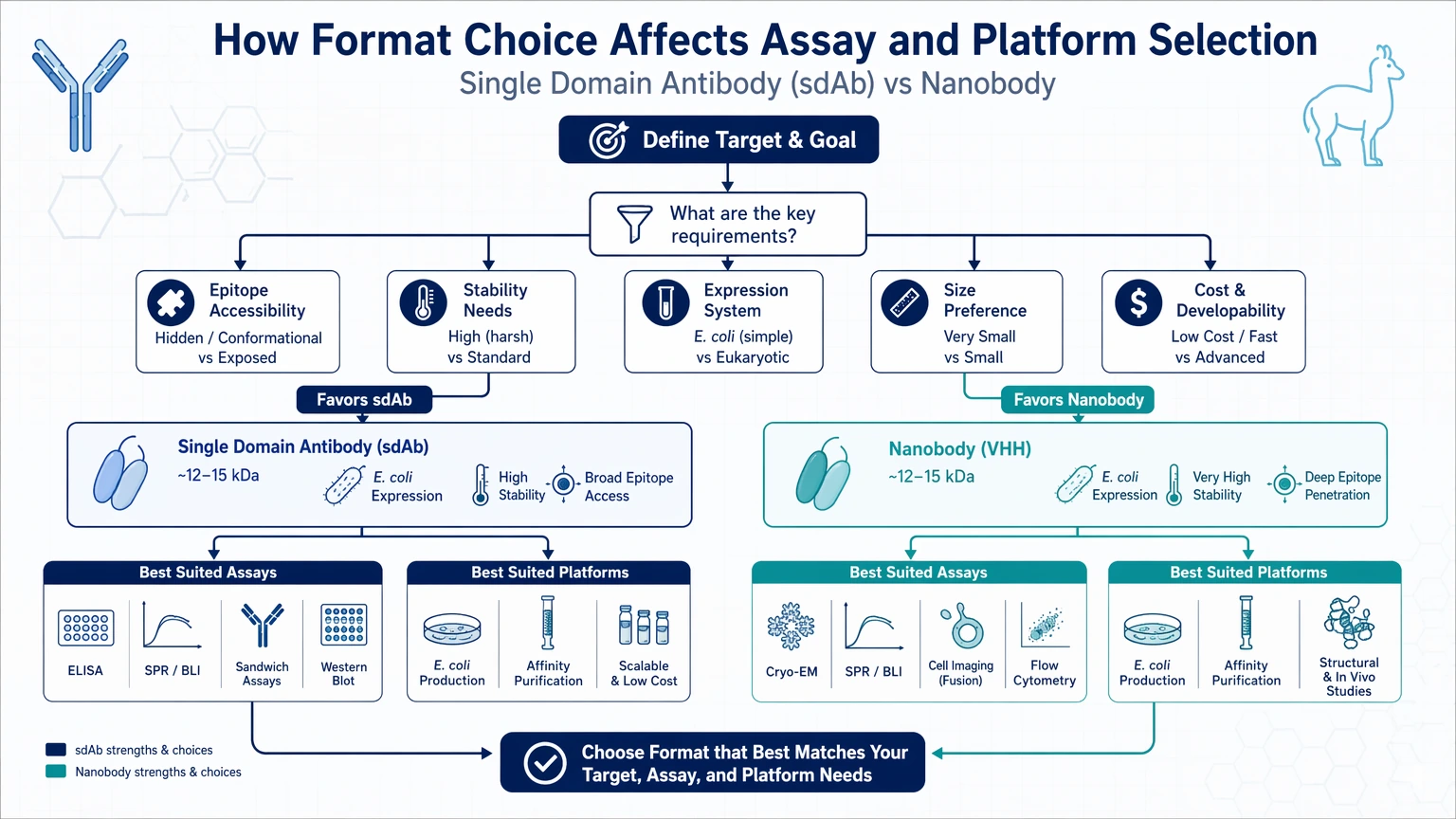
Difficult or recessed epitopes
When the biological question involves a buried pocket, enzyme cleft, or partially hidden region on a folded protein, a single-domain format may offer better physical access than a conventional IgG-derived reagent. In this setting, the most useful evidence is not the name of the scaffold but whether the candidate binds the intended epitope under relevant conditions.
Useful data include:
- orthogonal binding confirmation
- epitope mapping or binning
- binding to native versus recombinant target forms
- competition studies with reference antibodies or ligands
Membrane protein and conformational targets
For a membrane protein target, teams usually care about conformation sensitivity, detergent or membrane-mimetic compatibility, and performance in cell-based assays. A VHH-derived nanobody may be a good fit, but the project brief should still ask:
- Was binding measured on intact cells or only on purified antigen?
- Are the kinetics consistent in the matrix that matters for the assay?
- Does the candidate recognize the intended conformational epitope?
- Does labeling, fusion, or immobilization shift signal or background?
Imaging and tissue-access questions
Compact binders are often evaluated for imaging because smaller constructs can support different tissue-access and clearance profiles in research models. That said, smaller size is not a universal advantage. For imaging probe development, review:
- target abundance
- off-target signal risk
- linker and dye effects
- required residence time
- assay readout window
- whether monovalent binding is sufficient
If imaging is the goal, define the final construct architecture and validation plan explicitly rather than requesting a nanobody by default.
Multivalent and bispecific engineering
Single-domain scaffolds are frequently used as modular building blocks. If your team plans to build a multivalent or bispecific construct, compare candidates by more than monomer binding alone:
- expression yield after fusion
- linker tolerance
- aggregation profile
- retained specificity
- avidity-driven shifts in apparent binding behavior
- assay performance of the final construct, not just the starting domain
In this setting, a platform-level brief built around “single domain antibody” can be more useful than a narrow naming choice made too early.
Research Use Cases: When Each Format Is Commonly Considered
When teams usually specify “nanobody”
Use the nanobody label when the request needs to communicate a clear VHH expectation, such as:
- camelid-derived discovery
- continuity with existing VHH portfolios
- partner requests that explicitly require VHH
- engineering workflows already optimized around VHH frameworks
- sourcing or commercial discussions where subtype labeling matters
When teams usually specify “single domain antibody”
Use the broader term when the scientific need is functional rather than source-restricted, such as:
- reaching a cryptic or sterically constrained epitope
- building a compact binder-based assay reagent
- screening small-domain formats for a membrane protein target
- comparing monovalent and fusion-based construct options
- evaluating engineering flexibility before committing to one discovery route
When the distinction matters most
The wording matters most when the project brief will shape:
- library design
- sequence acceptance criteria
- analytical testing scope
- reformatting strategy
- third-party sourcing
- IP or commercial positioning language
If those decisions are sensitive to scaffold origin, the subtype should be stated explicitly. If they are not, the broader term may be enough.
What Data to Request Before Selecting a Reagent Format
Before choosing a candidate or launching a larger discovery effort, ask for data that support method selection rather than label-based assumptions.
Minimum comparison package
A useful request often includes:
- scaffold classification and sequence review
- recombinant expression screening summary
- monovalent binding affinity
- kinetic constants (ka, kd, and KD) measured by SPR or BLI
- specificity assessment with relevant controls
- epitope mapping or binning, especially in a competitive target landscape
- solubility and aggregation checks
- thermal stability readout such as Tm, when appropriate
- application-oriented validation in the assay format you plan to run
Questions that reduce rework
A stronger service inquiry usually states:
- the exact target type
- whether the target is soluble or membrane-associated
- whether native conformation must be preserved
- whether the final construct will remain monovalent or be reformatted
- which assays will determine advancement
- what cross-reactivity boundaries are acceptable
- whether scaffold origin matters for business, partner, or sourcing reasons
If your team is comparing a VHH candidate with a broader single domain antibody strategy, submit your requirements at that level of detail so the workplan can separate naming differences from actual platform differences.
How to Evaluate a Project Before Ordering Discovery or Validation Work
A disciplined review usually follows five steps:
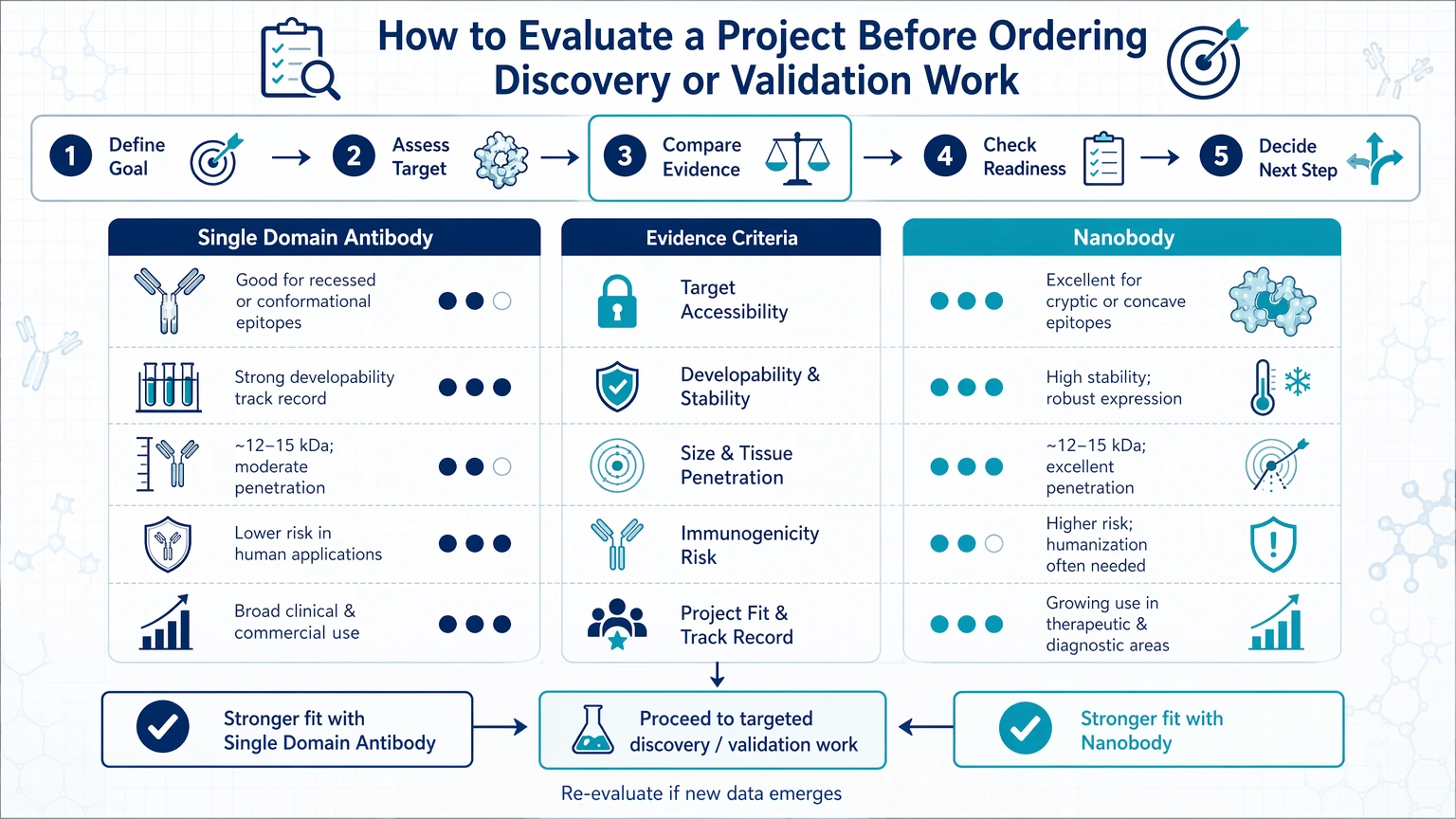
1. Define the scaffold requirement Is camelid VHH required, preferred, or optional?
2. Define the biological context Is the target a soluble antigen, cell-surface receptor, multipass membrane protein, or a conformationally sensitive protein state?
3. Define the final construct Will the reagent remain a standalone domain, or will it be converted into an Fc fusion, labeled probe, multivalent, or bispecific format?
4. Define the evidence threshold Which affinity, kinetics, specificity, and developability data are needed before advancing?
5. Define the application assay Is the reagent intended for a discovery screen, imaging, target engagement, flow cytometry, ELISA, or another translational research workflow?
At this stage, an external analytical review can be more useful than another round of terminology debate. If you need that kind of comparison, evaluate your project with MtoZ Biolabs based on target class, assay format, reformatting plan, and the characterization endpoints needed before platform selection.
Service Routes for Study Planning
For teams moving from method selection into execution, these service paths connect assay design, validation, and interpretation needs.
Conclusion
The most useful answer to single domain antibody vs nanobody is not that the terms are identical, and not that one format should replace the other. Single domain antibody is the broader category. Nanobody usually refers to a camelid VHH subtype within that category. That distinction matters when scaffold origin, construct design, partner communication, sourcing language, or validation scope must be defined precisely.
For assay planning and research use cases, the better choice comes from matching the binder format to the target biology and the final application. For difficult epitopes, a membrane protein target, imaging probes, or modular engineering, compare candidates with scaffold classification, affinity, kinetics, specificity, epitope evidence, and developability data. If terminology is slowing project scoping, contact us at MtoZ Biolabs to discuss a project evaluation centered on the construct, assay, and analytical package your team actually needs.
FAQ
Is a nanobody a single domain antibody?
Usually yes. In common research usage, a nanobody is a type of single domain antibody, most often a camelid VHH derived from a heavy-chain-only antibody. The broader term still matters because it does not automatically lock the project to a camelid scaffold.
Are all single domain antibodies nanobodies?
No. “Single domain antibody” describes a broader one-domain binding format. “Nanobody” is typically used for the camelid VHH subset. If your project brief treats the two as identical, you may narrow sourcing and discovery options without intending to.
What is the difference between VHH and single domain antibody?
VHH refers to a specific camelid variable-domain scaffold. Single domain antibody refers to the larger class of antibody-derived binders that use one domain for antigen recognition. A VHH is one example within that broader category.
Which is better for intracellular targeting or imaging?
The better choice depends less on the label and more on the construct and assay design. For intracellular or imaging applications, review intracellular stability, labeling strategy, background signal, specificity, and whether the reagent was validated in the exact format you plan to use.
Which format is easier to engineer into multivalent constructs?
Many single-domain scaffolds, including VHH-derived nanobodies, can be built into tandem, Fc-fused, or bispecific constructs. The practical question is whether a specific candidate retains expression, solubility, and binding after reformatting. That needs to be tested on the final construct, not inferred from the starting domain alone.
What analytical tests should be used to compare candidates?
A practical comparison typically includes sequence review, expression screening, SPR or BLI for affinity and kinetics, epitope mapping or binning, specificity panels, aggregation-related checks, and application-facing validation in the intended assay context. Those data are usually more informative than the naming convention by itself.
Does the naming difference affect reagent sourcing or service requests?
Yes. If you ask for a nanobody, many providers will interpret that as a request for a camelid VHH-derived scaffold. If your actual need is broader, asking for a single domain antibody and then specifying scaffold, construct, and assay requirements can reduce ambiguity.
How to order?




