






Short Peptide Sequencing Service
-
Raw MS MS data files generated from high-resolution LC-MS platforms
-
Processed results in CSV or Excel formats, including sequence assignments, fragment ions, and precursor information
-
A detailed PDF report summarizing analytical methods, QC metrics, and sequence interpretation
-
High-resolution figures, spectra, and chromatograms in TIFF or PNG formats
MtoZ Biolabs provides short peptide sequencing service using high-resolution mass spectrometry platforms and optimized sequencing methods to deliver reliable solutions for short peptide sequence determination, modification identification, and structural confirmation. This service is suitable for drug development, natural product analysis, peptide material research, and life science studies, providing essential data support for mechanism exploration, structural validation, and quality control.
The Technical Basis of Short Peptide Sequencing
The short peptide sequencing service at MtoZ Biolabs is typically based on high-resolution LC-MS/MS, where amino acid sequences are determined through fragment ion information. The overall technical system consists of data acquisition strategies, fragmentation techniques, and sequence reconstruction methods, which work together to generate reliable sequencing results.
|
Technical Category |
Technology Name |
Functional Role |
Applicable Peptide Types |
Technical Features |
|
Data Acquisition Strategy |
Top Down Peptide Analysis |
Direct fragmentation of intact short peptides for MS MS acquisition |
Cyclic peptides, natural peptides, modified peptides, and structurally intact small peptides |
Preserves full structural information, does not require enzymatic digestion, suitable for 2 to 50 aa, highly suitable for short peptide sequencing |
|
Fragmentation Techniques |
CID Collision-Induced Dissociation |
Fragmentation induced by energetic collisions |
General short peptides linear short peptides |
Generates abundant fragments applicable to most peptide sequences |
|
HCD Higher Energy Collisional Dissociation |
Generates high-energy fragments to improve sequence reconstruction |
Short peptides requiring uniform fragmentation in De Novo sequencing |
Producing more evenly distributed fragments improves sequencing accuracy |
|
|
ETD Electron Transfer Dissociation |
Fragmentation through electron transfer |
Modified short peptides PTM peptides with labile modifications |
Preserves modifications ideal for PTM analysis |
|
|
EThcD ETD plus HCD combined fragmentation |
Produces multiple ion series simultaneously |
Difficult to fragment structurally complex peptides |
b/y + c/z ion series increases coverage and confidence |
|
|
Sequence Reconstruction Methods |
De Novo Sequencing |
Determines amino acid sequence through fragment ions |
Unknown short peptides, natural peptides noncanonical peptides |
Does not rely on the database's core method for short peptide sequencing |
|
Database Assisted Sequencing |
Matches MS MS spectra with database entries |
Short peptides with known origins, synthetic peptide verification |
Fast and accurate, ideal for confirmation sequencing |
|
|
Auxiliary Strategies |
Amino Acid Composition Analysis |
Determines amino acid composition |
Difficult to fragment peptides with weak signal peptides |
Helps improve the accuracy of sequence reconstruction |
|
Chemical Cleavage, such as CNBr |
Cleaves at specific sites to increase fragment information |
Cyclic peptides with repeated sequences |
Enhances the readability of MS MS data |
|
|
Ring Opening Strategy for Cyclic Peptides |
Linearizes cyclic structures before fragmentation |
Cyclic peptides |
Significantly improves the success rate of sequence reconstruction |
Short Peptide Sequencing Service at MtoZ Biolabs
MtoZ Biolabs provides a mass spectrometry-based short peptide sequencing system designed to support comprehensive sequence confirmation.
☑️ Short peptide sequence determination to analyze unknown sequences or confirm the consistency of known sequences
☑️ Modification site analysis to identify phosphorylation, acetylation, methylation, fatty acylation, and other basic modifications
☑️ Molecular weight confirmation to verify amino acid composition, sequence integrity, and potential peptide impurities
☑️ Cyclic peptide and complex peptide analysis with ring opening strategies and multi-fragmentation support
☑️ Peptide purity confirmation to evaluate sample composition for quality control
This service is suitable for research institutions, pharmaceutical companies, and peptide material development teams.
Workflow of Short Peptide Sequencing Service
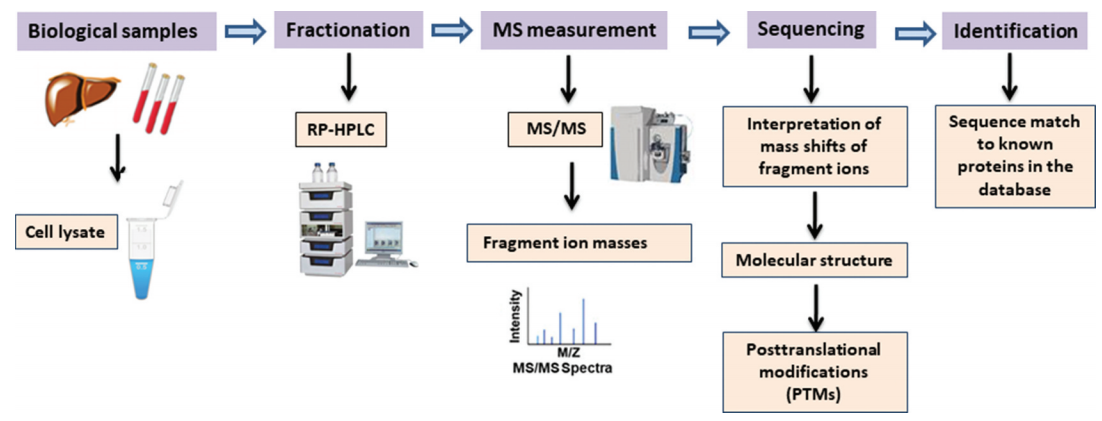
Vitorino, R. et al. Expert Rev Proteomics. 2021.
Figure 1. Peptide Sequencing Workflow
Why Choose MtoZ Biolabs
1️⃣ High-resolution platforms using globally recognized mass spectrometry systems to ensure accurate sequencing
2️⃣ Extensive experience with short peptides, including natural peptides, signaling peptides, antimicrobial peptides, and cyclic peptides
3️⃣ Stable analytical workflow designed to reduce sample loss and minimize repeat measurements
4️⃣ Professional scientific team with extensive experience in proteomics and peptide structural analysis
5️⃣ Expandable output supporting downstream structural validation, quantitative analysis, and modification studies
Applications of Short Peptide Sequencing Service
1. Peptide drug development for confirming synthetic peptide sequences, impurities, and key structural segments
2. Natural product research for determining small peptide structures derived from plants, animals, or microorganisms
3. Signaling pathway and immunology research for identifying functional peptides, signaling peptides, and immune-related peptides
4. Peptide material design for verifying self-assembling peptides, functional peptides, and engineered peptides
5. Quality control for monitoring batch consistency and product integrity
Deliverables
1. Short peptide sequencing results
2. MS/MS fragmentation spectra and supporting evidence
3. Modification information if applicable
4. Molecular weight determination results
5. Standardized technical report
6. Data files for further analysis
The report is clearly structured and can be used for publication, project submission, or quality assessment.
FAQs
Q1. What types of samples are suitable?
Suitable samples include peptide powders, synthetic peptides, natural peptide extracts, and purified peptide fractions. Sequencing can be performed as long as the molecular weight is appropriate and impurities are not excessive.
Q2. What is the service's general workflow?
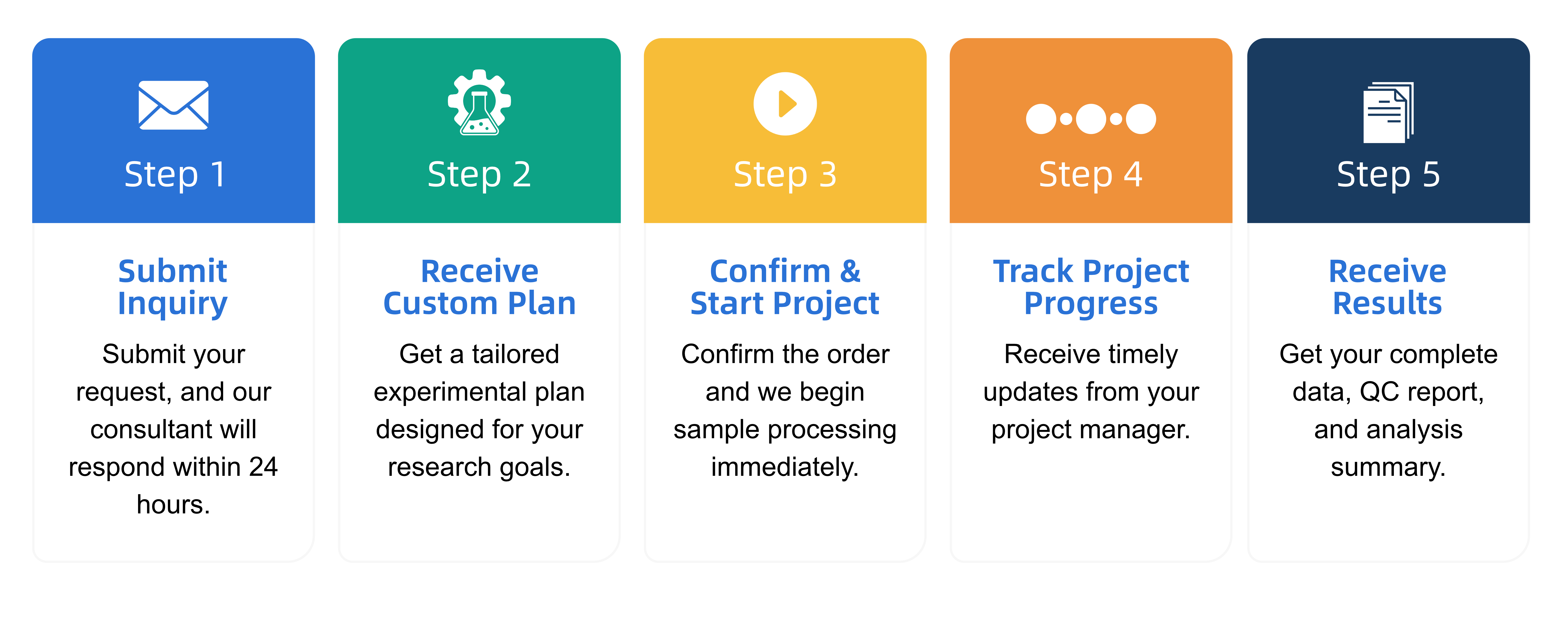
Q3. What data formats are provided?
MtoZ Biolabs provides comprehensive deliverables in standard formats to support downstream validation, publication, and regulatory documentation. Deliverables typically include:
Additional formats can be provided upon request to accommodate specific project needs.
Q4. How should I prepare my samples?
To ensure successful short peptide sequencing, MtoZ Biolabs recommends the following sample preparation guidelines:
1. Sample Type:
2. Sample Purity:
3. Sample Amount:
4. Storage and Shipping:
5. Documentation:
For more information, please refer to Sample Submission Guidelines for Proteomics and Sample Submission Guidelines for Metabolomics.
If you are unsure about your sample preparation, our technical team can provide personalized pre-analysis consultation and a sample submission guide to help you optimize preparation and shipping conditions.
Start Your Project with MtoZ Biolabs
MtoZ Biolabs is committed to providing reliable short peptide sequencing service for researchers worldwide. With high-resolution platforms, standardized workflows, and professional analytical capabilities, we support customers in short peptide research drug development and structural confirmation. Contact us for more information.
How to order?




