






Serum vs. Plasma vs. CSF Proteomics: Which Sample Type Fits Your Study?
Direct Answer
Choose the sample type from the biological claim first. Use CSF when the study requires a CNS-proximal protein readout. Use serum or plasma when the question concerns systemic circulation, peripheral responses, or blood-accessible biomarkers. Between serum and plasma, Choose serum when a post-clotting protein profile fits the study and serum collection is consistent across the cohort. Choose plasma when retaining clotting-related components is important or a standardized anticoagulated archive is available.
Do not treat serum, plasma, and CSF as interchangeable samples within the same primary comparison. Multiple matrices can be used only as predefined, separately analyzed biological compartments. In serum/plasma/CSF proteomics, mixing matrices inside one disease-versus-control list usually confounds biology with sample chemistry. Lock one primary sample type before collection or archive pull, then keep handling matched across arms.
If more than one matrix is available, share with MtoZ Biolabs the study claim, available matrices, plasma anticoagulant if relevant, and whether any matrix comparison is intentional. That brief is enough to judge which sample type fits before aliquots are committed.
How to Evaluate Serum, Plasma, and CSF Side by Side
A practical comparison starts with four questions that every biofluid project should answer once:
- Which biological compartment does the claim actually concern?
- Which matrix can be collected or retrieved with matched chemistry across all arms?
- Which matrix keeps contamination and handling risk low enough for the comparison?
- Is any second matrix needed as an explicit contrast, or only as backup?
Serum/plasma/CSF proteomics is strongest when those answers point to one primary matrix. A matrix can be analytically feasible and still be the wrong fit for the claim. That distinction is the core of sample-type evaluation.
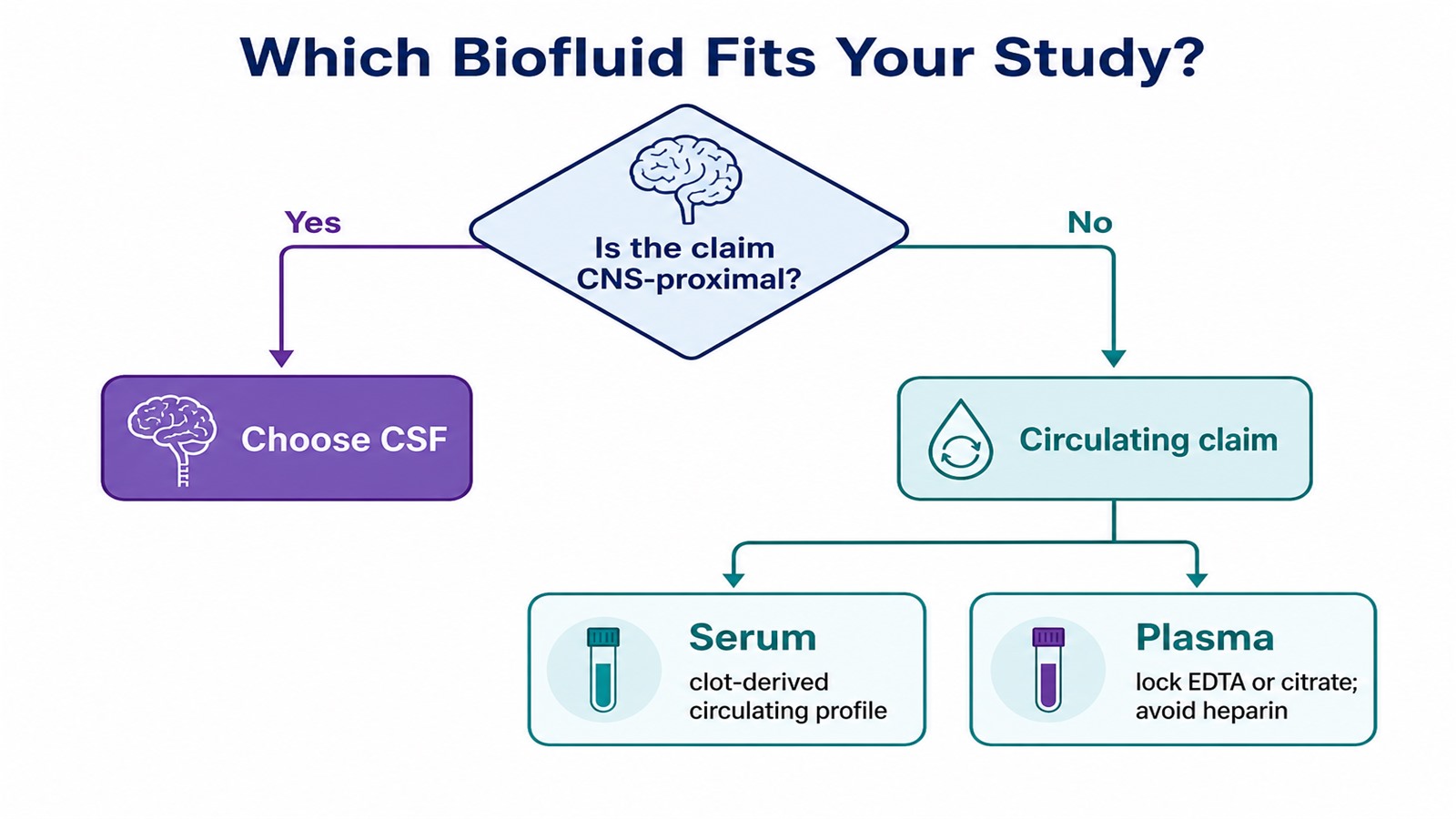
Figure 1. Start from the biological claim, then choose CSF for CNS-proximal questions or serum/plasma for circulating questions.
Comparison Table: Which Sample Type Fits?
Use this evaluation table to compare fit, not to rank one matrix as universally better.
|
Evaluation dimension |
Serum |
Plasma |
CSF |
|---|---|---|---|
|
Best claim fit |
Systemic circulating proteins after clotting |
Systemic circulating proteins with coagulation-related components retained |
CNS-proximal protein changes |
|
Weak fit |
CNS-centered claims without circulating evidence need |
Projects that ignore anticoagulant consistency |
Using CSF only because blood volume is limited |
|
Collection and processing controls |
Clotting and separation path |
One anticoagulant class; prefer EDTA or citrate, avoid heparin |
Collection order, blood-contamination status, cell removal, processing delay, and freeze history |
|
Main confounder risk |
Clotting time, separation, hemolysis, or inconsistent serum processing |
Mixed EDTA, citrate, and heparin tubes |
Blood contamination that obscures the native CSF profile |
|
Typical study examples |
Serum biobank case-control screens |
Plasma cohorts where anticoagulation is already standardized |
Neurology or CNS challenge comparisons |
|
Role of a second matrix |
Optional planned serum-versus-plasma contrast |
Optional planned plasma-versus-serum contrast |
Blood may be complementary, not a substitute |
Read each column as a fit profile. The right choice is the matrix whose strengths match the claim and whose risks can be controlled in your cohort.
When to Choose Each Matrix
Choose CSF when
The primary question requires a CNS-proximal protein readout that cannot be addressed adequately through circulating blood alone. Collection and storage records can support matched arms. Blood contamination should be documented and evaluated using consistent quality criteria before inclusion in the primary comparison. In that setting, CSF is the sample type that fits, and circulating blood is at most a complementary compartment.
Choose serum when
The claim is systemic circulation, clotting-derived chemistry is acceptable, and serum is already the standard path across sites or biobank lots. Serum is often the more practical choice for legacy serum archives, provided collection and processing remain consistent across all groups.
Choose plasma when
The claim needs circulating proteins under anticoagulation, or the available archive is already EDTA or citrate plasma. Plasma is suitable only when one anticoagulant type and one consistent processing workflow are used across the comparison. Prefer EDTA or citrate. Heparin is not recommended. Unknown or mixed anticoagulants make plasma a weak fit even if the disease labels look perfect.
Do not choose by convenience alone
Do not pick CSF because it “sounds more specific” when the claim is systemic. Do not pick plasma because a clinic drew EDTA tubes when the locked protocol is serum. Do not mix serum and plasma inside one contrast and interpret every protein difference as biology. Those mismatches are among the most common reasons serum/plasma/CSF proteomics results become hard to defend. Sample-type fit is a design decision, not a shipping convenience decision.
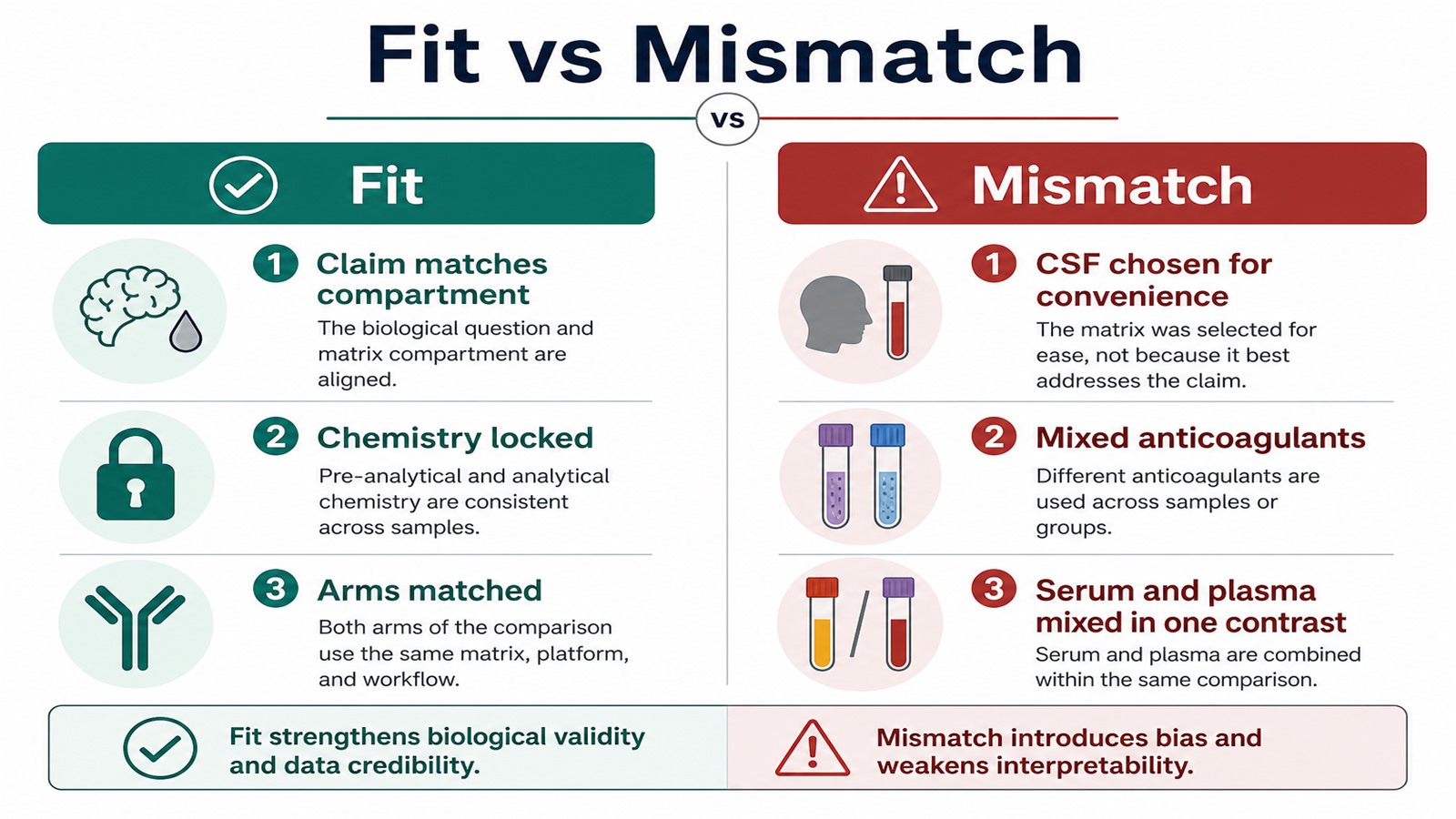
Figure 2. A matrix fits when claim, chemistry, and cohort controls align; convenience alone is a weak selection rule.
After the Sample Type Is Locked
Once the primary matrix is chosen, keep the rest of the design subordinate to that choice. This is where many serum/plasma/CSF proteomics projects regain or lose clarity.
Keep all primary-arm vials in the same matrix. If a serum-versus-plasma comparison is scientifically useful, label it as its own contrast rather than burying it inside disease grouping. A planned matrix contrast can be informative. An accidental matrix mix usually is not.
Confirm sample quality before shipment. Severely hemolyzed, lipemic, contaminated, precipitated, or repeatedly freeze-thawed vials are not recommended for primary arms. Infectious samples are not accepted. Applying the same predefined quality criteria across all study groups helps protect the intended comparison.
Choose identification or quantitative comparison after the matrix and arms are stable. DDA supports flexible discovery and protein identification, while DIA often improves data completeness and quantitative consistency across matched samples. Software direction commonly includes MaxQuant or Proteome Discoverer for DDA, and Spectronaut or DIA-NN for DIA. Platform options such as Orbitrap Exploris 480, timsTOF Pro, and Orbitrap Astral can be reviewed after the cohort is clear.
Annotation layers such as GO, KEGG, COG, PPI, and Reactome can support interpretation where species support allows. Reactome availability depends on both species and project type. For serum or plasma projects, current supported species include Bos taurus, Canis familiaris, Gallus gallus, Homo sapiens, Mus musculus, Rattus norvegicus, Sus scrofa, and Xenopus tropicalis. Confirm Reactome outside that set before promising it.
Submission amount should be confirmed with the laboratory for the locked matrix and design. Do not invent a one-size volume rule across serum, plasma, and CSF when the project details are still open. In serum/plasma/CSF protein analysis, volume planning follows the chosen matrix; it should not drive the matrix choice backward.
Related Services
Blood/Plasma/Serum Proteomics Solutions
Main route when the selected sample type is serum or plasma and the study needs discovery or quantitative circulating proteomics.
Cerebrospinal Fluid (CSF) Protein Quantitative Proteomics Solutions
Complementary when CSF is the better fit for a CNS-proximal claim.
Alternative when the evaluation clearly points to a serum-only circulating design rather than a plasma or CSF path.
Frequently Asked Questions
Can one study use serum, plasma, and CSF together?
Yes, but each matrix should be processed and analyzed as a predefined compartment. Cross-matrix results should be interpreted as complementary evidence rather than pooled into one differential comparison.
Is plasma always better than serum for proteomics?
No. Plasma fits when anticoagulation and coagulation-related chemistry matter and one anticoagulant class is locked. Serum often fits better for clot-derived circulating profiles and serum-standardized archives.
When is CSF the wrong choice?
When the claim is systemic circulation, when contamination cannot be controlled, or when CSF is selected only because blood samples are inconvenient.
What anticoagulant should plasma projects use?
Prefer EDTA or citrate. Avoid heparin. Keep the same class across compared arms.
What should be shared before choosing the sample type?
Share the biological claim, available matrices, anticoagulant records for plasma, and whether any matrix-to-matrix comparison is intentional. MtoZ Biolabs can then help judge which option best fits serum/plasma/CSF proteomics for the current study.
Conclusion
Serum, plasma, and CSF answer different proteomics questions. CSF fits CNS-proximal claims. Serum and plasma fit circulating claims, and the serum-versus-plasma choice depends on clotting chemistry, anticoagulant control, and what the biobank can actually keep matched. In serum/plasma/CSF protein analysis, the most appropriate sample type is the one that matches the biological question and can be handled consistently across all study groups.
Researchers comparing these options can review claim, matrix availability, and anticoagulant records with MtoZ Biolabs before the primary sample type is locked.
How to order?




