



Scoping a multiple reaction monitoring (MRM) or selected reaction monitoring (SRM) project starts with the sample, not with a transition spreadsheet. In project language, MRM quantitation on liquid chromatography-tandem mass spectrometry (LC-MS/MS) records scheduled precursor-product pairs on a closed peptide panel (Lange et al. 2008). Those transitions only hold if matrix, pretreatment, load, and digest are matched across every contrast arm before the panel is frozen. The guide below maps sample and prep decisions to transition design, sample-count planning, validation deliverables, workflow, parameters, limits, and route choice. It is not a price list, not a turnaround catalog, and not a vendor scorecard.
Unmatched prep across arms produces peptide-pool shifts that look like biology after peak integration. Plasma, tissue, lysate, and formulation each need a declared cleanup path before dwell times are optimized (Bantscheff et al. 2012). Relative fold change and amount with stable isotope-labeled internal standard (SIS) peptides remain separate claim units on the same sample set (Gerber et al. 2003).
In MtoZ Biolabs targeted offerings, MRM scope is set after matrix, pretreatment parity, closed panel status, cohort plus quality control (QC) count, and report use are written in the brief. Service intake appears in SRM-MRM Quantitative Proteomics Services.
What Sample and Pretreatment Scope Must Cover Before MRM Lock
Four sample layers belong in the brief and stay separated.
Matrix layer names plasma, serum, tissue, cell lysate, media, or formulation, plus storage and freeze-thaw history. Each matrix changes suppression and co-elution risk on the same peptide.
Pretreatment layer names extraction, depletion or enrichment if used, reduction, alkylation, digest enzyme, cleanup, and reconstitution. Rules must match on every contrast arm.
Load layer names protein or peptide mass on column from a matrix pilot. Overload compresses dynamic range; underload drops low-response transitions.
Cohort layer names biological replicates, technical repeats if any, blanks, QC pools, and calibration or SIS samples. Study n alone is not the injection count.
MRM transitions are scheduled on peptides that survive a declared prep. Prep drift mid cohort splits the assay record.
How Pretreatment Changes Transition Design and Sample Count
Sample handling and transition design are one planning object.
Proteotypic peptide choice depends on digest completeness and uniqueness after the declared enzyme and missed-cleavage policy. A peptide that appears in discovery files may fail after depletion or detergent cleanup.
Transition optimization must be checked on matrix-matched digests, not only on neat standards. Co-eluting ions track cleanup quality and load.
Panel size and cycle time interact with chromatography after cleanup. Residual lipids or polymers from incomplete prep lengthen method rescue more than adding dwell time.
SIS spike timing must match the claim and the prep step. Peptide standards added after digest do not correct unmatched extraction.
Sample count must include QC, blanks, and any calibration levels. A large study n with unmatched digest batches still fails validation review.
End-to-End Workflow to Scope MRM From Sample Inward
A practical sample-first MRM scoping spine usually runs as follows.
- Freeze contrast, claim unit, and closed peptide priority tiers.
- Document matrix, storage, and pretreatment route for every arm.
- Pilot digest and load on representative material before shipping the full cohort.
- Optimize transitions and dwell schedule on matrix-matched digests.
- Size biological n plus QC, blanks, and SIS or calibration injections.
- Lock one prep and one MRM method version for the cohort block.
- Acquire interleaved study and QC samples when cohort size allows.
- Integrate peaks; flag prep or transition failures against prespecified rules.
- Deliver tables with prep record, transition list, and QC notes; archive methods with the report.
Steps 1 through 3 are sample and prep gates. Steps 4 through 6 lock the assay. Steps 7 through 9 produce the quantitative record.
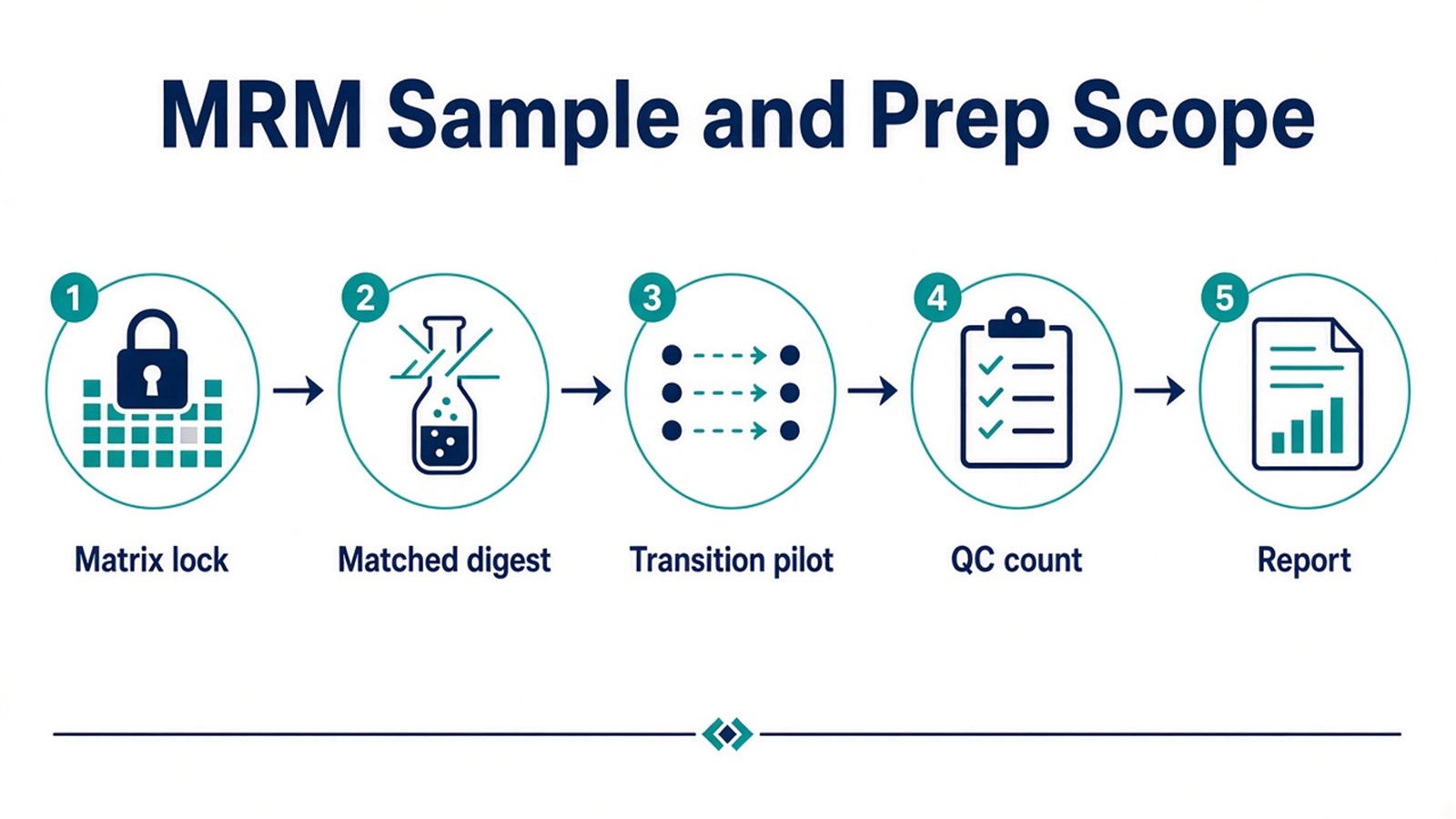
Figure 1. MRM scope is set after matched pretreatment and a matrix-matched transition pilot; sample count includes QC and calibration injections.
Parameters That Must Be Locked for Sample, Prep, and Transitions
Layer |
Parameter that must be declared |
Failure mode if ignored |
|---|---|---|
Matrix |
Type, storage, freeze-thaw count |
Hidden suppression between arms |
Pretreatment |
Extraction, digest, cleanup parity |
Peptide-pool shift as biology |
Enrichment |
Depletion or pull-down on all arms |
Bait-only artifacts |
Load |
Mass on column from pilot |
Saturation or dropped transitions |
Panel |
Peptide list version and priority tiers |
Late growth breaks cycle time |
Transitions |
Precursor, products, dwell, collision energy |
Neat-standard methods fail in matrix |
SIS |
Spike step aligned to claim |
Peptide amount misread as extract amount |
Cohort |
Study n plus QC, blanks, calibrators |
Underpowered or undocumented batches |
Contrast |
Frozen before peak review |
Post hoc arm relabeling |
Deliverable |
Table, transition list, QC depth |
Report rebuilt after acquisition |
Limits follow the same table. MRM does not correct unmatched harvest or digest. Large panels do not replace a small, prep-stable list when cycle time is tight. Discovery detectability does not prove MRM response after cleanup (Peterson et al. 2012).
How to Choose MRM Sample Scope Versus Other Routes
Use matrix pilot, prep parity, panel size, and report use together.
Sample and prep signal |
Scope that often fits |
Recheck before committing |
|---|---|---|
Matched lysate prep, small closed panel |
MRM after matrix-matched transition lock |
Ship full cohort before digest pilot |
Plasma or tissue with new cleanup |
Staged prep plus transition pilot |
Assume lysate transitions transfer |
Depletion or pull-down used |
Same enrichment on every arm |
Enrichment on treated arm only |
Study n large, QC omitted from count |
Recalculate injection load |
Quote on study n alone |
Amount claim after digest SIS |
Peptide-level calibration only |
Treat as protein extract amount |
Prep-stable MRM, few peptides fail |
Hybrid MRM plus PRM subset |
Whole-panel PRM without need |
Open protein list, prep still moving |
Discovery LFQ first |
MRM on unnamed targets |
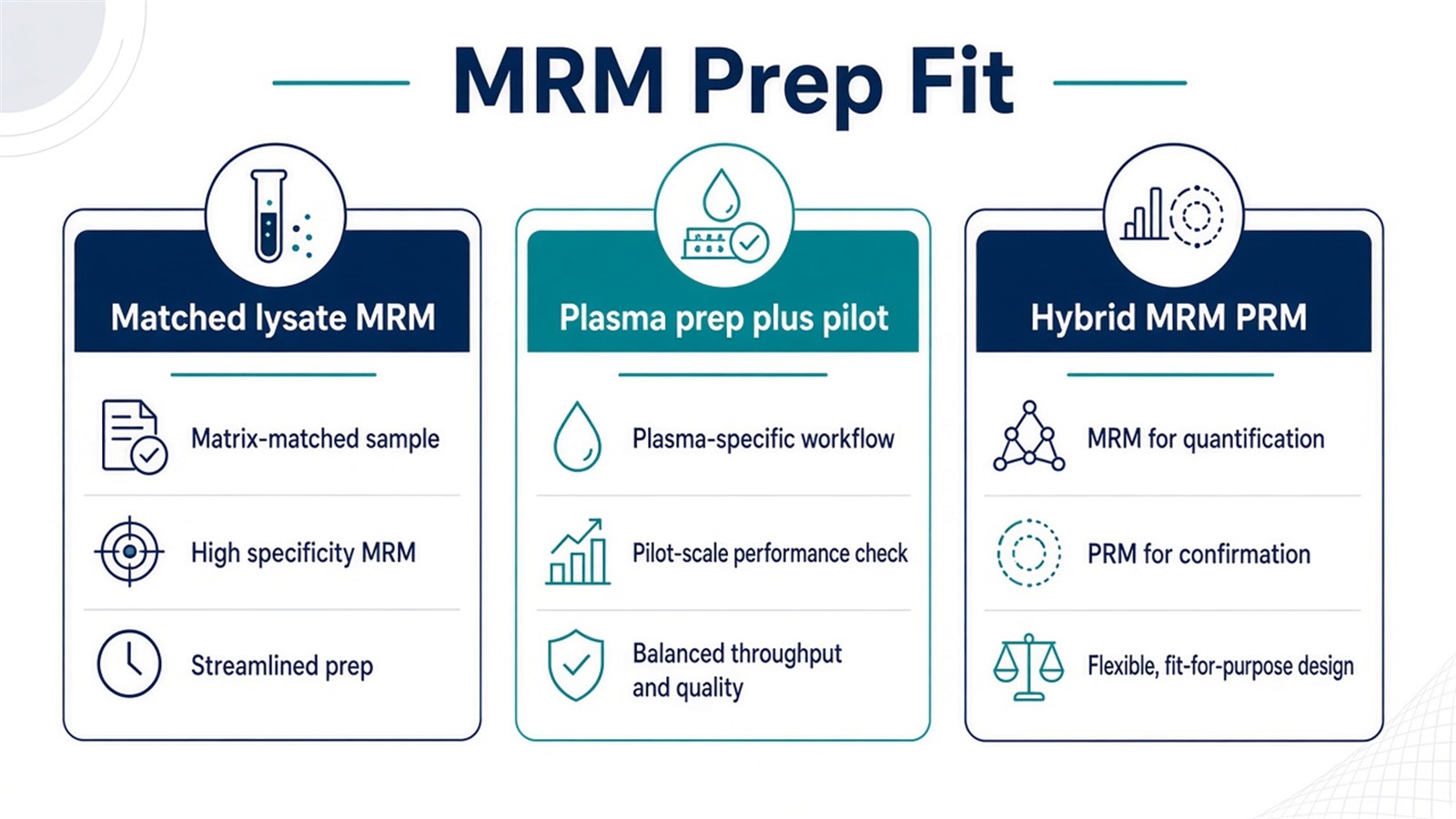
Figure 2. Match MRM scope to pretreatment parity and a matrix-matched pilot; keep QC and SIS injections inside the sample count.
Teams with matrix documentation, pretreatment record, closed peptide tiers, and QC-inclusive sample counts can review MtoZ Biolabs SRM-MRM Quantitative Proteomics Services when those fields are declared in the project record.
Frequently Asked Questions
1. How many samples are needed for an MRM study?
There is no fixed n. Count biological replicates required by the contrast, then add blanks, QC pools, and any SIS or calibration levels. Study n alone understates injection load.
2. Can transitions be optimized on neat peptide standards only?
Neat standards help choose starting products. Matrix-matched digests after the declared prep are required before cohort lock.
3. Does a larger panel reduce the need for matched pretreatment?
No. A larger panel increases cycle-time pressure. Unmatched digest or cleanup still shifts peptide pools across arms.
4. What belongs in the quote request for sample and prep?
Matrix type, storage, pretreatment route, whether enrichment is used, closed peptide list with priority tiers, study n plus planned QC, relative versus amount claim, and SIS spike step if known.
5. When should prep problems move peptides from MRM to PRM?
When matrix-matched pilots still show unstable transition ratios after cleanup and collision-energy work, a PRM subset can be scoped. Prep mismatch should be fixed first. PRM fallback after matrix interference appears in Parallel Reaction Monitoring vs MRM: Which Fits?. PRM cost scoping after high-resolution follow-up appears in What Affects Parallel Reaction Monitoring Costs?.
MtoZ Biolabs can discuss MRM sample and pretreatment scoping when matrix, prep parity, panel tiers, and QC-inclusive counts are documented.
If further evaluation of digest pilots, SIS spike timing, or hybrid MRM plus PRM panels is needed, project details can be submitted for a feasibility review.
Reference
- V. Lange, P. Picotti, B. Domon, R. Aebersold (2008). Selected reaction monitoring for quantitative proteomics: a tutorial. Mol. Syst. Biol., 4, 222. https://doi.org/10.1038/msb.2008.61
- M. Bantscheff, S. Lemeer, H.U. Haab, B. Kuster (2012). Quantitative mass spectrometry in proteomics: a critical review. Anal. Bioanal. Chem., 404, 939-965. https://doi.org/10.1007/s00216-012-5892-4
- S.A. Gerber, J. Rush, O. Stemman, M.W. Kirschner, S.P. Gygi (2003). Absolute quantification of proteins and phosphoproteins from cell lysates by tandem MS. Proc. Natl. Acad. Sci. U.S.A., 100, 6940-6945. https://doi.org/10.1073/pnas.0832254100
- A.C. Peterson, J.D. Russell, A.A. Klammer, P.F. Doubleday, H. Liu, J.N. Anderson, M.J. MacCoss (2012). Parallel reaction monitoring for high resolution and high mass accuracy quantitative, targeted proteomics. Mol. Cell. Proteomics, 11, 1475-1488. https://doi.org/10.1074/mcp.O112.020271
- J. Cox, M.Y. Hein, C.A. Luber, I. Paron, M. Mann (2014). Accurate proteome-wide label-free quantification by delayed normalization and maximal peptide ratio extraction, termed MaxLFQ. Mol. Cell. Proteomics, 13, 2513-2526. https://doi.org/10.1074/mcp.M113.031031
