






Peptide Structural Verification Service
-
Synthetic peptide confirmation for pharmaceutical and biochemical applications.
-
Therapeutic peptide development for drug quality control and stability testing.
-
Biopharmaceutical process validation including formulation and degradation analysis.
-
Protein and peptide interaction studies through structure–function correlation.
-
Academic research in structural biology, enzymology, and biomaterial engineering.
MtoZ Biolabs provides comprehensive Peptide Structural Verification Services that integrate advanced chromatographic and mass spectrometric platforms to confirm peptide identity, purity, and structural integrity. Our service enables accurate determination of amino acid sequence, disulfide bonding, modifications, and three-dimensional conformation, supporting peptide synthesis validation, drug development, and functional research.
Why Peptide Structural Verification Matters?
Peptide-based research and therapeutic development demand high structural accuracy and consistency. Even minor variations in amino acid sequence, folding pattern, or modification state can dramatically alter peptide activity, stability, and biological function. Structural verification ensures that the synthesized or isolated peptide truly matches its intended design, safeguarding data reliability and regulatory compliance.
Key reasons for performing peptide structural verification include:
1. Quality assurance: Confirming sequence accuracy and chemical integrity.
2. Functionality validation: Verifying correct folding and modification patterns critical to biological activity.
3. Batch consistency: Ensuring reproducibility across production batches for therapeutic peptides.
4. Regulatory support: Providing validated structural evidence for drug submissions or patent filings.
By combining multi-dimensional analytical techniques, peptide structure verification not only validates synthetic outcomes but also supports the rational design of novel bioactive peptides.
Peptide Structural Verification Service at MtoZ Biolabs
MtoZ Biolabs integrates liquid chromatography–mass spectrometry (LC-MS/MS), nuclear magnetic resonance (NMR), and infrared (IR) spectroscopy to provide in-depth verification of peptide structures. Our comprehensive approach covers sequence confirmation, post-translational modification analysis, disulfide linkage mapping, and conformational characterization.
Our analytical capabilities include:
🔸Sequence verification through LC-MS/MS peptide mapping and de novo sequencing.
🔸Purity and identity analysis using HPLC and high-resolution MS detection.
🔸Disulfide bond characterization under non-reducing and reducing conditions.
🔸Secondary structure evaluation using circular dichroism (CD) spectroscopy.
🔸Tertiary structure confirmation through NMR and molecular modeling.
🔸Modification assessment for acetylation, amidation, oxidation, or cyclization.
These methods collectively provide complete structural confidence for synthetic, recombinant, and naturally derived peptides.
Workflow of Peptide Structural Verification Service
1. Sample Assessment: Evaluate peptide purity and solubility to determine optimal analytical methods.
2. Chromatographic Separation: Perform HPLC purification or fractionation under optimized conditions.
3. Mass Spectrometry Analysis: Conduct LC-MS/MS for sequence verification and modification mapping.
4. Spectroscopic Analysis: Apply NMR, CD, and FTIR to confirm folding and conformation.
5. Data Processing and Integration: Combine multi-platform data to reconstruct and confirm peptide structure.
6. Comprehensive Reporting: Deliver a full interpretation including raw data, annotated spectra, and verification summary.
Why Choose MtoZ Biolabs
✔️High Sensitivity and Accuracy
Utilizes high-resolution mass spectrometers such as Orbitrap and Q-TOF to ensure precise identification of amino acid sequences, disulfide linkages, and modifications.
✔️Broad Applicability
Applicable to synthetic, recombinant, and naturally derived peptides, enabling structural validation across a wide range of research and industrial applications.
✔️Customization and Flexibility
Analytical workflows can be tailored to meet project-specific requirements, including verification of complex or modified peptides.
✔️Experienced Scientific Team
Supported by experts in peptide chemistry, proteomics, and biopharmaceutical analysis, ensuring accurate data interpretation and professional reporting.
Applications of Peptide Structural Verification Service
Peptide Structural Verification supports a broad range of research and industrial needs:
FAQ
Q1: What types of samples are suitable?
We accept a broad range of peptide samples, including synthetic peptides, purified recombinant peptides, and naturally derived peptide fractions. Samples can be provided as lyophilized powder or in solution. For special or low-quantity materials, please contact MtoZ Biolabs for specific preparation guidance.
Q2: How should I prepare my samples?
1. Peptides should be of high purity and free from salts, detergents, or reducing agents.
2. Store samples at −20°C or −80°C and ship on dry ice to maintain structural stability.
3. Include detailed sample information such as sequence, molecular weight, and known modifications.
For more information, please refer to Sample Submission Guidelines for Proteomics.
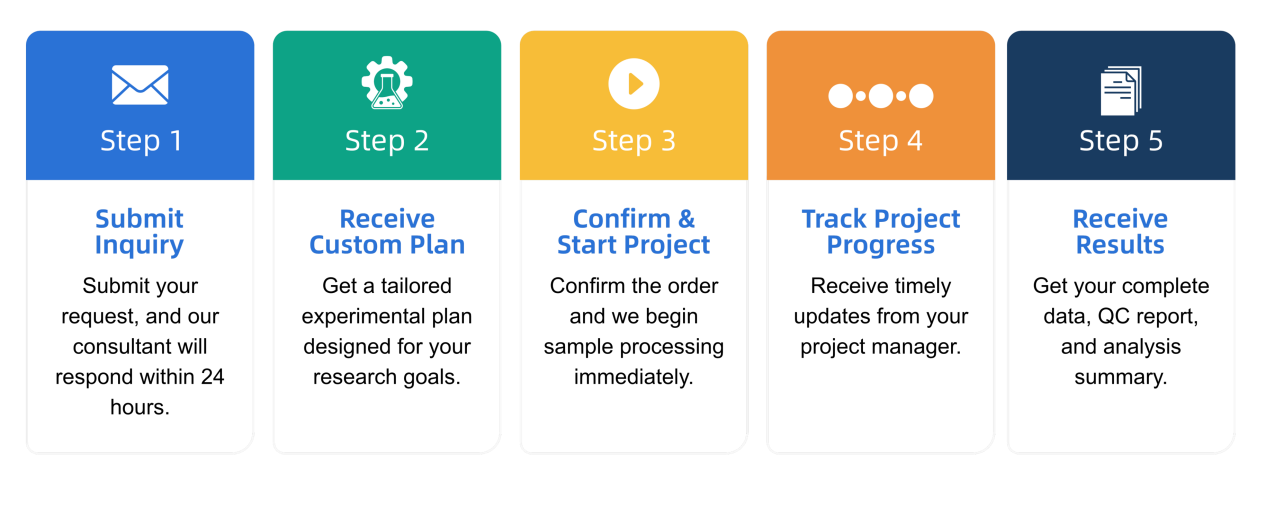
Q3: What is the service general workflow?
Q4: What data formats are provided?
1. Comprehensive result reports in PDF format summarizing experimental workflow, results, and interpretation.
2. Raw and processed MS data in mzML or CSV formats for convenient secondary analysis.
3. Sequence confirmation and spectra provided in FASTA or equivalent open-access standards.
4. Chromatograms and visual data outputs in PNG or TIFF for publication-quality presentation.
5. Additional formats can be arranged upon request to meet specific analytical or regulatory requirements.
Start Your Project with MtoZ Biolabs
Contact us today to confirm your peptide structure with confidence and precision. By combining advanced analytical platforms with expert interpretation, we help researchers ensure the quality, stability, and functionality of peptides in both research and therapeutic contexts.
How to order?




