






Peptide Mapping Service for Biologics Characterization
Introduction
Therapeutic proteins, monoclonal antibodies, fusion proteins, and antibody-drug conjugates must be characterized at the primary structure level before release testing, comparability review, or regulatory submission can proceed with confidence. A biologics team may know the intended amino acid sequence from the expression construct, yet the manufactured product can differ through post-translational modifications, sequence variants, clipped termini, or process-related changes across batches.
Peptide mapping service addresses that gap by digesting the biologic into peptides and analyzing the resulting fragments with LC-MS/MS. The measured peptides are matched to the expected sequence to build a coverage map, confirm identity, localize modifications, and document product-related differences when reference and test materials are compared. For biologics characterization, peptide mapping provides sequence-level evidence that complements intact mass analysis, charge profiling, and higher-order structural assays.
What Peptide Mapping Means in Biologics Characterization
In biologics characterization workflows, peptide mapping answers a focused question: which peptide fragments from the digested product match the expected sequence, and where do modifications or sequence differences appear?
Intact mass analysis reports the overall molecular weight of the biologic. Peptide mapping breaks the molecule into smaller sequence-defined fragments that are easier to identify with high confidence in LC-MS/MS data. That fragmentation improves the ability to confirm identity at the amino acid level, localize glycosylation or other PTMs, and compare peptide evidence between reference and test lots.
The recovered information usually spans sequence coverage across heavy chain, light chain, or fusion domains, peptide spectrum matches (PSMs) with confidence metrics, localized PTMs such as oxidation, deamidation, glycosylation, or conjugation sites, product-related sequence variants when present above detectable levels, and comparability evidence when multiple batches or process conditions are analyzed.
Peptide mapping service is a primary structure workflow. It does not replace binding assays, potency testing, or higher-order structural characterization on its own.
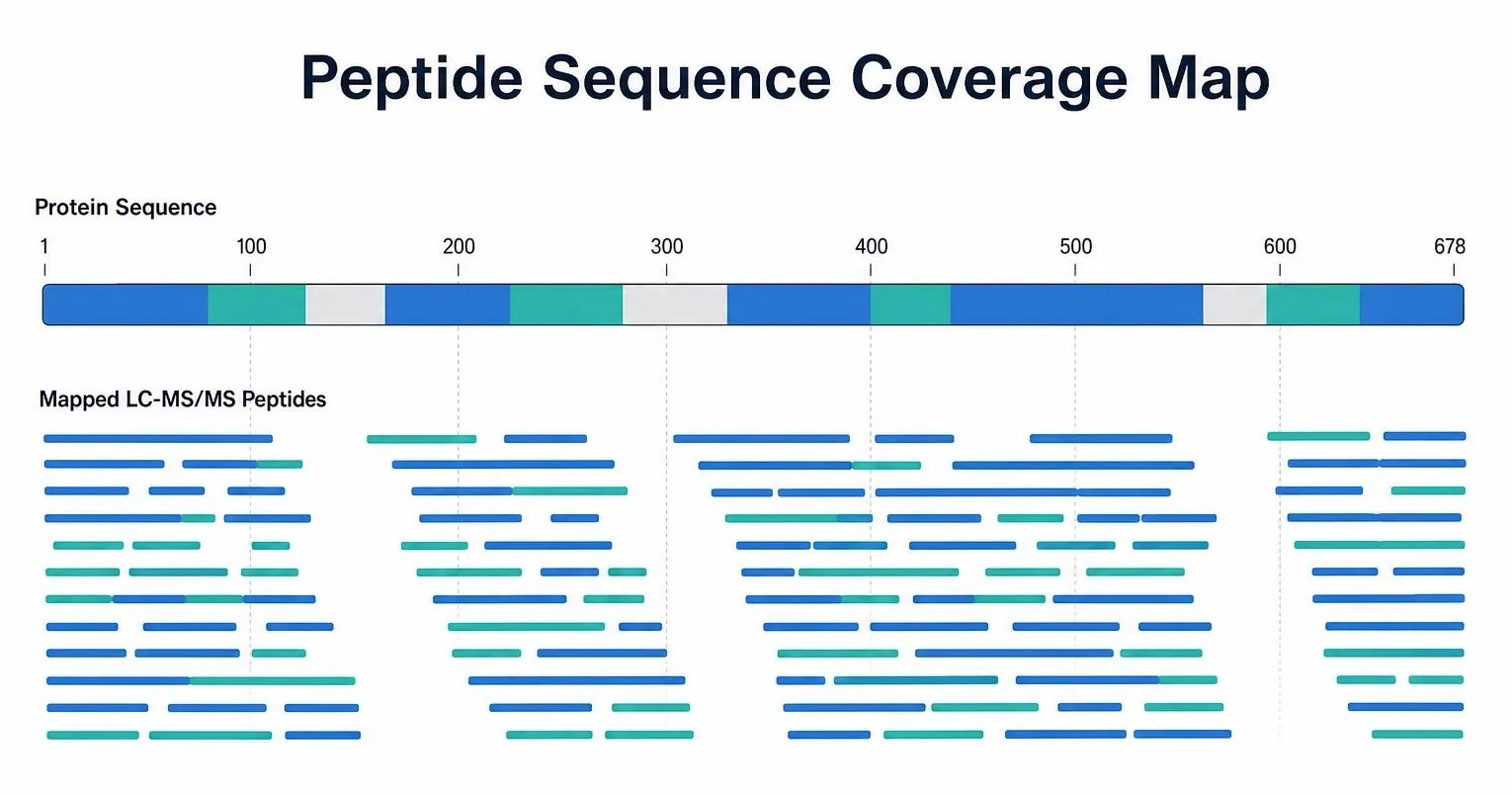
Figure 1. Peptide mapping builds sequence coverage by matching LC-MS/MS peptide evidence to the expected biologic sequence.
Core Principles of Peptide Mapping
Peptide mapping is a bottom-up mass spectrometry workflow. The biologic is cleaved enzymatically or chemically into peptides, separated by liquid chromatography, and identified by tandem mass spectrometry.
Protein digestion strategy
Digestion enzyme choice defines peptide size, chromatographic behavior, and coverage pattern. Trypsin is widely used because it cleaves after lysine and arginine residues and produces peptides well suited to LC-MS/MS. Alternative enzymes such as Lys-C, Glu-C, chymotrypsin, or multi-enzyme combinations may be selected when the product sequence, disulfide architecture, or modification pattern requires broader or complementary coverage.
LC-MS/MS identification
Peptides elute during LC separation and enter the mass spectrometer for precursor selection and fragment ion generation. Database searching or targeted spectral matching assigns peptide identities based on observed mass, retention time, and fragment ion patterns. High-resolution accurate mass platforms improve specificity when distinguishing closely related modified forms.
Coverage and PTM localization
Recovered peptides are mapped onto the reference sequence to calculate coverage percentage and identify unobserved regions. Modified peptides are evaluated for mass shifts and diagnostic fragment ions that support PTM localization to specific residues. Reporting should distinguish confirmed localizations from ambiguous assignments when fragment evidence is incomplete.
Expert review and reporting
Automated search results require review for false matches, missed cleavages, co-eluting peptides, and low-abundance variants. A useful peptide mapping report documents search parameters, coverage metrics, modification assignments, and any regions that remain unsupported by observed peptide evidence.
Standard Peptide Mapping Workflow
A robust peptide mapping project for biologics characterization follows a defined sequence of steps.
Project scoping defines product type, reference sequence, reporting goal, and whether comparability or PTM localization is required. Sample feasibility review assesses purity, concentration, buffer composition, and storage condition. Digestion design selects enzyme strategy, reduction and alkylation conditions, and any enrichment steps for modified peptides. Peptide cleanup and LC-MS/MS analysis prepare digests for chromatography and acquire high-quality MS/MS data. Database search and coverage mapping match spectra to the reference sequence and calculate coverage. PTM and variant review evaluate modified peptides, clipped forms, and sequence differences. Report delivery provides coverage maps, peptide tables, spectral evidence, and interpretation notes.
Sample matrix strongly affects outcome. Highly buffered formulations, excipients, detergents, or low product concentration can reduce digestion efficiency and LC-MS performance. Feasibility review before digestion often prevents repeat analysis caused by incompatible sample preparation.
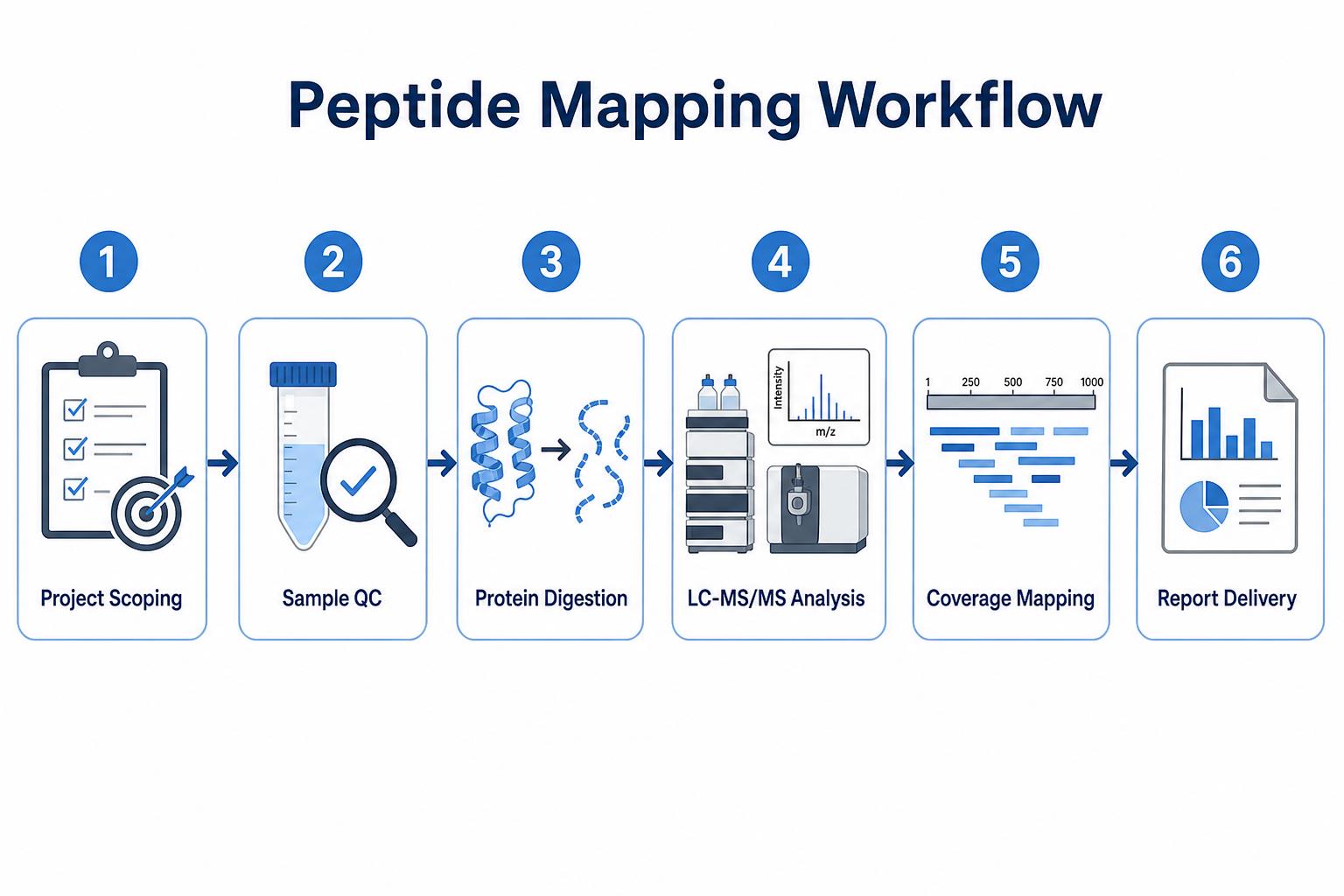
Figure 2. A peptide mapping service workflow moves from digestion design through LC-MS/MS analysis to sequence coverage reporting for biologics characterization.
Related Services
When a biologics program moves from intact mass review to sequence-level confirmation, peptide mapping is often paired with adjacent primary structure services. Relevant options include:
Primary Structure Analysis Service
HPLC-Based Peptide Mapping Assays Service
Protein Full Sequence Coverage Analysis Service
Peptide Coverage/Peptide Spectrum Match (PSM) Analysis Service
N-Terminal Sequence Analysis Service
Researchers planning biologics characterization can consult MtoZ Biolabs to review product type, reference sequence availability, and peptide mapping deliverable scope before samples are submitted.
Sample and Method Considerations
Sample type defines whether a peptide mapping project can proceed efficiently on the first attempt. Common starting materials include:
- Purified mAb or fusion protein. Defined product with an available reference sequence; buffer additives may interfere with digestion or LC performance.
- Drug substance lot. Representative batch material for release or comparability support; low concentration can reduce peptide detection.
- Drug product formulation. Reflects the administered form but excipients may suppress low-abundance peptides.
- Reference standard plus test sample. Enables direct peptide-level comparability when concentration and buffer differences are normalized.
- Reduced and alkylated sample. Improves coverage across cysteine-linked domains; incomplete reduction or over-alkylation can distort results.
These considerations support planning but do not replace sample-specific feasibility review before digestion begins.
Platform and Digestion Strategy Comparison
Peptide mapping projects may combine different digestion and acquisition routes depending on product complexity and reporting needs.
|
Approach |
Typical Use |
Main Technical Strength |
Main Technical Limitation |
|---|---|---|---|
|
Single-enzyme tryptic mapping |
Standard mAb identity and PTM review |
Established workflow and searchable peptide libraries |
Some regions may remain poorly covered |
|
Multi-enzyme mapping |
Complex fusion proteins or low-coverage products |
Complementary peptides improve overall coverage |
More complex data review and reporting |
|
HPLC-UV peptide map |
QC release with established retention map |
Strong repeatability for routine lot testing |
Less detail on modifications without MS |
|
LC-MS/MS peptide mapping |
Identity, PTM localization, and variant detection |
High-specificity fragment evidence |
Requires higher method and review effort |
|
Enriched modified-peptide mapping |
Focused review of oxidation, deamidation, or glycosylation |
Improved sensitivity for low-abundance PTMs |
Additional sample handling steps |
Core Technical Advantages and Current Limitations
Core Technical Advantages
Sequence-level identity confirmation.
Peptide mapping links observed fragments directly to the expected biologic sequence.
PTM localization capability.
LC-MS/MS fragment patterns support residue-level assignment of many common modifications.
Flexible coverage strategy.
Single- or multi-enzyme digestion can be adapted to product architecture and reporting goals.
Comparability support.
Peptide-level comparison helps document batch similarity or process-related differences.
Regulatory-friendly primary structure evidence.
Coverage maps, peptide tables, and spectral matches support CMC and QC documentation when reporting scope is defined appropriately.
Current Limitations
Coverage may remain incomplete.
Highly modified regions, repetitive sequences, or poor ionization peptides can leave gaps.
Low-abundance variants are challenging.
Sequence variants or clipped forms near the detection limit may require enriched workflows or orthogonal methods.
Matrix effects can reduce sensitivity.
Excipients, detergents, and salts may suppress peptide recovery or chromatography performance.
Not a standalone release strategy.
Peptide mapping supports primary structure characterization but does not replace potency, safety, or higher-order structural testing.
Peptide mapping service is valuable for biologics characterization when the reporting goal, digestion design, and review standard are matched to the intended use.
Applications in Biologics Characterization
Peptide mapping supports multiple characterization scenarios across discovery, development, manufacturing, and regulatory support. Common application areas include identity confirmation, PTM profiling, comparability review, biosimilar assessment, release support, and investigation of sequence variants or clipped forms.
|
Characterization Scenario |
What Peptide Mapping Provides |
Complementary Evidence Often Still Needed |
|---|---|---|
|
Identity confirmation for mAb or fusion protein |
Sequence coverage and peptide spectrum matches |
Intact mass and charge variant profiling |
|
PTM profiling during process development |
Localized oxidation, deamidation, glycosylation, or conjugation evidence |
Glycan analysis or site-specific glycosylation assays |
|
Comparability after manufacturing change |
Peptide-level differences between reference and test lots |
Higher-order structure and functional assays |
|
Biosimilar primary structure assessment |
Confirmed sequence and modification pattern relative to reference |
Extended analytical similarity package |
|
Release or stability supporting data |
Documented peptide map with tracked critical peptides |
Established specification and trend review |
|
Variant or clipped-form investigation |
Detection of unexpected peptides or truncated sequences |
N-terminal or C-terminal sequencing for termini |
Teams evaluating peptide mapping for a biologics program should define whether the immediate need is identity confirmation, modification mapping, comparability, or regulatory documentation. That decision determines digestion depth, acquisition platform, and reporting format.
Expected Deliverables and Validation
A useful peptide mapping report for biologics characterization should include more than a list of peptide names. Common deliverables include:
- sequence coverage map for each chain or domain
- peptide identification table with retention time, mass, and search scores
- PTM summary with localization confidence notes
- annotated MS/MS spectra for key peptides when required
- comparability summary when multiple samples are analyzed
- method notes covering digestion, LC-MS/MS platform, and search parameters
- QC comments on unsupported regions or ambiguous assignments
Validation should match the intended use. A report intended for clone or construct confirmation requires complete coverage of critical regions. A report intended for lot release may focus on a qualified peptide map with predefined acceptance criteria. Orthogonal confirmation through intact mass, N-terminal sequencing, or glycan analysis may strengthen conclusions when modifications or variants are central to the review.
Work with MtoZ Biolabs for complete peptide mapping outputs and customized validation matching your bioprogram’s intended use.
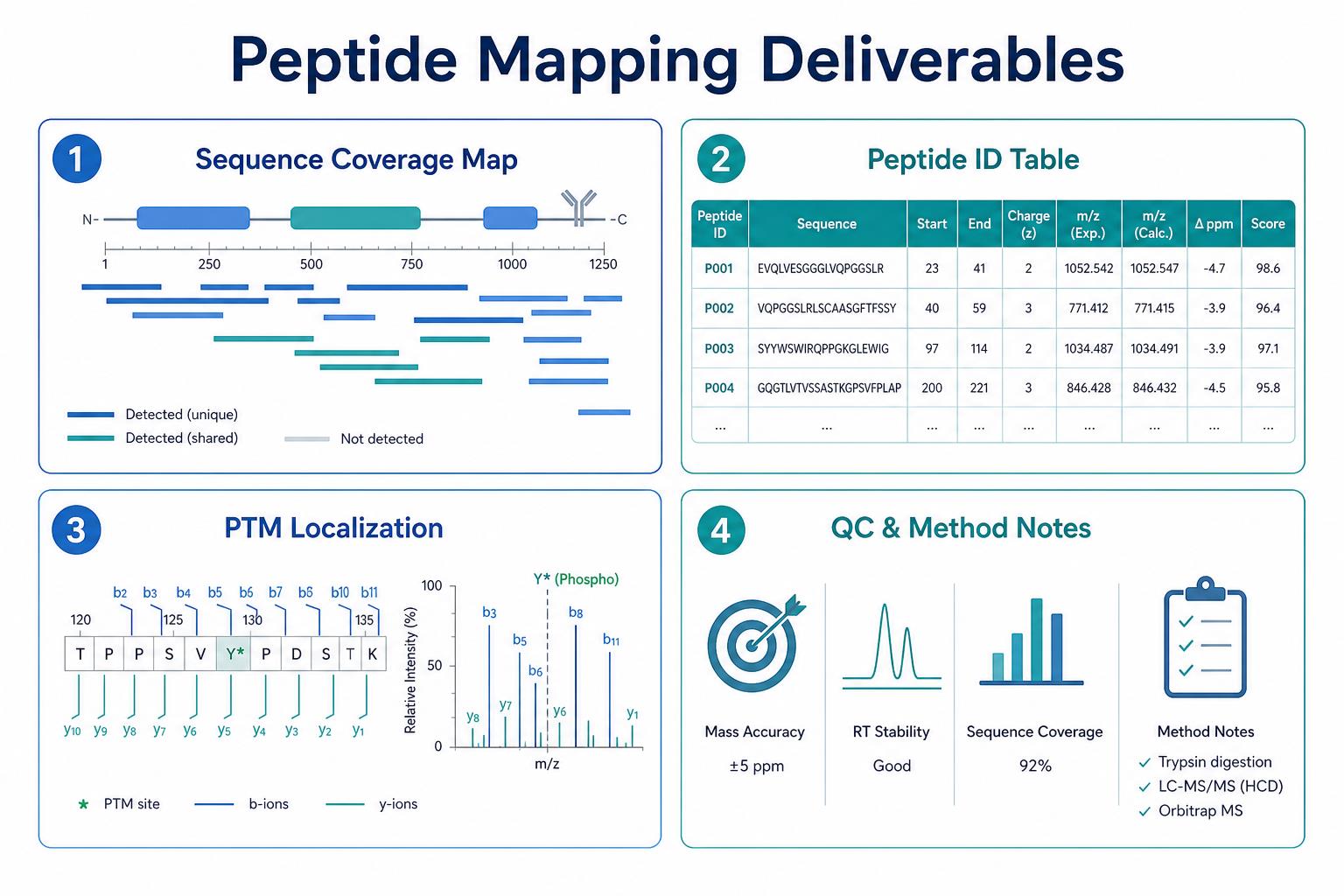
Figure 3. A biologics characterization peptide mapping report should document coverage maps, peptide tables, PTM assignments, and method QC notes.
Future Outlook
Peptide mapping continues to benefit from higher-resolution LC-MS platforms, improved software for modified peptide review, and more integrated primary structure workflows that combine intact mass, peptide mapping, and terminal sequencing. Laboratories are increasingly using peptide mapping not only for late-stage release support, but also earlier in process development to track modification trends before they become specification issues. Expert review remains important because biologics are heterogeneous, matrix effects vary by product, and automated search results still require scientist-level interpretation.
Frequently Asked Questions
1. What is a peptide mapping service?
A peptide mapping service digests a biologic protein into peptides and analyzes the fragments by LC-MS/MS or HPLC-based methods to confirm sequence identity, calculate coverage, and localize modifications during biologics characterization.
2. Why is peptide mapping important for biologics characterization?
Peptide mapping provides amino acid-level evidence that links the manufactured product to the intended sequence. It supports identity confirmation, PTM localization, comparability review, and primary structure documentation.
3. What sample types are suitable for peptide mapping?
Purified antibodies, fusion proteins, drug substance, and many drug product formulations can be analyzed when concentration, purity, and buffer composition are compatible with digestion and LC-MS/MS analysis. Feasibility review is recommended before submission.
4. Can peptide mapping detect post-translational modifications?
Yes. LC-MS/MS peptide mapping can localize many common PTMs, including oxidation, deamidation, glycosylation, and some conjugation-related changes, when fragment ion evidence supports residue-level assignment.
5. How does peptide mapping differ from intact mass analysis?
Intact mass analysis measures the overall molecular weight of the intact biologic. Peptide mapping analyzes digested fragments to provide sequence coverage and residue-level modification detail that intact methods cannot resolve on their own.
Conclusion
Peptide mapping service provides a practical route to sequence-level biologics characterization when a reference sequence is available and the product can be digested into analyzable peptides. By combining digestion design, LC-MS/MS analysis, coverage mapping, and expert review, the workflow supports identity confirmation, PTM localization, comparability assessment, and regulatory documentation across therapeutic protein programs. It does not replace functional or higher-order structural testing, and incomplete coverage or matrix interference can limit interpretation when project scope is not defined early. Reliable outcomes come from matching digestion strategy, platform choice, and reporting depth to the intended characterization use. Researchers planning peptide mapping for biologics characterization can contact MtoZ Biolabs to review product type, reference sequence, and the appropriate validation path before sample submission.
How to order?




