






Peptide Drug Metabolic Stability Analysis Service
-
Human liver microsomes
-
Rat and mouse liver microsomes
-
Cryopreserved hepatocytes (human, rat, mouse)
-
Fresh or frozen plasma and serum
-
S9 fractions
-
Custom matrices based on research needs
-
Parent peptide quantification
-
Time-course kinetic models
-
Degradation profiling
-
Peptide fragment identification
-
Semi-quantitative metabolite mapping
-
In vitro half-life
-
Intrinsic clearance
-
Percent remaining at each time point
-
Degradation rate constants
-
Rational redesign
-
Stability enhancement
-
Peptide engineering and optimization
-
Identify stable peptide candidates
-
Guide sequence modifications
-
Evaluate structural engineering strategies
-
Predict in vivo clearance
-
Support selection of dosing frequency and route of administration
-
Evaluate metabolic risk for drug-drug interactions
-
Rank analogs in SAR campaigns
-
Assess effects of chemical modifications
-
Support optimization cycles for potency versus stability
-
Determine stability in plasma or gastrointestinal fluids
-
Evaluate compatibility with excipients and carriers
-
Support oral, injectable, or targeted delivery development
-
Identify breakdown products
-
Understand biotransformation pathways
-
Support safety and toxicology research
-
Evaluate enzyme-specific degradation
-
Explore stability under different physiological conditions
-
Assess susceptibility to proteases or metabolic enzymes
MtoZ Biolabs provides a Peptide Drug Metabolic Stability Analysis Service to help researchers and developers accurately evaluate how therapeutic peptides behave within biological systems and how rapidly they undergo enzymatic degradation. Using high-performance LC-MS platforms and validated in vitro models, we characterize metabolic stability, identify degradation pathways, and quantify half-life with precision. This service supports drug discovery teams seeking to optimize peptide design, improve pharmacokinetic properties, and reduce development risks through clear, data-driven metabolic insights.
Introduction
Peptide-based therapeutics have become an essential modality in modern drug development. Their high specificity, reduced toxicity, and flexible design make them attractive candidates across oncology, metabolic disorders, immunology, neurology, and infectious disease research. Despite these advantages, most peptides are subject to rapid enzymatic degradation and clearance in biological systems. This instability can significantly reduce bioavailability, compromise pharmacokinetics, and limit therapeutic efficacy.
Metabolic stability refers to the ability of a peptide drug to resist enzymatic breakdown within biological matrices such as liver microsomes, hepatocytes, plasma, or serum. The stability profile of a peptide provides essential insights into half-life, metabolic soft spots, biotransformation routes, and structure-activity relationships. Understanding metabolic stability during early discovery can reduce project risk, improve lead optimization, and support rational modification strategies such as N-terminal capping, cyclization, unnatural amino acid incorporation, PEGylation, or lipid conjugation.
Regulatory agencies also consider metabolic stability a key parameter for assessing drug-drug interaction risk, systemic exposure, and potential metabolite formation. As a result, accurate and reproducible metabolic stability data are critical for moving peptide candidates from preclinical research into clinical development.
Peptide Drug Metabolic Stability Analysis Service at MtoZ Biolabs
MtoZ Biolabs offers a comprehensive analytical solution combining high-performance LC-MS workflows, optimized in vitro incubation systems, and quantitative kinetic modeling. Our service provides detailed degradation profiles, half-life determination, metabolite identification, and mechanistic interpretation to support early discovery screening, lead optimization, formulation evaluation, and preclinical development.
1. Multiple Biological Matrices
We offer metabolic stability assessment in a range of physiologically relevant systems:
These systems enable evaluation of species differences and prediction of in vivo metabolism.
2. Quantitative LC-MS Analysis
High-performance LC-MS methods measure the abundance of the intact peptide and detect the emergence of fragments or metabolites. Our service uses high-sensitivity LC-MS instruments for:
Advanced analytical performance ensures accurate assessment of even low-abundance metabolites.
3. Half-Life and Clearance Calculations
A peptide drug is incubated with a biological matrix and sampled at multiple time points. Quantifying the parent peptide over time allows calculation of key kinetic parameters, including:
These parameters help guide medicinal chemistry decisions.
4. Soft Spot Identification
We map the major cleavage sites within the peptide sequence. This information facilitates:
5. Side-by-Side Comparison of Analogs
For peptides undergoing iterative optimization, our workflows support ranking and comparing analogs to identify the most stable candidates.
Why Choose MtoZ Biolabs
✔️Advanced LC-MS Capabilities
High-resolution and high-sensitivity mass spectrometers ensure accurate quantification and reliable metabolite detection.
✔️Comprehensive Biological Matrices
We provide stability testing across liver, plasma, and cellular systems to simulate realistic metabolic environments.
✔️Expertise in Peptide Chemistry
Our team has extensive experience with therapeutic peptides, including linear peptides, cyclic peptides, stapled peptides, and modified sequences.
✔️Customizable Study Designs
Every project is tailored to meet the specific needs of each peptide and development program.
✔️Rapid Turnaround and Consistent Quality
Optimized workflows allow efficient processing without compromising analytical rigor.
Applications of Peptide Drug Metabolic Stability Analysis Service
Peptide metabolic stability analysis is essential across drug discovery and development. Key applications include:
1. Lead Optimization
2. Preclinical Development
3. Comparative Stability Screening
4. Formulation Studies
5. Metabolite Profiling
6. Mechanistic Studies
FAQ
Q1: What types of samples are suitable?
Our metabolic stability assays support a wide range of peptide therapeutics, including linear peptides, cyclic peptides, stapled peptides, peptide conjugates, and modified sequences such as PEGylated or lipidated peptides. We can evaluate peptides in human or animal liver microsomes, hepatocytes, S9 fractions, plasma, serum, or other biological matrices depending on your study goals.
Q2: How should I prepare my samples?
Peptides should be supplied in a high-purity form with clear information on sequence, molecular weight, solubility, and recommended solvents. We recommend preparing stock solutions in compatible solvents such as water, buffer, or DMSO and aliquoting to avoid repeated freeze-thaw cycles. Samples should be clearly labeled and shipped under appropriate temperature-controlled conditions. If your peptide is unstable, light sensitive, or sensitive to moisture, please include all handling precautions and relevant storage instructions.
For more information, please refer to Sample Submission Guidelines for Proteomics and Sample Submission Guidelines for Metabolomics
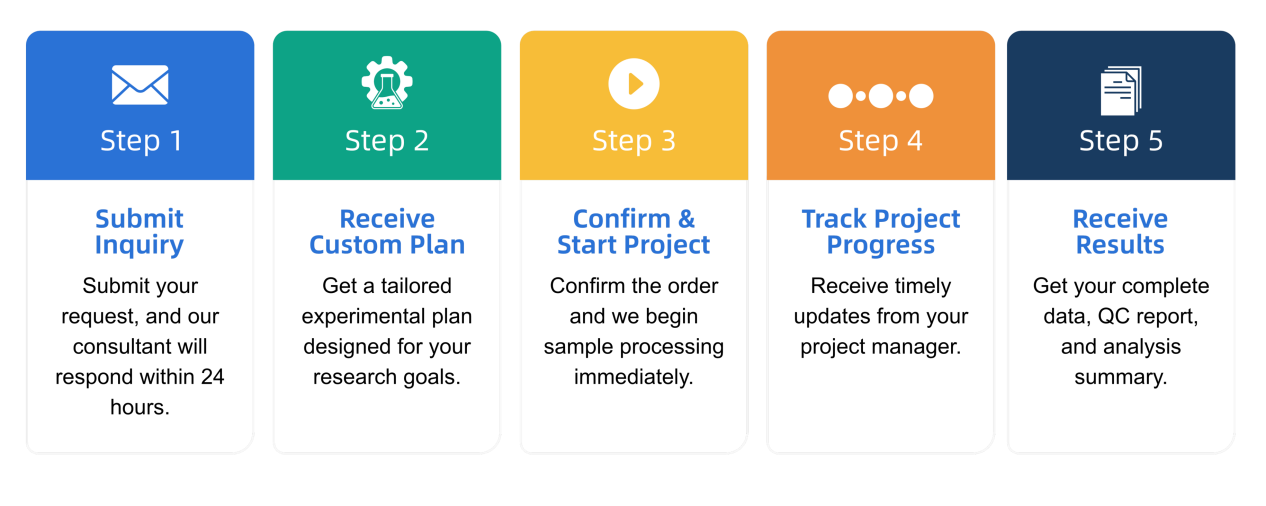
Q3: What is the service general workflow?
Q4: What data formats are provided?
We provide a complete and organized data package in common formats to support secondary analysis and reporting needs:
1. PDF report summarizing the study design, incubation conditions, LC-MS methodology, stability curves, kinetic calculations, and data interpretation.
2. Excel or CSV files containing time-point quantitative data, degradation percentages, half-life calculations, and processed numerical outputs.
3. Raw LC-MS instrument files including chromatograms and spectral data for independent verification.
4. High-resolution image files such as PNG or TIFF for figures, stability curves, and LC-MS peak charts.
5. Additional file formats can be provided upon request to meet specific regulatory or publication requirements.
Start Your Project with MtoZ Biolabs
MtoZ Biolabs delivers reliable, data-driven metabolic stability assessment tailored for peptide drug development. Our integrated analytical platform provides the quantitative insights necessary for optimizing peptide design, predicting in vivo behavior, and supporting informed preclinical decisions.
Contact us to discuss your research objectives or request a tailored metabolic stability assessment plan.
How to order?




