






Drug Metabolism and Pharmacokinetics (DMPK) Analysis Service
MtoZ Biolabs provides Drug Metabolism and Pharmacokinetics (DMPK) Analysis Service to support peptide drug R&D, offering comprehensive experimental and analytical solutions across metabolism, clearance, exposure, and in vivo performance evaluation. Our service covers in vitro and in vivo DMPK studies, metabolite identification, enzyme characterization, PBPK modeling, metabolic stability testing, and the integration of PK and PD readouts.
What Is Drug Metabolism and Pharmacokinetics (DMPK)?
DMPK analysis describes the systematic evaluation of how a drug moves through and is transformed within the body. For peptide based therapeutics, these processes involve complex interactions with enzymatic pathways, biological membranes, and systemic compartments. Although peptides differ from small molecules in terms of structure, metabolism, and clearance mechanisms, they still require rigorous evaluation to ensure predictable pharmacological behavior.
A complete DMPK program for peptide drugs typically includes:
- Assessment of metabolic stability in physiologically relevant systems
- Identification of enzymes responsible for peptide breakdown or modification
- Profiling of major and minor metabolites
- Understanding absorption and systemic exposure
- Characterizing distribution into tissues and organs
- Evaluating elimination routes, including renal and hepatic pathways
- Predicting pharmacokinetic variability and potential drug interactions
Peptide drugs may be susceptible to enzymatic hydrolysis, oxidation, or conjugation, and their clearance may be governed by renal filtration, peptidase activity, or transporter involvement. Comprehensive DMPK characterization helps predict these outcomes early, reduces development risk, and improves downstream success.
Principle of Drug Metabolism and Pharmacokinetics (DMPK) Analysis
Our DMPK studies rely on validated biochemical, cellular, in vivo, and computational methodologies designed to capture the full spectrum of peptide drug behavior.
1. In Vitro Metabolic Assessment
We use liver microsomes, hepatocytes, recombinant enzymes, and S9 fractions to evaluate peptide metabolic stability, identify metabolic pathways, and quantify enzyme specific turnover rates. These systems allow early prediction of in vivo clearance and metabolic half life.
2. Enzyme Identification and Interaction Evaluation
Peptide compounds may interact with major metabolic enzymes such as CYPs, UGTs, peptidases, esterases, or other hydrolases. By applying targeted enzyme reaction assays and LC MS based metabolite monitoring, we determine which enzymes participate in peptide metabolism and whether the peptide acts as an inhibitor or substrate.
3. Metabolite Detection and Profiling
Using high resolution LC MS platforms, we identify metabolite structures, formation rates, and clearance pathways. Both in vitro and in vivo systems can be used to build comprehensive metabolite profiles.
4. Pharmacokinetic Characterization
PK studies quantify systemic exposure following different routes of administration. Analytical strategies include plasma concentration analysis, tissue distribution evaluation, and elimination studies. Data are processed to determine key parameters such as Cmax, Tmax, AUC, clearance, and volume of distribution.
5. PBPK and PK PD Modeling
Computational models integrate biological parameters to simulate human or animal pharmacokinetics, predict drug drug interactions, estimate tissue penetration, and support dosing optimization. These models provide mechanistic insight and can reduce reliance on in vivo studies.
Drug Metabolism and Pharmacokinetics (DMPK) Analysis Service at MtoZ Biolabs
💠Peptide Drug Metabolic Stability Analysis Service
Evaluation of metabolic stability in liver microsomes, hepatocytes, or recombinant systems. Half life determination, turnover rate calculation, and qualitative metabolite detection are included.
💠Metabolizing Enzymes Identification Service
Identification of metabolic enzymes responsible for peptide clearance. Assessment includes enzyme kinetics, pathway contribution, and turnover mechanism evaluation.
💠Metabolite Identification and Profiling Service
Comprehensive profiling of in vitro and in vivo metabolites using high resolution LC MS analysis. Structural characterization and pathway elucidation are included.
💠Pharmacokinetics (PK) and Pharmacodynamics (PD) Analysis Service
In vivo and in vitro PK PD studies to determine systemic exposure, target engagement, and biological effect. Multi species, multi route studies are available.
💠Physiologically Based Pharmacokinetic (PBPK) Modeling Service
Advanced computational modeling to predict human pharmacokinetics, simulate clinical scenarios, and assess drug drug interaction potential based on mechanistic data.
Why Choose MtoZ Biolabs
✔️Deep Expertise
Our scientific team has extensive experience in peptide specific metabolic pathways, enzymatic mechanisms, and pharmacokinetic behavior, allowing us to generate data that accurately reflects peptide drug properties.
✔️Customized Study Designs
We tailor each DMPK package to the stage of development and scientific goals, delivering targeted study plans that support early discovery, candidate optimization, or regulatory submission needs.
✔️High Analytical Accuracy
All assays are performed using validated platforms with strict quality control, ensuring consistent, reproducible, and defensible data for your decision making process.
✔️Clear Interpretation and Scientific Guidance
Every report includes mechanistic explanations, quantitative assessment, and practical recommendations that help guide formulation choices, dosing strategies, and safety evaluation.
✔️Excellent Client Support
Dedicated project managers and scientific experts provide timely communication, technical consultation, and seamless coordination throughout the entire study.
Applications of Drug Metabolism and Pharmacokinetics (DMPK) Analysis Service
- Early stage peptide drug screening and optimization
- Preclinical safety evaluation and risk assessment
- Dosing strategy design and formulation selection
- Prediction of metabolic liabilities and instability
- Identification of major and minor metabolic pathways
- Evaluation of drug drug interaction potential
FAQ
Q1: What types of samples are suitable?
We accept a wide range of biological matrices generated during DMPK studies, including:
In vitro samples
- Liver microsomes
- S9 fractions
- Primary hepatocytes
- Recombinant enzyme systems
- Incubation supernatants for metabolic stability or enzyme pathway studies
In vivo samples
- Plasma, serum, or whole blood
- Urine and bile
- Feces and intestinal content
- Tissue samples such as liver, kidney, lung, heart, brain, muscle, and fat
These samples support metabolic stability assessment, enzyme identification, metabolite profiling, and PK evaluation.
Q2: How should I prepare my samples?
To maintain integrity and ensure accurate analysis, please follow these guidelines:
- Aliquot samples immediately and avoid repeated freeze thaw cycles.
- Store plasma, serum, and tissue samples at low temperatures, preferably below minus 80 degrees.
- Use appropriate stabilizers if your peptide is prone to degradation.
- Label each vial clearly with sample type, time point, concentration (if applicable), and any special handling notes.
- Provide accompanying metadata including dosing information, formulation details, and known peptide characteristics such as solubility or instability issues.
For more information, please refer to Sample Submission Guidelines for Proteomics and Sample Submission Guidelines for Metabolomics.
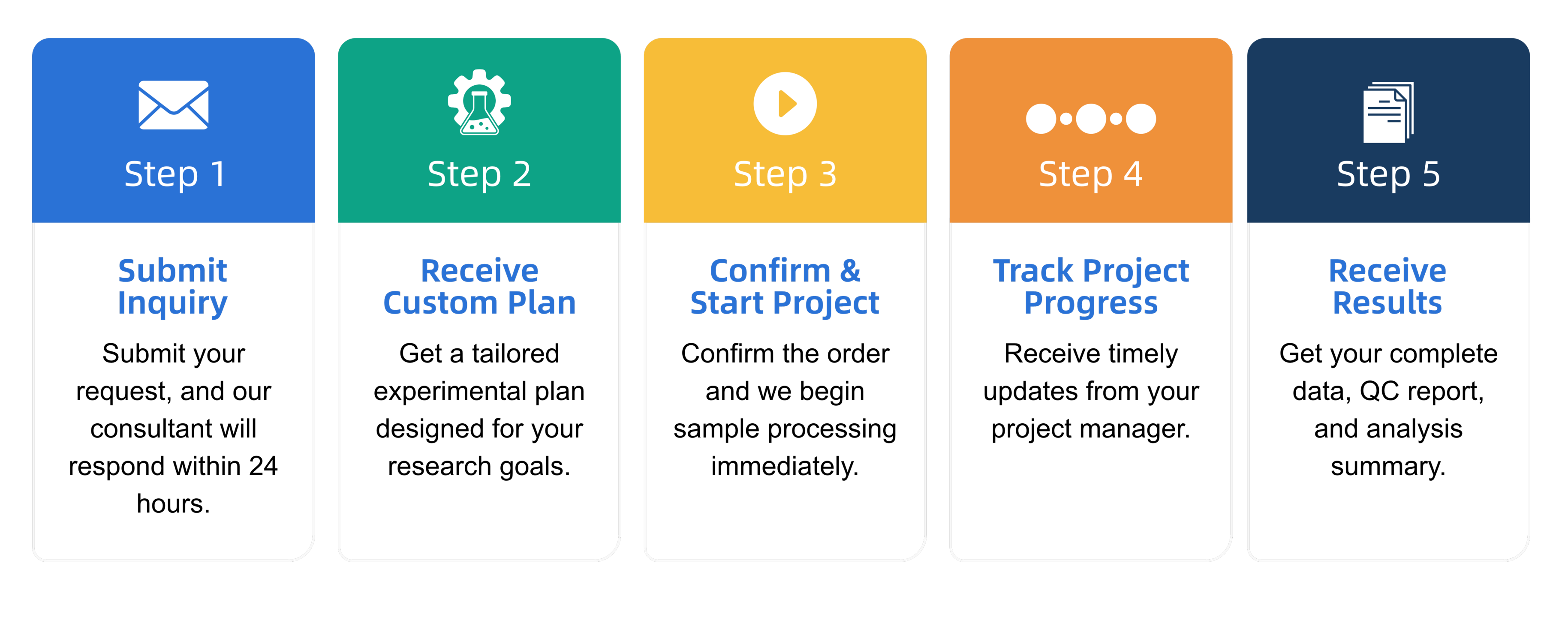
Q3: What is the service general workflow?
Q4: What data formats are provided?
We provide a complete DMPK data package in standard, user friendly formats:
- PDF report summarizing workflows, results, PK parameters, and interpretation.
- Excel or CSV files for raw concentration values, processed PK tables, and enzyme activity data.
- LC MS raw data in native instrument formats such as Thermo .raw or equivalent when applicable.
- High resolution PNG or TIFF graphics for plots, curves, and distribution profiles.
- Modeling files for PBPK or PK PD simulations available in formats suitable for downstream use.
- Additional formats can be supplied upon request for publication or regulatory submission.
Start Your Project with MtoZ Biolabs
Contact us to discuss your experimental design or request a quote. Our technical specialists are available to provide a free business assessment.
How to order?




