






Peptide Drug Activity Prediction Service
MtoZ Biolabs provides a comprehensive Peptide Drug Activity Prediction Service, integrating computational modeling, structural bioinformatics, and pharmacological analysis to accurately predict the biological activity, bioavailability, and therapeutic potential of peptide-based drugs. This service helps researchers evaluate drug candidates at an early stage, reduce experimental costs, and accelerate peptide drug development through data-driven predictions.
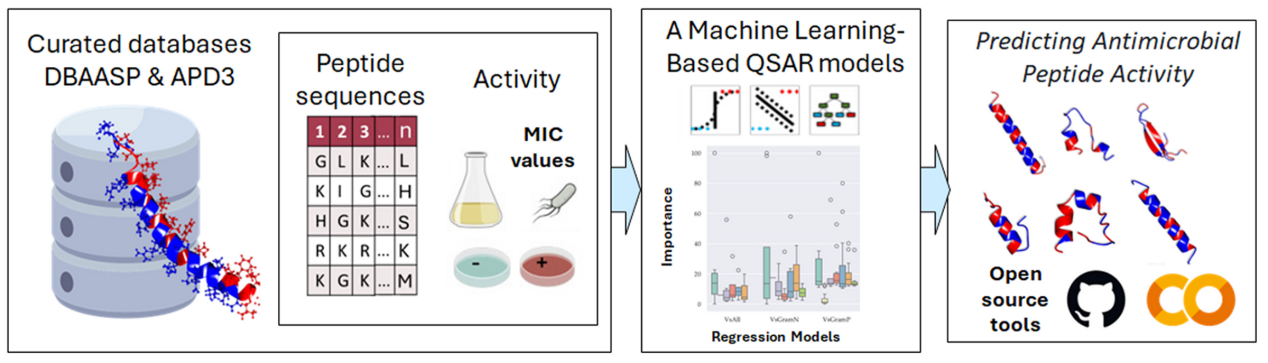
Bonifacio-Velez de Villa, E. I. et al. Pharmaceutics. 2025.
Figure 1. Predicting Antimicrobial Peptide Activity Using A Machine Learning-Based Quantitative Structure-Activity Relationship Approach
Background
Peptide drugs are short amino acid chains that mimic natural biological molecules and regulate various physiological functions. They act as hormones, enzyme inhibitors, receptor ligands, and signaling modulators in pathways associated with cancer, metabolism, cardiovascular, and neurodegenerative diseases. Peptide drugs represent an expanding class of therapeutic molecules due to their high specificity, low toxicity, and excellent biocompatibility.
The three-dimensional structure of a peptide directly influences its binding affinity, metabolic stability, and efficacy. The ability to identify biologically active conformers and accurately predict peptide behavior is essential for rational drug design and molecular optimization. However, their structural flexibility often results in multiple conformational isomers, making it challenging to determine which molecular structures are responsible for biological activity. By applying computational prediction tools, researchers can model the interactions between peptides and target proteins, simulate their dynamics, and forecast therapeutic activity before experimental testing.
Principle of Peptide Drug Activity Prediction
Peptide Drug Activity Prediction uses advanced algorithms to learn from the properties of known drug molecules and predict the behavior of new compounds. These models leverage experimental data from previously synthesized peptides, combining it with molecular descriptors, physicochemical parameters, and biological context to evaluate activity, toxicity, and absorption characteristics. Incorporating ligand-protein complex data from X-ray crystallography and molecular docking further enhances the reliability of prediction outcomes. This approach enables a more precise understanding of structure-activity relationships (SARs), streamlining candidate screening and design optimization.
The methods include:
🔸QSAR (Quantitative Structure-Activity Relationship) Modeling
Correlates molecular descriptors with biological activity to predict pharmacological behavior.
🔸Multiple-Instance Learning (MIL)
Addresses datasets with uncertain or incomplete activity labels, improving prediction of partially characterized peptides.
🔸Homology-Based Methods
Uses known peptide sequences and homologous structures to infer potential biological functions.
🔸Sequence Motif-Based Prediction
Identifies conserved amino acid patterns associated with specific activities, enabling discovery of functional motifs.
🔸Structure-Based Modeling
Employs molecular docking and conformational sampling to simulate peptide–protein interactions and estimate binding affinity.
🔸Genomic Context-Based Prediction
Integrates genomic and proteomic datasets to uncover peptides relevant to particular biological pathways.
🔸Network-Based Modeling
Maps peptides into biological interaction networks to reveal potential multi-target effects and system-level activity.
Peptide Drug Activity Prediction Service at MtoZ Biolabs
MtoZ Biolabs integrates multiple computational and data-driven methods to evaluate the biological, pharmacokinetic, and safety characteristics of therapeutic peptides. By combining quantitative modeling, structural analysis, and machine learning approaches, we provide a full-spectrum prediction platform that helps researchers identify promising peptide drug candidates and optimize their pharmacological performance.
Our prediction framework covers:
💠Peptide Activity Property Prediction
Evaluation of biological functions, receptor binding affinity, and predicted therapeutic roles based on structural and sequence characteristics.
💠Peptide Side-Effect Prediction
Identification of potential immunogenicity, cytotoxicity, and off-target effects using integrated molecular and toxicity prediction databases.
💠Blood-Brain Barrier (BBB) Permeability Prediction
Estimation of peptide transport capacity across the BBB for neurological applications through sequence-based modeling and molecular docking.
💠Peptide Drug-Likeness Prediction
Comprehensive evaluation of pharmacokinetic properties, including stability, solubility, and metabolic half-life, to determine suitability as drug candidates.
💠Peptide Bioavailability Prediction
Prediction of absorption, distribution, metabolism, and excretion (ADME) characteristics, optimizing peptide design for in vivo application.
Why Choose MtoZ Biolabs
✔️Comprehensive Analysis Platform
Integration of multiple predictive models and biological databases for multidimensional evaluation.
✔️High Prediction Reliability
Cross-validation with experimental datasets ensures accurate, reproducible outcomes.
✔️Customizable Solutions
Flexible workflows tailored to specific research goals and peptide classes.
✔️Advanced Computational Infrastructure
High-performance systems ensure rapid data processing and reliable modeling.
✔️Experienced Bioinformatics Team
A multidisciplinary team with expertise in pharmacology, proteomics, and peptide chemistry ensures expert interpretation.
Applications of Peptide Drug Activity Prediction Service
-
Screening for high-activity peptide drug candidates
-
Evaluating peptide-target interactions in drug discovery
-
Optimizing peptide structures for improved pharmacokinetics
-
Predicting safety, immunogenicity, and off-target effects
-
Assessing peptide performance for CNS-targeted drugs
-
Supporting rational design of novel therapeutic peptides
FAQ
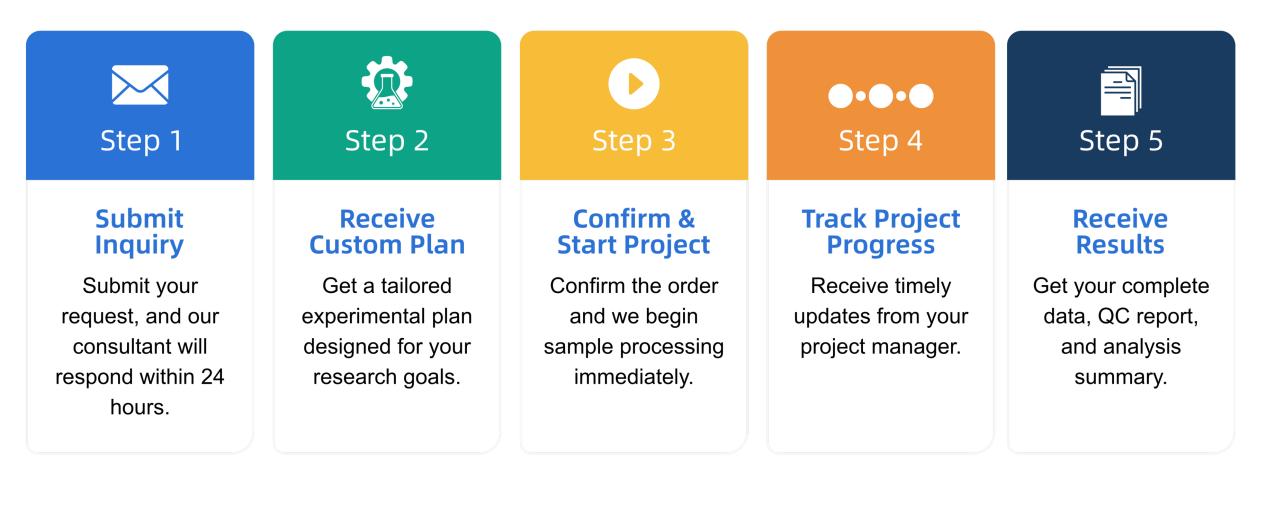
Q1: What is the service general workflow?
Q2: What data formats are provided?
1. Comprehensive reports in PDF format, including workflow, prediction outcomes, and interpretation.
2. Raw and processed data in Excel or CSV format for further analysis.
3. Sequence and structural outputs in FASTA and PDB formats.
4. Visualization files (e.g., activity curves, docking models) in PNG or TIFF.
5. Additional data formats can be provided upon request to accommodate publication or data integration requirements.
Start Your Project with MtoZ Biolabs
MtoZ Biolabs offers an advanced Peptide Drug Activity Prediction Service to accelerate peptide-based drug discovery with data-driven precision. Contact us today to discuss your project needs or request a detailed quotation.
How to order?




