






NMR Based Polysaccharide Analysis Service
-
Accurately identify monosaccharide types and their relative proportions in polysaccharides
-
Analyze glycosidic linkage patterns and configurations (α/β)
-
Determine substitution positions and branching distributions
-
Evaluate molecular conformations and chain flexibility characteristics
-
Support structural validation in combination with other analytical methods (such as MS or HPLC)
-
Raw NMR spectral data
-
Processed spectrum files (PDF or PNG format)
-
Tables of chemical shifts and signal assignments (Excel format)
-
A complete analysis report (PDF format) including experimental conditions and result interpretation
MtoZ Biolabs has launched the NMR based polysaccharide analysis service which enables comprehensive and precise analysis of polysaccharide structures. This service is widely applied in natural product research, polysaccharide structural identification, and biomaterial development, providing high-resolution data support for polysaccharide structure elucidation and functional studies.
Principle of Nuclear Magnetic Resonance
Nuclear Magnetic Resonance (NMR) spectroscopy is a structural analysis technique that utilizes the resonance characteristics of atomic nuclei with spin in an external magnetic field. By detecting the chemical shifts and coupling constants of atoms such as hydrogen and carbon within molecules, NMR can reveal the chemical environment and spatial configuration of a molecule. With its advantages of high resolution and non-destructive analysis, it is widely used in the study of organic compound structures. In polysaccharide analysis, the combined application of 1H NMR, 13C NMR, and two-dimensional correlation spectra provides critical information for polysaccharide structure elucidation and structure-activity relationship studies.
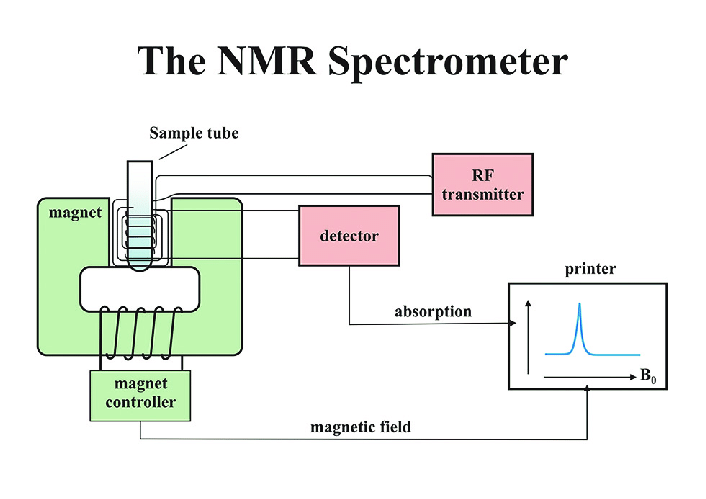
Zia, K. et al. European Journal of Dentistry, 2019.
Figure 1. Schematic Presentation of Typical Nuclear Magnetic Resonance Spectrometer.
NMR Based Polysaccharide Analysis Service at MtoZ Biolabs
Through high-resolution NMR spectroscopy, MtoZ Biolabs provides clients with systematic analysis services of polysaccharide structures and conformations, enabling multi-level elucidation from monosaccharide composition to spatial structure. This service helps researchers gain an in-depth understanding of the structural characteristics and physicochemical properties of polysaccharides.
Our analysis provides a comprehensive understanding of polysaccharide composition and structures, allowing researchers to further explore the relationship between structure and function.
Workflow of NMR Based Polysaccharide Analysis Service
1. Sample Preparation
Polysaccharide samples are purified, desalted, and dried to ensure a clean and stable solution. An appropriate solvent is selected based on solubility.
2. Spectral Acquisition
NMR is used to collect signals and obtain key information on chemical shifts and coupling constants.
3. Data Processing and Spectrum Interpretation
Specialized software is employed for peak identification and signal assignment to determine monosaccharide types, glycosidic linkage positions, and α/β configurations.
4. Structural and Conformational Analysis
By integrating one-dimensional and two-dimensional spectra, molecular structural models of polysaccharides are analyzed to reveal their conformational features and structural patterns.
5. Results Compilation and Reporting
A comprehensive report including spectra, chemical shift tables, and structural interpretation is provided to offer reliable data support for subsequent research.
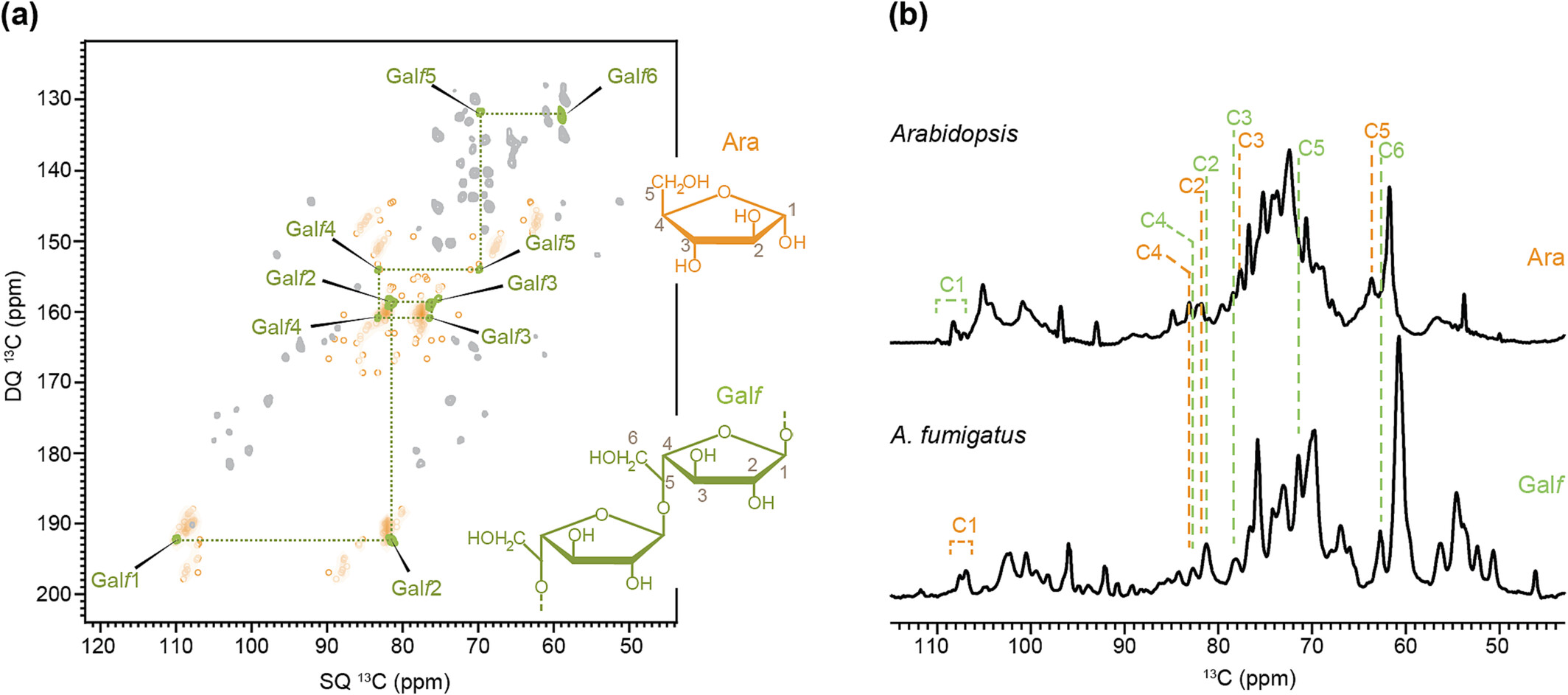
Zhao, W C. et al. Magentic Resonance in Chemistry, 2024.
Figure 2. Comparison of the NMR Signals of Galactofuranose and Arabinofuranose.
Why Choose MtoZ Biolabs?
✅ High-Resolution Detection: Accurately resolves the molecular structure and conformational features of polysaccharides.
✅ Non-Destructive Analysis: Provides complete structural information without damaging the sample.
✅ Standardized Quality Control Process: Strict experimental procedures ensure data reliability and reproducibility.
✅ Multi-Level Structural Elucidation: Simultaneously reveals monosaccharide composition, linkage patterns, and spatial conformation.
✅ Multi-Technology Integration: Compatible with mass spectrometry and chromatography platforms for more comprehensive structural verification.
Applications of NMR Based Polysaccharide Analysis Service
1. Polysaccharide Conformation and Dynamics Studies
Used to investigate the three-dimensional conformation and molecular motion of polysaccharides in solution, revealing their structural flexibility and interaction characteristics.
2. Biosynthesis and Metabolism Research
Assists in analyzing structural changes of polysaccharides during biosynthesis, modification, and degradation processes, supporting metabolic pathway studies.
3. Natural Products and Polysaccharide Derivatives Research
Applied to characterize the structural features of polysaccharides and their derivatives derived from plants, microorganisms, and marine sources.
4. Quality Control and Standardized Analysis
Evaluates the purity and structural consistency of polysaccharide samples to ensure product quality control and stability.
5. Structure-Function Relationship Studies
Elucidates the relationship between polysaccharide structural characteristics and their physicochemical properties or biological activities, providing a basis for subsequent functional studies.
Deliverables
1. Comprehensive Experimental Details
2. Materials, Instruments, and Methods
3. Polysaccharide Structure and Conformation Analysis Results
4. NMR Spectral Data
5. Comprehensive Analysis Report
6. Raw Data Files
FAQ
Q1: What types of samples are suitable?
A1: The NMR based polysaccharide analysis service is suitable for various types of polysaccharide samples, including natural polysaccharides, synthetic polysaccharides, and their derivatives. To ensure clear signals and reliable results, samples should have high purity, free from proteins, salts, and other interfering impurities, and the concentration should meet the requirements for NMR detection.
Q2: What is the service general workflow?
A2:

Q3: What data formats are provided?
A3: The service delivers standardized and multi-format data results to facilitate research analysis and downstream applications. Typical deliverables include:
If special analytical requirements exist, data formats can be customized according to project specifications.
Q4: How should I prepare my samples?
A4: To ensure analytical accuracy and reproducibility, it is recommended that sample preparation follows these guidelines:
(1) Sample form: lyophilized powder or solution forms are acceptable
(2) Purity: avoid samples containing high salt concentrations or surfactants
(3) Storage conditions: store at -20℃ for short-term and -80℃ for long-term preservation
(4) Sample transportation: transport with cold chain or dry ice, ensuring sealed, leak-proof containers clearly labeled with sample information
(5) Information provided: specify sample source, concentration, and solvent type to optimize detection parameters
For more information, please refer to Sample Submission Guidelines for Proteomics, Sample Submission Guidelines for Metabolomics.
Start Your Project with MtoZ Biolabs
Contact us to discuss your experimental design or request a quote. Whether you aim to elucidate polysaccharide structural characteristics or explore their structure-function relationships in biological systems, MtoZ Biolabs provides high-precision and professional NMR analytical support and technical services.
How to order?




