






Multiple Reaction Monitoring or Discovery Proteomics? Matching MRM to Biomarker Validation and QC Needs
Introduction
Quantitative proteomics projects rarely fail because teams lack mass spectrometry capability. They fail because the selected workflow does not match the study stage or evidence standard required for the next decision. One team may need to survey thousands of proteins to generate biomarker hypotheses. Another may need to measure ten predefined peptides across five hundred clinical samples with tight reproducibility. A third may need to quantify a product-related peptide in a biopharmaceutical matrix for QC documentation.
Multiple reaction monitoring and discovery proteomics answer different questions. Discovery workflows prioritize breadth and hypothesis generation. MRM prioritizes specificity, reproducibility, and repeat quantitation for predefined targets. The best choice depends on whether the protein list is known, how many samples must be measured, and whether the project requires assay-level precision rather than proteome-wide coverage.
If your team is selecting a quantitative proteomics strategy before samples are prepared, MtoZ Biolabs can Compare targeted and discovery routes across MRM, PRM, and profiling workflows.
Related Services
| Customer Need | Recommended Service Direction |
| Need multiple reaction monitoring quantitation | Multi Reaction Monitoring MRM Service |
| Need MRM or PRM proteomics support | MRM/PRM Quantitative Proteomics Service |
| Need targeted proteomics workflow | Targeted Proteomics Service |
| Need MRM-based peptide quantification | MRM-Based Peptide Quantification Service |
| Need broader quantitative proteomics | Quantitative Proteomics Service |
| Need discovery-scale profiling first | Label-Free Quantitative Proteomics Service, MS Based |
Start With the Study Stage
Method selection usually begins with one of four project scenarios:
1. Hypothesis Generation
The target list is unknown and broad profiling is required.
2. Candidate Validation
A short list of proteins must be quantified reproducibly in many samples.
3. Assay-Level QC or Biopharmaceutical Quantitation
A predefined peptide panel must meet specificity and reproducibility expectations.
4. Combined Discovery-to-Validation Pipeline
Profiling identifies candidates that MRM or PRM then confirms at scale.
These scenarios lead to different default routes. Early discovery favors label-free or isobaric multiplexing. Late validation and QC favor multiple reaction monitoring or PRM.
Route Comparison at a Glance
| Decision Factor | Multiple Reaction Monitoring | Label-Free Discovery | TMT/iTRAQ Multiplexing | PRM |
| Core readout | Predefined transition quantitation | Relative protein abundance across proteome | Multiplexed relative quantitation across samples | High-resolution targeted peptide quantitation |
| Best study stage | Validation, QC, longitudinal tracking | Hypothesis generation | Multiplexed group comparisons | Validation when specificity is critical |
| Target definition | Required upfront | Not required | Not required | Required upfront |
| Sample throughput | High for fixed panels | Moderate | Moderate to high by plex design | Moderate |
| Common bottleneck | Assay development, matrix effects | Depth vs throughput tradeoff | Ratio compression, missing values | Method setup, panel size |
| Ideal deliverable | Targeted quantitative assay data | Candidate protein lists | Multiplexed differential tables | High-specificity targeted quantitation |
When Multiple Reaction Monitoring Is the Better Fit
MRM is usually the preferred route when:
-
the target peptide panel is already defined
-
many samples must be measured with consistent assay performance
-
matrix specificity and reproducibility matter more than proteome breadth
-
biomarker candidates move from discovery into validation
-
biopharmaceutical or QC workflows require a fixed quantitative assay
Strengths include high selectivity through predefined transitions, efficient cycle use for known peptides, and established acceptance in targeted proteomics and validation studies. For predefined panels in plasma, tissue, cell lysate, or formulation matrices, multiple reaction monitoring is often the most direct validation route.
Limitations include upfront assay development and dependence on peptide detectability in the study matrix.
Teams with defined target lists may review Multi Reaction Monitoring MRM Service or MRM-Based Peptide Quantification Service.
When Discovery Proteomics Is the Better Fit
Label-Free Quantitative Proteomics Service, MS Based or label-based multiplexing is often preferable when:
-
the study goal is unbiased protein profiling
-
biomarker candidates have not yet been narrowed
-
broad pathway or treatment response analysis is required
-
sample number is moderate and proteome coverage is the priority
Discovery workflows excel at generating candidates but are weaker as standalone validation assays when strict repeat quantitation across hundreds of samples is required.
When PRM Fits Between MRM and Discovery
MRM/PRM Quantitative Proteomics Service supports high-resolution targeted quantitation when:
-
interference limits triple-quadrupole MRM performance
-
high-specificity fragment ion confirmation is required
-
the target panel is defined but assay conditions are challenging
PRM retains targeted quantitation logic while using high-resolution MS for product ion detection. It is often selected for difficult matrices or when transition interference persists after MRM optimization.
Combined Discovery-to-MRM Pipelines
Many projects benefit from a staged strategy. Label-free or TMT profiling identifies candidate proteins, then multiple reaction monitoring quantifies a prioritized panel in an expanded cohort. This approach avoids over-investing in assay development before candidates are validated at the discovery level, while still delivering the reproducibility required for later-stage studies.
For biopharmaceutical or biomarker programs with long timelines, planning the validation assay during discovery reduces delay when candidates advance.
Outsourcing both discovery and MRM validation to one provider can also reduce method transfer friction. Transition selection, internal standard sourcing, and report format are easier to keep consistent when the same team that observed discovery detectability also locks the targeted assay.
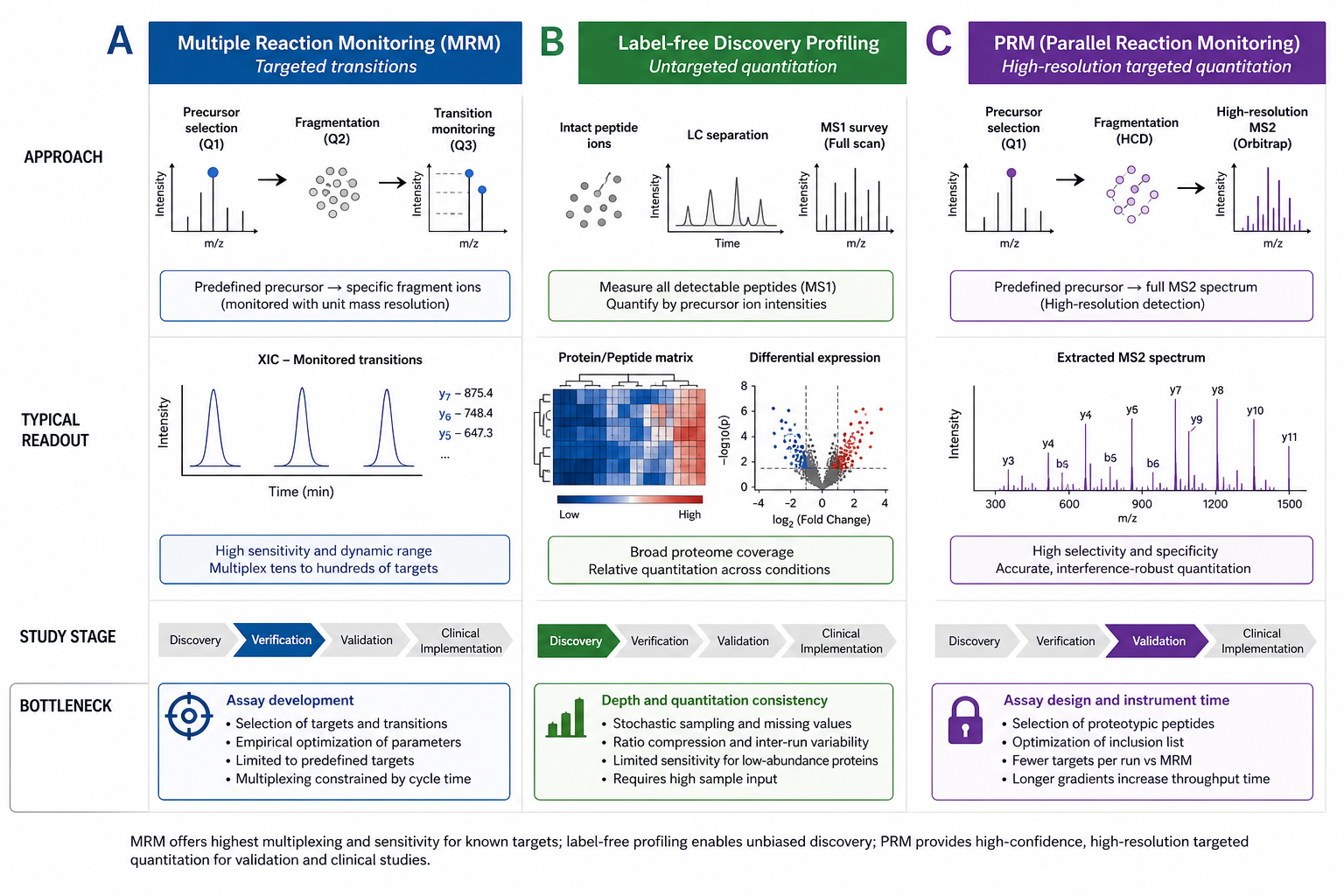
Figure 1. Study stage, target definition, and reproducibility requirements determine whether MRM, discovery profiling, or PRM is the better fit.
Decision Recommendations by Project Goal
Choose multiple reaction monitoring when:
-
the peptide panel is predefined
-
sample count is high and assay consistency is critical
-
validation or QC documentation is the primary goal
Choose label-free discovery when:
-
the target list is unknown
-
hypothesis generation is the primary goal
Choose TMT or iTRAQ when:
-
multiplexed group comparison is needed in one design
-
relative quantitation across conditions is the main readout
Choose PRM when:
-
targets are defined but matrix interference limits MRM
-
high-resolution specificity is required
In practice, the cost difference between discovery and MRM is not only instrument time. Assay development, labeled standard procurement, and matrix validation add upfront effort that is justified only when the target list is stable enough to measure repeatedly across the full study cohort.
Practical Examples by Study Type
1. Plasma Biomarker Validation After Discovery
Ten candidate proteins, four hundred samples. MRM with stable isotope-labeled internal standards is often the most efficient validation route.
2. Exploratory Treatment Response Study
Pathway coverage unknown, twenty samples. Label- free discovery is usually the better starting point.
3. Biopharmaceutical Peptide Monitoring in Formulation Matrix
One or few product-related peptides, strict QC requirements. MRM assay development with matrix-matched validation is typically preferred.
4. Tissue Signaling Panel with Interference History
Defined targets, co-elution problems on triple-quadrupole MRM. PRM may provide better specificity.
Programs that begin with Label-Free Quantitative Proteomics Service, MS Based should define MRM transition candidates during discovery rather than after cohort expansion. Peptides that are identifiable in discovery but weak in matrix often need alternate proteotypic selection before validation scale-up begins.
When comparing vendors, ask whether discovery results are translated into a practical MRM panel within the same project plan. Providers that treat profiling and targeted quantitation as separate handoffs often lose time re-evaluating peptide detectability that was already visible in the discovery dataset.
For internal decision meetings, summarize the comparison in one line: if the target list is fixed and repeat measurement is the bottleneck, choose MRM; if the target list is still open, stay in discovery until candidates survive initial filtering.
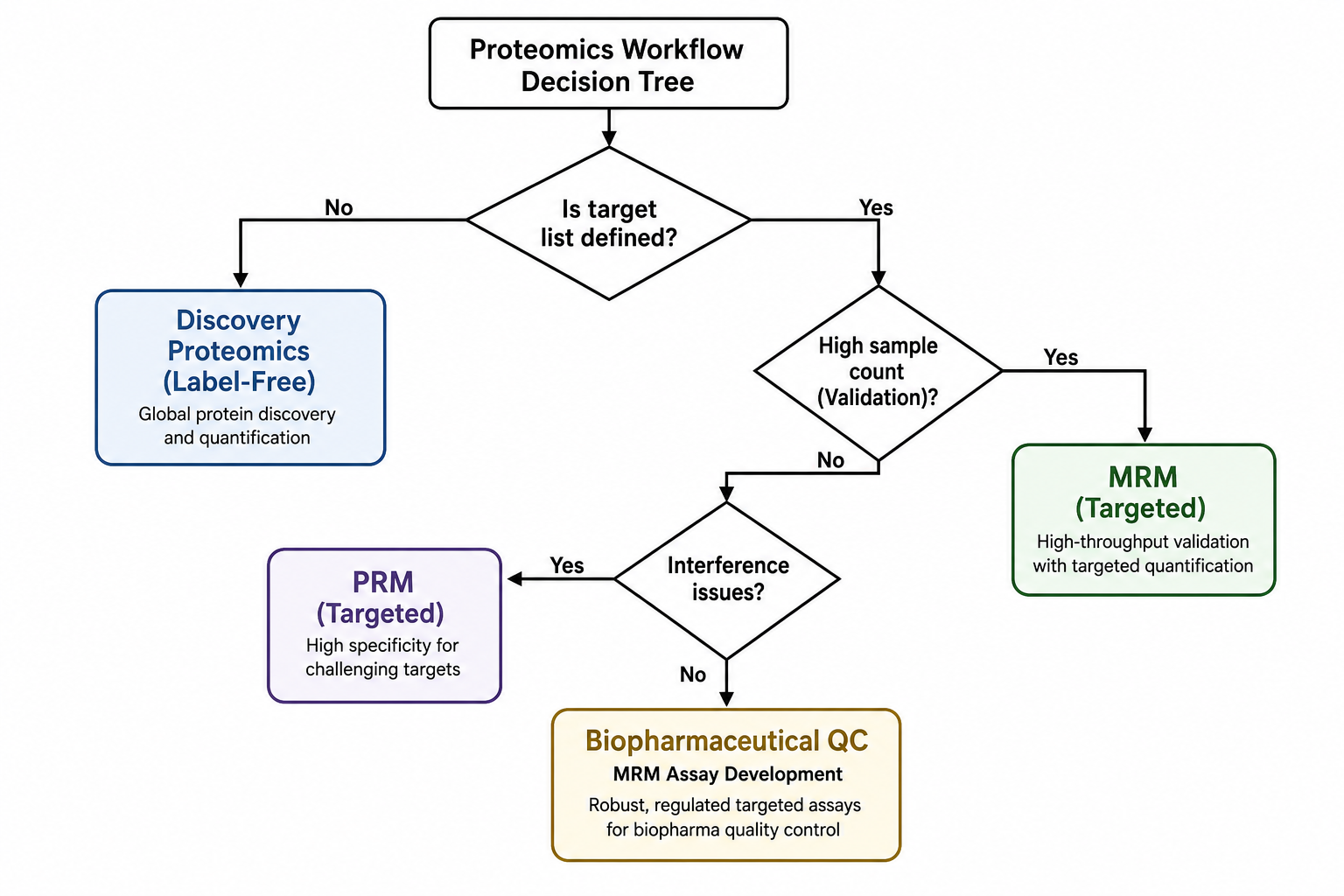
Figure 2. Target definition and study stage determine whether discovery profiling or targeted MRM is the preferred quantitative route.
Frequently Asked Questions
1. Should every proteomics project move to MRM after discovery?
Not always. Only candidates that survive initial validation and require large-scale repeat measurement usually justify MRM assay development.
2. Can MRM and label-free be combined in one program?
Yes. Many biomarker programs use discovery to nominate targets and MRM to validate them in larger cohorts.
3. Is PRM always better than MRM?
No. MRM remains efficient and well established for many panels. PRM is often chosen when specificity or interference drives the decision.
4. Can MRM support biopharmaceutical QC?
Yes, when proteotypic peptides are detectable and the assay is validated for the matrix and reporting requirement.
5. Does targeted proteomics replace full Quantitative Proteomics Service workflows?
No. It complements broader quantitative strategies by focusing on predefined targets with assay- level performance.
Conclusion
Multiple reaction monitoring and discovery proteomics serve different stages of the quantitative workflow. Discovery methods generate breadth and candidates. MRM delivers selective, reproducible quantitation for predefined peptides across large sample sets. PRM adds high- resolution specificity when matrix complexity demands it. Method selection should begin with study stage and target definition, not platform preference alone.
MtoZ Biolabs can Match the quantitative workflow to project stage across Multi Reaction Monitoring MRM Service, MRM/PRM Quantitative Proteomics Service, and Label-Free Quantitative Proteomics Service, MS Based. Contact the technical team to compare options before sample submission.
How to order?




