






Metabolizing Enzymes Identification Service
-
Identify key enzymes responsible for rapid degradation
-
Support targeted sequence modifications
-
Guide incorporation of stabilizing amino acids or chemical groups
-
Predict metabolic clearance mechanisms
-
Understand species differences in enzyme activity
-
Support selection of animal models for in vivo studies
-
Identify major and minor metabolites
-
Explore potential toxic or reactive species
-
Support metabolite identification required for regulatory review
-
Evaluate enzyme effects in plasma or tissue matrices
-
Assess protective strategies for oral or parenteral delivery
-
Understand enzyme interactions with specific peptide motifs
-
Determine susceptibility to polymorphic enzymes
-
Support mechanistic modeling of metabolic pathways
MtoZ Biolabs provides a Metabolizing Enzymes Identification Service using advanced LC-MS platforms and diverse enzymatic systems to identify the specific enzymes involved in the metabolic breakdown of peptide-based drug candidates. This service delivers detailed mechanistic insight essential for stability optimization, metabolic risk assessment, and preclinical development planning.
Introduction
Peptide therapeutics continue to expand across modern drug development due to their high target specificity, favorable safety profiles, and the ability to modulate biological pathways that small molecules often cannot address. However, peptides are inherently susceptible to enzymatic degradation in biological systems. Proteases, peptidases, and other metabolic enzymes can rapidly cleave peptide bonds or modify amino acid side chains, directly influencing peptide half-life, systemic exposure, pharmacokinetics, and overall therapeutic performance.
To advance a peptide candidate successfully, researchers must understand not only how fast the peptide is metabolized but also which enzymes contribute to its degradation. Enzyme-specific information is crucial for predicting metabolic clearance, identifying potential drug interaction risks, assessing variability across individuals, and designing stability-enhanced analogs. This information becomes even more valuable when dealing with enzymes that display genetic polymorphisms or tissue-specific expression patterns, as they can dramatically alter metabolic outcomes. Metabolizing enzyme identification provides a mechanistic framework that supports decisions during lead optimization and preclinical evaluation.
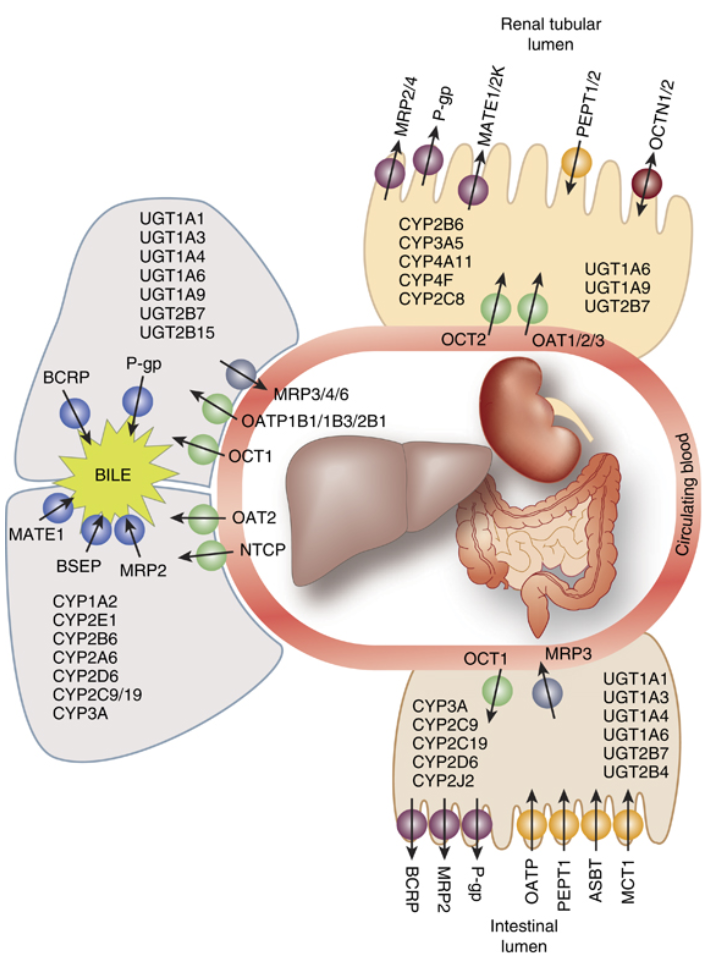
Yeung, C. K. et al. Kidney Int. 2014.
Figure 1. Drug-Metabolizing Enzymes and Drug Transporters Operate in the Human Liver, Kidney, and Intestine
Metabolizing Enzymes Identification Service at MtoZ Biolabs
MtoZ Biolabs provides a comprehensive Metabolizing Enzymes Identification Service that defines which enzymes are responsible for peptide metabolism and clarifies how these pathways impact stability, clearance, and drug interaction risk.
1. Identification of enzymes involved in peptide metabolism
We screen peptide candidates against recombinant enzymes (e.g., CYP, UGT, NAT, MAO, CE, AOX, SULT and FMO), liver-derived systems, and selective inhibition assays to determine which metabolic enzymes contribute to degradation.
2. Assessment of enzyme-related variability
We evaluate enzymes known for genetic or expression variability to help predict differences in metabolic clearance among individuals or populations.
3. Metabolite detection and pathway mapping
High-resolution LC-MS is used to characterize metabolites and outline primary and secondary metabolic routes formed during incubation.
4. Mechanistic profiling using recombinant and microsomal systems
Our approach incorporates recombinant enzyme data, liver microsome incubations, and linear kinetic evaluations to generate enzyme-specific activity profiles and parameter estimates such as Vmax and Km.
5. Integrated LC-MS monitoring for substrate and metabolite analysis
A single LC-MS workflow provides quantitative monitoring of parent peptide loss and metabolite formation, giving a comprehensive view of enzyme contributions.
Why Choose MtoZ Biolabs
✔️High Analytical Sensitivity
Advanced LC-MS platforms allow detection of low-abundance metabolites and minor reaction pathways.
✔️Comprehensive Enzyme Coverage
We provide broad enzyme screening options, enabling complete metabolic pathway identification.
✔️Expertise in Peptide Chemistry and Metabolism
Our team brings extensive experience in peptide drug development, protease biology, and metabolic analysis.
✔️Customizable Study Designs
Each project is tailored to the compound, its properties, and the development goals.
✔️Rapid Turnaround
Optimized workflows ensure efficient processing and timely delivery of results.
Applications of Metabolizing Enzymes Identification Service
1. Lead Optimization
2. Preclinical Pharmacokinetic Assessment
3. Metabolite Profiling and Safety Assessment
4. Formulation and Delivery Strategy Development
5. Mechanistic Studies
FAQ
Q1: What types of samples are suitable?
This service supports a wide range of peptide-based therapeutics, including linear peptides, cyclic peptides, stapled peptides, conjugated peptides, and modified sequences. Both research-grade and high-purity development-stage materials are acceptable. Peptides intended for metabolism, stability, enzymatic profiling, or metabolite identification studies are all suitable for this service.
Q2: How should I prepare my samples?
Peptides should be provided in high purity with clear documentation on sequence, molecular weight, solubility, and recommended solvents. We recommend preparing aliquoted stock solutions in suitable solvents such as water, buffer, or DMSO to avoid repeated freeze-thaw cycles. Samples should be labeled with any special handling instructions, such as light sensitivity or known stability concerns.
For more information, please refer to Sample Submission Guidelines for Proteomics and Sample Submission Guidelines for Metabolomics.
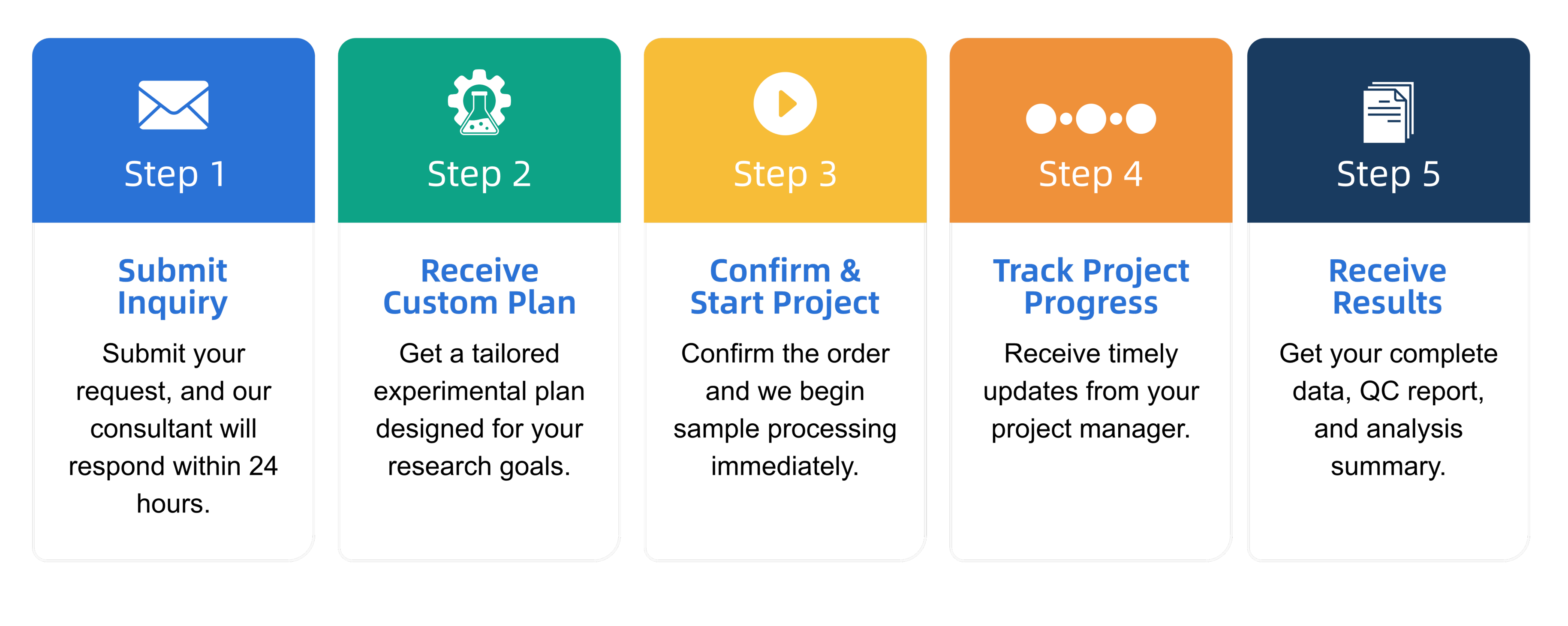
Q3: What is the service general workflow?
Q4: What data formats are provided?
MtoZ Biolabs delivers a complete and organized data package in commonly used scientific formats:
1. PDF report detailing experimental design, methods, enzyme systems tested, metabolite identification, and data interpretation
2. Excel or CSV files containing quantitative time-course data, enzyme-specific degradation results, and kinetic parameter calculations
3. Raw LC-MS files including chromatograms and mass spectra for independent review
4. High-resolution images such as PNG or TIFF for metabolic pathway maps, cleavage diagrams, and analytical figures
5. Additional formats can be provided upon request to support regulatory submissions or publication needs.
Start Your Project with MtoZ Biolabs
MtoZ Biolabs delivers comprehensive metabolizing enzyme identification using high-resolution LC-MS platforms and diverse enzymatic systems. Our service provides the mechanistic insight required to optimize peptide stability, reduce development risks, and guide preclinical strategy.
Contact us to discuss your project and receive a customized research plan.
How to order?




