






Mannuronic Acid Analysis Service
-
Raw analytical data from platforms such as HPLC, MS, or NMR;
-
Processed result tables (in Excel or CSV format), listing content, ratios, and retention times;
-
Analysis reports (in PDF format) outlining the experimental methods and key findings;
-
Spectral files (in TIFF or PNG format) for result presentation and comparison.
MtoZ Biolabs utilizes a multi-platform analytical system and offers the mannuronic acid analysis service which allows precise analysis of the content, composition, and distribution characteristics of mannuronic acid in polysaccharides. This service is widely applied in studies on alginate structure, natural polysaccharide characterization, and biopolymer development, providing reliable data support for polysaccharide modification research and the high-value utilization of biological resources.
What Is Mannuronic Acid?
Mannuronic acid is a monosaccharide acid derived from the oxidation of D-mannose and is one of the main structural units of alginic acid, often co-polymerized with guluronic acid. It plays a key role in the cell walls of algae and in polysaccharide structures, affecting the gelation properties and biocompatibility of alginates. Due to its excellent physicochemical properties and biological functions, mannuronic acid is widely used in food, pharmaceuticals, biopolymers, and marine bioresource development.
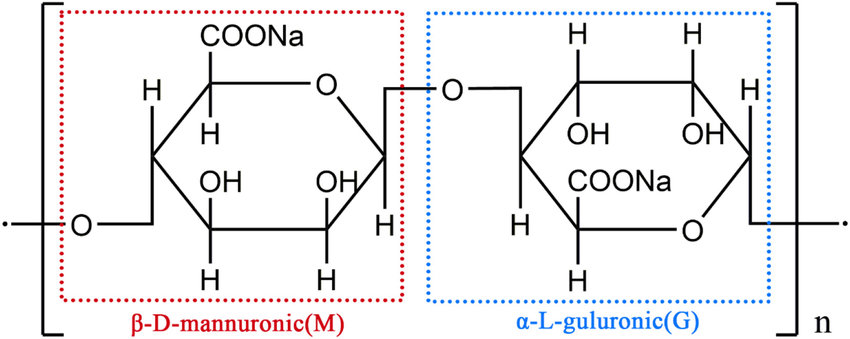
Xia, L C. et al. Materials & Design, 2019.
Figure 1. Chemical Structure of SA with β-D-Mannuronic Acid(M) and α-L-Guluronic Acid(G).
Technical Platforms for Mannuronic Acid Analysis Service
1. High-Performance Liquid Chromatography (HPLC)
With excellent separation performance and reproducibility, it efficiently separates and detects mannuronic acid components in samples.
2. Mass Spectrometry (MS)
(1) Liquid Chromatography-Mass Spectrometry (LC-MS): With high sensitivity and quantitative accuracy, it is suitable for the detection and confirmation of mannuronic acid in complex systems.
(2) Gas Chromatography-Mass Spectrometry (GC-MS): It offers high resolution and accuracy, ideal for analyzing volatile or derivatized samples.
3. Nuclear Magnetic Resonance (NMR)
Provides precise molecular structure and conformation information, useful for confirming the chemical bond types and spatial arrangement of mannuronic acid.
4. High-Performance Anion Exchange Chromatography with Pulsed Amperometric Detection (HPAEC-PAD)
Combining high-resolution separation and electrochemical detection, it enables sensitive and accurate quantification of acidic sugar components in complex samples.
Mannuronic Acid Analysis Service at MtoZ Biolabs
1. Qualitative and Quantitative Analysis
Accurately detect the content and composition ratio of mannuronic acid in samples, providing reliable support for structural studies and sample comparison.
2. Structural Characterization
Reveal the connection and arrangement characteristics of mannuronic acid in alginates and polysaccharide chains, aiding molecular structure analysis.
3. Metabolic Analysis
Evaluate the trend of mannuronic acid changes under different biological or chemical conditions, supporting metabolic pathway and functional mechanism studies.
Why Choose MtoZ Biolabs?
✅ Multidimensional Analysis: Covers various aspects, including content, structure, and metabolism.
✅ Customized Solutions: Analysis workflows can be flexibly adjusted according to sample types and research objectives.
✅ High Data Reliability: Standardized procedures and parallel sample monitoring ensure consistent results.
✅ Fast Turnaround Time: Efficient experimental and analytical systems shorten project timelines.
✅ One-Stop Service: Full technical support from sample handling to data reporting.
Applications of Mannuronic Acid Analysis Service
1. Biomedicine Research
Used to analyze the composition of mannuronic acid in drug carriers or biological formulations, evaluating their stability and biocompatibility.
2. Fermentation and Metabolic Engineering
Monitors the generation and transformation of mannuronic acid during microbial fermentation, optimizing metabolic pathways and production efficiency.
3. Plant Cell Wall Research
Detects the distribution and content of mannuronic acid in plant tissues, exploring the regulatory mechanisms of cell wall structure and function.
4. Environmental and Biodegradation Research
Analyzes the changes in mannuronic acid during biomass degradation or environmental processing, evaluating ecological transformation efficiency.
5. Biopolymer Characterization
Used to assess the chemical composition and structural characteristics of biopolymers containing mannuronic acid, providing a basis for material performance research.
Deliverables
1. Comprehensive Experimental Details
2. Materials, Instruments, and Methods
3. Quantitative and Composition Analysis Results
4. Structural and Metabolic Related Data
5. Image and Spectral Data Files
6. Bioinformatics Analysis
7. Raw Data Files
FAQ
Q1: What type of samples are suitable?
A1: MtoZ Biolabs' mannuronic acid analysis service is suitable for various sample types, including purified mannuronic acid, alginates and their hydrolysis or degradation products, fermentation system samples, plant extracts, and polysaccharide complexes. To ensure stable and reliable results, it is recommended that the samples be free of proteins, salts, and particulate impurities and undergo appropriate desalting or filtration.
Q2: What is the service general workflow?
A2:

Q3: What data formats are provided?
A3: MtoZ Biolabs offers standardized, multi-format data delivery to ensure results are ready for scientific analysis and report writing. The typical deliverables include:
If special analytical requirements exist, data formats can be customized according to project specifications.
Q4: How should I prepare my samples?
A4: To ensure the accuracy and repeatability of the analysis, MtoZ Biolabs recommends the following sample preparation guidelines:
(1) Sample form: Liquid samples or freeze-dried powder are both acceptable;
(2) Sample purity: Avoid interference from high salt, lipids, or organic solvents;
(3) Storage conditions: Short-term storage at -20°C, long-term storage at -80°C is recommended;
(4) Transportation: It is recommended to use dry ice for cold-chain transportation, with sealed, leak-proof containers;
(5) Additional information: Please provide sample origin, treatment method, and analysis objectives to optimize the testing plan.
For more information, please refer to Sample Submission Guidelines for Proteomics, Sample Submission Guidelines for Metabolomics.
Start Your Project with MtoZ Biolabs
Contact us to discuss your experimental design or request a quote. Whether you aim to analyze the structural composition of mannuronic acid or explore its role in biological systems and metabolic processes, MtoZ Biolabs can provide you with high-quality, specialized analytical support.
How to order?




