






Lactulose Analysis Service
Lactulose is a synthetic disaccharide composed of galactose and fructose, produced through the isomerization of lactose. It is widely recognized for its therapeutic importance in the treatment of hepatic encephalopathy and chronic constipation, as well as for its prebiotic effects in promoting beneficial gut microbiota. Because lactulose is not absorbed in the small intestine, it reaches the colon where it is metabolized by bacteria, making it a key component in clinical nutrition and gastrointestinal health studies.

Source: Wikipedia
Figure 1. Structure of Lactulose
Understanding the chemical, structural, and biological characteristics of lactulose is crucial for pharmaceutical quality control, functional food development, and metabolic research. MtoZ Biolabs provides a comprehensive Lactulose Analysis Service that offers accurate and detailed evaluation of content, purity, structure, stability, and metabolic behavior. Leveraging our advanced analytical platforms and expertise in carbohydrate chemistry, we deliver high-precision results that support both academic research and industrial applications.
Our Lactulose Analysis Service platforms include High-Performance Liquid Chromatography (HPLC), Liquid Chromatography–Mass Spectrometry (LC-MS), Gas Chromatography (GC), Mass Spectrometry (MS), Ion Chromatography (IC), and Nuclear Magnetic Resonance (NMR). These technologies enable sensitive detection and precise quantification of lactulose, even in complex biological or food matrices.
Service at MtoZ Biolabs
💠Lactulose Content Determination
Quantitative measurement of lactulose concentration in pharmaceutical formulations, dairy products, or biological samples.
💠Lactulose Purity Analysis
Detection and quantification of impurities such as lactose, galactose, and fructose to ensure high-purity lactulose for clinical or commercial applications.
💠Lactulose Structural Characterization
Structural confirmation of lactulose through LC-MS, GC-MS, and NMR, determining linkage type, stereochemistry, and molecular integrity.
💠Lactulose Stability Evaluation
Assessment of lactulose degradation kinetics under varying storage conditions (pH, temperature, humidity) to determine shelf life and product stability.
💠Lactulose Metabolic Profiling
Analysis of lactulose metabolism and breakdown products in biological systems, supporting studies on intestinal fermentation, gut microbiota interactions, and prebiotic efficacy.
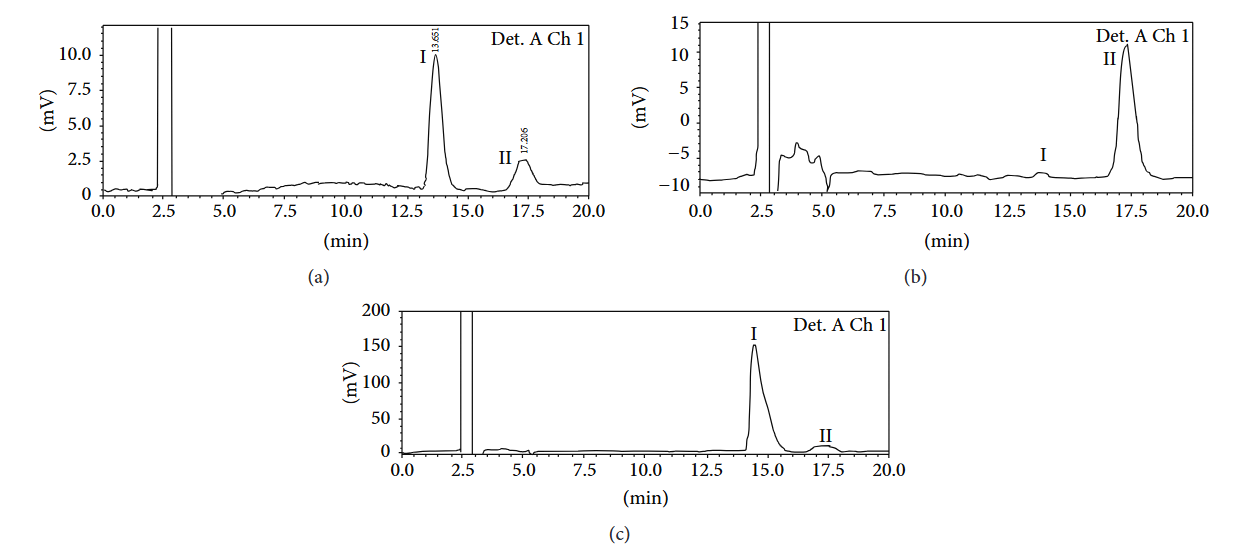
Silveira, M. F. et al. J Chem. 2015.
Figure 1. Chromatogram by HPLC-RID: (a) Standard Lactose-Lactulose; (b) UHT Milk Sample; (c) Condensed Milk Sample. I: Lactulose (13.6 min); II: Lactose (17.2 min).
Service Advantages
☑️Comprehensive Analytical Coverage: Multi-technique integration enables complete chemical, structural, and quantitative assessment of lactulose.
☑️High Sensitivity and Specificity: Detection of trace-level impurities and metabolites with superior accuracy using LC-MS and GC-MS systems.
☑️Robust Data Quality: All analyses are performed under validated methods following strict quality assurance standards to ensure reproducibility.
☑️Customizable Method Development: Tailored analytical protocols designed to meet specific project goals, research questions, or regulatory demands.
☑️Rapid Turnaround and Expert Support: Efficient processing and expert consultation from sample submission to final data interpretation.
Applications
1. Pharmaceutical Industry
Quality control, impurity profiling, and stability testing of lactulose formulations used in hepatic and digestive treatments.
2. Food and Nutrition Research
Quantification of lactulose in functional foods, prebiotics, and dairy products to ensure labeling accuracy and health efficacy.
3. Clinical and Biomedical Studies
Monitoring of lactulose metabolism in gastrointestinal research, liver function assessment, and gut permeability testing.
4. Fermentation and Biotechnology
Evaluation of lactulose production efficiency during enzymatic or microbial synthesis.
5. Agricultural and Plant Studies
Investigation of carbohydrate metabolism and disaccharide transport mechanisms in plant systems.
6. Regulatory and Quality Assurance
Ensuring compliance with pharmacopeial standards and global regulatory guidelines for food and drug quality.
Sample Submission Suggestions
1. Sample Types: Dairy products (milk, yogurt, cheese, whey), pharmaceutical formulations, biological fluids, fermentation liquids, and plant extracts.
2. Recommended Sample Quantity:
Liquid samples: ≥ 2 mL
Solid samples: ≥ 2 g
Complex or low-concentration samples: ≥ 5 g
3. Storage and Transport: Samples should be stored at –20°C or below. Transport on dry ice or cold packs to maintain stability.
*Notes: For special sample types or low-yield materials, please contact us before preparation.
How to order?




