






Identify Unknown Autoantibodies vs ELISA: Method Selection and Research Use Cases
Quick Answer
Choose ELISA when your team already has a known antigen or a defined antigen panel and needs to measure serum reactivity against those targets. Choose an unknown autoantibody discovery workflow when the antigen is unknown at the start and the project goal is autoantigen identification, hypothesis generation, or the detection of unexpected reactivity. In many translational research use cases, the most practical strategy is staged: use discovery methods such as immunoprecipitation and LC-MS/MS to nominate a candidate target, then apply orthogonal validation and a targeted immunoassay such as ELISA for confirmation and later cohort screening.
What This Comparison Actually Decides
The real question behind *identify unknown autoantibodies vs ELISA* is not which method is better overall. It is whether your study begins with a defined target or with unexplained biological reactivity.
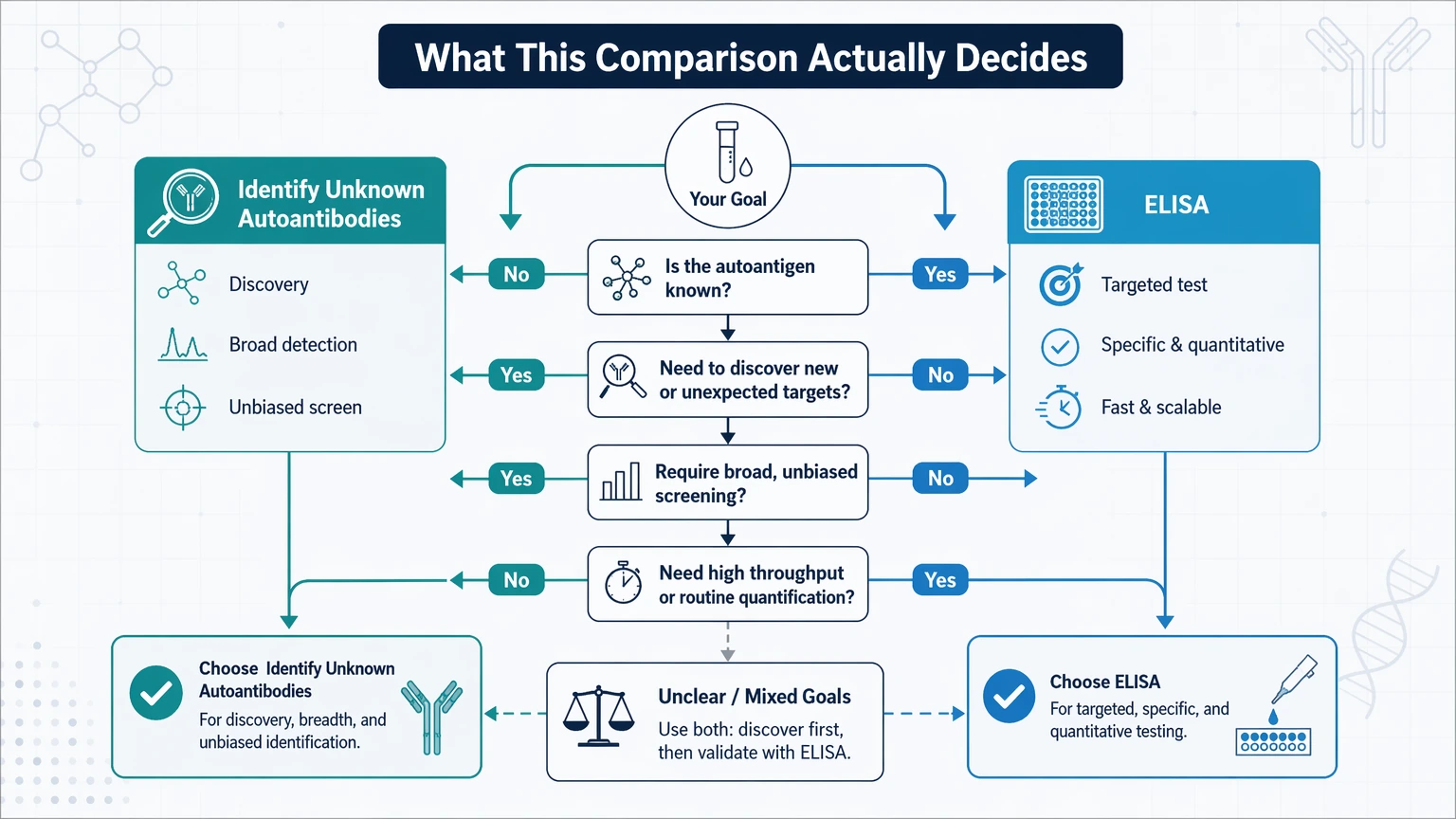
That starting point changes the workflow:
- If your team asks, “Do these samples react with antigen X, Y, or Z?” ELISA fits the question.
- If your team asks, “What antigen are these samples reacting to?” ELISA cannot identify the target on its own.
- If your current antigen shortlist is weak and missing the relevant biology is a serious risk, a discovery workflow is usually the stronger starting point.
This distinction matters in translational research use, where serum, plasma, CSF, or tissue-associated immune material may contain real reactivity that is not represented in a standard panel.
ELISA: What It Can Answer and What It Cannot
ELISA is a targeted immunoassay. It measures antibody binding to an antigen that has already been selected, immobilized, and formatted into the assay.
What ELISA is suited for
ELISA is typically suited for research questions such as:
- Is there measurable serum reactivity against a known antigen?
- How do relative signal levels compare across groups or time points?
- Can a previously nominated antigen be assessed in a larger sample set?
- After discovery, can one or a few candidate targets be followed in a more scalable format?
For that reason, ELISA often fits later project stages, including:
- targeted confirmation of a shortlisted antigen
- comparative analysis across treatment groups
- pilot assay development
- expansion from a small discovery set to broader cohort screening
What ELISA cannot do on its own
ELISA does not directly perform autoantigen identification when the antigen is unknown. A positive signal shows binding to the antigen included in the assay. It does not establish novelty, reveal an untested target outside the panel, or prove biological relevance beyond the assay context.
That limitation becomes especially important when:
- the disease biology is poorly characterized
- candidate antigens are speculative
- unexpected paraneoplastic or autoimmune patterns are suspected
- standard panels may miss noncanonical or previously uncharacterized targets
In those settings, ELISA can become a precise test for the wrong hypothesis.
Unknown Autoantibody Identification Workflows: What They Are Designed to Do
A discovery workflow starts from the possibility that the relevant antigen is not yet known. Instead of asking whether antibodies bind to a predefined target, it asks which proteins, peptides, complexes, or antigen sources are associated with the observed reactivity.
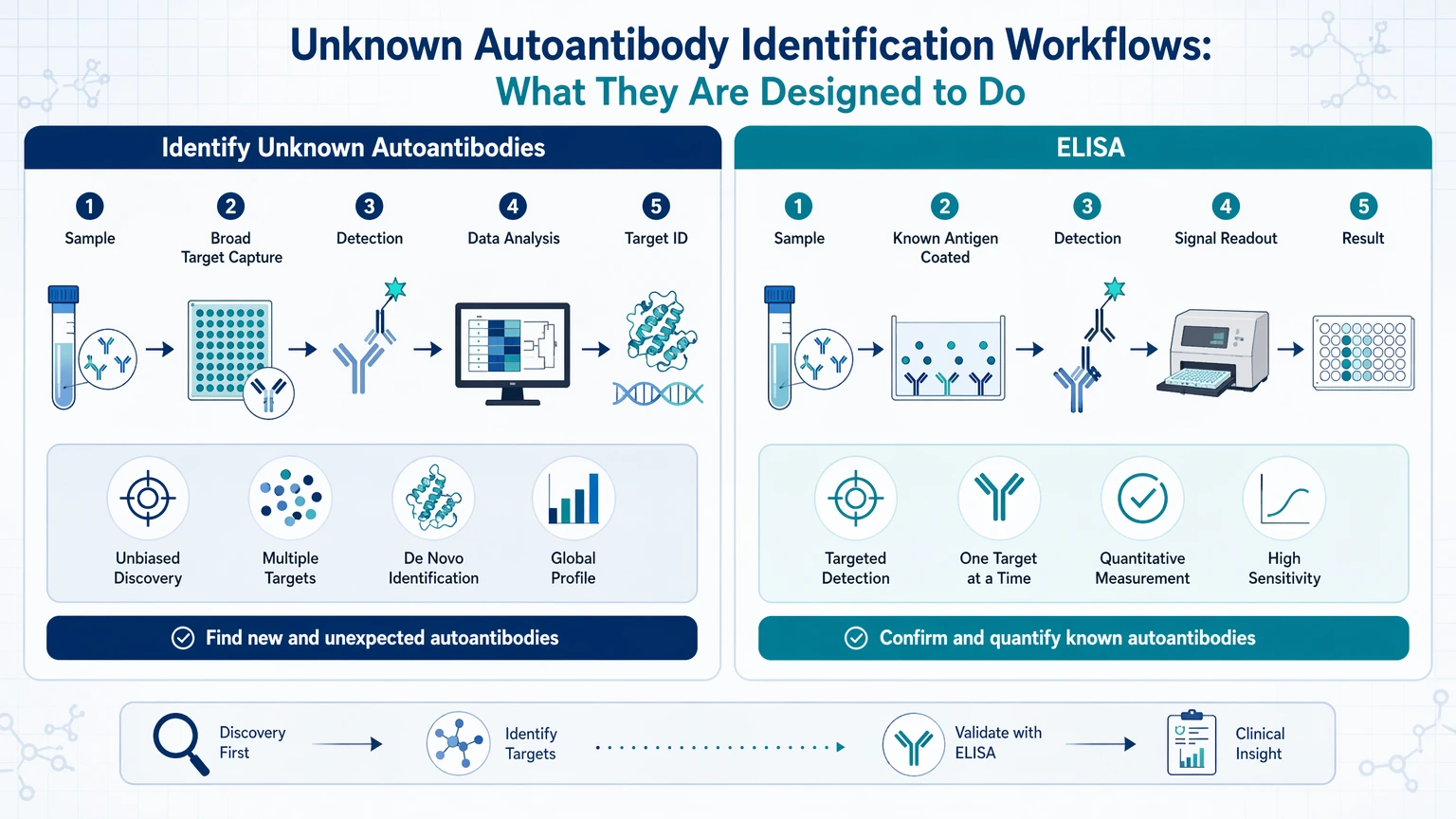
Common research-use-only discovery strategies may include:
- immunoprecipitation of antigen-antibody complexes
- downstream LC-MS/MS for protein identification
- antigen array or broader profiling approaches
- tissue- or cell-based reactivity screening followed by antigen assignment
- orthogonal follow-up methods to refine antigen specificity
What these workflows can produce
A discovery workflow may generate:
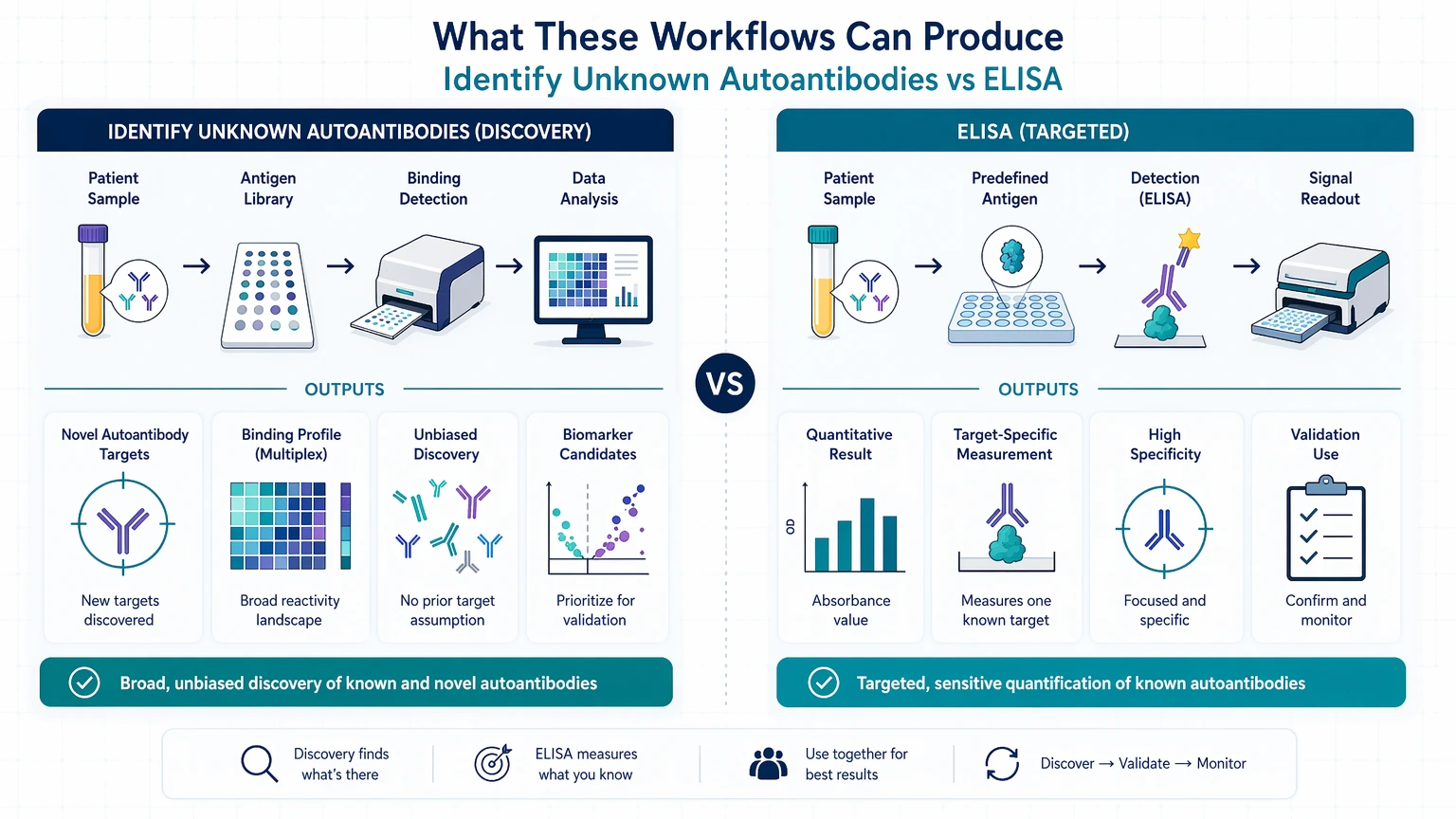
- one or more candidate target proteins
- supporting analytical evidence for antigen association
- a ranked list that requires biological review
- direction for follow-up assay design
- a path from exploratory signal to a testable validation plan
This output differs from ELISA output. ELISA usually produces a targeted signal against a predefined antigen. Discovery workflows produce candidate identities and evidence that still require interpretation.
What they usually require
Unknown autoantibody studies usually carry a heavier interpretation burden. Teams often need to plan for:
- sample matrix compatibility and background complexity
- immunoglobulin abundance and nonspecific binding
- antigen source selection
- control design and blocking strategy
- candidate prioritization
- orthogonal validation after initial discovery
A discovery hit is not final proof. It is a lead that should be tested with independent methods.
Side-by-Side Comparison
The table below summarizes the main planning implications for the method choice.
| Dimension | ELISA | Unknown Autoantibody Discovery Workflow |
|---|---|---|
| Starting assumption | Antigen is already defined | Antigen may be unknown |
| Core purpose | Measure reactivity to a predefined target | Identify or nominate targets behind unexplained reactivity |
| Readout type | OD or related signal on immobilized antigen | Candidate antigen identities plus supporting analytical evidence |
| Discovery scope | Single or limited antigen set | Broader search space shaped by workflow design |
| Fit for novel targets | Low unless the target is already included | Higher because the workflow can search beyond preset panels |
| Workflow complexity | Lower, with a more standardized assay format | Multi-step enrichment, identification, and confirmation |
| Interpretation burden | More direct for a known-target question | Higher; candidate ranking and plausibility review are needed |
| Validation needs | Internal controls and assay confirmation still matter | Usually requires substantial orthogonal follow-up |
| Scalability | Good for follow-up and cohort screening | Better for early exploratory sets than for large-scale screening |
| Best study stage | Hypothesis testing and targeted follow-up | Hypothesis generation and target discovery |
Use these differences to align the analytical method with the biological question and validation plan.
The practical boundary is straightforward: ELISA tests a known idea; discovery workflows help define the idea when the antigen is still unknown.
When ELISA Is the Right Choice
ELISA is usually the right first method when the scientific question is already narrow.
Typical fit-for-purpose scenarios
1. You already have a credible target list
If prior literature, mechanistic data, or earlier internal experiments point to a small set of antigens, ELISA can efficiently test serum reactivity against those candidates.
2. You need targeted follow-up after discovery
Once a candidate target has been nominated, ELISA can be used to ask whether additional samples show reactivity to that same antigen in a more scalable format.
3. You are moving into cohort expansion
Discovery workflows are generally less practical for broad cohort screening. After the target is defined, ELISA may support larger comparative studies.
4. You need a focused assay development path
If the objective is a standardized research assay for one antigen, starting with ELISA may keep the project aligned with that endpoint.
The main risk is using ELISA too early when the antigen assumption is still weak. In that case, a clean negative result may only show that the relevant target was never tested.
When Discovery Workflows Are the Better Starting Point
Unknown autoantibody identification is usually the better starting point when the biology remains open-ended.
Common trigger conditions
1. The antigen is genuinely unknown
If the team cannot name a defensible known antigen at study start, a targeted immunoassay is answering a narrower question than the project actually needs.
2. Existing panels are unlikely to capture the biology
This often occurs in exploratory autoimmune or paraneoplastic projects where standard antigen panels may not reflect the observed phenotype.
3. The goal includes novel or unexpected target finding
If one project objective is to identify previously uncharacterized reactivity, ELISA cannot replace a discovery workflow.
4. Sample behavior suggests real reactivity without target assignment
For example, serum or CSF may show a pattern in tissue-based or cell-based systems, but the responsible antigen remains unresolved.
5. You need a bridge from biological signal to assay design
Discovery methods can convert unexplained reactivity into a shortlist of antigens that can later be reformatted into targeted assays.
If your team is unsure whether the study is truly discovery-focused or already narrow enough for a predefined assay, this is the point to evaluate your project before committing to a platform that answers the wrong question.
Research Use Cases Mapped to Method Choice
Use case 1: Suspected autoimmune reactivity with a weak antigen hypothesis
A translational group has patient serum with suspected autoimmune features, but the available candidate list is based on indirect clues rather than direct evidence.
Better starting point: discovery workflow Why: the project needs autoantigen identification, not just testing of a speculative shortlist. Next step after discovery: orthogonal confirmation, then ELISA for focused follow-up.
Use case 2: Known pathway, known proteins, limited target panel
A team studies reactivity against a defined signaling pathway and already has three antigens supported by prior internal data.
Better starting point: ELISA Why: the question is already a targeted measurement problem. Next step: compare group-level serum reactivity and refine panel design if needed.
Use case 3: Discovery completed, expansion now needed
A pilot study using immunoprecipitation and LC-MS/MS produced a shortlist of candidate antigens.
Better starting point: targeted follow-up, often including ELISA Why: discovery has already completed the broad search; the next task is confirmation and scalability.
Use case 4: Complex matrix, uncertain specificity, multiple candidate hits
A project yields several plausible proteins from a discovery run, but background binding is a concern.
Better starting point: discovery plus planned orthogonal validation Why: the decision is no longer discovery versus ELISA alone, but how to confirm antigen specificity with independent evidence before large-scale screening.
Why a Combined Workflow Often Makes More Sense Than an Either/Or Choice
Many teams frame discovery and ELISA as competing platforms. In practice, they often work best in sequence.
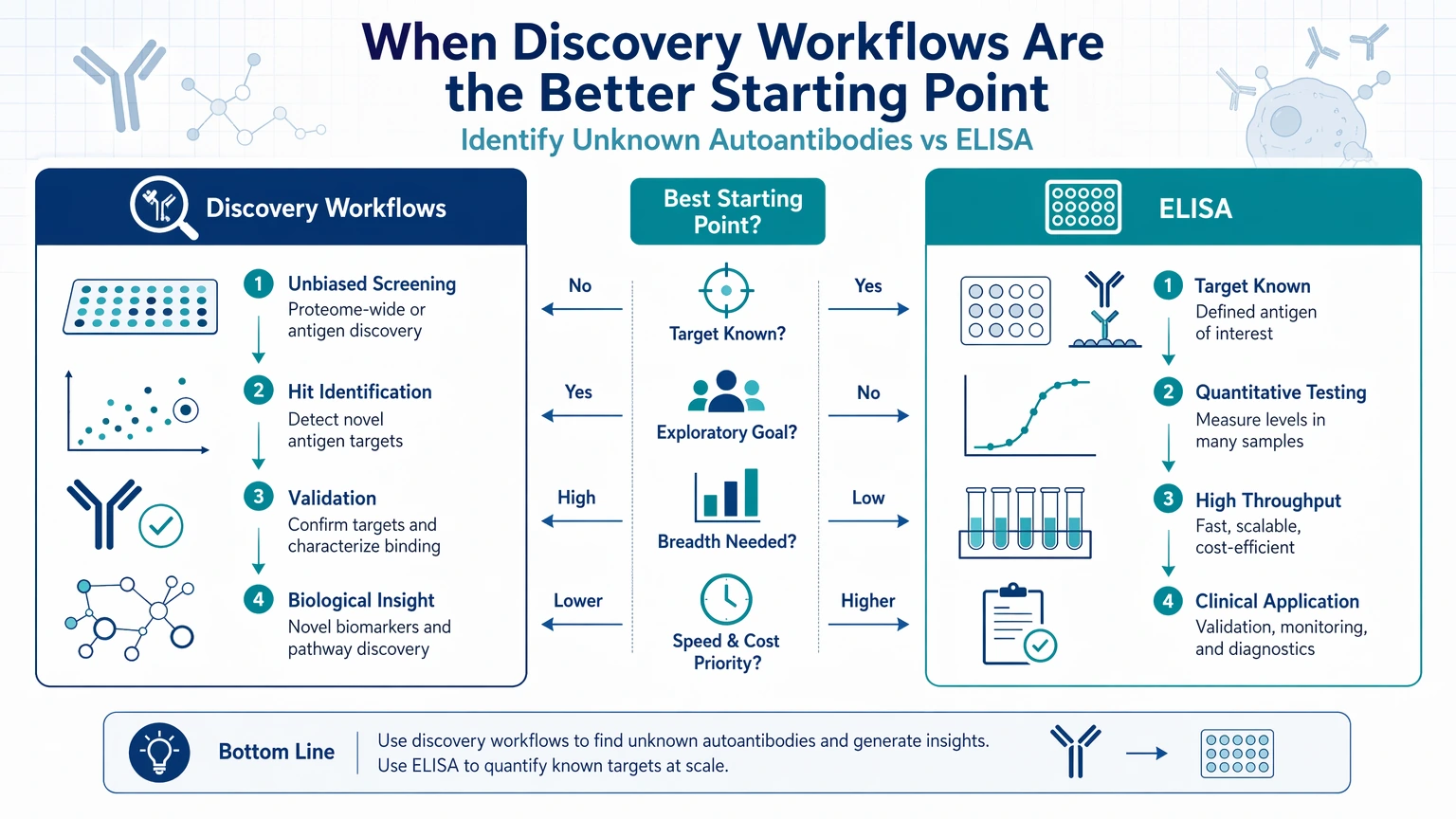
A common staged model looks like this:
1. Start with a discovery workflow when the antigen is unknown. 2. Use immunoprecipitation, LC-MS/MS, or broader profiling to nominate a candidate antigen. 3. Review biological plausibility and technical evidence. 4. Perform orthogonal validation with one or more independent methods. 5. Build a targeted assay, often including ELISA, for follow-up samples and cohort screening.
Each method answers a different question:
- discovery asks what is the target?
- ELISA asks do additional samples react to this defined target?
That division of labor is usually more efficient than forcing one method to do the other’s job.
Practical Decision Points Before You Commit to a Platform
Before selecting a workflow, teams should define a few project-shaping variables.
Antigen status
Can you name a biologically justified known antigen now, or is antigen identity still the main unknown?
Sample type and matrix complexity
Serum, plasma, CSF, and tissue-derived materials differ in background composition, volume constraints, and immunoglobulin context. Those differences can affect enrichment strategy, control design, and downstream confirmation.
Desired output
Do you need a direct targeted signal, or do you need candidate identities that support hypothesis generation?
Validation plan
If the study identifies a new candidate, what will count as enough evidence for follow-up? Western blot, cell-based assays, peptide mapping, targeted MS, or ELISA may each address different confirmation questions.
Scale of the next phase
If the next step is a 200-sample screen, discovery may not be the operational endpoint. If the next step is “find the target first,” ELISA may be premature.
For teams planning that transition, MtoZ Biolabs can evaluate your project around sample type, antigen status, discovery workflow design, and orthogonal validation planning before you move into a larger screening phase.
Can ELISA Ever Contribute Early in an Unknown Autoantibody Project?
Yes, but only in a limited role. ELISA can be useful early when you want to test a few high-priority hypotheses while keeping discovery in reserve. It can also help rule in or rule out obvious candidate antigens before a broader workflow begins.
That is not the same as identifying unknown autoantibodies. Early ELISA can narrow a shortlist, but it does not replace a discovery workflow when the main goal is target finding.
A practical rule is:
- use ELISA early for hypothesis checking
- use discovery early for hypothesis generation
Those are related tasks, but they are not interchangeable.
Service Routes for Study Planning
For teams moving from method selection into execution, these service paths connect assay design, validation, and interpretation needs.
Conclusion
For identify unknown autoantibodies vs ELISA, the decision boundary is clear: choose ELISA for targeted questions about a known antigen, and choose a discovery workflow when the antigen is unknown and the study requires autoantigen identification. ELISA fits targeted confirmation and later cohort screening. Discovery workflows fit unexplained reactivity, novel target finding, and early-stage hypothesis generation. The main limitation of discovery is that candidate hits require careful orthogonal validation. The main limitation of ELISA is that it cannot reveal targets that were never included in the assay.
For many translational programs, the most workable path is discovery first, validation second, and scalable targeted testing after the target is defined. If you need to map sample type, antigen status, and confirmation strategy into a research-use-only plan, contact us or submit your requirements to MtoZ Biolabs to discuss project-focused method selection and follow-up workflow design.
FAQ
Can ELISA identify unknown autoantibody targets?
No. ELISA measures antibody binding to antigens that are already selected for the assay. It can confirm reactivity to a predefined target, but it does not discover an unknown target outside that design.
What does a discovery workflow return that ELISA does not?
A discovery workflow may return one or more candidate target identities with supporting analytical evidence, such as proteins enriched through immunoprecipitation and identified by LC-MS/MS. Those outputs still require prioritization and confirmation.
If a discovery workflow nominates a target, is the project finished?
Usually not. Candidate nomination is an analytical milestone, not final biological proof. Teams still need to test antigen specificity, check background binding, and decide which orthogonal methods are appropriate for confirmation.
How does sample type affect method choice?
Sample type influences both workflow design and interpretation. Serum, plasma, CSF, and tissue-associated materials differ in background complexity, immunoglobulin abundance, and available input volume, which can affect enrichment, control strategy, and downstream validation.
What usually comes after autoantigen identification?
After initial target nomination, teams often use orthogonal validation methods such as ELISA, Western blot, cell-based assays, peptide mapping, or targeted MS. The right follow-up depends on whether the next question is target identity, binding confirmation, or readiness for cohort screening.
If we already have a small candidate list, should we skip discovery?
Not necessarily. If the list is strongly supported and the project only needs targeted testing, ELISA may be sufficient. If the list is speculative and missing an unexpected antigen would materially affect the study, a discovery workflow may still be the better first step.
How to order?




