






How to Improve Phage Display Antibody Analysis Optimization in Research Workflows
Quick Answer
Teams can improve phage display antibody analysis optimization by combining enrichment trends, sequence-family context, normalized assay data, and orthogonal validation before ranking clones. When rankings shift after replicate review, specificity controls, or family-level clustering, the bottleneck is usually analysis design rather than screening volume, and that logic should be corrected before downstream characterization.
When Phage Display Analysis Needs Optimization
Many teams first notice the problem when more data creates less confidence. After phage display, the dataset expands, but clone selection becomes harder rather than clearer. This usually appears in one or more of the following patterns:
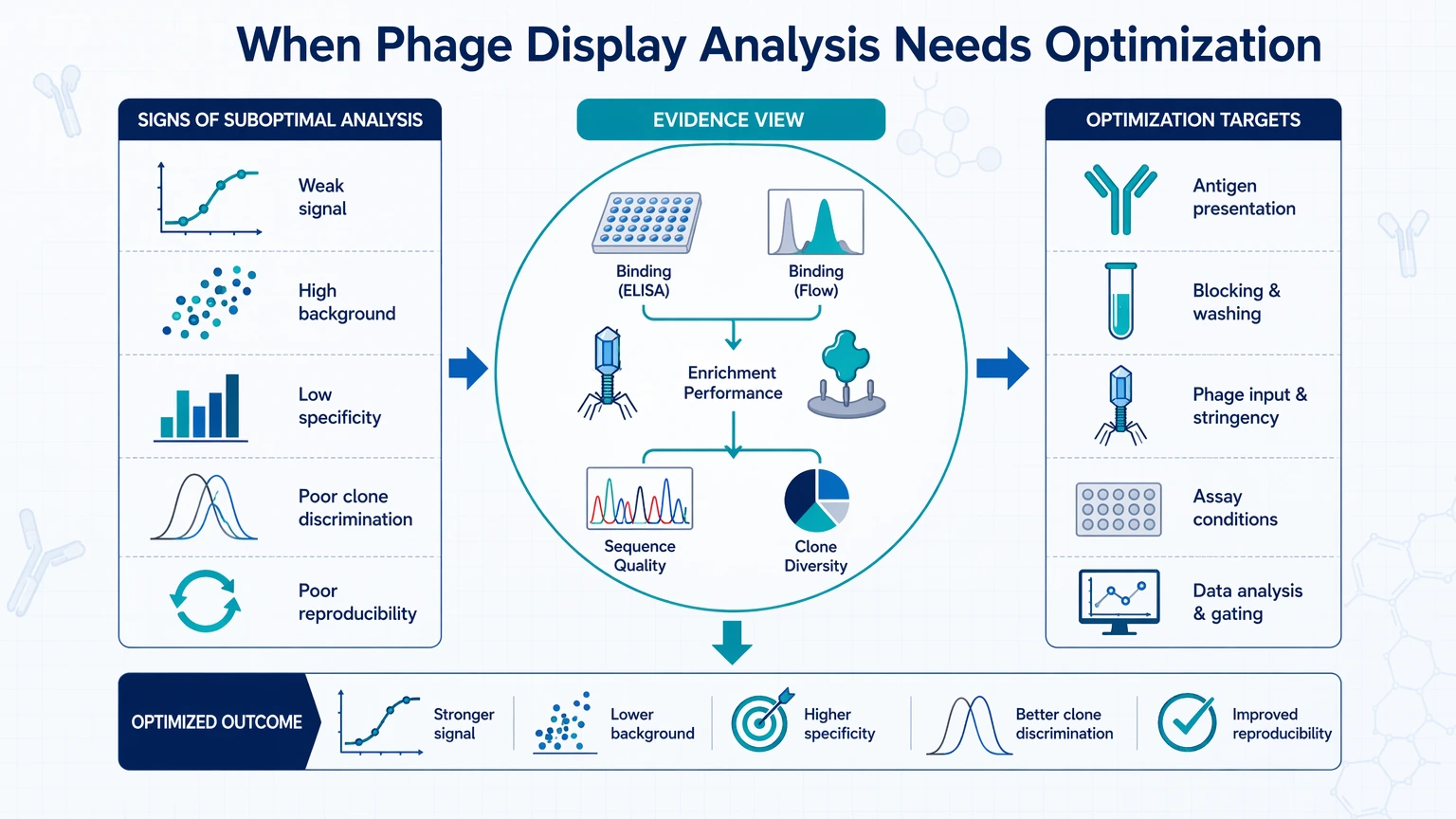
- NGS enrichment does not align with monoclonal phage ELISA ranking
- a small number of clones dominate after panning rounds, but many perform weakly in confirmatory assays
- replicate agreement drifts across plates, operators, or assay days
- sequence family expansion looks strong, but consensus sequence review shows limited meaningful diversity
- top clones lose priority once target specificity or cross-reactivity testing is added
- hit confirmation rates drop sharply in orthogonal validation
These signals suggest that phage display antibody analysis optimization should focus on interpretation quality and result reproducibility, not simply on repeating the same screen.
Define the Real Goal: Interpretable and Reproducible Clone Ranking
In this setting, optimization does not mean pushing more clones through the funnel. It means building a ranking framework that remains defensible when results move from discovery to validation and then to downstream characterization.
A useful workflow asks five connected questions:
1. Did enrichment reflect target-relevant selection, or amplification bias? 2. Did the antibody library retain enough clonal diversity to support meaningful ranking? 3. Are the apparent top hits supported by consistent assay behavior? 4. Have false positives from nonspecific binding or format artifacts been filtered out? 5. Could another team review the package and reach a similar advancement decision?
If the answer to the fifth question is no, the analysis package is not ready, even if the first-pass data looks promising.
Common Failure Modes After Panning
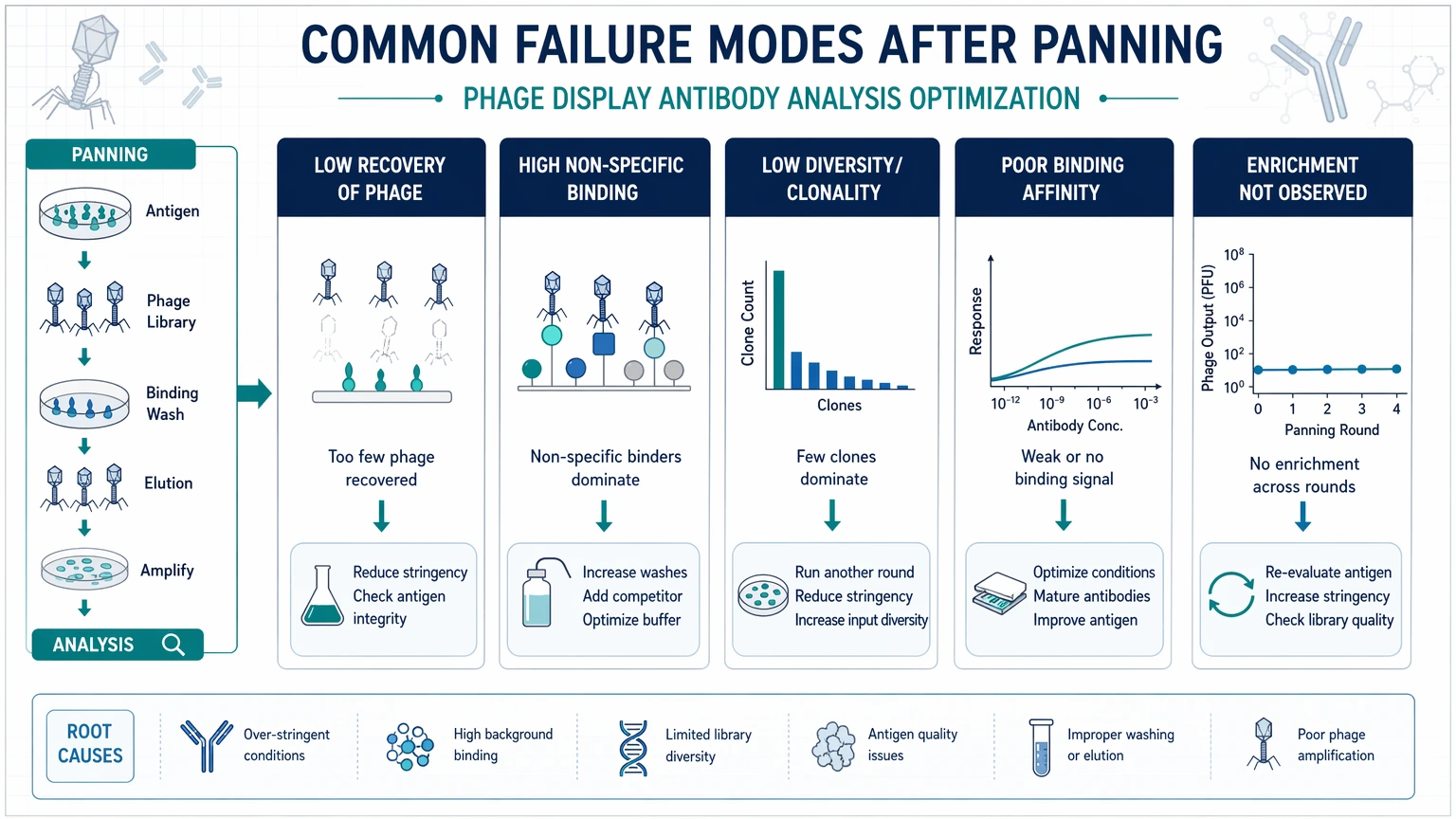
Enrichment Is Treated as a Standalone Winner Signal
Enrichment is informative, but it is not a universal decision rule. A clone with a strong binder frequency increase across panning rounds may still be a poor lead if it expanded because of propagation advantage, display bias, or assay compatibility rather than target-binding quality.
Teams should compare:
- frequency shift between rounds
- absolute abundance versus relative gain
- enrichment within a sequence family rather than only at the single-clone level
- enrichment behavior in relation to controls and selection stringency
If a clone ranks highly only because it amplified efficiently, sequence-level prominence can obscure weak target specificity.
Diversity Collapse Hides Better Candidates
A sharp drop in unique sequence count may reflect successful selection, but it can also reduce visibility into useful families that did not amplify as aggressively. Early diversity collapse is especially risky when panning conditions favor fast-growing phage over functionally distinct binders.
Reviewing clonal diversity after each round helps teams determine whether they are seeing convergent enrichment or simple overrepresentation. If the output is dominated by near-identical variants with limited sequence family breadth, additional monoclonal screening may not solve the underlying problem.
Assay Artifacts Distort Clone Ranking
Monoclonal phage ELISA often becomes the practical ranking gate, but it is sensitive to assay setup. Common distortions include:
- plate-to-plate baseline shifts
- inconsistent washing or blocking
- signal saturation at high phage input
- weak positive/negative control separation
- target coating differences between runs
- readout inflation from sticky or multivalent phage particles
A clone that appears strong in one plate format may fall quickly once signal-to-background ratio and replicate agreement are reviewed side by side.
How to Troubleshoot by Workflow Stage
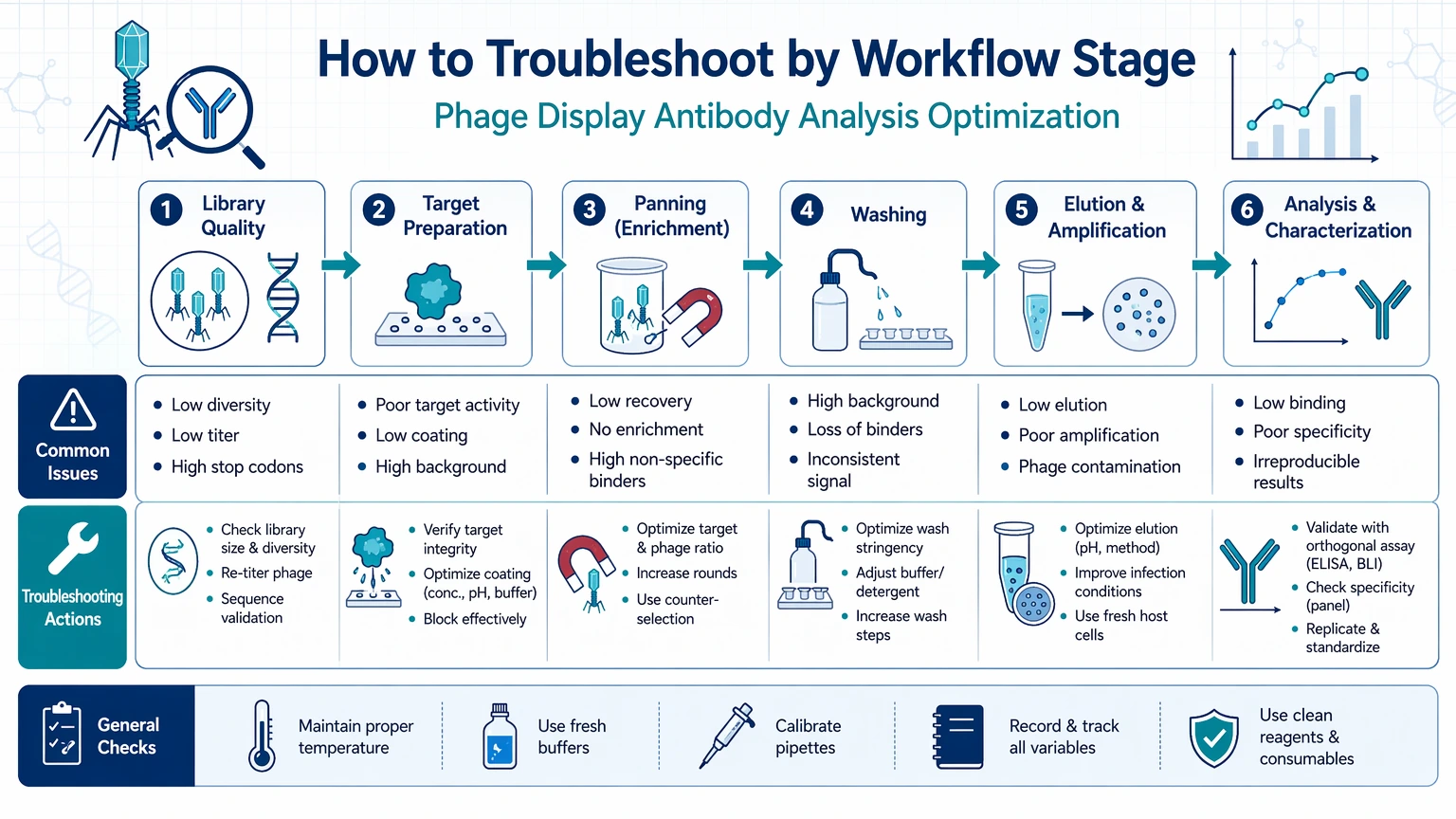
1. Start With Sequence-Level Diagnostics
Before re-running broad screens, review the sequence output systematically.
Check enrichment patterns across rounds
Look for clones or sequence families that rise steadily rather than appearing as isolated spikes. Abrupt jumps can still matter, but they should be interpreted cautiously if they coincide with low overall diversity or known amplification bias.
Useful checks include:
- clone enrichment trends across all panning rounds
- family-level enrichment rather than single-sequence rank alone
- retention of minority families with related motifs
- comparison of dominant clones with the total unique sequence count
Use Sequence Clustering to Reduce False Certainty
Sequence clustering is one of the most practical ways to improve clone ranking. It prevents a dataset from appearing more diverse than it actually is and helps show whether several “independent hits” are close relatives from one sequence family.
Cluster review should answer:
- how many genuinely distinct families remain
- whether high-frequency clones represent one dominant family
- whether a consensus sequence emerges within enriched families
- whether lower-frequency families contain fewer liabilities or show better validation behavior
This step often changes prioritization. A moderately enriched family with better specificity and stronger internal consistency may be more useful than one overrepresented clone.
Flag Sequence Liabilities Before Validation Expands
Even at the analysis stage, sequence review should capture obvious developability concerns, unusual motifs, or framework features that may complicate downstream characterization. These flags do not automatically remove a clone, but they should inform re-testing and reformatting decisions.
2. Rebuild Assay Comparability Before Ranking More Clones
If monoclonal phage ELISA data are noisy, the answer is rarely to screen more plates first. Normalize the assay system so that clone-to-clone differences are interpretable.
Review Control Behavior First
Clone ranking is weak when controls are unstable. Check:
- separation between positive and negative controls
- intra-plate and inter-plate consistency
- background signal distribution
- whether replicate placement or operator effects are visible
If control windows drift, clone-level comparisons become unreliable.
Normalize Signals to the Right Reference Frame
Raw absorbance values often create false rank inflation. Teams should compare clones using signal-to-background ratio, within-plate normalized values, and run-level control references when appropriate. The goal is not to force every assay into one metric. The goal is to make sure that a strong signal on one day means roughly the same thing on another day.
Review Replicate Agreement, Not Just Mean Signal
A clone with a high average but poor replicate agreement may be less actionable than a clone with slightly lower binding and stronger result reproducibility. This becomes especially important when deciding which candidates should move into orthogonal validation.
3. Separate True Binders From Nonspecific Binders
False positives often persist longer than expected when specificity checks come late.
Add Target Specificity Review Earlier
A clone should not advance on target-binding intensity alone. Review how it behaves against:
- negative antigen controls
- matrix or scaffold controls
- related proteins for cross-reactivity assessment
- blocking conditions that challenge weak interactions
Some clones lose priority as soon as target specificity is measured in parallel rather than after the main screen.
Watch for Format-Dependent Stickiness
Nonspecific binding can look convincing in phage-based formats because avidity and surface presentation amplify weak interactions. If several high-ranked clones show broad reactivity patterns or elevated background across unrelated controls, the team should suspect assay-driven selection rather than true binder quality.
4. Use Orthogonal Validation as a Decision Filter
Orthogonal validation is not just a confirmatory formality. It is often the point where a phage display analysis package either becomes credible or starts to break down.
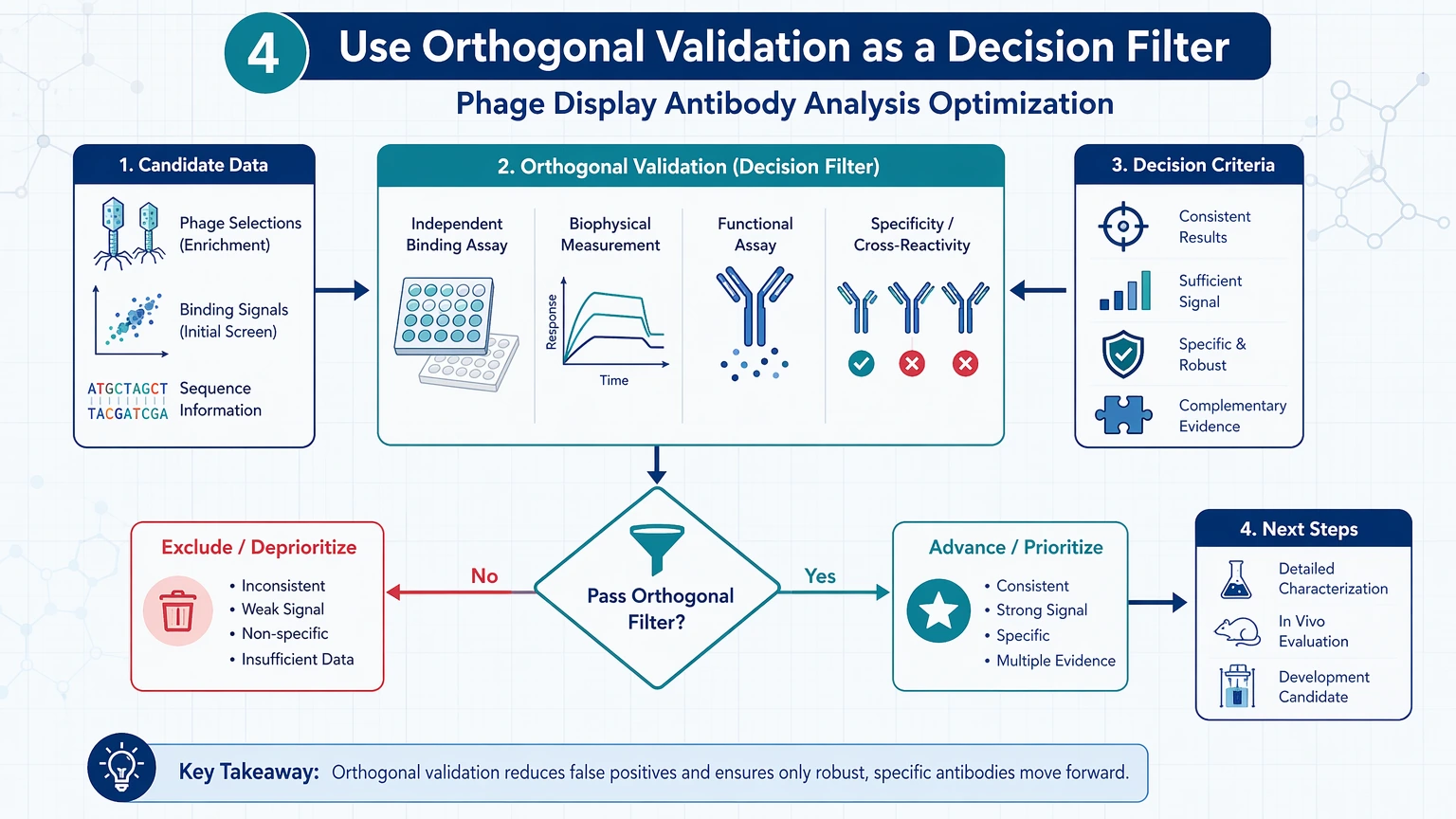
A strong validation plan does three things:
- tests whether rank order survives outside the original screen format
- checks whether apparent binders remain positive after reformatting or independent readout
- measures hit confirmation rate as an indicator of upstream workflow quality
Examples include comparing monoclonal phage ELISA winners with alternative binding assays, re-testing selected clones under different presentation conditions, or examining whether sequence family representatives confirm more consistently than isolated singletons.
When confirmation rates are low, teams should not assume the later assay is the problem. Low hit confirmation may indicate earlier enrichment noise, poor normalization, or a ranking framework that overweights binder frequency.
A Practical Ranking Framework for Downstream Decisions
A workable clone ranking framework usually combines four evidence layers:
The table below summarizes the main planning implications for the method choice.
| Evidence layer | What to review | Why it matters |
|---|---|---|
| Sequence enrichment | frequency shift, round-to-round trend, family expansion | distinguishes stable selection from isolated abundance |
| Diversity context | unique sequence count, clonal redundancy, sequence clustering | prevents overcounting related clones |
| Assay behavior | signal-to-background ratio, control separation, replicate agreement | shows whether binding data are comparable |
| Validation quality | target specificity, cross-reactivity, orthogonal validation, hit confirmation | improves confidence in advancement decisions |
Use these differences to align the analytical method with the biological question and validation plan.
This framework supports clearer next-step decisions:
- Re-test when a clone is promising but replicate agreement or normalization is weak
- Re-analyze when sequence family interpretation was missing or enrichment logic was too simplistic
- Reformat when phage-format signals do not translate cleanly into confirmation assays
- Deprioritize when apparent binding is driven by nonspecific binding or unstable controls
- Re-pan when diversity collapse or selection bias prevents meaningful clone ranking
What Metrics Should Be Reviewed Before Downstream Characterization?
Before moving candidates forward, teams should assemble a compact but decision-ready package:
- clone enrichment across panning rounds
- binder frequency and frequency shift by round
- unique sequence count and clonal diversity retention
- sequence family distribution after sequence clustering
- consensus sequence patterns in enriched families
- signal-to-background ratio in monoclonal phage ELISA
- replicate agreement across plates or assay dates
- positive/negative control separation
- nonspecific binding and cross-reactivity rate
- hit confirmation rate after orthogonal validation
- sequence liability flags relevant to downstream characterization
If several of these elements are missing, downstream teams may need to reconstruct the logic from fragmented data instead of acting on a coherent selection package.
When External Analytical Support Makes Sense
Specialized support becomes useful when wet-lab, bioinformatics, and assay teams each hold part of the answer, but no single group can reconcile the full dataset. That is often the point where internal iteration consumes more time than targeted analysis review.
For example, a team may have acceptable panning output, partial sequence clustering, and mixed monoclonal phage ELISA data, yet still lack a defensible path for hit confirmation. In that situation, a workflow review that connects enrichment, sequence family structure, assay normalization, and validation design can sharpen the go/no-go decision. If your team needs to evaluate your project around difficult clone ranking or fragmented validation packages, contact MtoZ Biolabs to discuss a research-focused workflow review and data interpretation strategy.
Documentation Practices That Improve Handoff Quality
Many ranking disputes are not driven by biology alone. They arise from incomplete documentation. A useful handoff package should record:
- panning round conditions and selection stringency changes
- sequencing depth and analysis methods used for enrichment calls
- clustering rules and family definitions
- assay normalization approach
- control acceptance logic
- re-test criteria and advancement criteria
- reasons for deprioritizing apparent high-frequency clones
This makes downstream characterization more efficient because the next team can see not only which clones advanced, but also why they advanced.
FAQ
Why do NGS-enriched clones sometimes fail during hit confirmation?
NGS enrichment tracks representation changes, not binding quality by itself. A clone may rise because of amplification bias, display advantage, or family overrepresentation, then fail when tested in a different assay format. That mismatch becomes more interpretable when enrichment is reviewed alongside sequence clustering, specificity controls, and replicate behavior.
Should clone ranking be done at the individual sequence level or the sequence family level?
Usually both should be reviewed together. Individual sequences matter for final handoff, but family-level analysis helps distinguish broad, reproducible enrichment from one-off abundance spikes. When multiple related clones behave similarly, the sequence family often provides a stronger basis for prioritization than a single read count.
What is a practical sign that monoclonal phage ELISA data should be normalized before more screening?
If the same control set produces different apparent ranking windows across plates or assay days, normalization should come before additional screening. Large baseline shifts, weak control separation, or high replicate spread can create false confidence in clone order even when raw signals look strong.
How can teams decide which borderline clones deserve orthogonal validation?
Borderline clones are often worth carrying forward when they represent a distinct sequence family, show acceptable replicate agreement, or raise useful questions about target specificity that the primary screen cannot resolve. The goal of orthogonal validation is not only to confirm obvious winners, but also to test whether uncertain candidates become clearer under a different assay logic.
When is re-analysis more useful than starting a new panning campaign?
Re-analysis is usually the better first move when the main problem is interpretive inconsistency rather than obvious selection failure. If sequence enrichment, monoclonal phage ELISA, and specificity data tell different stories, the workflow may need better clustering, normalization, or validation design before a new panning campaign is justified.
Service Routes for Study Planning
For teams moving from method selection into execution, these service paths connect assay design, validation, and interpretation needs.
Conclusion
Phage display antibody analysis optimization works best when teams stop treating enrichment, binding signal, and confirmation as separate checkpoints and instead evaluate them as one decision system. More reliable clone ranking comes from linking sequence clustering, clonal diversity, assay normalization, target specificity, and orthogonal validation within a reproducible review framework. This approach is most useful for workflows that already have candidate binders but still lack confidence in which ones should move into downstream characterization.
It also has limits. Some datasets are constrained by the original antibody library, panning design, or assay format, and analysis alone cannot fully recover those weaknesses. In those cases, the next step may be targeted re-testing, family-based reformatting, or a new selection round rather than forced advancement from ambiguous evidence. If your team needs to submit your requirements or evaluate your project around difficult clone ranking, hit confirmation, or phage display data interpretation, contact MtoZ Biolabs for a focused review of the workflow, evidence package, and validation plan.
How to order?




