






How to Identify High-Confidence Interactors from IP-MS Data
Introduction
High-confidence IP-MS interactors are prey proteins that enrich in target IP relative to matched isotype controls and show consistent support across biological replicates—not every protein detected in the bait IP sample. Detection alone is low confidence; isotype contrast plus replicate enrichment defines a validation-ready shortlist.
High-confidence does not prove direct binding. It means the data justify prioritizing a prey for reciprocal Co-IP, domain mapping, or other follow-up. The ranking steps, evidence ladder, confidence table, and shortlist checklist below show how to move from raw identifications to defensible candidates without overcalling the MS table.
What High-Confidence Means in IP-MS
In IP-MS, confidence is an enrichment-evidence concept. A high-confidence interactor candidate is a prey protein that co-purifies with the target more strongly and more reproducibly than background proteins in matched isotype or nonspecific control immunoprecipitations. High-confidence does not require proof of direct binary contact, nor does it mean the protein is a permanent complex member in every cellular state—it does mean the data support prioritization for orthogonal validation rather than exploratory listing only.
Useful confidence language stays proportional to the evidence. Detection in the target IP sample is low confidence; enrichment over isotype control in multiple replicates is higher confidence; orthogonal validation supports a different claim level altogether.
Evidence Levels for IP-MS Interactor Candidates
Interactor candidates can be grouped by evidence strength:
- Level 1 detection: the prey protein was identified in a target IP sample
- Level 2 specificity: the prey is enriched relative to a matched isotype, nonspecific IgG, bead-only, or no-antibody control
- Level 3 reproducibility: the prey appears in multiple biological replicates with consistent enrichment direction
- Level 4 prioritization: the prey ranks highly by quantitative contrast and survives project-appropriate filtering
- Level 5 validation: reciprocal Co-IP, domain mapping, pairwise binding, or functional follow-up supports the interaction claim beyond IP-MS alone
High-confidence interactor selection in IP-MS usually requires at least Level 2 and Level 3 for discovery shortlists. Level 5 belongs to validation, not to the initial MS table alone.
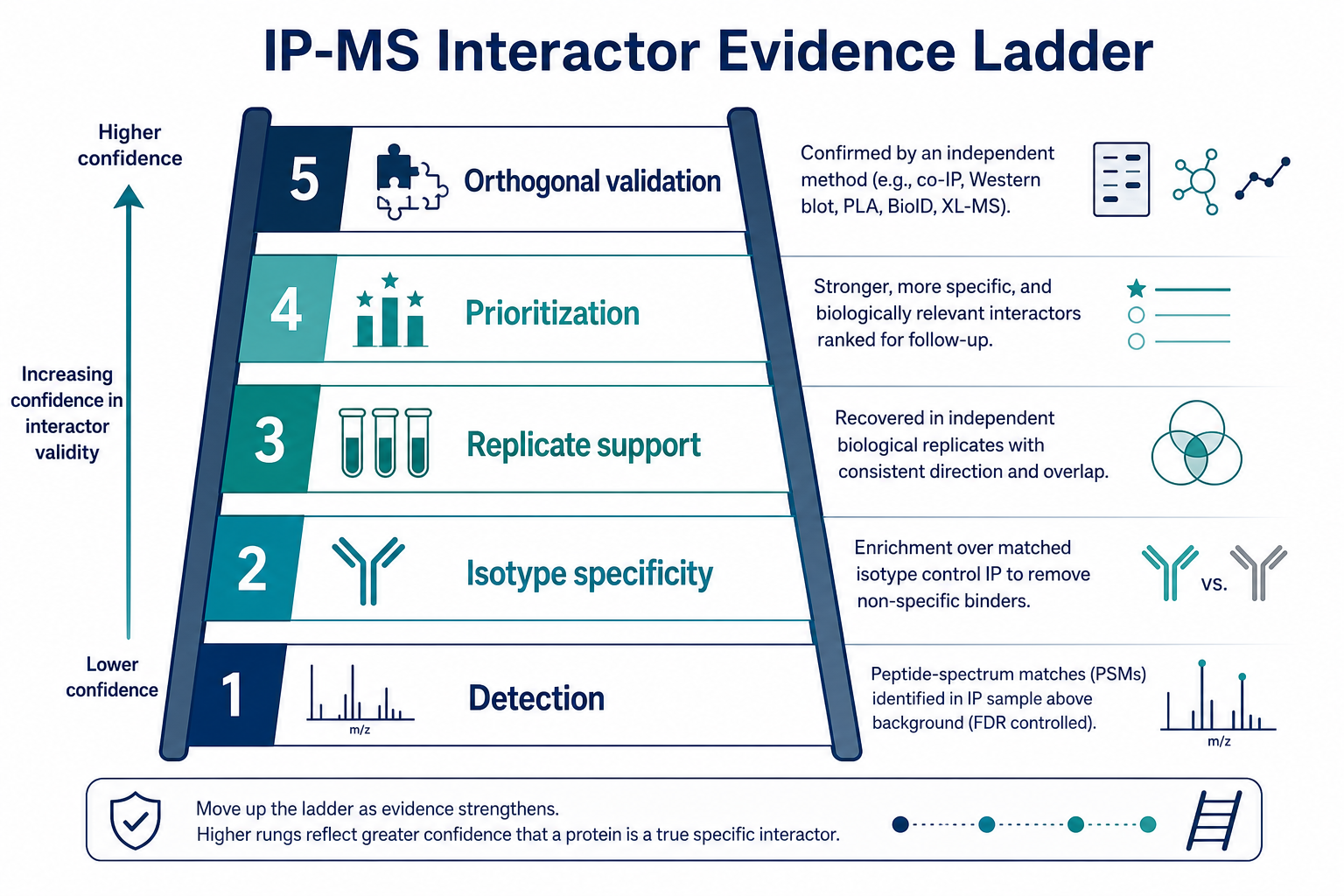
Figure 1. High-confidence IP-MS candidates require isotype-specific enrichment and replicate support before validation.
Step 1. Confirm Target Recovery and Control Integrity
Candidate ranking should not begin if the immunoprecipitation comparison itself is unreliable. Verify that target protein recovery was acceptable in the IP samples being ranked, confirm that isotype control arms were processed with matched lysis, wash, elution, digestion, and LC-MS/MS handling, and check whether target recovery was similar across replicates and compared arms—large recovery differences can distort prey ranking. Review whether control samples show the expected antibody background profile for the capture system used.
If target or control integrity is weak, confidence ranking will be unstable regardless of filtering method.
Step 2. Rank Prey by Isotype Control Contrast, Not Presence Alone
The central IP-MS specificity filter is target-versus-isotype contrast. Proteins present in both target IP and isotype control at similar levels are low-confidence candidates even if abundant in the target sample, while proteins enriched in target IP relative to matched isotype or nonspecific controls move up the candidate list. Quantitative metrics such as fold change, spectral index contrast, or statistical scoring are preferable to binary detected-or-not calls when available.
Prey proteins seen only in target IP and absent from isotype control are candidates worth review, but single-run absence in control is not enough without replicate support. Control contrast converts a raw identification list into an enrichment-ranked candidate set.
Step 3. Require Replicate Support for Shortlist Candidates
Reproducibility separates stable enrichment from sporadic carryover. A prey protein seen in one target IP replicate but not others should rarely enter a high-confidence shortlist, and biological replicates are more informative than technical repeats for interaction ranking. Replicate support can be evaluated by repeated enrichment direction, correlated quantitative signal, or consistent identification across independent sample generations.
The higher the biological claim, the stronger the replicate requirement should be. Discovery projects may tolerate broader lists with weaker replicate support; validation-bound shortlists should not.
Step 4. Remove Frequent Background and Assay Artifacts
After control contrast and replicate review, apply background-aware filtering. Remove or down-rank proteins that enrich similarly in unrelated IP experiments or appear in frequent contaminant resources when project controls confirm nonspecific behavior. Down-rank keratin, ribosomal, cytoskeletal, antibody chain, and other common sticky proteins unless they show exceptional target-specific enrichment supported by isotype controls.
Use literature contaminant lists as a secondary aid, not as a substitute for experimental isotype controls. Background filtering shortens the list but should not override project-specific control evidence.
Step 5. Use Biological Coherence as a Secondary Filter
Biological plausibility helps prioritize candidates after quantitative filtering. Pathway coherence, known complex membership, localization compatibility, and prior literature can support candidate ordering, but biological coherence should not rescue proteins that fail isotype contrast or replicate support.
A biologically surprising candidate can be valid, but it requires stronger quantitative evidence and clearer validation planning than a coherent candidate with the same score. Use biology to prioritize within the filtered set, not to bypass filtering.
High-Confidence Criteria Checklist
A prey protein is closer to high-confidence interactor status when most of the following are true:
- The protein is enriched relative to the matched isotype or primary control
- The enrichment is observed in more than one biological replicate when replicates were planned
- The protein is not equally abundant in unrelated control arms that expose sticky binders or antibody background
- Target recovery was sufficient in the replicates where the prey was detected
- The prey rank remains strong after background-aware filtering
- There is a feasible orthogonal validation assay for the interaction claim
Not every candidate must satisfy every item for exploratory discovery, but validation-bound shortlists should satisfy most of them.
Confidence Level and Supported Claim
|
Confidence level |
Typical IP-MS support |
Claim appropriate now |
|---|---|---|
|
Low |
Detected in target IP only |
Hypothesis only |
|
Moderate |
Enriched over isotype control in one replicate |
Exploratory candidate |
|
High |
Enriched over isotype control in multiple replicates |
Validation shortlist |
|
Very high |
Strong enrichment plus orthogonal support |
Interaction claim in follow-up figures |
The table keeps IP-MS evidence separate from validation evidence. High-confidence IP-MS ranking stops at the validation shortlist unless orthogonal data are already available.
Common Mistakes When Calling High-Confidence Interactors
Several errors inflate confidence beyond what IP-MS supports:
- Calling every target IP identification an interactor
- Ignoring isotype controls because the protein was not detected there in one run
- Using pathway enrichment alone to elevate weak prey candidates
- Treating high spectral counts as specificity when isotype control signal is equally high
- Selecting candidates without replicate support because the list must be short
- Labeling IP-MS candidates as validated interactors before orthogonal testing
Avoiding these mistakes keeps high-confidence language aligned with the data.
When to Move Candidates to Orthogonal Validation
High-confidence IP-MS ranking is meant to produce a shortlist, not a final interaction map. Reciprocal Co-IP or pull-down is commonly used when co-enrichment must be confirmed in the reverse direction. Domain or mutation analysis helps when the prey interaction depends on a specific target surface. Pairwise binding assays support direct contact claims that IP-MS cannot make alone. Functional assays become necessary when the project claim depends on biological activity rather than association alone.
Validation should focus on the smallest set of candidates that can answer the project question, not every protein that survived initial filtering.
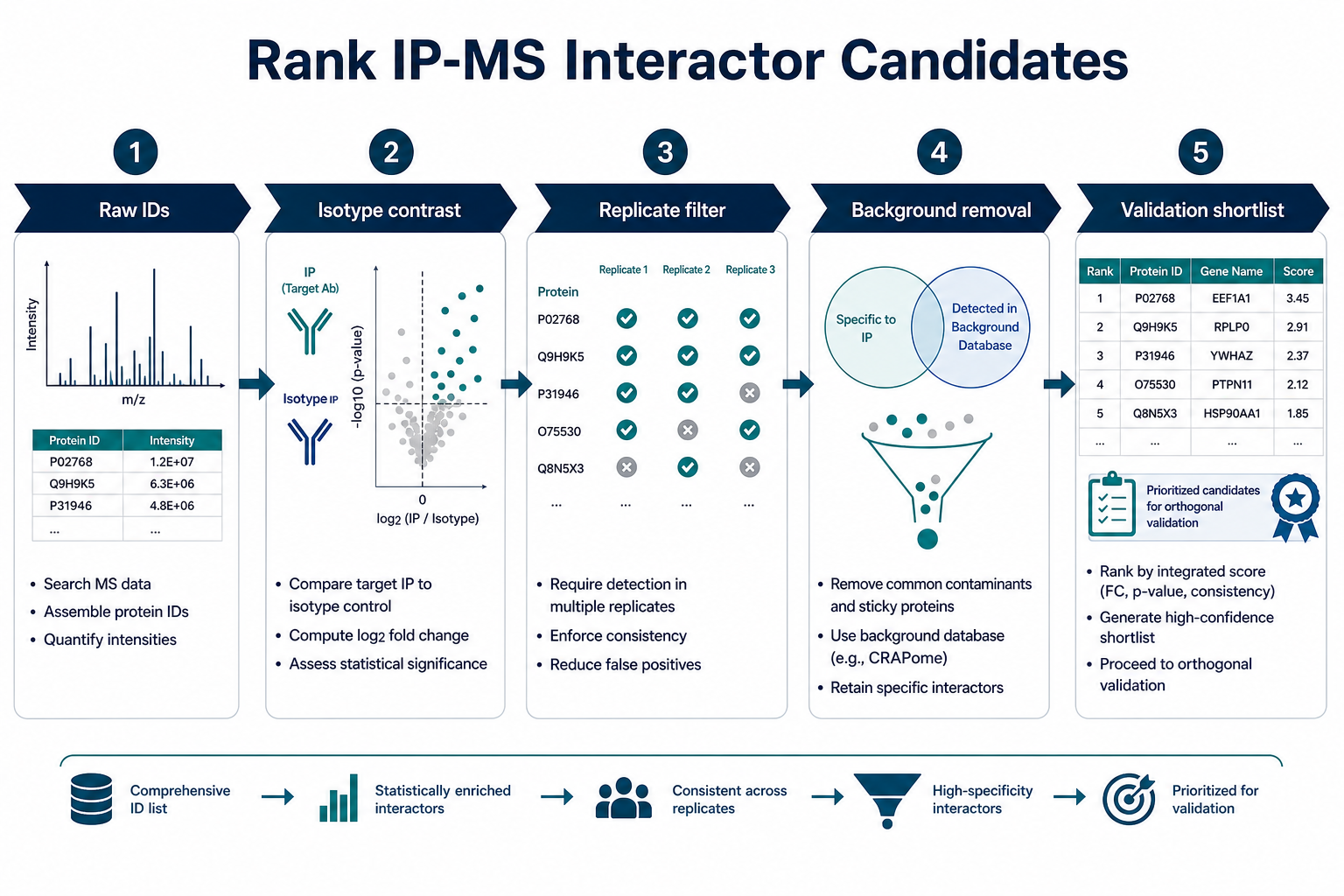
Figure 2. Ranking workflow: isotype contrast, replicate filter, background removal, then validation shortlist.
What to Document in a High-Confidence Shortlist
A defensible shortlist should record more than protein names:
- Isotype or primary control type used for specificity ranking
- Replicate support for each candidate
- Enrichment direction and whether quantitative scoring was used
- Proteins removed by background filtering and why
- Validation assay planned for each top candidate
- Target recovery status in the relevant replicates
This documentation makes high-confidence claims auditable during internal review or manuscript preparation. MtoZ Biolabs can help apply project-appropriate ranking criteria to IP-MS datasets and define a validation-ready shortlist.
Frequently Asked Questions
1. Does high-confidence in IP-MS mean the interaction is proven?
No. It means the prey is strongly supported as a candidate by isotype control contrast and replicate enrichment evidence. Direct binding still requires orthogonal validation.
2. How many replicates are needed for a high-confidence shortlist?
Biological replicates are preferred for ranking. Exact replicate number depends on project goals, but validation-bound shortlists should not rely on single-run detection.
3. Can I use only contaminant databases to find high-confidence interactors?
No. Contaminant resources help interpretation but cannot replace matched target and isotype control immunoprecipitations.
4. Should all high-ranking proteins be validated?
No. Validate the smallest set needed to answer the project question. High-confidence ranking is a prioritization tool.
5. What if a known interactor ranks low or is absent?
Review target recovery, filtering, and protocol context before concluding biological loss. Absence or low rank does not automatically invalidate the rest of the shortlist.
Related Services
IP-MS Protein Interactomics Analysis Service
Request candidate ranking support or isotype control design review when building a high-confidence IP-MS shortlist.
Co-Immunoprecipitation Protein Interaction Analysis Service
Validate IP-MS-ranked candidates with targeted co-enrichment assays.
MS-Based Protein-Protein Interaction Analysis Service
Plan broader PPI analysis when IP-MS discovery is one step in a larger interaction program.
Conclusion
Identifying high-confidence interactors from IP-MS data depends on isotype control contrast, replicate support, enrichment ranking, and disciplined shortlist criteria. Detection in the target IP sample is only the starting point—specificity relative to matched controls and reproducibility across replicates define which candidates deserve validation.
High-confidence IP-MS language should remain proportional to enrichment evidence and should not be used as a substitute for orthogonal interaction proof. Researchers ranking IP-MS candidates can review the IP-MS Protein Interactomics Analysis Service page or contact MtoZ Biolabs with control design, replicate structure, and shortlist goals for analysis support.
How to order?




