






How to Choose an LC-MS/MS Proteomics Service: Key Deliverables, Sample Requirements, and Cost Drivers
Introduction
Choosing an LC-MS/MS proteomics service is rarely a simple price comparison. One quote may list bottom-up protein identification for a low per-sample rate yet exclude the bioinformatics review needed for publication. Another may include TMT quantitation but not state whether pathway analysis, raw data transfer, or replicate-based statistics are part of the deliverable. A biologics team may request peptide mapping and receive a discovery-style protein list that does not meet sequence documentation expectations. A translational group may compare two providers and still be unsure which quote actually matches the study goal.
An LC-MS/MS proteomics service should be evaluated by deliverables, sample fit, workflow capability, reporting quality, and the cost drivers behind the quoted scope. The lowest per-sample price is not always the most economical option when repeat analysis, missing deliverables, or incompatible sample intake create project delays. This guide explains how to choose an LC-MS/MS proteomics service by reviewing what the report must contain, what samples the laboratory can handle, and which technical choices shape project scope and cost.
The Core Selection Question
Before comparing providers, define the decision the service must support.
That decision may be discovery protein identification, quantitative comparison across treatment groups, biomarker panel validation, phosphoproteomics mapping, or biologics peptide coverage review. Each goal requires a different LC-MS/MS workflow and a different reporting package. A service that is appropriate for cell lysate discovery may be a weak fit for plasma biomarker validation or antibody peptide mapping without additional scope.
The selection question is therefore not which laboratory owns an LC-MS/MS instrument. It is which provider can deliver the evidence type, sample handling, and reporting format required for the next research, translational, or quality milestone.
Key Deliverables to Compare Across Providers
Deliverables are the most important comparison point because they define what the client receives after LC-MS/MS analysis.
Protein identification deliverables usually include peptide-spectrum match tables, protein inference lists, false discovery rate reporting, and sequence coverage notes. Quantitative deliverables add normalized abundance tables, group comparison statistics, and optional volcano plots or heatmaps. PTM deliverables include modified peptide assignments and localization support. Biologics deliverables may include peptide coverage maps against a reference sequence, modified residue tables, and documentation-oriented spectral evidence. Targeted validation deliverables provide panel-level quantitative results with method performance notes. Data transfer deliverables may include raw files, search results, or software-compatible output for internal review.
Providers should state clearly which deliverables are included in the base quote and which require additional scope. A quote that mentions LC-MS/MS without specifying report contents is difficult to evaluate.
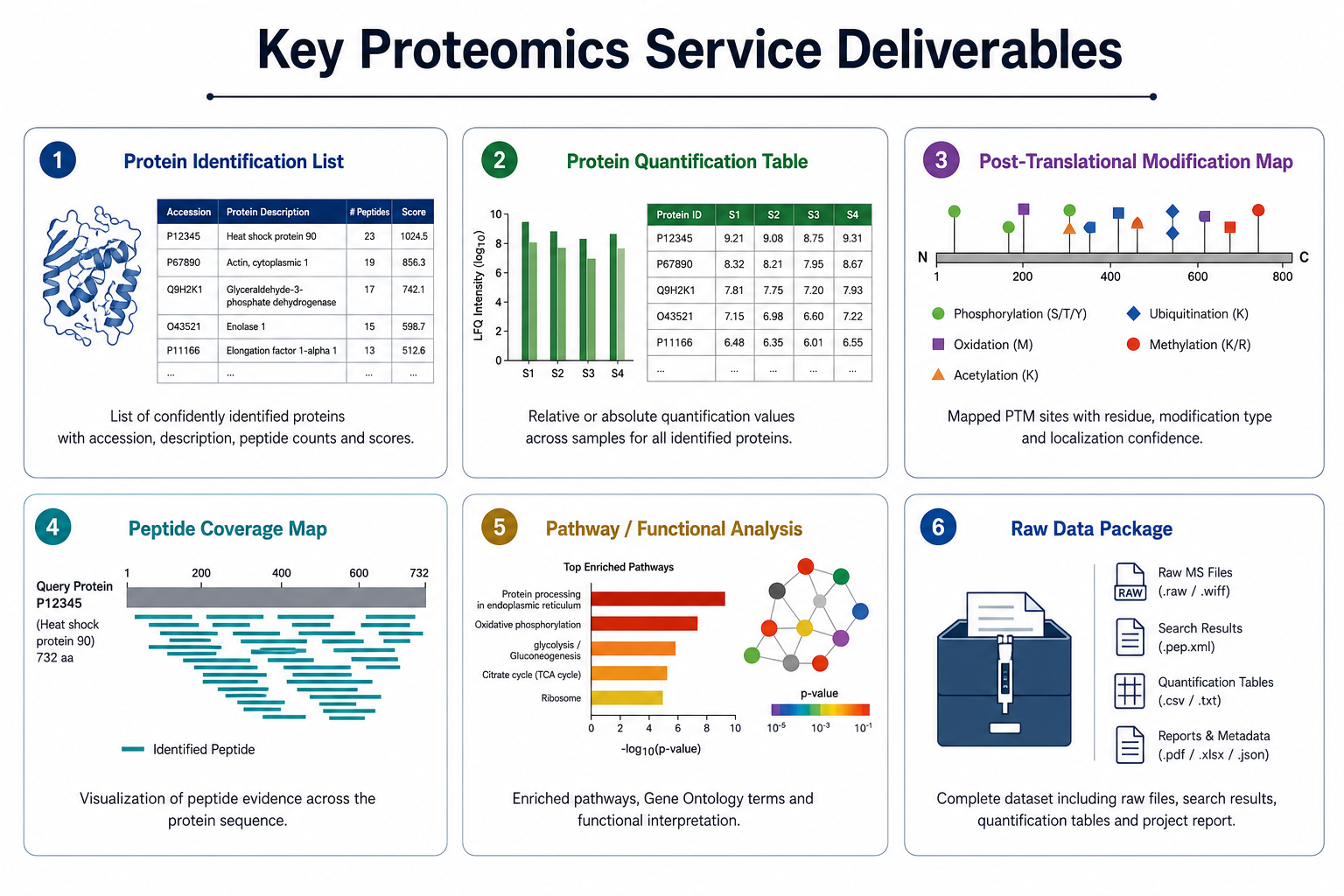
Figure 1. When choosing an LC-MS/MS proteomics service, compare deliverables such as identification tables, quantitative reports, modification maps, peptide coverage, pathway analysis, and raw data transfer.
Sample Requirements and Service Fit
A proteomics service should be evaluated for sample fit before price.
Cell and tissue lysates are widely supported in standard bottom-up workflows, but protein amount, lysis buffer, and storage history still affect intake success. Plasma and serum projects may require depletion, enrichment, or adapted preparation that not every provider includes in a standard package. Immunoprecipitation and pull-down samples need background control planning because binders and contaminants can dominate identification results. Purified proteins and antibodies may require peptide mapping, disulfide review, or intact mass characterization rather than discovery-scale analysis. Formalin-fixed or limited-input samples may need specialized workflows.
Ask each provider which sample types are routinely accepted, what protein amount or cell count is recommended, which buffers are incompatible, and whether enrichment or fractionation is available when the project depends on low-abundance targets.
Sample fit also includes logistics. Confirm shipping temperature, labeling requirements, and intake review steps before selecting a provider.
Workflow Capability to Review in a Quote
LC-MS/MS proteomics is not one standard experiment. Workflow capability should be matched to the study goal.
Discovery workflows use data-dependent or data-independent acquisition for broad protein identification. Quantitative workflows may use label-free LC-MS, TMT or iTRAQ multiplexing, SILAC metabolic labeling, or DIA-based cohort comparison. PTM workflows require enrichment and modified peptide searching. Targeted workflows require PRM or MRM method development and panel validation. Biologics workflows require reference sequence mapping and often more conservative reporting standards.
When evaluating a service, confirm that the quoted workflow matches the project goal rather than a generic discovery package. Also confirm whether phase 1 sample preparation, phase 2 LC-MS/MS acquisition, and bioinformatic reporting are all included or priced separately.
Related Services
Quantitative Proteomics Service
Label-Free Quantitative Proteomics Service, MS Based
Proteomics Bioinformatic Analysis Service
Researchers comparing LC-MS/MS proteomics service options can consult MtoZ Biolabs to review deliverables, sample fit, and quoted workflow scope against the study goal.
Cost Drivers in LC-MS/MS Proteomics Services
Proteomics service cost is driven by scope rather than by the phrase LC-MS/MS alone.
Sample number and replicate structure are primary drivers. A small discovery set costs less in run time than a multi-group quantitative study with biological replicates across many specimens. Validation projects with targeted panel development can add method optimization scope beyond simple per-sample pricing.
Workflow type is another major driver. Label-free identification requires different preparation and analysis scope than TMT multiplexing, phosphoproteomics enrichment, or biologics peptide mapping with manual spectral review.
Instrument time and acquisition depth also affect scope. Longer LC gradients, repeated injections, offline fractionation, and DIA library generation increase coverage but expand scheduling and analysis time.
Bioinformatics and reporting depth add further scope. Basic protein tables cost less than full quantitative statistics, pathway enrichment, documentation-grade peptide coverage, or customized report formatting for regulatory review.
Support and project management should be considered part of value rather than overhead. Intake review, milestone communication, and expert interpretation can reduce total project cost even when the base quote is higher.
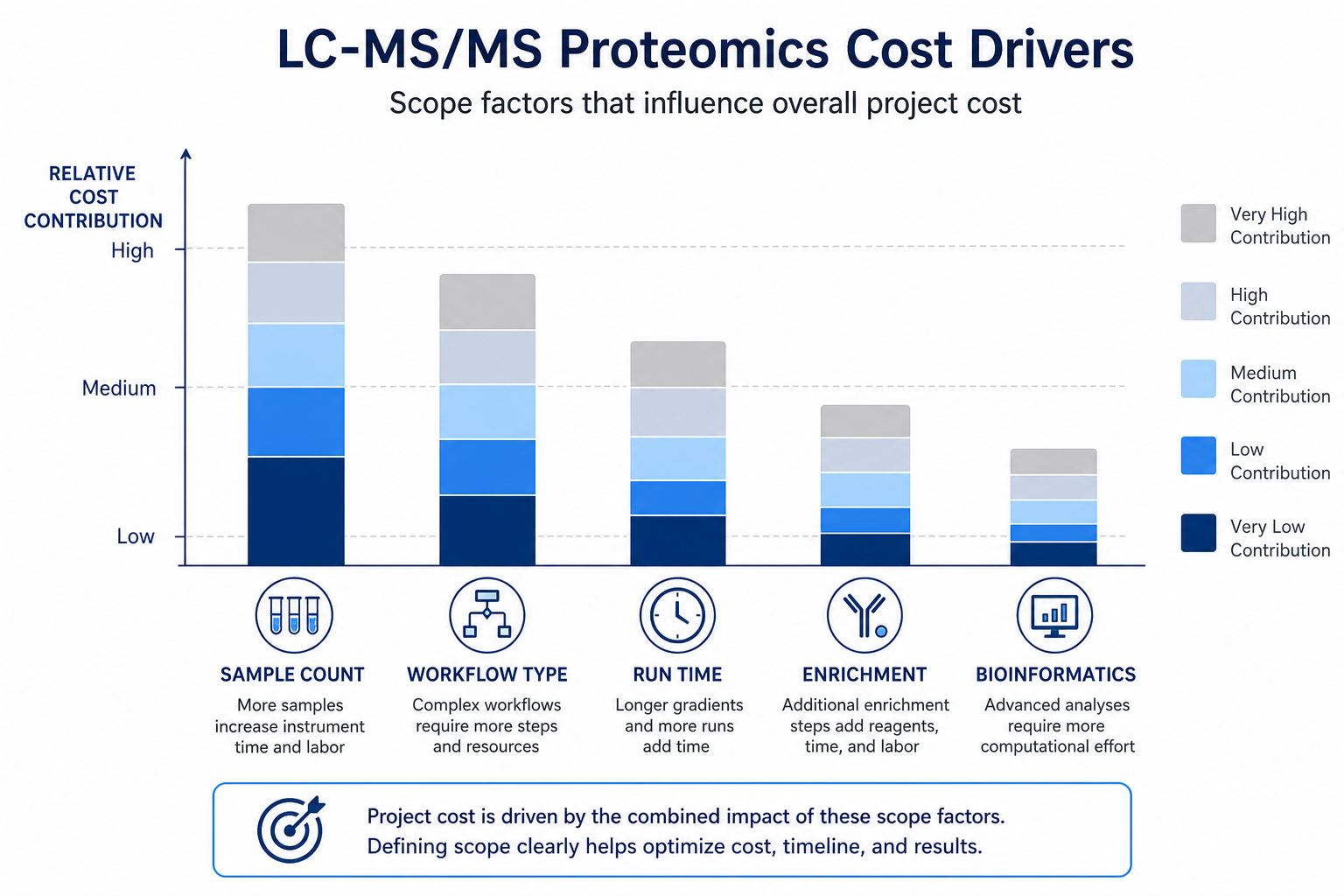
Figure 2. LC-MS/MS proteomics service scope and cost are driven by sample number, workflow type, run time, enrichment requirements, and reporting depth.
Deliverable and Cost Comparison Table
Use the table below to compare quotes from different providers on the same project goal.
|
Evaluation item |
What to ask the provider |
Why it affects value |
|---|---|---|
|
Included deliverables |
Protein tables, quant stats, PTM map, raw data, pathway analysis |
Determines whether the report supports the project decision |
|
Workflow match |
Discovery, TMT, DIA, PRM, peptide mapping |
Prevents paying for the wrong experiment type |
|
Sample intake support |
Accepted matrices, amount guidance, buffer limits |
Reduces resubmission and preparation failure |
|
Replicate handling |
Biological versus technical replicate processing |
Affects quantitative credibility |
|
FDR and inference rules |
PSM FDR, protein grouping, unique peptide minimums |
Affects confidence in identification claims |
|
Timeline phases |
Phase 1 prep and phase 2 acquisition milestones |
Improves planning for grants or CMC deadlines |
|
Repeat policy |
What happens if sample prep or acquisition must be repeated |
Affects total project risk |
A provider that answers these items clearly is usually easier to evaluate than one that quotes only a per-sample rate without scope detail.
How to Evaluate Reporting Quality
Reporting quality should be part of service selection, not an afterthought.
A strong LC-MS/MS proteomics report should connect raw spectral evidence to protein-level conclusions in a traceable format. Identification reports should include peptide support, score metrics, and false discovery rate information. Quantitative reports should explain normalization and show replicate consistency. Biologics reports should map peptides to the reference sequence and highlight unsupported regions. Targeted reports should document transition selection and measurement reproducibility.
Ask whether the provider includes expert review, whether report formats can be adapted for publication or CMC documentation, and whether follow-up consultation is available after delivery.
Red Flags When Comparing Proteomics Services
Several warning signs suggest a quote may not match the project need.
A quote that does not specify deliverables should be clarified before samples are sent. A provider that treats all sample types as standard lysates may underestimate plasma, IP, or biologics complexity. A discovery-only package proposed for a validation milestone often lacks reproducibility design.
Selection Steps Before Awarding the Project
A practical provider selection process can be completed in five steps.
Step one: define the study goal and required deliverable in writing. Step two: request quotes that specify workflow, sample intake conditions, deliverables, and phase 1 and phase 2 milestones. Step three: compare sample fit and reporting quality rather than per-sample price alone. Step four: confirm whether follow-up targeted validation or bioinformatics can be added within the same provider workflow if needed. Step five: finalize written scope before shipping samples.
This process helps teams choose a service based on fit and total project value.
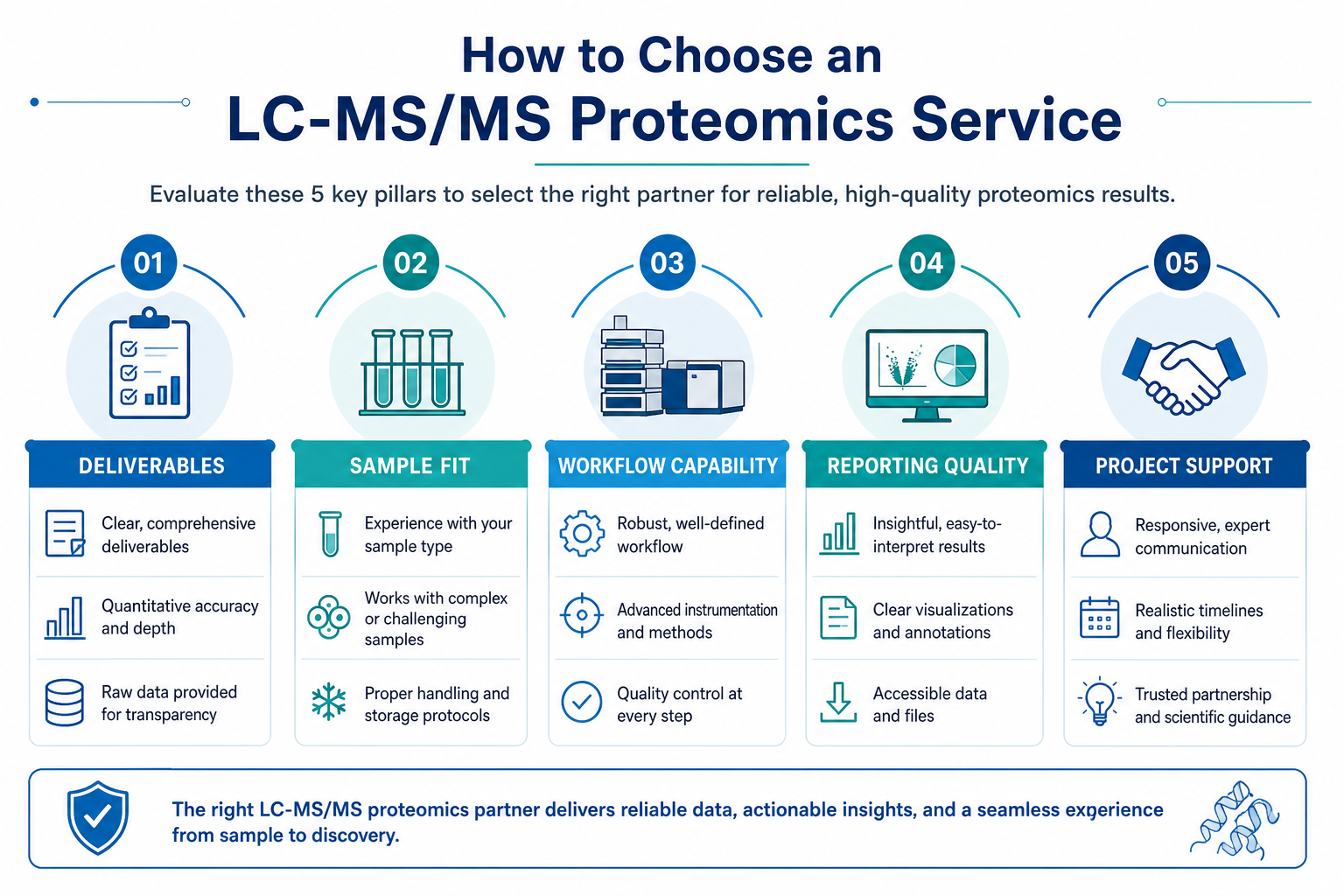
Figure 3. Choose an LC-MS/MS proteomics service by evaluating deliverables, sample fit, workflow capability, reporting quality, and project support.
Matching Service Type to Project Goal
Different project goals favor different service packages.
Discovery identification is appropriate when the goal is unbiased protein screening in lysates, tissues, or enriched samples. Quantitative comparison is appropriate when treatment effects or disease differences must be supported by replicate-based statistics. Targeted PRM validation is appropriate when a defined peptide panel must be measured repeatedly. PTM services are appropriate when modification site mapping is the primary output. Peptide mapping services are appropriate when biologics sequence confirmation is the reporting priority.
Choosing the right service category first makes provider comparison more objective because quotes can be evaluated against the same technical standard.
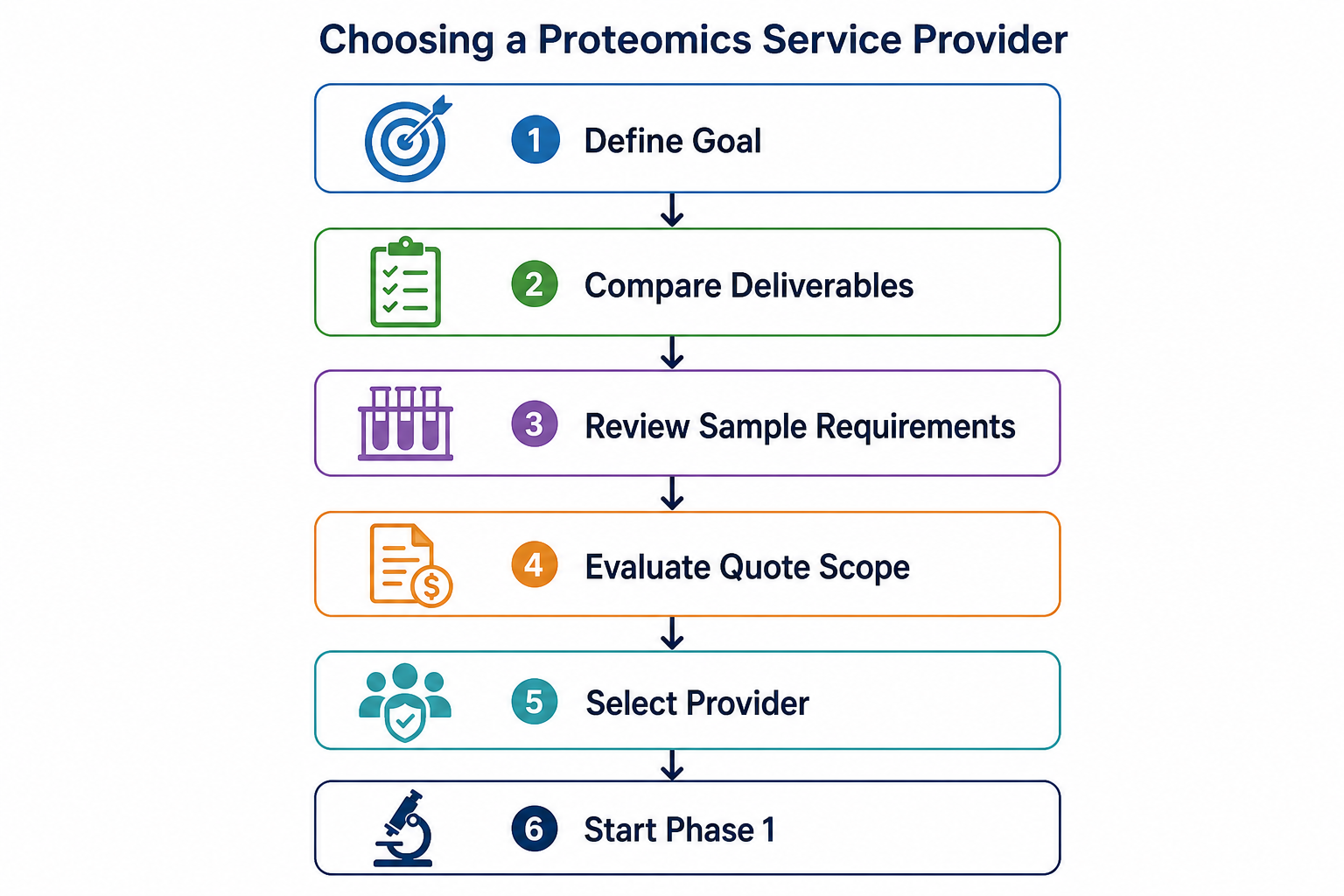
Figure 4. Choosing an LC-MS/MS proteomics service moves from goal definition to deliverable comparison, sample requirement review, quote evaluation, and phase 1 project start.
Frequently Asked Questions
1. What should I compare first when choosing an LC-MS/MS proteomics service?
Compare deliverables, workflow match, sample fit, and reporting quality before comparing per-sample price. These factors determine whether the service can support the project decision.
2. Why do proteomics service quotes vary for the same sample number?
Quotes vary because workflow type, acquisition depth, enrichment needs, replicate handling, and bioinformatics scope differ. A discovery quote and a TMT quantitative quote are not equivalent even when sample count is the same.
3. What sample information should I share when requesting a quote?
Share sample type, buffer composition, storage conditions, protein amount or cell count if known, replicate design, comparison groups, and the deliverable required for the project decision.
4. Are raw data transfer and pathway analysis always included?
No. Providers differ in whether raw files, search outputs, statistical analysis, and pathway interpretation are included in the base scope or priced as add-ons. Confirm these items in writing.
5. When is a targeted proteomics service more appropriate than discovery?
Targeted PRM or MRM is more appropriate when protein targets are already defined and the project requires repeated, reproducible panel measurement rather than broad proteome screening.
Conclusion
Choosing an LC-MS/MS proteomics service requires more than comparing instrument access or per-sample pricing. Deliverables, sample requirements, workflow capability, reporting quality, and the cost drivers behind scope together determine whether the service will produce usable protein evidence for the project goal. Teams that define the required report first and compare quotes on workflow fit and total value are more likely to select a provider that supports the next research, translational, or quality milestone without repeat analysis.
If your group is evaluating LC-MS/MS proteomics service options for discovery, quantitation, validation, or biologics characterization, MtoZ Biolabs can help compare deliverables, sample fit, and project scope against your study goal. Contact MtoZ Biolabs to request a project assessment and review the deliverables, sample requirements, and cost drivers relevant to your proteomics workflow.
How to order?




