






How to Choose an Antibody for Endogenous Protein Interaction Studies
Choose an antibody for endogenous protein interaction studies when native bait capture must work without an affinity tag, and a pilot immunoprecipitation shows enough target recovery to support partner readout. Endogenous Co-IP or IP-MS depends entirely on the target-specific reagent: there is no FLAG, HA, or GFP pull-down to compensate for weak enrichment. An antibody validated for IP-MS is tested before delivery for immunoprecipitation performance under stated conditions; that evidence matters more than western blot band intensity when the goal is unknown partners from native lysate.
The practical decision is which antibody class matches the bait state and interaction claim. Total endogenous node capture usually starts with Target Protein Antibodies. Modification-conditioned complexes may require PTM-specific or pan-modification reagents. If native capture cannot be validated in pilot work and tagging is acceptable for the biological question, AP-MS may be the more workable route.
Why Endogenous Interaction Work Raises the Antibody Bar
Tagged AP-MS recovers bait through the tag even when endogenous antibody performance is uncertain. Endogenous interaction studies do not have that fallback.
The capture reagent must bind the bait under native or native-like lysis, survive bead capture and washes, enrich enough material for LC-MS/MS, and keep nonspecific binders low enough that partner lists stay interpretable. Western blot validation uses denatured sample handling that does not predict those outcomes.
Isoform and close homolog awareness also matters in endogenous work. An antibody raised against one splice form or species ortholog may under-recover the bait in your model, producing an interaction list that reflects capture failure rather than biology.
Endogenous projects also include low-expression regulators, membrane proteins, and modified subpopulations that are harder to recover than abundant housekeeping baits. Antibody choice and sample prep must be planned together rather than treated as a late ordering step.
Map the Interaction Question Before Comparing Catalog Listings
Most endogenous plans fall into one of four question types.
Open interactome mapping asks which proteins co-enrich with a native kinase, receptor, scaffold, or transcription factor. Target Protein Antibodies for that node are the usual starting point when total bait capture defines the experiment.
Condition-dependent remodeling asks how partnerships change between resting and stimulated, treated and control, or disease-relevant states. The same antibody should be used across arms so comparison reflects biology rather than reagent lot changes.
Modification-conditioned complexes ask whether phosphorylation, acetylation, ubiquitination, or another mark changes partnership. PTM-specific or pan-modification reagents may fit when the modified subpopulation is the biological state under study.
Known partner confirmation asks whether one or two expected interactors co-enrich with the bait. Targeted Co-IP with detection may suffice when open MS discovery is not required.
|
Endogenous question |
Bait logic |
Antibody class to review first |
When to reconsider workflow |
|---|---|---|---|
|
Native node interactome |
Total endogenous protein |
Target Protein Antibodies |
No validated option for bait after pilot review |
|
Stimulus-dependent remodeling |
Same bait across conditions |
Target Protein Antibody with IP-MS evidence |
Bait recovery differs by condition |
|
Modified-bait complex |
Modified subpopulation |
PTM-specific or pan-modification reagents |
Modified bait too low for MS |
|
Known partner confirmation |
Endogenous bait plus expected partner |
Target Protein Antibody |
Small partner set; Co-IP blot may suffice |
|
Direct domain binding |
Recombinant probe |
Not antibody-first for bait |
Pull-down-MS |
The table supports shortlisting. It does not replace pilot testing in your matrix.
Shortlist Criteria for Endogenous Capture
Define the bait state first. Decide whether the experiment captures total endogenous protein or a modified form. That choice determines whether Target Protein Antibodies or PTM-oriented reagents lead the search.
Confirm the endogenous requirement explicitly. If tagging is acceptable, AP-MS may reduce antibody risk. If native expression and localization define the claim, stay with antibody-centered Co-IP or IP-MS and prioritize IP-MS validated products.
Review application evidence. Prefer reagents with IP-MS validation or documented bait recovery in an enrichment workflow. Treat WB-only listings as higher risk unless pilot IP is built into the timeline.
Match matrix and species. Check whether validation was reported in a lysate type similar to your cells or tissues. Species, isoform differences, and lysis stringency all affect endogenous capture.
Plan controls before ordering at scale. Isotype or IgG controls, bead-only IPs, and condition-matched negative controls are part of endogenous design, not optional steps after purchase.
Record the intended interaction claim in the protocol before comparing catalog pages. A discovery-oriented IP-MS plan, a targeted Co-IP confirmation, and a condition-comparison interactome each impose different wash, replicate, and control requirements on the same bait antibody.
Compare format and amount. Review host, isotype, bead compatibility, and whether enough material exists for replicate IPs. Bead-conjugated formats can simplify setup when they match the matrix and validation scope.
Target Protein, PTM-Specific, and Pan-Modification Routes
Target Protein Antibodies are the default entry when the bait is a defined endogenous node such as a kinase, receptor subunit, or pathway scaffold. The reagent should document bait enrichment compatible with partner discovery around that protein.
PTM-specific reagents fit when the hypothesis depends on a defined modified state rather than total protein abundance. Validation must support capture of the relevant modified population, not only detection on a blot.
Pan-modification reagents fit broader questions that start from a modification class before MS readout. They are usually not the first choice for a single-node interactome unless the mark itself defines the bait logic.
Do not assume that a pan-target antibody will recover the biologically active modified subpopulation when the hypothesis depends on that mark.
Compare two shortlisted reagents in the same pilot matrix when sample amount allows. For endogenous work, the useful comparison is bait enrichment in eluate at acceptable background, not the longer list of applications printed on the product page.
Pilot IP Before Scaling Endogenous Discovery
Run a small immunoprecipitation series before committing replicate LC-MS/MS. Examine eluate, flow-through, and input when immunoblot or targeted readouts are available. For endogenous work, the key observation is whether the intended bait enriches above parallel control lanes or control runs.
Hold lysis, wash, and elution conditions constant across contrast arms. Endogenous interaction claims depend on matched handling so partner differences are not confounded by prep drift.
Decide the next readout only after bait recovery is acceptable. If enrichment remains borderline, adjust lysis, antibody amount, or wash conditions before scaling discovery runs.
For endogenous discovery, it helps to define what counts as acceptable bait enrichment in the pilot before anyone interprets early MS results. That threshold can be based on immunoblot signal, targeted peptide detection, or consistent eluate behavior across replicate IPs.
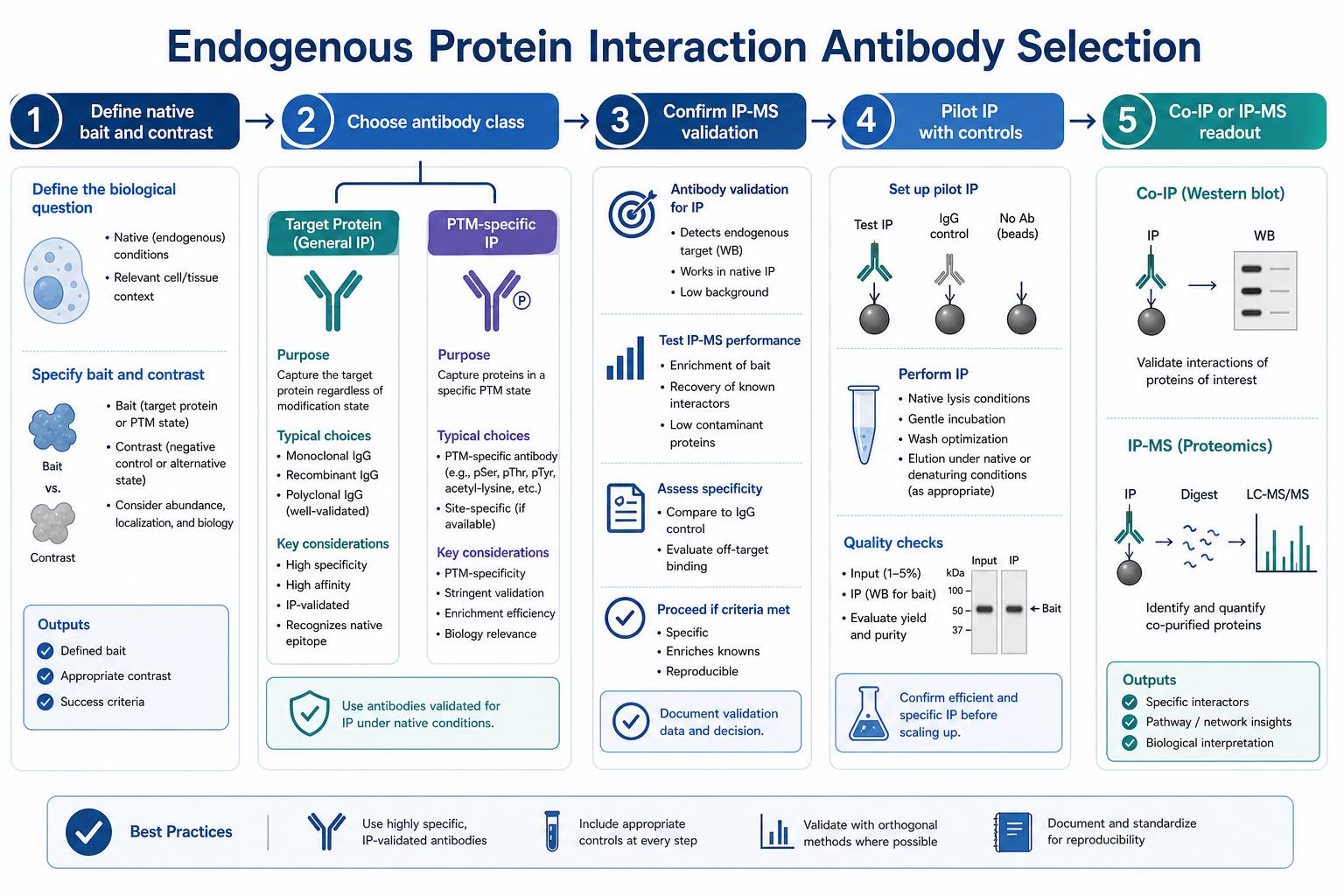
Figure 1. Endogenous interaction planning starts with native bait definition, antibody class selection, validation review, pilot controls, then Co-IP or IP-MS readout.
When to Stay on Antibody IP-MS Versus Switch Workflow
Classical Co-IP with targeted detection fits when partners are already known and MS discovery is not required.
AP-MS fits when tagging is acceptable and no reliable endogenous IP-MS validated antibody exists for the bait after pilot review.
Pull-down-MS fits when the question is direct or reconstituted binding with a recombinant domain rather than native complex architecture in cells.
Protein Interaction Analysis services fit when enrichment design is settled but MS identification, filtering, and reporting need dedicated support.
Switching workflow is a design decision, not a rejection of the biological question. Endogenous capture is often the right scientific choice and remains the most antibody-demanding route.
Teams sometimes keep endogenous capture for the discovery phase and use orthogonal tagged or biochemical follow-up only for confirmatory tests on priority partners. That sequence preserves native context for the initial partner list without forcing every downstream assay to remain untagged.
Application Contexts Where Native Capture Planning Matters Most
Signaling nodes under acute stimulation can change both bait level and epitope presentation. Use the same antibody across time points or treatment arms and document harvest timing carefully.
Membrane and organelle-associated baits may need compartment-aware lysis before immunoprecipitation. Antibody selection should not be separated from prep choices that preserve the target.
Disease-model comparisons across genotypes require consistent bait recovery in each background. Pilot work in each matrix prevents false remodeling signatures caused by uneven pull-down.
Rare or inducible baits overlap with low-abundance planning. Endogenous interaction work in those models may need higher input, gentler washes, or format choices that reduce handling loss.
Primary cells and limited clinical material add another constraint. When replicate number is fixed by sample availability, antibody efficiency per reaction matters more because there is little room to recover from a weak first pull-down.
Controls and Wash Strategy in Endogenous Co-IP-MS
Document lysis conditions, wash stringency, replicate number, and condition labels before scaling MS. Harsh washes may reduce background but can strip weak interactors. Mild washes may preserve partners but increase sticky proteins.
IP-MS validation reduces bait-side risk. It does not replace control design or orthogonal follow-up of priority partners.
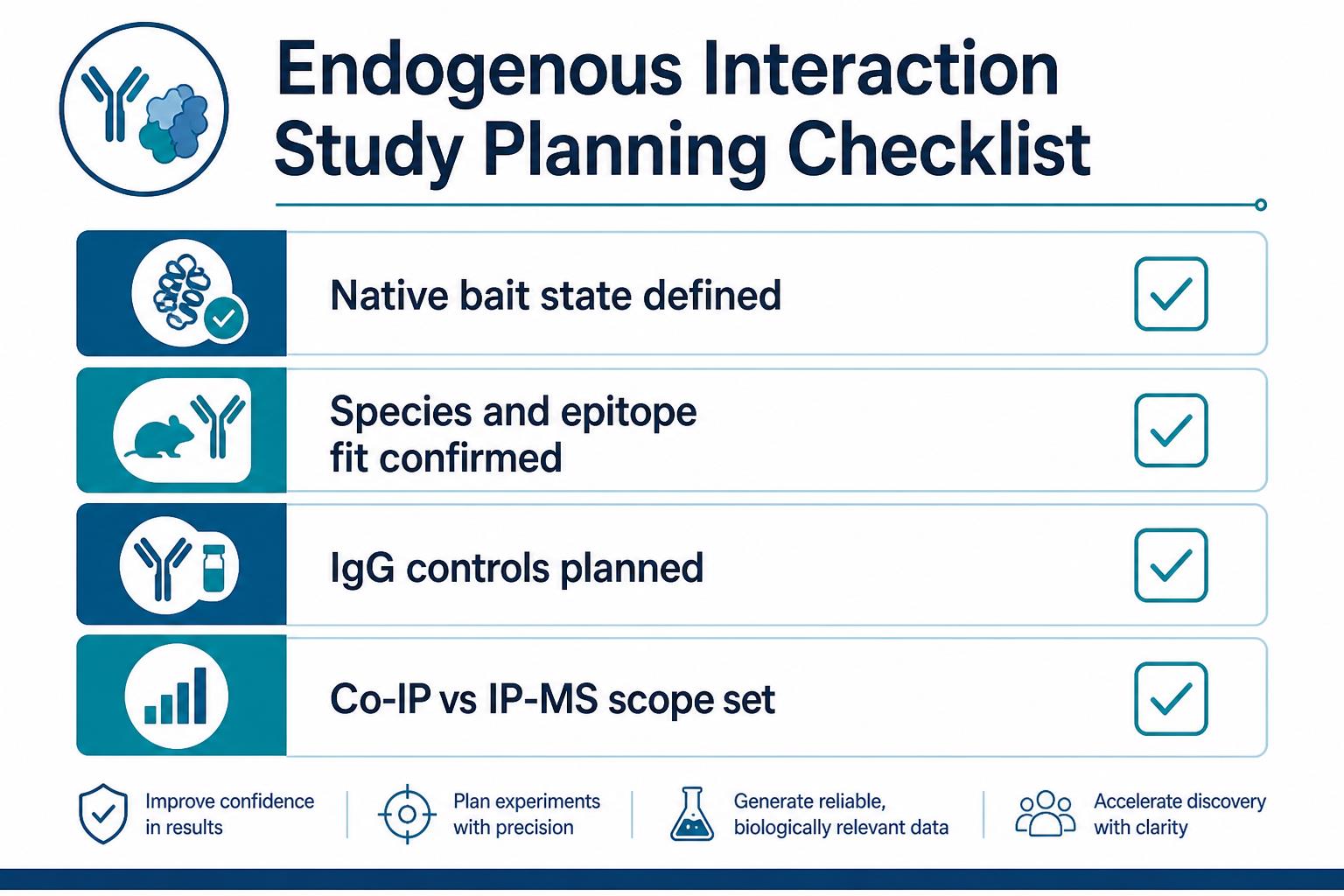
Figure 2. Confirm bait state, species fit, validation evidence, controls, and analysis scope before ordering reagents or services at scale.
Related Products
Related Services
IP-MS Protein Interactomics Analysis Service
Co-Immunoprecipitation Protein Interaction Analysis Service
Protein-Protein Interaction Analysis Service
Limits That Belong in the Study Plan
IP-MS validation indicates enrichment performance under stated IP conditions before delivery. It does not by itself confirm that every endogenous bait, treatment state, or cell model will recover in your lab. Pilot immunoprecipitation in the planned matrix remains required.
Partner lists from endogenous IP-MS are enrichment hypotheses. Direct binding, stoichiometry, and functional roles still need follow-up outside one capture experiment.
Pan-target capture may miss modified subpopulations that define the biology. Modification-aware reagents broaden one question but can reduce absolute bait amount and change background characteristics.
When the study moves from in-house immunoprecipitation to outsourced interactomics analysis, keep the same antibody lot, lysis path, and control design across replicates so service-side partner ranking reflects the native capture plan rather than mid-project reagent changes.
Frequently Asked Questions
1. Why is antibody choice harder for endogenous studies than for tagged AP-MS?
Endogenous Co-IP or IP-MS depends entirely on target-specific capture. Tagged AP-MS can recover bait through the tag when antibody options are limited.
2. Should I start with Target Protein Antibodies or PTM-oriented reagents?
Start with Target Protein Antibodies when total endogenous bait capture defines the question. Use PTM-specific or pan-modification reagents when the modified bait state is the focus.
3. Is IP-MS validation necessary for endogenous discovery?
It is important when LC-MS/MS will define unknown partners. Classical Co-IP with western detection may tolerate IP-capable reagents without MS validation when the partner set is small and predefined.
4. What if no IP-MS validated antibody exists for my bait?
Review whether tagging and AP-MS are acceptable, whether pull-down-MS answers a narrower binding question, or whether pilot testing of a related reagent is warranted in your matrix.
5. How should wash stringency be chosen?
Match washes to the interaction claim. Transient partners may need gentler conditions; high-background lysates may need stricter washes. Document the tradeoff in the study plan.
6. What should I share before choosing an endogenous interaction antibody?
Provide bait identity, species, sample type, native versus tagged requirement, condition contrast, and whether the readout is discovery-oriented IP-MS or targeted confirmation.
Conclusion
Choosing an antibody for endogenous protein interaction studies means matching antibody class and IP-MS validation evidence to a native bait, its modification state, and the interaction question. Target Protein Antibodies support most node-centered endogenous interactomes. PTM-oriented reagents support modification-conditioned complexes. Pilot immunoprecipitation with controls should precede replicate MS when native capture defines the workflow.
Contact MtoZ Biolabs to review bait design, IP-MS validated antibody options, and Co-IP or IP-MS analysis fit before final reagent or service selection.
How to order?




