






How AP-MS Works?
Introduction
Affinity purification-mass spectrometry proposals often list AP-MS as a single method without explaining what happens between bait capture and the final protein list. A collaborator may ask whether tagged-bait purification is required. A reviewer may ask how background proteins are filtered. A project team may receive an interactome table without understanding which experimental steps created that result.
AP-MS works by enriching a bait protein together with associated partners, then identifying the recovered proteins by LC-MS/MS. The method is powerful for bait-centered interaction discovery, but only when each step is understood: how the bait is captured, how washes affect recovery, how controls define specificity, and how MS converts an eluate into ranked candidates. This article explains how AP-MS works step by step, what each stage contributes, and where common failure points appear before interpretation begins.
What AP-MS Is Designed to Do
AP-MS is an interaction proteomics workflow that purifies a bait protein from lysate or extract and identifies co-enriched proteins by mass spectrometry.
The bait may be captured through an epitope tag, an antibody, or another affinity handle. Proteins that remain associated with the bait through binding and wash conditions are eluted, digested into peptides, and analyzed by LC-MS/MS. Database searching or related matching strategies assign peptide and protein identities. Comparison with negative controls then helps separate candidate interactors from proteins that bind beads, tags, or abundant contaminants.
AP-MS therefore answers a bait-centered question: which proteins are recovered with this bait under these enrichment conditions. It does not, by itself, prove direct binary binding in living cells.
Why Understanding the Workflow Matters
AP-MS results are shaped by process choices as much as by biology. Harsh washes can remove weak partners. Gentle washes can increase background. Incomplete controls can make sticky proteins look like specific interactors. Poor bait expression can yield empty enrichments that still contain contaminant proteins.
Understanding how AP-MS works helps teams design the experiment before samples are prepared. It also helps interpret whether a missing partner reflects true absence, dissociation during purification, or insufficient MS depth. For protein-protein interaction projects, workflow literacy prevents treating every identified protein as an equally validated interactor.
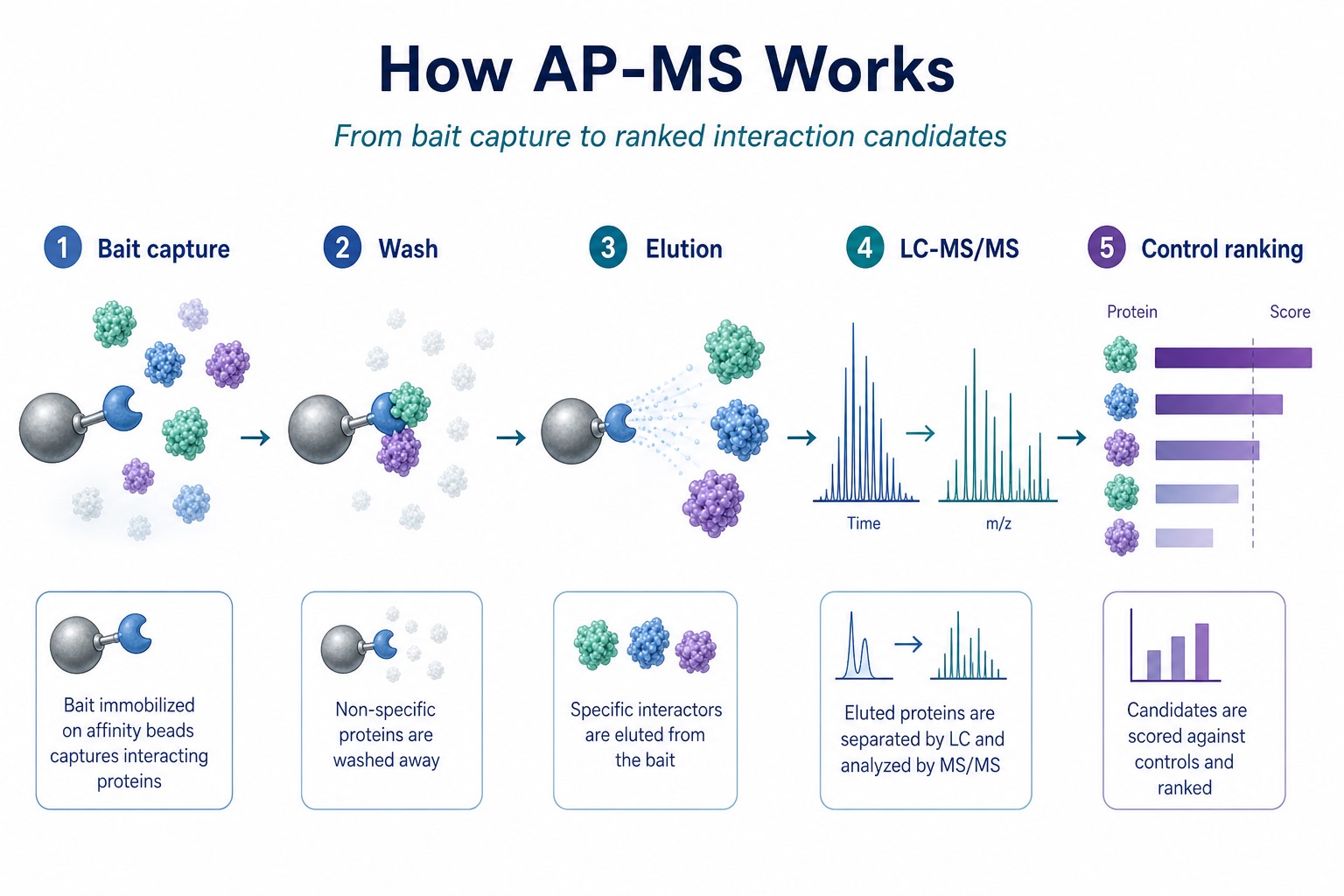
Figure 1. AP-MS works by capturing a bait, washing and eluting associated proteins, identifying them by LC-MS/MS, and ranking candidates against controls.
How AP-MS Works Step by Step
An AP-MS experiment can be divided into a practical sequence.
Step 1. Define the bait and capture strategy
The workflow begins with a clear bait. Common designs use epitope-tagged baits for reproducible affinity capture. Antibody-based immunoprecipitation of endogenous bait is also used when tagging is undesirable. Capture chemistry must be compatible with the lysis conditions needed to preserve relevant interactions.
Step 2. Prepare lysate under interaction-compatible conditions
Cells or tissues are lysed in buffers chosen to solubilize the bait while retaining enough interaction stability for enrichment. Detergent strength, salt, and protease or phosphatase inhibitors influence both recovery and background. This step determines which complexes are available for capture.
Step 3. Affinity capture of the bait
The lysate is incubated with affinity resin or antibody-coupled beads that bind the bait. The bait and associated proteins are immobilized, while unbound lysate proteins remain in solution. Capture efficiency depends on bait abundance, tag accessibility, antibody quality, and incubation conditions.
Step 4. Wash to reduce non-specific binders
Beads are washed to remove unbound and loosely associated proteins. Wash stringency is a central trade-off in how AP-MS works. Stronger washes can improve specificity but lose weak or transient partners. Weaker washes retain more candidates but increase background complexity for MS.
Step 5. Elute the bait-associated proteins
Bound material is released by competitive elution, denaturing elution, cleavage, or related strategies depending on the affinity system. The eluate contains the bait, retained partners, and residual background proteins that survived washing.
Step 6. Digest and analyze by LC-MS/MS
Proteins in the eluate are typically digested into peptides and analyzed by liquid chromatography tandem mass spectrometry. Fragment ion spectra support peptide identification, which are assembled into protein assignments. This is the stage where AP-MS converts an enriched protein mixture into a proteomics dataset.
Step 7. Compare with controls and rank candidates
Negative controls such as empty beads, tag-only samples, non-bait IPs, or related background models are processed in parallel when possible. Candidate interactors are then ranked by enrichment relative to controls, reproducibility across replicates, and biological plausibility. Presence in a single bait purification is not enough for high-confidence claims.
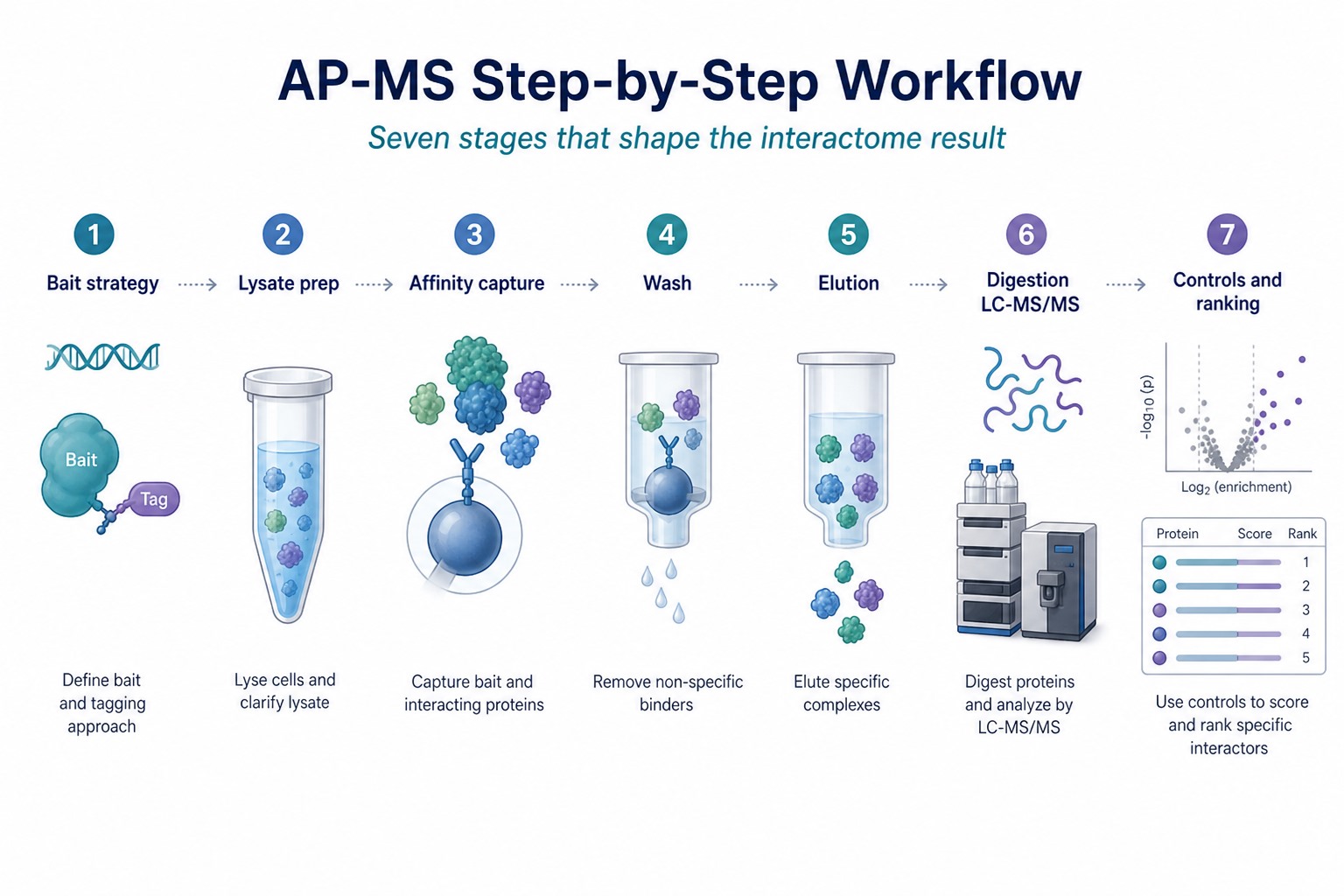
Figure 2. AP-MS proceeds from bait design and lysate capture through washing, elution, LC-MS/MS, and control-based candidate ranking.
What Each Stage Contributes to the Final Result
Each stage leaves a signature on the output.
Bait design determines whether the purified protein represents a functional form of the target. Lysis chemistry determines which interactions remain intact entering capture. Wash conditions determine the balance between specificity and recovery of weak partners. MS depth determines how completely the eluate is sampled. Control design determines whether enrichment can be distinguished from background.
When AP-MS works well, these stages are aligned to one question. Discovery of stable partners may tolerate stricter washes. Recovery of weaker associations may require milder conditions and stronger quantitative controls. The method is flexible, but that flexibility must be intentional.
Technical Value of the AP-MS Mechanism
The technical value of AP-MS comes from coupling affinity enrichment with proteome-scale identification.
AP-MS can identify co-enriched proteins without requiring a separate antibody for every candidate partner.
AP-MS concentrates bait-associated proteins before LC-MS/MS, improving the chance of detecting lower-abundance interactors relative to unfractionated lysate analysis.
AP-MS supports controlled comparison designs that convert raw identification lists into ranked interaction candidates.
AP-MS can be adapted to tagged-bait or endogenous-bait formats depending on biological constraints.
AP-MS provides a practical discovery engine that feeds orthogonal validation methods such as Co-IP or pairwise binding assays.
These are mechanistic strengths of the workflow. They do not remove the need for controls or follow-up confirmation.
Where AP-MS Workflows Commonly Break Down
AP-MS can fail at predictable points in the chain.
Bait expression may be too low for efficient capture. Tags may alter localization or interaction competence. Overly harsh lysis or washes may strip true partners. Incomplete washing may leave abundant sticky proteins that dominate MS spectra. Missing or weak controls may prevent specificity assignment. Insufficient replicates may make enrichment scores unstable. Poor peptide recovery or inadequate MS acquisition may leave real partners undetected.
Understanding how AP-MS works makes these failure modes easier to diagnose. A sparse protein list is not always a biological negative. An overcrowded list is not always a rich interactome.
Related Services
MS-Based Protein-Protein Interaction Analysis Service
Fusion Protein Interaction Analysis Service | Pull-Down and MS
Pull Down based Protein Analysis Service with Mass Spectrometry
Protein Identification Service
Co-Immunoprecipitation Protein Interaction Analysis Service
Teams designing AP-MS workflows for protein interaction discovery can consult MtoZ Biolabs to review bait strategy, wash stringency, control setup, and LC-MS/MS depth for the current project phase.
Typical Uses Once the Workflow Is Understood
When the mechanism is clear, AP-MS is applied to defined interaction questions.
Bait-centered partner discovery
AP-MS is used to generate candidate interactor lists around a tagged or immunoprecipitated bait.
Condition-dependent enrichment comparison
Parallel AP-MS experiments can compare recovered partners across selected biological conditions when bait recovery remains comparable.
Shortlist generation for orthogonal validation
Ranked AP-MS candidates are commonly advanced to Co-IP, biophysical binding assays, or functional tests.
For programs that need discovery followed by confirmation, MtoZ Biolabs can help connect AP-MS candidate generation with targeted validation planning.
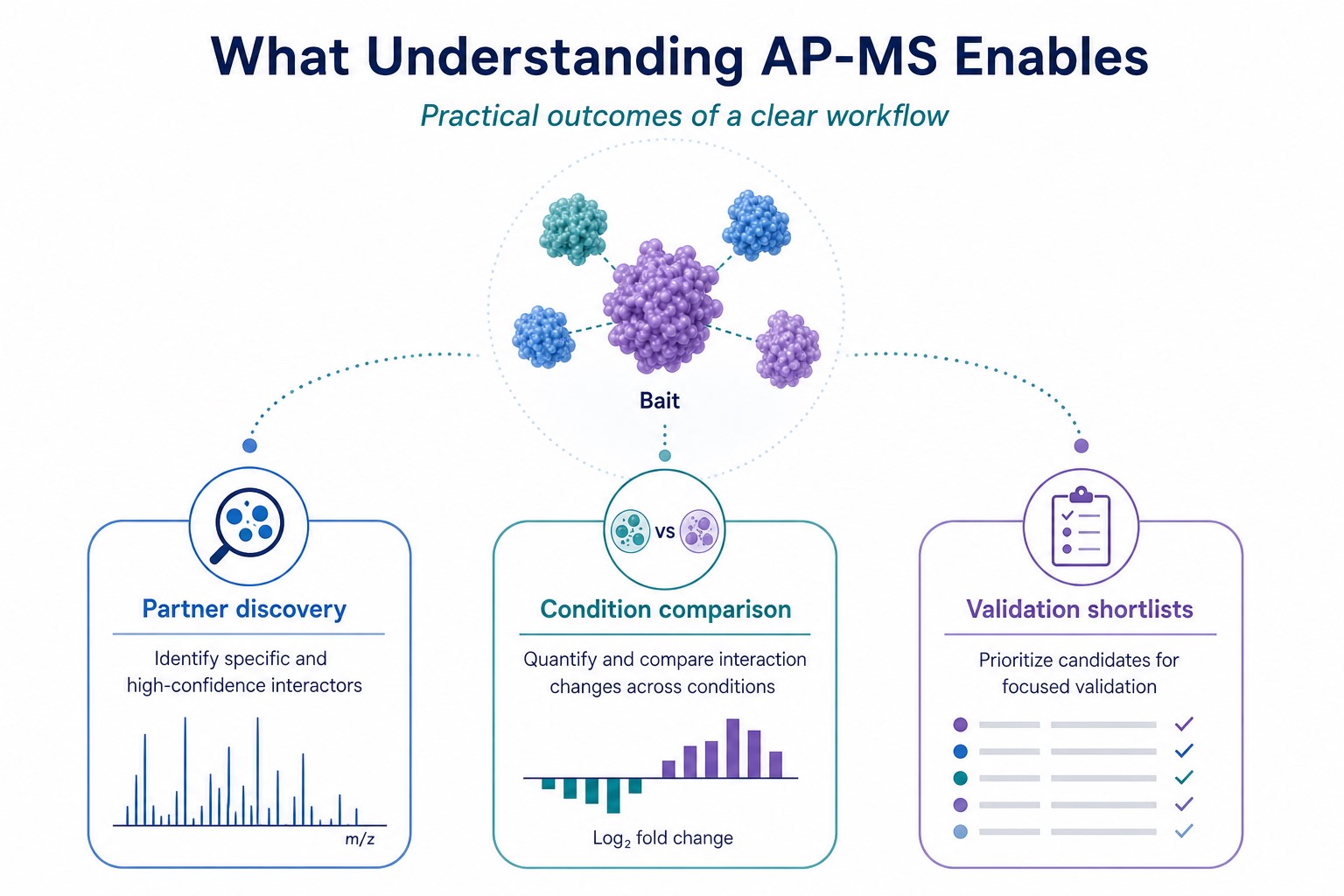
Figure 3. Understanding how AP-MS works supports partner discovery, condition comparison, and generation of validation-ready candidate shortlists.
Frequently Asked Questions
1. How does AP-MS work in simple terms?
AP-MS captures a bait protein, washes away unbound proteins, elutes what remains associated, and identifies those proteins by LC-MS/MS with control comparison.
2. Is tagging always required for AP-MS?
No. Tagged baits are common, but antibody-based capture of endogenous bait is also used when tagging is not suitable.
3. Why are washes so important in AP-MS?
Washes remove non-specific binders, but overly stringent washes can also remove weak true partners. Wash design shapes both specificity and sensitivity.
4. Why are negative controls required?
Controls help distinguish proteins specifically enriched with the bait from proteins that bind beads, tags, or common contaminants.
5. Does AP-MS prove direct protein-protein interaction?
No. AP-MS shows co-enrichment under the conditions used. Direct binding usually needs orthogonal assays.
6. What is the final output of a typical AP-MS experiment?
Typical outputs include protein identification tables, enrichment comparisons against controls, and ranked candidate interactor lists for follow-up.
Conclusion
AP-MS works by enriching a bait and its associated proteins through affinity capture, then identifying the recovered proteins by LC-MS/MS and interpreting them against controls. Each stage, from lysis and washing to elution and MS acquisition, changes which partners are observed and how confidently they can be ranked. Understanding this mechanism helps teams design cleaner experiments and avoid overinterpreting background proteins or empty enrichments.
For bait-centered interaction discovery, AP-MS remains a practical route from molecular capture to proteomics-scale candidate lists when workflow choices are matched to the biological question. Researchers planning AP-MS projects can contact MtoZ Biolabs to review the capture strategy and analytical sequence matched to the current study phase.
How to order?




