






Glycan Methylation Analysis Service
Glycan is polysaccharide molecules formed by the linkage of monosaccharide units through glycosidic bonds, widely present in biomolecules such as glycoproteins and glycolipids. Methylation refers to the addition of a methyl group (-CH₃) to a specific position on a molecule, a modification that often affects the molecule’s function and structure. In glycan chains, methylation modifications can regulate the stability, interactions, and functions of glycans both inside and outside of cells. The study of glycan methylation is crucial for understanding its important roles in biological processes such as cell recognition and signal transduction.
The glycan methylation analysis service is widely applied across various fields. In glycomics, analyzing glycan methylation helps to deepen the understanding of the function of glycosylation modifications in living organisms and their changes in diseases. In cancer research, the methylation status of glycan chains is often used as a potential biomarker for early tumor diagnosis and prognosis evaluation. In immunology and drug development, it helps identify new therapeutic targets and optimize treatment strategies, providing important support for disease mechanism research and new drug development.
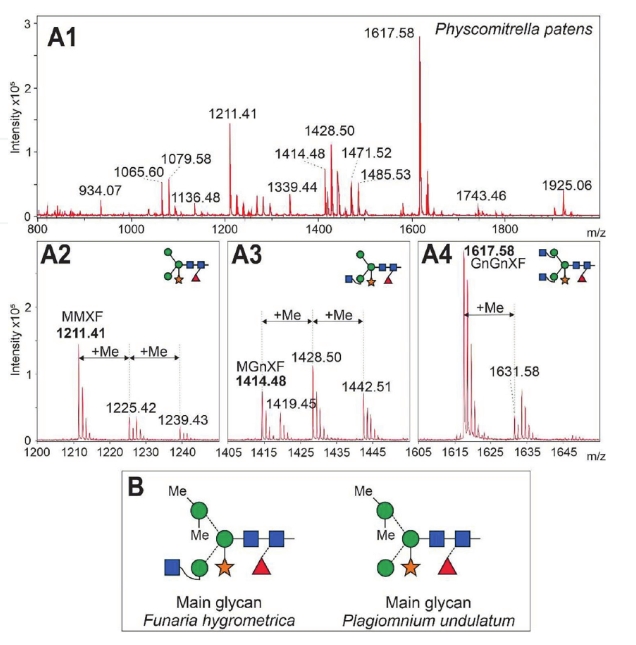
Stenitzer, D. et al. Bryophytes - The State of Knowledge in a Changing World, 2022.
Figure 1. Detection and Structures of Methylated N-Glycans in Mosses.
Services at MtoZ Biolabs
Based on advanced instruments such as high-resolution liquid chromatography (HPLC) and mass spectrometry (MS), MtoZ Biolabs' glycan methylation analysis service provides precise analysis of glycan methylation. By separating, enriching, and detecting different methylated glycans, the service delivers detailed qualitative and quantitative data, including the types, concentrations, and modification patterns of methylated glycans. The final results can be used for functional studies of methylation modifications, exploration of disease mechanisms, and identification of potential drug targets.
Analysis Workflow
1. Sample Preparation
The samples are first pretreated to remove impurities, providing a clean sample for subsequent analysis.
2. Glycan Release and Enrichment
Glycans are released from the samples using enzymatic or chemical methods, and specific enrichment techniques are applied to extract methylated glycans.
3. Derivatization
If necessary, glycan samples undergo derivatization to enhance the detectability and analysis sensitivity of the methylation modifications.
4. Separation and Analysis
High-performance liquid chromatography (HPLC) and mass spectrometry (MS) are used to separate, identify, and quantify the released glycans, precisely identifying methylation sites and the degree of methylation.
5. Data Interpretation and Reporting
Bioinformatics analysis is used to interpret the data, generating a detailed report that provides both qualitative and quantitative analysis results of glycan methylation modifications.
Service Advantages
1. High-Precision Analysis
Advanced liquid chromatography (HPLC) and mass spectrometry (MS) techniques are used to provide high-precision glycan methylation analysis, ensuring the accuracy and reliability of the results.
2. High Sensitivity
Through derivatization and optimized analytical processes, low-abundance methylated glycans can be detected, making the analysis suitable for complex biological samples.
3. Customized Services
Personalized analysis plans are provided based on the client's research goals and sample characteristics, offering flexible solutions to meet various research needs.
4. One-Stop Service
A comprehensive service is offered, covering everything from sample preparation, glycan release, derivatization, separation and analysis, to data interpretation, helping clients achieve a complete glycan methylation study.
Applications
1. Glycomics Research
The glycan methylation analysis service can be used for in-depth analysis of the role of glycan methylation in glycosylation modifications, revealing the relationship between glycan structure and function, and advancing research in the field of glycomics.
2. Cell Biology Research
By studying the regulatory role of glycan methylation in cell recognition, signal transduction, and other life activities, it explores its crucial role in intercellular interactions.
3. Immunology Research
The glycan methylation analysis service can be used to analyze the role of glycan methylation in immune responses, particularly in the regulation of immune cell recognition and immune responses, supporting further developments in immunology research.
4. Plant and Agricultural Research
By studying changes in glycan methylation in plants, it explores its key role in plant growth, development, stress resistance, and carbohydrate metabolism, aiding agricultural research and crop improvement.
Deliverables
1. Comprehensive Experimental Details
2. Materials, Instruments, and Methods
3. Data Analysis, Preprocessing, and Estimation
4. Bioinformatics Analysis
5. Raw Data Files
Related Services
Glycan Modification Analysis Service
How to order?




