






Protein Glycosylation Identification Service
- Sample Preparation: Pretreat samples carefully to preserve glycosylation modifications.
- Enzymatic Digestion: Use specific digestion protocols to generate detectable peptides.
- Glycopeptide Enrichment: For N-glycopeptides, PNGase F release followed by solid-phase extraction or affinity chromatography; for O-glycopeptides, β-elimination or affinity-based enrichment.
- Mass Spectrometry Detection: High-resolution LC-MS/MS combined with liquid chromatography.
- Data Analysis: Database searching and software interpretation to identify glycosylation sites and types.
- Result Interpretation: Deliver site distribution maps with functional annotations to reveal overall glycosylation patterns.
- Protein Function Research: Study how glycosylation regulates folding, stability, and activity.
- Disease Mechanism Studies: Investigate disease-related glycosylation patterns in cancer, immune disorders, and neurodegeneration.
- Biomarker Discovery: Identify glycosylation features associated with diseases to support diagnostics and personalized medicine.
- Biopharmaceutical Quality Control: Characterize glycosylation in recombinant proteins and antibodies to ensure quality and efficacy.
- Evolutionary and Systems Biology: Compare glycosylation profiles across species and tissues to understand biological significance.
- Comprehensive Experimental Details
- Materials, Instruments, and Methods
- High-quality Spectra and Visualized Charts
- Site-specific Glycosylation Identification with Detailed Annotation
- Bioinformatics Analysis
- Raw Data Files
Protein glycosylation identification based on mass spectrometry is a key approach to studying protein post-translational modifications, enabling precise site-level analysis of glycosylation types and distributions. Glycosylation is one of the most complex and widespread PTMs, including N-glycosylation and O-glycosylation. By covalently attaching oligosaccharides to specific amino acid residues, glycosylation alters protein properties and conformation, thereby affecting folding, stability, secretion, localization, and molecular interactions. It plays central roles in cell communication, immune response, signal transduction, and protein quality control, and is closely linked to cancer, immune disorders, neurodegenerative diseases, and infectious diseases. Accurate glycosylation identification not only reveals regulatory networks but also provides insights for biomarker discovery and therapeutic strategy development.
MtoZ Biolabs offers a high-quality Protein Glycosylation Identification Service powered by Thermo Fisher Q Exactive HF, Orbitrap Fusion, and Orbitrap Fusion Lumos mass spectrometers combined with Nano-LC systems. With established data analysis workflows and targeted glycopeptide enrichment methods, we deliver precise identification of glycosylation sites and glycan structures, supporting systematic studies of glycosylation in both physiology and pathology, and accelerating the translation from research to clinical applications.
Analysis Workflow
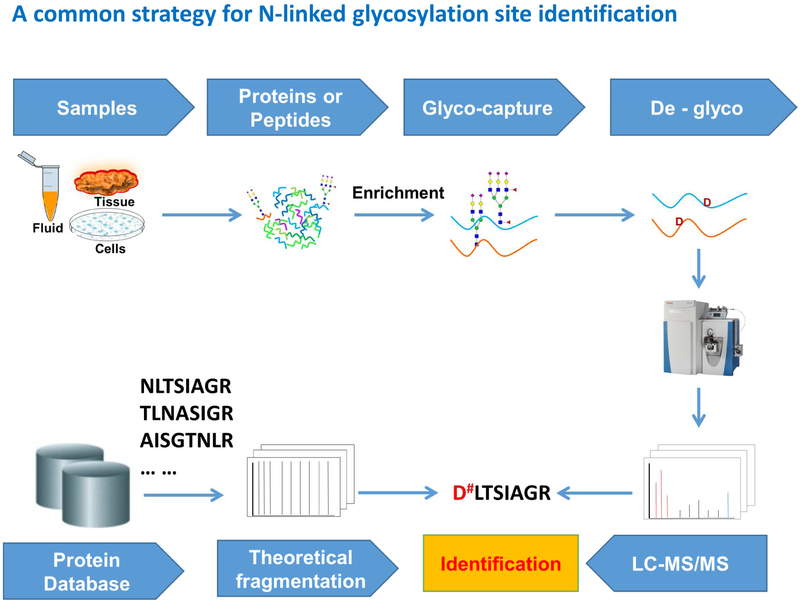
Dang, L. et al. Trends Analyt Chem. 2019.
Figure 1. Workflow for N-Glycosylation Site Identification
Why Choose MtoZ Biolabs?
✅ High-Resolution Platforms: Orbitrap-based mass spectrometry combined with Nano-LC ensures high sensitivity and reliable accuracy for glycosylation analysis.
✅ Experienced Specialists: A dedicated team with strong expertise in protein glycosylation delivers professional data interpretation and technical support.
✅ Targeted Enrichment Methods: Advanced enzymatic and affinity-based enrichment strategies enhance detection of low-abundance N- and O-glycopeptides.
✅ Broad Sample Compatibility: Supports a wide range of biological samples, including cells, tissues, blood, and bodily fluids, offering maximum flexibility for research applications.
✅ Flexible Service Packages: Customized solutions with quick turnaround times provide dependable results that fit diverse project needs.
Sample Submission Suggestions

Note: Provide details on sample collection and handling. If you need further details, our technical support team is happy to assist and provide comprehensive guidance on sample submission.
Applications
What Could Be Included in the Report?
MtoZ Biolabs Protein Glycosylation Identification Service delivers reliable data for basic research, disease studies, and drug development, advancing both life sciences and clinical applications. We also offer site identification services for phosphorylation, acetylation, methylation, and ubiquitination, helping researchers build comprehensive protein modification networks. Contact us today for more details.
FAQs
Q1: How Is Enrichment Efficiency for N- and O-glycopeptides Ensured?
A1: We combine enzymatic digestion with affinity methods. N-glycopeptides are enriched after PNGase F release through solid-phase extraction or affinity chromatography, while O-glycopeptides are enriched using β-elimination or affinity-based techniques. With high-resolution MS, this approach captures low-abundance glycopeptides effectively, ensuring high coverage and accuracy.
Q2: Does the Analysis Include Glycan Type Information?
A2: Yes. Our workflow identifies glycosylation sites together with glycan types and structural annotations. Bioinformatics analysis provides distribution maps and functional insights, supporting studies on protein function and disease mechanisms.
Related Services
How to order?




