






Galacturonic Acid Analysis Service
-
Raw data files from MS, HPLC, or HPAEC-PAD platforms;
-
Processed result tables (Excel or CSV format) containing retention times, concentrations, and compositional ratios;
-
Comprehensive analysis reports (PDF format) detailing experimental methods, quality assessments, and key findings;
-
Chromatographic and mass spectrometric images (TIFF or PNG format) for visualization and comparison.
MtoZ Biolabs employs advanced instruments and analytical platforms to offer the galacturonic acid analysis service which enables precise qualitative and quantitative detection of galacturonic acid in various samples. This service is widely applied in pectin structure elucidation, plant cell wall research, and polysaccharide degradation mechanism studies, providing reliable data support for functional polysaccharide research and biomass utilization.
What Is Galacturonic Acid?
Galacturonic acid is a monosaccharide derivative formed by the oxidation of D-galactose and serves as an essential structural unit of pectin and many plant polysaccharides. It typically exists in plant cell walls through α-1,4-glycosidic linkages, playing a critical role in maintaining cell wall stability, regulating plant growth, and facilitating pectin degradation. Because of its close relationship with polysaccharide structure and biological function, galacturonic acid analysis is widely applied in phytochemistry, biomass utilization, and polysaccharide functional research.
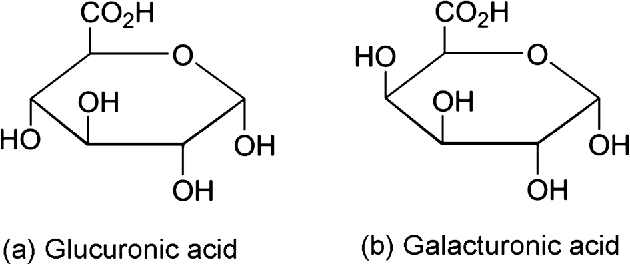
Kawano, M. et al. Clay Science, 2018.
Figure 1. Molecular Structures of Glucuronic Acid and Galacturonic Acid.
Technical Platforms for Galacturonic Acid Analysis Service
1. High-Performance Liquid Chromatography (HPLC)
Provides excellent separation performance and high reproducibility, enabling efficient separation and stable detection of sugar acid components in samples.
2. Mass Spectrometry (MS)
(1) Liquid Chromatography-Mass Spectrometry (LC-MS): Combines high sensitivity and separation capability, suitable for complex systems containing polar and non-volatile compounds.
(2) Gas Chromatography-Mass Spectrometry (GC-MS): Offers high sensitivity and resolution, ideal for analyzing volatile compounds.
3. Nuclear Magnetic Resonance (NMR) Spectroscopy
Features non-destructive and highly accurate characteristics, allowing precise confirmation of compound structural features.
4. High-Performance Anion Exchange Chromatography with Pulsed Amperometric Detection (HPAEC-PAD)
Combines anion exchange chromatography with pulsed amperometric detection, effectively separating individual sugars and enabling high-sensitivity quantification of acidic sugars.
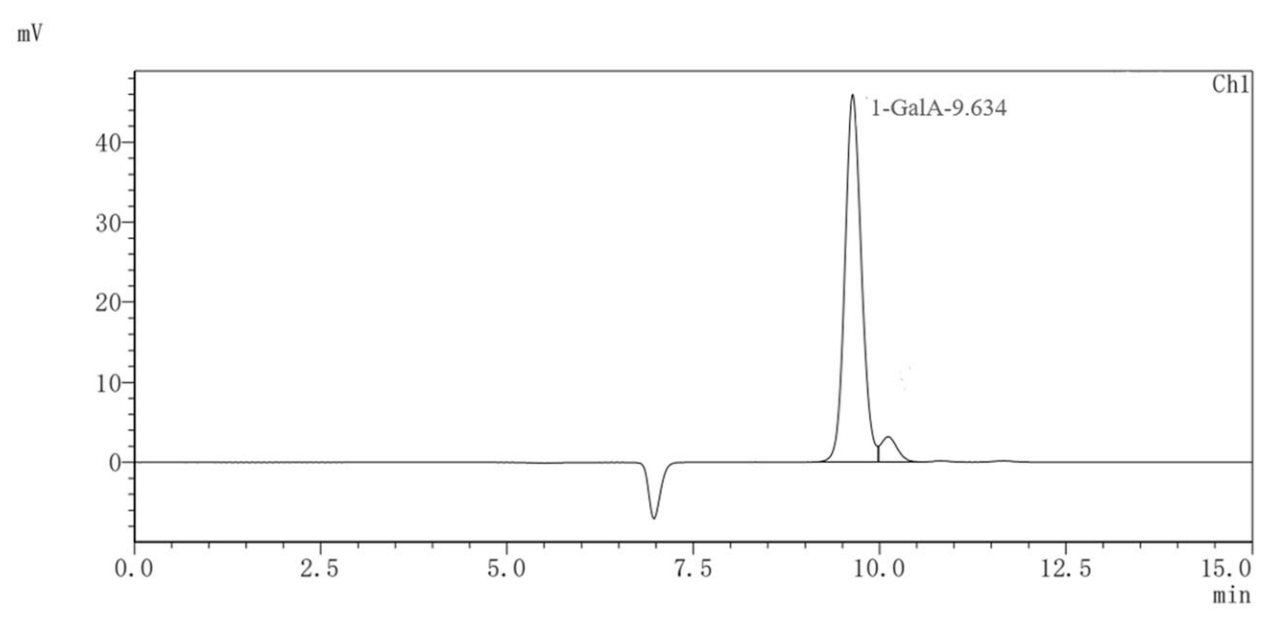
Li, D F. et al. Food Additives & Contaminants: Part A, 2023.
Figure 2. HPLC Standard Chromatogram of GalA in Pectin Fraction.
Galacturonic Acid Analysis Service at MtoZ Biolabs
1. Qualitative and Quantitative Analysis
Accurately determines the composition and content of galacturonic acid in samples, ensuring precise and reliable data.
2. Structural Characterization
Elucidates the linkage patterns and structural features of galacturonic acid within polysaccharides, revealing its molecular configuration.
3. Metabolic Analysis
Evaluates changes in galacturonic acid content and composition during various reactions or biological processes, supporting metabolic mechanism research.
Why Choose MtoZ Biolabs?
✅ Multi-dimensional Analysis: Provides comprehensive evaluation covering content, composition, and structural characteristics.
✅ Expert Data Interpretation: Delivers reliable results and scientific insights from an experienced analytical team.
✅ Flexible Workflow Design: Customizes analytical procedures according to sample types and research objectives.
✅ Rigorous Quality Control: Ensures data consistency through standard calibration and parallel sample monitoring.
✅ One-stop Service: Offers efficient end-to-end support from sample testing to report delivery.
Applications of Galacturonic Acid Analysis Service
1. Pectin Structure Research
Analyzes the galacturonic acid composition in pectin and its degradation products to reveal structural characteristics and modification effects.
2. Polysaccharide Hydrolysis Mechanism Research
Evaluates the release and variation of galacturonic acid during enzymatic reactions to elucidate polysaccharide degradation pathways.
3. Plant Cell Wall Research
Determines galacturonic acid content in plant cell walls to study mechanisms of wall formation and remodeling.
4. Biomass Conversion Research
Monitors galacturonic acid generation during biomass pretreatment and conversion to assess degradation efficiency.
5. Polysaccharide Quality Control
Provides data support for quality evaluation and standardized production of pectin and related polysaccharide products.
Deliverables
1. Comprehensive Experimental Details
2. Materials, Instruments, and Methods
3. Quantitative and Compositional Analysis Results
4. Structural Characterization Data and Corresponding Spectra
5. Bioinformatics Analysis
6. Raw Data Files
FAQ
Q1: What types of samples are suitable?
A1: The Galacturonic Acid Analysis Service provided by MtoZ Biolabs is suitable for a wide range of sample types, including purified galacturonic acid, galacturonic acid formulations, pectin and its degradation products, plant cell wall extracts, fermentation broths, and polysaccharide samples. To ensure accurate and stable results, samples should be free of visible impurities, proteins, or high salt residues and should be properly desalted or filtered to minimize interference.
Q2: What is the service general workflow?
A2:

Q3: What data formats are provided?
A3: MtoZ Biolabs provides standardized, multi-format data outputs to ensure reliable results. Deliverables include:
Customized formats can be provided upon request for specific research needs.
Q4: How should I prepare my samples?
A4: To ensure analytical accuracy and reproducibility, MtoZ Biolabs recommends the following sample preparation guidelines:
(1) Sample purity: Avoid the presence of high salt, surfactants, or organic solvents that may interfere with detection;
(2) Storage conditions: Store at -20°C for short-term or -80°C for long-term preservation;
(3) Transportation: Ship samples on dry ice using sealed, leak-proof containers;
(4) Additional information: Provide details on sample source, pretreatment procedures, and analysis objectives to facilitate optimal method selection.
For more information, please refer to Sample Submission Guidelines for Proteomics, Sample Submission Guidelines for Metabolomics.
Start Your Project with MtoZ Biolabs
Contact us to discuss your experimental design or request a quote. Whether you aim to elucidate the structural characteristics of galacturonic acid or explore its role in biological systems and polysaccharide metabolism, MtoZ Biolabs will provide you with professional, high-quality analytical support.
How to order?




