



Many proteomics projects do not begin with an open-ended question about the entire proteome. They begin with a defined list of peptides or proteins that must be measured repeatedly, with high specificity, across many samples. A biomarker validation study may need to track a short candidate panel in plasma. A biopharmaceutical group may need to quantify a product-related peptide in formulation matrix. A pharmacology team may need to confirm pathway protein changes across treatment arms.
Multiple reaction monitoring (MRM), also called selected reaction monitoring (SRM) on some triple-quadrupole platforms, answers that need by measuring predefined precursor-to-product ion transitions for target peptides. The mass spectrometer selects a peptide precursor in the first quadrupole (Q1), fragments it in the collision cell (Q2), and monitors one or more product ions in the third quadrupole (Q3). By monitoring only pre-specified transitions, MRM focuses acquisition time on the closed panel rather than on stochastic discovery peaks.
Researchers evaluating whether a predefined peptide panel can support reproducible quantitation can review the MtoZ Biolabs Multi Reaction Monitoring MRM Service for assay feasibility before samples are prepared or submitted.
What Multiple Reaction Monitoring Quantifies
MRM quantifies predefined peptide targets that serve as surrogates for proteins of interest. This differs from unlabeled discovery profiling, which surveys many proteins without pre-specifying transitions. It also differs from isobaric labeling workflows such as TMT, which prioritize multiplexed relative discovery inside a closed plex over assay-level transition monitoring for a fixed panel.
MRM is especially relevant when researchers need to:
- validate biomarker candidates identified in discovery studies
- quantify product-related peptides in biopharmaceutical matrices
- measure pathway proteins across many preclinical or research samples
- develop reproducible targeted assays for longitudinal studies
- confirm peptide abundance with high selectivity in complex backgrounds
When the target list is known and repeat measurement matters more than proteome-wide discovery, MRM is often an efficient quantitative route. Side-by-side placement with PRM and DIA is summarized in What are the Differences in Targeted Proteomics Techniques?.
How MRM Transitions Become an Assay
An MRM assay begins with peptide selection. Proteotypic peptides unique to the target protein are chosen based on sequence, ionization behavior, and expected modification risk. For each peptide, one or more precursor-to-product transitions are defined and monitored during LC-MS analysis.
A typical MRM workflow includes:
- Target protein and peptide selection.
- Transition optimization on standard peptides.
- LC method development for peptide separation.
- Sample digestion and preparation.
- Scheduled or dynamic MRM acquisition.
- Peak integration and quantitation against calibrators or internal standards.
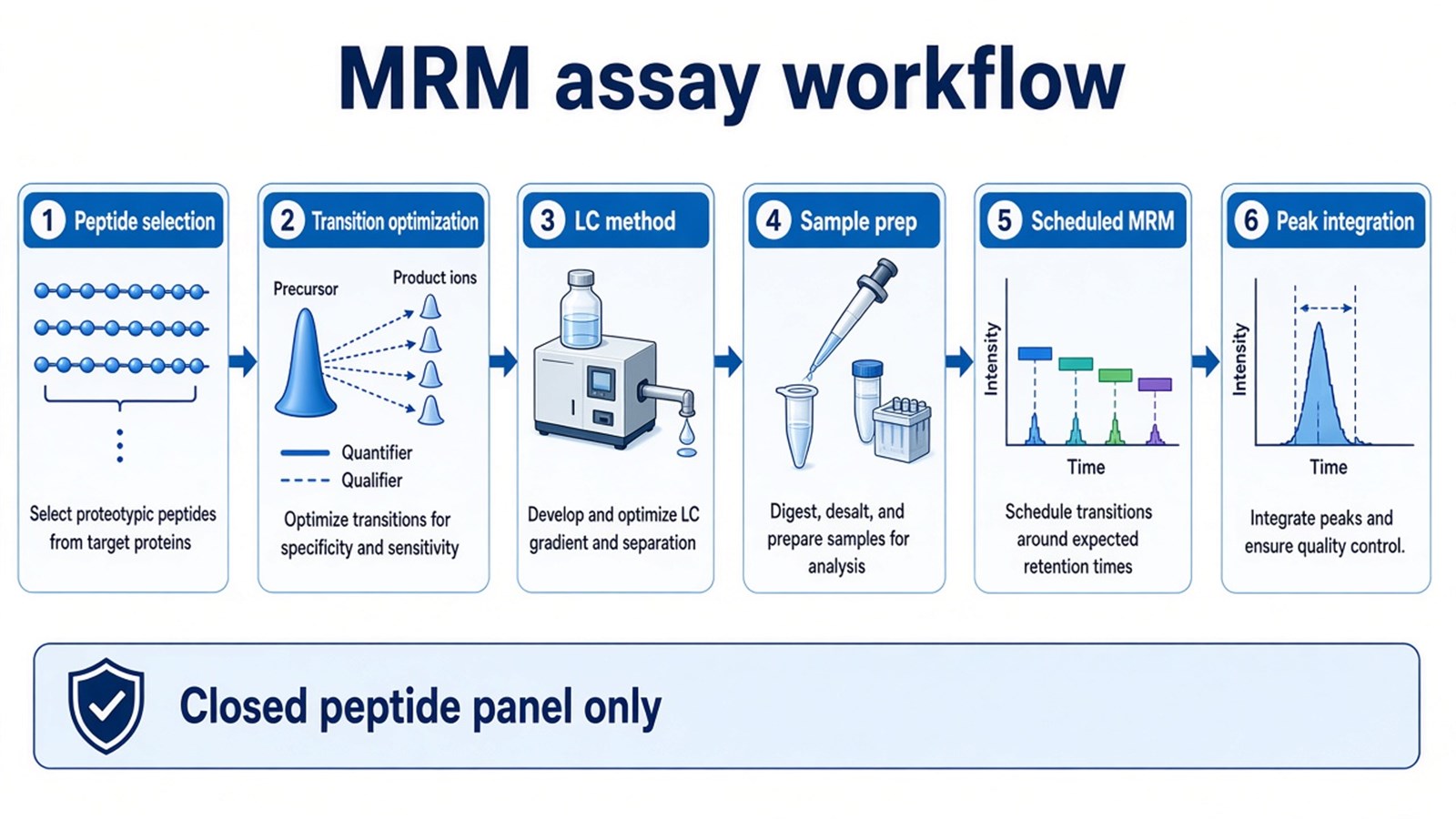
Figure 1. MRM assays move from peptide and transition selection through LC-MS acquisition to targeted quantitation across sample cohorts.
During acquisition, the instrument cycles through the predefined transition list. Because only selected ions are measured, dwell time per transition can be optimized for sensitivity and reproducibility. Scheduled MRM further restricts monitoring to expected retention-time windows, improving cycle efficiency for larger panels.
One Transition in Detail
Each MRM measurement tracks a specific precursor ion and one or more fragment ions produced upon collision-induced dissociation.
1. Precursor Selection (Q1)
The first quadrupole isolates the target peptide precursor ion by m/z.
2. Fragmentation (Q2)
The selected precursor enters the collision cell and generates product ions.
3. Product Monitoring (Q3)
The third quadrupole monitors defined product ion m/z values associated with the peptide.
4. Quantitation
Peak area for each transition is integrated and related to analyte abundance through calibrators, stable isotope-labeled internal standards, or relative normalization strategies.
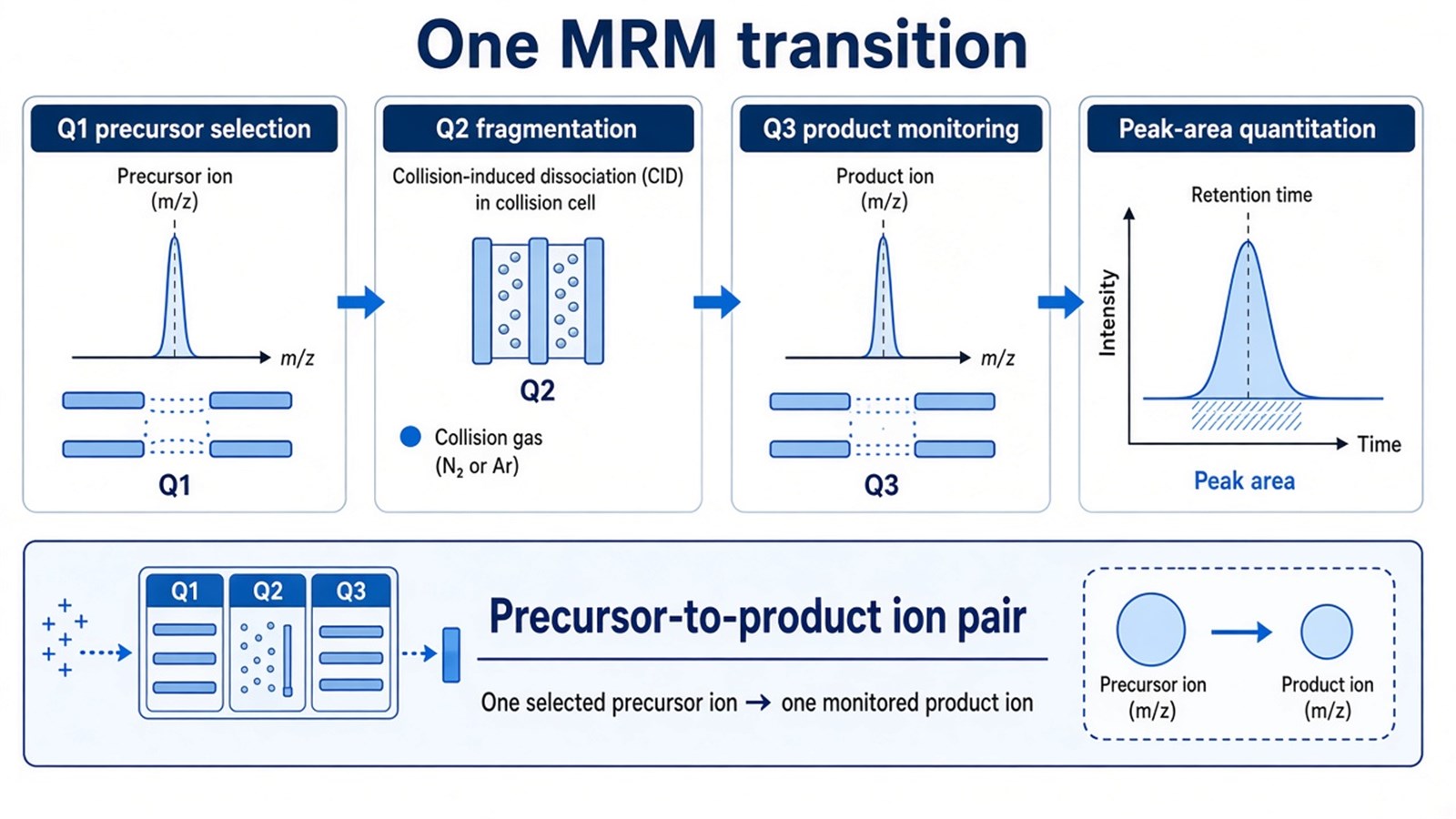
Figure 2. Each MRM transition monitors a defined precursor-to-product ion pair for selective peptide quantitation.
Using multiple transitions per peptide improves specificity. A co-eluting interference may affect one transition but is less likely to match all monitored product ions for the target peptide.
Typical Application Scenarios
1. Biomarker Validation
Confirm candidate protein abundance in larger research cohorts after discovery profiling.
2. Biopharmaceutical Peptide Quantitation
Measure product-related or process-related peptides in complex matrices for research or CMC-supporting characterization.
3. Pathway Protein Tracking
Quantify predefined signaling proteins across treatment conditions or time points.
4. Assay Transfer and Reproducibility Studies
Support methods that must perform consistently across batches when QC documentation is part of the project scope.
Strength |
Why it matters |
Limit if ignored |
|---|---|---|
High selectivity |
Predefined transitions reduce unrelated ion load |
Interference can still match a single transition |
Quantitative precision |
Optimized dwell and standards support repeat measurement |
Near-limit signals need QC acceptance rules |
Efficiency for fixed panels |
Cycle time spent on named targets |
Unknown proteins stay unmeasured |
Mature assay logic |
Transition lists transfer across cohorts |
Upfront method development is required |
Advantages and Challenges
Advantages
Predefined transitions reduce interference from unrelated ions in complex matrices. Optimized dwell times and internal standards support reproducible measurement across large sample sets when the panel is mature. MRM is well suited when the target list is fixed and repeat analysis is required.
Challenges
Unknown proteins cannot be quantified without prior peptide selection. Transition optimization, LC separation, and matrix evaluation take upfront effort. Low-abundance targets may require enrichment or improved sample prep. MRM confirms and quantifies predefined targets rather than surveying the proteome de novo.
Comparison with high-resolution precursor monitoring is covered in PRM vs MRM: Comparative Analysis in Quantitative Proteomics.
Sample and Assay Requirements
Reliable MRM quantitation depends on assay design as much as instrument performance.
1. Peptide Choice
Proteotypic peptides with strong MS response and limited modification variability are preferred.
2. Internal Standards
Stable isotope-labeled peptides improve precision and support absolute quantitation when used with calibrators.
3. Matrix Compatibility
Plasma, tissue, cell lysate, and formulation matrices each require specific prep and interference evaluation.
4. LC Separation
Adequate retention-time separation reduces isobaric interferences and improves transition specificity.
5. Sample Amount
Requirements depend on target abundance, panel size, and prep workflow. Feasibility review before shipment prevents underpowered assays.
For absolute quantitation projects, calibrator and stable isotope-labeled standard design should be scoped alongside transition selection. Relative quantitation may be sufficient for exploratory pathway comparisons. Biomarker validation and biopharmaceutical monitoring often require documented linear range, precision, and matrix-matched QC before results are used for publication or internal specification comparison. GMP release testing is outside ordinary research MRM reporting unless a separately validated framework is declared.
Expected Deliverables
A useful MRM project report should include more than peak lists. Typical deliverables often include:
- quantified analyte tables across samples
- transition list and retention-time documentation
- calibration or normalization method notes
- project-scoped quality metrics such as precision or linearity summaries when validated
- comments on matrix interference or failed transitions when applicable
Researchers should define whether relative or absolute quantitation is required during scoping. Validation studies may also require specificity and reproducibility documentation aligned to the project plan. For biopharmaceutical CMC-supporting workflows, document which transitions are reportable and how system suitability will be judged before the full sample queue is submitted.
Frequently Asked Questions
1. How is multiple reaction monitoring different from PRM?
Both are targeted quantitative approaches. MRM typically uses triple-quadrupole instruments with predefined transitions. PRM often uses high-resolution MS and stores full product-ion spectra for post-acquisition fragment selection. Both quantify predefined peptides.
2. Can MRM quantify proteins in plasma?
Yes, when proteotypic peptides are detectable after appropriate sample prep and interference is controlled. Low-abundance targets may require enrichment.
3. Does MRM replace discovery proteomics?
No. Discovery workflows identify candidates. MRM validates and quantifies predefined targets at scale.
4. How many proteins can one MRM panel include?
Panel size depends on chromatography, cycle time, and scheduling strategy. Feasibility review clarifies realistic multiplexing for a given sample type.
5. Is SRM the same as MRM?
The terms are often used interchangeably for targeted triple-quadrupole quantitation, though instrument platforms may use different naming conventions.
Conclusion
Multiple reaction monitoring provides a selective, reproducible route to targeted peptide quantitation when the protein or peptide list is predefined and repeat measurement across many samples is required. By optimizing transitions, LC separation, and internal-standard strategy, teams can build assays that support biomarker validation, biopharmaceutical peptide monitoring, and pathway-focused quantitation with higher specificity for a fixed panel than discovery-scale profiling alone. Researchers planning MRM assay development or targeted peptide quantitation can contact MtoZ Biolabs to review target list, sample matrix, and reporting needs, and can also consult the MtoZ Biolabs Multi Reaction Monitoring MRM Service for project-specific feasibility and method planning.
