






Folate Receptor Autoantibodies: Principles, Applications, and Method Considerations
Folate receptor autoantibodies can be measured in research, but the assay should match the biological question
Before starting or outsourcing a folate receptor autoantibody study, a research team should define four points: whether the project needs a binding or blocking readout, which specimen types and storage histories are acceptable, how antigen format and controls will affect comparability, and what the assay can reasonably support in interpretation. In practice, folate receptor autoantibodies are not a single uniform analyte class with one standard measurement strategy. A binding signal, a ligand-blocking effect, and a receptor-functional response are related observations, but they are not interchangeable. That distinction should shape assay selection, QC design, and reporting expectations from the start.
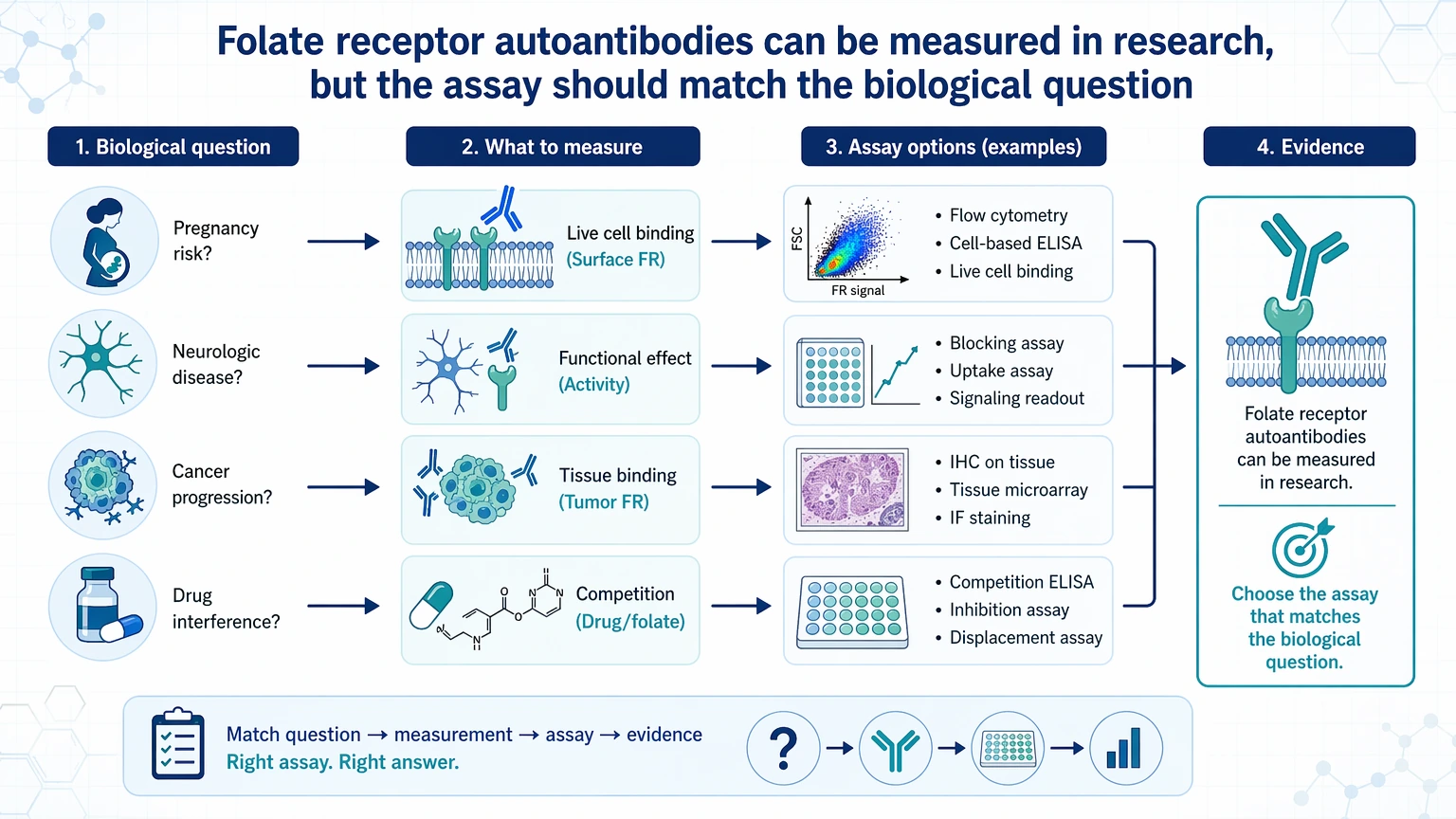
This matters early, especially for archived serum or plasma. Sample matrix, freeze-thaw exposure, endogenous folate, receptor source, and cutoff logic can all influence how a result is generated and how well it can be compared across cohorts. The most useful first step is not comparing providers by speed or price. It is checking whether the biological question, available samples, and analytical format actually fit one another.
What Are Folate Receptor Autoantibodies?
Folate receptor autoantibodies are endogenous antibodies that recognize folate receptor proteins, most often folate receptor alpha (FRα) in the research literature. FRα is a folate-binding protein involved in cellular folate uptake through receptor-mediated processes. When investigators refer to folate receptor autoantibodies, they may mean antibodies that simply bind the receptor, antibodies that interfere with folate binding, or both.
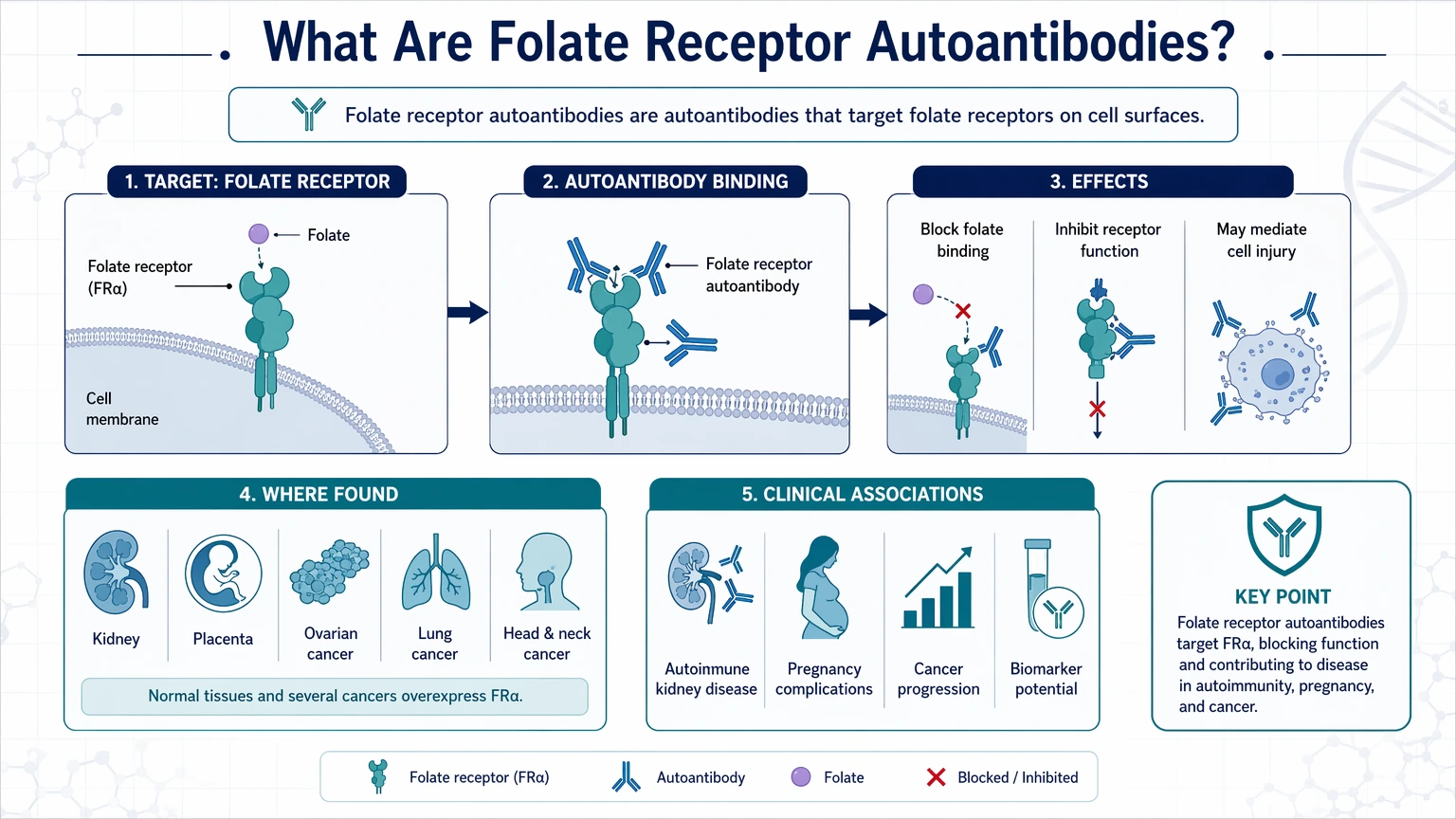
The terminology can be misleading because the phrase sounds singular, while the measurable behaviors are not. A study may report:
- total or relative binding autoantibodies
- blocking autoantibodies that inhibit folate binding
- functional effects on a ligand-receptor interaction
- assay-specific units that cannot be directly compared across platforms
For researchers planning exploratory biomarker research, the first decision is conceptual: do you want to know whether antibodies recognize FRα at all, or whether they disrupt a defined receptor-ligand event?
Biological Principles Behind Folate Receptor Autoantibody Measurement
All folate receptor autoantibody assays rely on antigen-antibody recognition, but the meaning of the signal depends on how the receptor is presented and which endpoint is measured.
Antigen source and conformation affect detectability
An antibody may recognize a linear epitope, a conformational epitope, or an epitope exposed only under a particular immobilization or buffer condition. For that reason, antigen conformation is a major design variable. Recombinant FRα coated onto a plate, native receptor captured from a biological source, and receptor displayed in a cell-based context may not expose the same binding surfaces.
This affects two practical questions:
1. whether an antibody in the sample is detected at all 2. whether the detected signal represents the same antibody population across methods
Binding signal and biological function are different readouts
A positive binding assay shows that antibodies in the sample interact with the assay antigen under defined conditions. It does not automatically show that those antibodies interfere with folate binding or receptor activity. A blocking assay goes a step further by testing whether sample antibodies reduce receptor access to folate, or to a folate-like ligand probe.
That difference is central to interpretation. The literature may discuss folate receptor autoantibodies broadly, but the assay measures only the event built into that method.
Binding vs. Blocking Autoantibodies: What Is the Difference?
Binding autoantibodies are detected through recognition. In a typical ELISA, FRα is immobilized, the sample is incubated, and bound immunoglobulin is detected with a labeled secondary antibody. The readout is usually an optical or chemiluminescent signal that tracks antibody binding within the assay’s working range.
Blocking autoantibodies are detected through interference. In an inhibition assay, the core question is whether antibodies in the sample reduce the interaction between FRα and folate, or another assay ligand. The readout is therefore functional within the assay system, even though it is still not a direct model of in vivo folate transport.
Why the distinction matters:
- Binding assays are often easier to implement for screening and higher-throughput workflows.
- Blocking assays map more directly to the question of folate binding inhibition.
- A sample may appear positive in one format and equivocal in another.
- Cross-study comparison becomes difficult when one group reports binding units and another reports percent inhibition.
For a large archived cohort, a binding assay may be appropriate for broad stratification. For a mechanistic study focused on disrupted receptor engagement, a blocking format may be more informative. Some projects use a staged design: screen with a binding assay first, then test selected samples in an inhibition-based method.
Common Assay Approaches for Folate Receptor Autoantibody Analysis
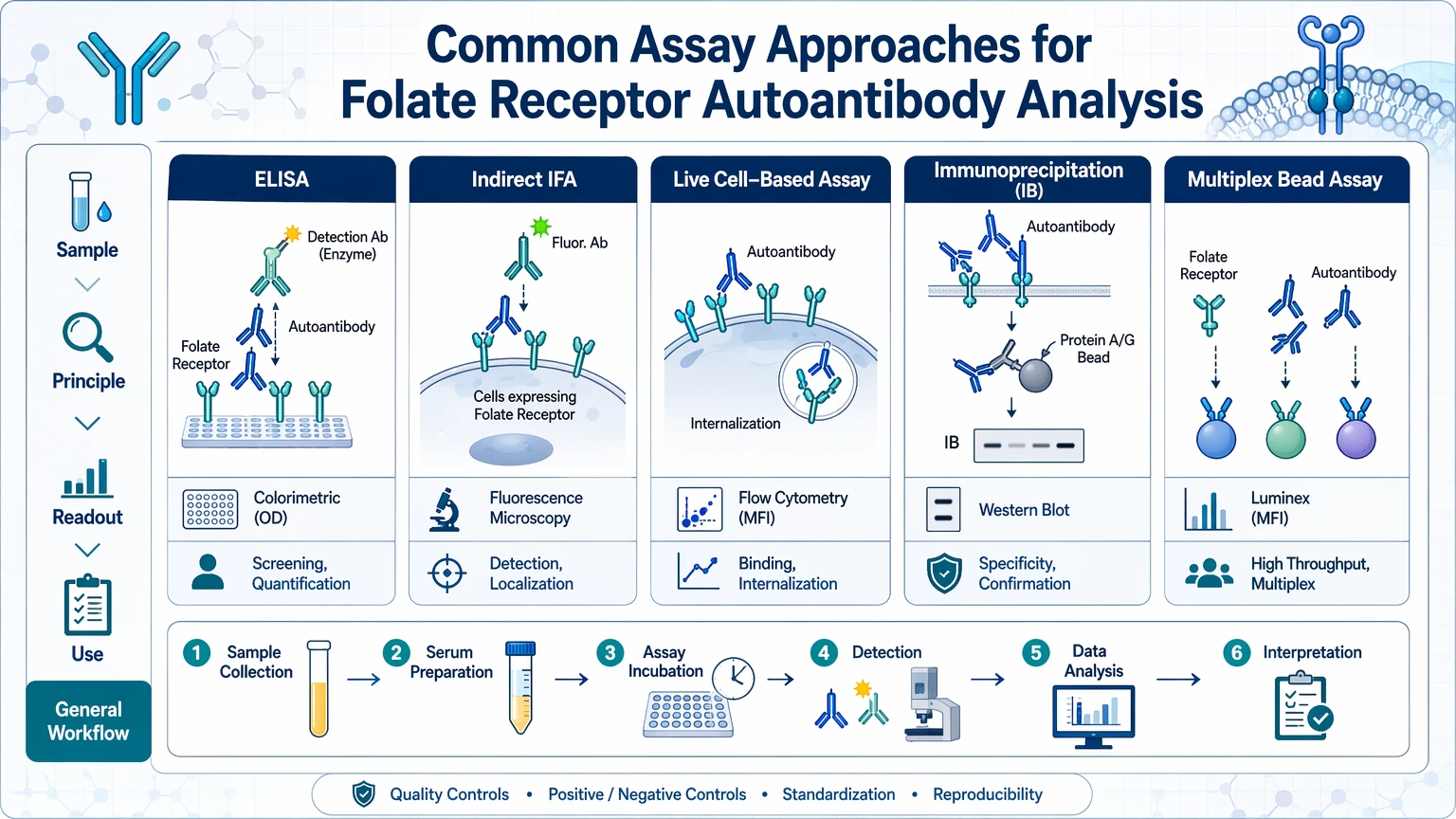
ELISA-style binding assays
An ELISA or similar plate-based immunoassay is commonly used for binding autoantibody detection. Advantages include manageable throughput, batch-based processing, and relatively straightforward normalization. However, assay behavior depends heavily on coating chemistry, receptor purity, blocking buffer composition, and control of nonspecific background.
Useful review points include:
- receptor identity and preparation
- plate coating or capture strategy
- secondary antibody specificity
- calibration model or semi-quantitative reference approach
- blank, negative control, and positive control placement
- duplicate or triplicate measurement plan
Competitive or inhibition-based formats
A blocking or competitive format evaluates whether sample antibodies reduce a receptor-folate interaction. This can be implemented through labeled ligand competition, receptor occupancy approaches, or other assay-specific inhibition workflows. The main advantage is closer alignment with the question of interference. The main challenge is that endogenous folate, matrix background, and receptor-ligand equilibrium conditions can complicate interpretation.
Investigators should ask how inhibition is defined, how baseline signal is normalized, and whether the report provides raw signal, percent inhibition, or a calculated titer-like result.
Cell-based or receptor-functional formats
Some projects use cell-based methods when receptor presentation or membrane context is part of the research question. These assays may preserve more native receptor display, but they also introduce added variability from cell state, expression level, and assay timing. They are usually less suitable for broad screening unless the project specifically requires that context.
Calibration and reporting
Not every folate receptor autoantibody method yields an absolute concentration. Many are qualitative or semi-quantitative. That is acceptable for research-use-only work, but the reporting format should be defined before the study begins:
- qualitative positive/negative calls
- semi-quantitative normalized units
- relative titer
- percent inhibition
- quantitative signal against a reference calibrator, if available
Research Applications and Study Contexts
Folate receptor autoantibody analysis is relevant when the study question involves immune recognition of FRα, receptor-ligand interference, or inclusion of this analyte class in a broader biomarker program.
Exploratory cohort stratification
A team may want to know whether archived serum or plasma contains detectable folate receptor autoantibodies and whether the signal distribution supports subgroup analysis. In that setting, consistency of sample handling and assay batching often matters more than maximizing mechanistic depth in the first pass.
Mechanistic immunology studies
Here the goal may be to determine whether antibodies recognize FRα, whether they differ by epitope or function, and whether a binding readout tracks with a blocking readout. That usually calls for orthogonal assays rather than a single platform.
Developmental or maternal-fetal research contexts
Some literature discusses folate receptor autoantibodies in neurodevelopmental or maternal-fetal settings. In a research-focused article like this one, the main takeaway is methodological restraint: associations reported in the literature do not make a research assay a diagnostic tool. When samples come from heterogeneous biobanks, pre-analytical comparability becomes a primary concern.
Panel expansion or method transfer
Teams expanding an autoantibody panel or receptor-ligand workflow may include folate receptor autoantibodies as one analyte family among others. In that case, platform compatibility, throughput, and control harmonization may matter more than direct comparison with legacy publications.
Method Considerations That Affect Data Interpretation
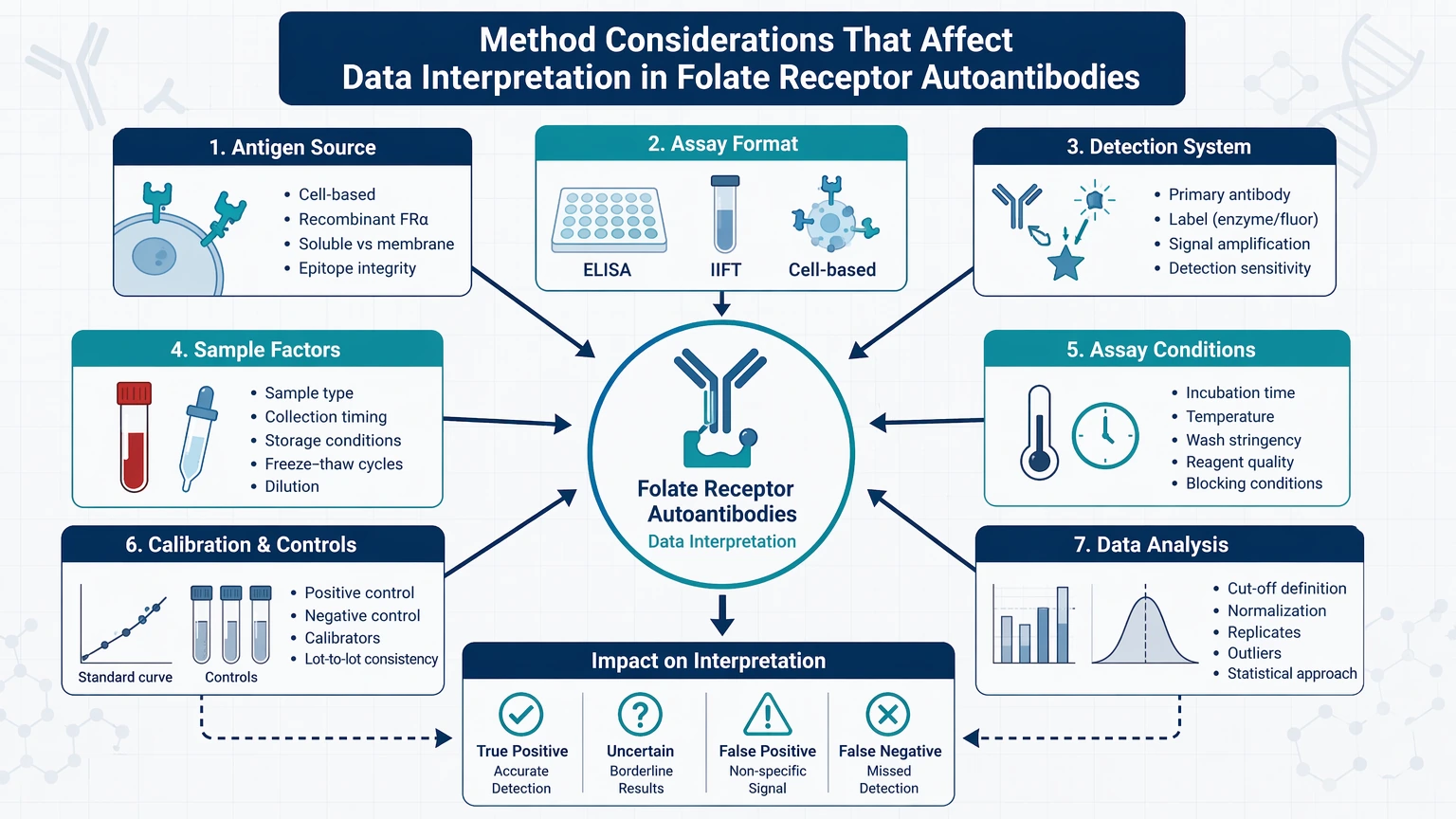
Sample type and storage history
Serum and plasma are both used in research, but they should not be treated as interchangeable without prior review. Anticoagulant effects, storage duration, and sample bank handling records may shift background or stability characteristics. Archived specimens should be grouped by comparable handling history whenever possible.
Freeze-thaw exposure
Repeated freeze-thaw cycles may change immunoreactivity, background, or aggregate behavior in some matrices. Even when the effect is modest, unequal freeze-thaw history across groups can weaken confidence in cross-sample comparison.
Matrix effect and sample quality
A matrix effect may arise from endogenous proteins, heterophilic antibodies, lipemia, hemolysis, or other sample-specific background. This becomes especially important in low-signal assays. Analytical specificity should therefore be assessed in the intended matrix rather than inferred from buffer-only experiments.
Endogenous folate and assay interference
In a blocking format, endogenous folate or related assay interference may alter the apparent degree of receptor-ligand inhibition. That does not automatically invalidate the assay, but it does mean pre-analytical handling and assay buffer design should be reviewed as part of the study plan.
Receptor preparation and lot consistency
Different FRα preparations may not behave identically. Changes in purity, folding, capture orientation, or lot-to-lot manufacturing can alter signal windows and comparability. For studies that span multiple runs or long enrollment periods, reagent continuity is part of the interpretation framework, not just an operational detail.
Precision and repeatability
For research use, the key question is whether precision is fit for purpose. A broad discovery screen, a pilot cohort, and a mechanistic follow-up do not require the same depth of analytical characterization. Ask for within-run and between-run repeatability data that match the intended matrix and reporting format.
Cutoff strategy
Cutoffs in folate receptor autoantibody research are method-dependent. A threshold derived from one platform should not be transferred to another without justification. Some studies are better served by distribution-based reporting, percentile stratification, or continuous signal analysis rather than a hard binary call.
How to Scope an Analytical Service for Folate Receptor Autoantibody Projects
A productive service discussion starts with the study design rather than the catalog label. Before outsourcing, prepare a short method brief that answers:
- Is the primary endpoint binding, blocking, or both?
- Are samples serum, plasma, or mixed archived materials?
- What is the sample count and expected batching strategy?
- Is the output qualitative, semi-quantitative, or inhibition-based?
- Which controls are required for scientific review?
- What level of fit-for-purpose validation is appropriate for the project stage?
It is also worth asking the provider to define the control system clearly. At minimum, that often includes a positive control, negative control, blanks, and, where relevant, inhibition controls. Reporting should explain how data are normalized, how outliers or repeat tests are handled, and which matrix limitations remain unresolved.
If your team is deciding whether a binding assay or an inhibition assay better fits an archived cohort, MtoZ Biolabs can help evaluate your project and outline a research-use workflow aligned with matrix constraints, control design, and reporting expectations before samples are committed.
Service Routes for Study Planning
For teams moving from method selection into execution, these service paths connect assay design, validation, and interpretation needs.
Conclusion
Folate receptor autoantibodies are a useful research analyte class when the study question is framed carefully. The main practical point is that there is no single universal measurement: binding autoantibodies, blocking autoantibodies, and receptor-functional effects answer different questions and may require different assay formats. Interpretation also depends on sample matrix, storage history, endogenous interference, receptor preparation, and the way controls and cutoffs are defined.
For most teams, the next step is to translate the biological question into an assay plan: choose the readout, confirm matrix compatibility, define the reporting format, and request analytical characterization that matches the project stage. To scope folate receptor autoantibody analysis for an exploratory or translational study, submit your requirements or contact us at MtoZ Biolabs to discuss sample type, study design, controls, and reporting needs.
FAQ
In research use, what does “folate receptor autoantibodies” actually refer to?
In most studies, the term refers to antibodies in a biological sample that recognize folate receptor proteins, usually folate receptor alpha (FRα). The term does not describe a single assay output. It may include simple receptor binding, measurable folate binding inhibition, or both, depending on the method.
When would a team choose a binding assay instead of a blocking assay?
A binding assay is often chosen when the first goal is screening, relative stratification, or confirming immunoreactivity against FRα. A blocking assay is more appropriate when the study needs to test whether antibodies interfere with a defined receptor-ligand interaction. The choice should follow the biological endpoint, not just assay convenience.
Which sample types are commonly used for folate receptor autoantibody detection?
Serum and plasma are the matrices most often considered in translational and exploratory studies. Either may be workable, but they should not be assumed to behave the same way. Matrix compatibility, anticoagulant effects, storage history, and sample quality should be reviewed before mixed-matrix analysis is attempted.
Why can two folate receptor autoantibody assays disagree on the same sample set?
Assay disagreement often reflects method design rather than simple error. Results can shift with receptor source, antigen conformation, binding versus blocking format, normalization strategy, control selection, and matrix interference. Two methods may be answering different analytical questions under the same analyte label.
Does detection of folate receptor binding antibodies prove functional interference?
No. Detection of binding autoantibodies shows that antibodies interact with the assay antigen under the stated conditions. It does not establish blocking activity. Functional interference should be tested in a functional assay or competitive format that directly evaluates the relevant ligand-receptor interaction.
What information should researchers prepare before requesting external analytical support?
A good starting package includes the study objective, target readout, sample matrix, storage history, expected sample count, batching plan, and preferred reporting style. It is also helpful to specify whether the project needs screening only, a blocking readout, orthogonal confirmation, or limited fit-for-purpose validation before larger-scale sample analysis.
How to order?




