






Fab vs Fc Antibody: Method Selection and Research Use Cases
Quick Answer
Choose a Fab-focused antibody method when your primary question is about antigen binding, variable-region access, epitope-related behavior, fragment detection, or reducing unwanted Fc-driven signal. Choose an Fc-focused method when your main question is about intact IgG quantification, isotype- or subclass-aware detection, Fc receptor interaction, Fc-mediated function, or whether the Fc region remains present and structurally relevant.
The choice becomes much easier when four points are defined up front: the biological question, the molecular format being measured, the matrix or platform, and the most damaging interpretation error. A Fab-specific antibody may produce the cleaner readout for binding-related questions, but an Fc-directed strategy may be more informative when Fc engineering, glycosylation-dependent behavior, or Fc-containing cleavage states affect interpretation. If the Fc region adds background, steric hindrance, or biology that is not relevant to the readout, Fab recognition is often the better fit.
Fab vs Fc Antibody: What Is the Functional Difference?
In method-selection terms, Fab refers to the antigen-binding fragment that contains the variable region and forms the paratope that engages an epitope on the target. Fc refers to the crystallizable fragment, the antibody constant region associated with isotype, subclass, and many forms of Fc-mediated function.
That structural distinction matters because Fab- and Fc-directed reagents answer different experimental questions.
A Fab-directed reagent is typically chosen to report on:
- whether the binding-competent region is present
- whether an antibody fragment such as Fab or F(ab')2 is detectable
- whether the variable domain remains accessible in the selected assay format
- whether a binding event can be measured without introducing Fc-related interactions
An Fc-directed reagent is typically chosen to report on:
- whether the analyte is an intact IgG or another Fc-containing construct
- whether subclass-aware detection is needed
- whether Fc integrity, Fc conformation, or Fc-associated interactions affect the assay
- whether Fc receptor binding or complement-relevant behavior is part of the study
For research teams, the key issue is not only which region is recognized, but what the signal means once it appears. A Fab-positive signal can indicate preserved binding-capable structure even if Fc is absent, altered, or cleaved. An Fc-positive signal can confirm the presence of an Fc-containing analyte even when antigen engagement is weak, blocked, or not measured directly.
How Fab-Directed and Fc-Directed Antibodies Change Assay Readouts
The same sample can lead to different conclusions depending on whether detection is Fab-selective or Fc-selective.
The table below summarizes the main planning implications for the method choice.
| Comparison Dimension | Fab-Directed Method | Fc-Directed Method |
|---|---|---|
| Region recognized | Variable-domain side of the antibody | Constant-region side of the antibody |
| Reports on | Binding-capable region, fragment presence, epitope-facing accessibility | Fc-containing analyte, intact format, subclass-linked behavior |
| Fragment discrimination | Can detect Fab and sometimes F(ab')2, depending on reagent design | Usually favors Fc-containing molecules and may miss Fc-free fragments |
| Intact antibody detection | May not distinguish intact IgG from certain fragments if Fab is preserved | Better suited when Fc presence defines the analyte |
| Fc receptor relevance | Usually avoids direct Fc biology in the readout | Appropriate for Fc receptor interaction or Fc-dependent interpretation |
| Matrix risk | Can reduce some endogenous Fc-related background | May be more exposed to Fc-like interference from endogenous immunoglobulins |
| Engineered molecule fit | Often useful for Fc-silenced or Fc-removed formats | Useful when Fc engineering itself is under study |
Use these differences to align the analytical method with the biological question and validation plan.
This difference changes assay behavior in several practical ways.
First, readout identity changes. In a ligand-binding assay, Fab recognition may show that a molecule still has accessible antigen-binding structure, but it does not confirm that the Fc region is intact. By contrast, Fc recognition can confirm an Fc-containing analyte, but it may not show whether the variable region remains functionally available.
Second, interference sources change. If the matrix contains endogenous immunoglobulins or Fc-binding components, an Fc-specific antibody can add unwanted background or increase cross-reactivity risk. A Fab-specific antibody may reduce that problem when it is truly selective for the analyte-facing binding region. However, Fab-focused detection can still be affected by target-bound complexes, anti-idiotype effects, or steric masking around the paratope.
Third, steric accessibility changes with assay geometry. In SPR, BLI, ELISA, or bead-based formats, a Fab epitope may become partly blocked when the therapeutic antibody is target-bound. In the same complex, an Fc epitope may remain exposed, or the opposite may occur if Fc is surface-proximal or conformationally restricted. Region choice should therefore be considered together with capture orientation, solution-phase behavior, and the expected complex state.
Fab vs Fc Antibody Selection by Research Goal
A practical starting point is the decision the assay must support.
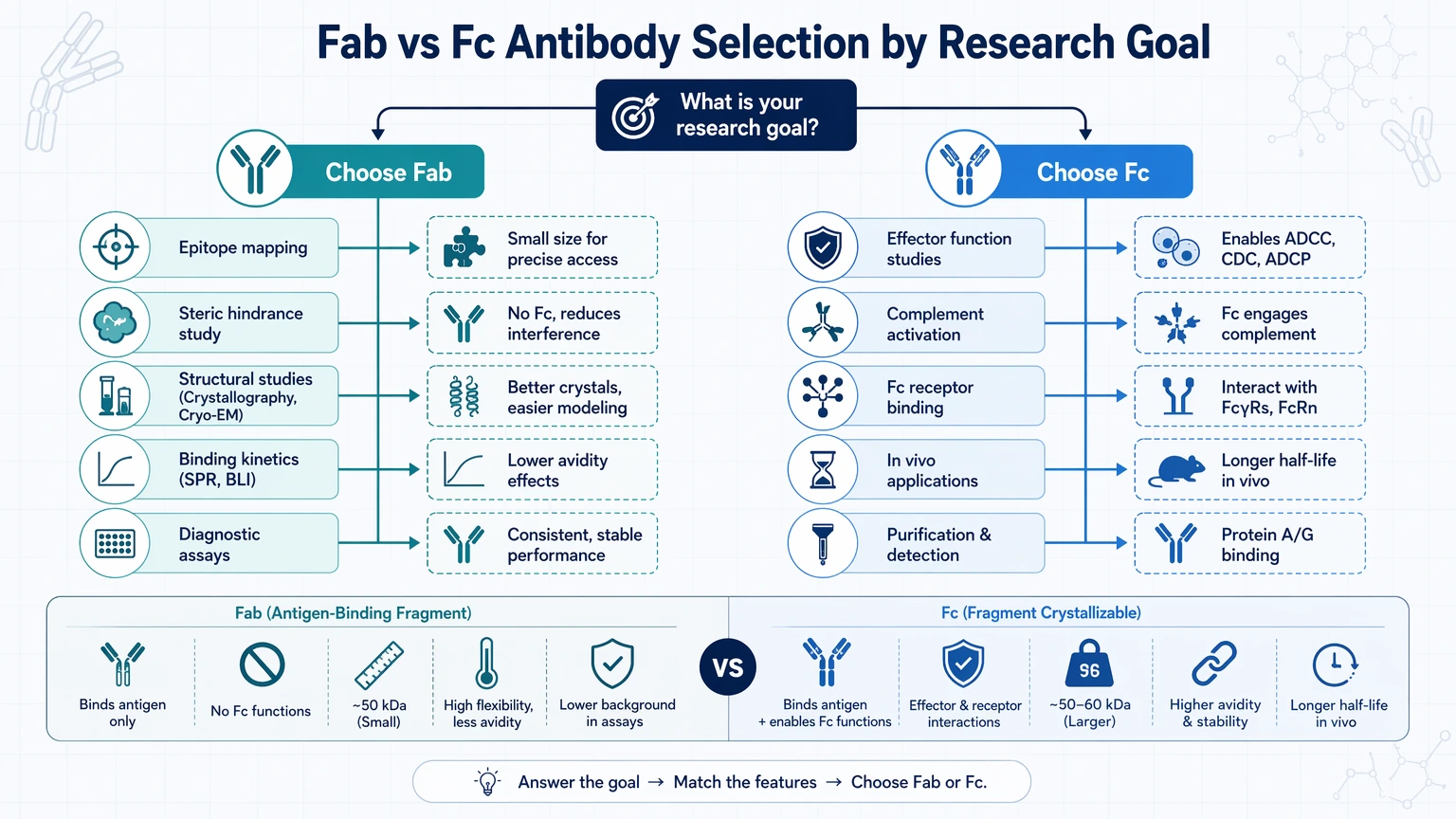
Choose a Fab-focused approach when the goal is to measure binding-related behavior
This includes projects centered on:
- target engagement
- epitope-sensitive binding characterization
- competition or blocking studies
- variable-region accessibility
- fragment tracking
- bispecific antibody arm-specific questions in which Fc presence is not the main readout
In these cases, a Fab-specific antibody often provides a more direct signal because the monitored region is closer to the biological interaction of interest. This is especially useful when the Fc region would add irrelevant detection signal or when the analyte includes Fc-silenced or Fc-truncated formats.
Choose an Fc-focused approach when the goal is to measure format-related behavior
This includes projects centered on:
- intact antibody detection
- isotype or subclass differentiation
- Fc receptor binding study
- glycosylation-sensitive Fc workflows
- Fc integrity during stress, conjugation, or bioanalytical handling
- comparison of full-length molecules with fragment-based derivatives
Here, the Fc region is part of the biological question rather than a passive structural feature. If interpretation depends on whether the molecule carries Fc, which subclass it belongs to, or whether Fc conformation remains preserved, Fc-directed detection is often necessary.
When to Choose Fab-Specific Methods
A Fab-specific strategy is often the better choice in the following scenarios.
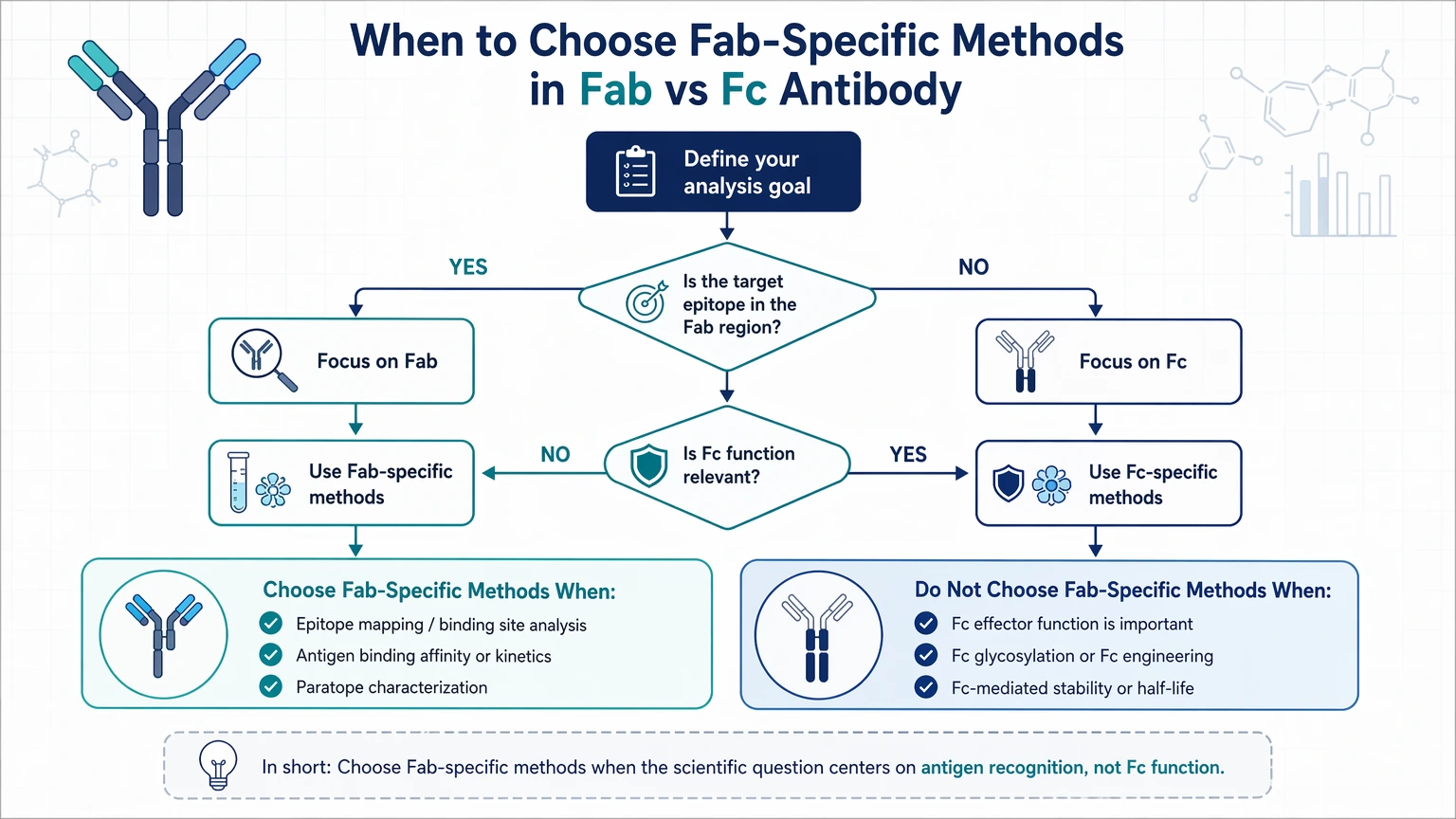
1. You need to track antigen-binding capability rather than whole-molecule presence
For receptor occupancy or target-binding workflows, a Fab-focused reagent can align the signal more closely with binding competence. This is useful when a full-length antibody, Fab fragment, or F(ab')2 may all be present, but only the antigen-binding side matters for interpretation.
2. Fc background is likely to distort the readout
In serum- or plasma-like matrices, endogenous immunoglobulins and Fc-binding proteins can complicate Fc-directed detection. A Fab-specific antibody can reduce those signals when it is selective for the relevant binding domain or idiotype-facing structure. It does not remove all matrix interference, but it can narrow the main sources of ambiguity.
3. The molecule is Fc-engineered, Fc-silenced, or Fc-free
An engineered antibody may include Fc changes introduced for half-life tuning, effector silencing, or developability goals. Fragment therapeutics may remove Fc entirely. In those cases, Fc-directed methods may underreport, fail to detect, or generate a signal that no longer maps well to the research objective.
4. You need to distinguish binding-capable fragments from intact format
In antibody fragment analysis, Fab recognition can help identify whether a cleaved or fragment-derived species still contains active antigen-binding architecture. That matters when cleavage products remain relevant to the study but should not be interpreted as intact IgG.
5. You want to minimize Fc-mediated biology in the assay itself
If Fc binding to cells, receptors, or matrix components would change apparent target binding, Fab-directed capture or detection can produce a cleaner analytical setup.
When to Choose Fc-Specific Methods
An Fc-specific strategy is favored when the Fc region itself carries meaning for quantification or biological interpretation.
1. The analyte must be confirmed as intact IgG
If the question is “how much full-length therapeutic remains present,” Fc recognition is often more appropriate than Fab recognition. A Fab signal alone may still come from partially degraded or fragmented material with preserved binding domains.
2. Subclass or isotype matters to the workflow
When comparing candidates with different subclasses, or when subclass-dependent behavior affects detection, an Fc-specific antibody can add selectivity that a Fab-directed reagent does not provide. This can matter in candidate ranking, bridging assay design, or reagent qualification.
3. Fc receptor interaction is part of the study
For Fc receptor binding, effector-linked characterization, or Fc conformation-sensitive questions, Fab-directed methods do not address the main mechanism. In these studies, the constant-region side of the molecule is central to the design.
4. You need to separate full antibody from Fc-free formats
In mixed samples containing intact antibody, cleavage products, or fragment-based constructs, Fc-focused detection can help define which signal belongs to the Fc-containing population.
5. Conjugation, glycosylation, or Fc engineering may change interpretation
ADC-related workflows, Fc glycan changes, or Fc substitutions can alter epitope exposure and shift what the assay signal represents. In those settings, an Fc-specific antibody may be required not only for detection but also for structural-state interpretation.
Platform and Workflow Considerations for Fab vs Fc Studies
Method selection is also shaped by platform mechanics.
ELISA and ligand-binding assay formats
In ELISA or other ligand-binding assay workflows, Fab recognition can work well when target binding is the biological anchor and Fc should remain analytically silent. Fc recognition fits better when the goal is to quantify full-length analyte or track Fc-containing species across samples.
Key design questions include:
- Is the analyte free, target-bound, or complexed?
- Does the capture reagent expose or mask the Fab epitope?
- Will endogenous immunoglobulins affect Fc-specific detection?
- Do you need to differentiate Fab, F(ab')2, and intact IgG?
SPR and BLI
In label-free binding studies, steric orientation matters as much as region specificity. If capture through Fc leaves the variable region exposed for target interaction, Fc capture may be analytically convenient. If Fc capture distorts binding geometry or if Fc heterogeneity affects baseline behavior, Fab-side strategies may be preferable.
Flow cytometry and receptor occupancy assay design
For cell-based receptor occupancy or target engagement studies, Fab-directed detection can help when Fc interactions with cell-surface Fc receptors would inflate background. Fc-directed detection may still be the right choice if the goal is to track intact therapeutic at the cell interface rather than only the binding-competent region.
Western blot and immunoprecipitation
Under denaturing conditions, Fc and Fab epitopes can behave differently than they do in native-state assays. A reagent that performs well in native binding analysis may not preserve the same selectivity in blotting or pull-down workflows. This is especially relevant for disulfide-linked fragments, cleavage products, and conformationally sensitive Fc reagents.
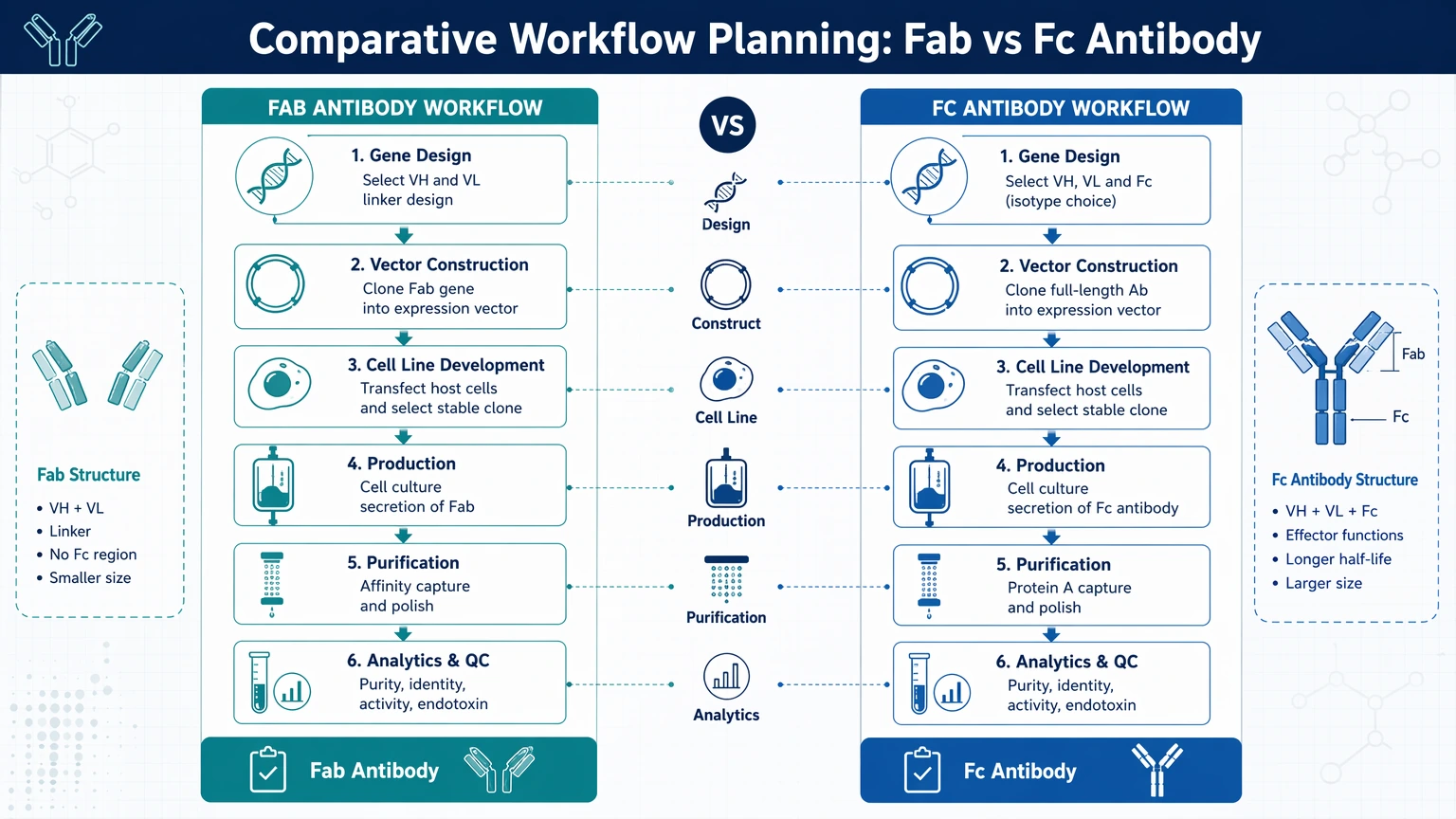
Comparative workflow planning
When uncertainty remains high, a side-by-side pilot using Fab- and Fc-directed reagents often shows whether the main risk comes from background, fragment ambiguity, or target-complex masking. Teams planning that comparison can submit your requirements to MtoZ Biolabs for workflow evaluation tied to assay objective, analyte format, and interpretation risk.
Common Pitfalls in Fab vs Fc Antibody Method Selection
Several common mistakes can make the data harder to interpret.
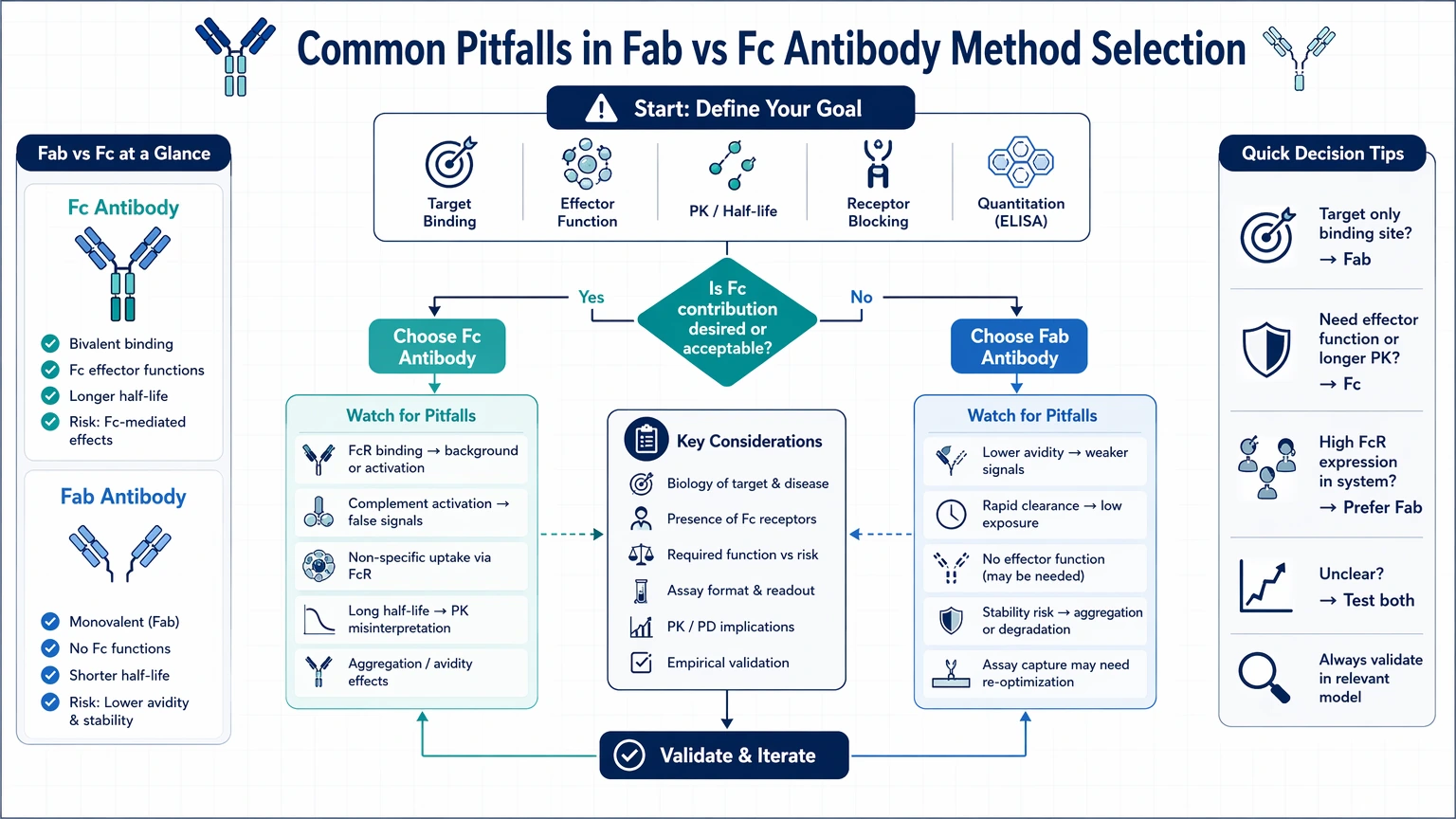
Treating Fab-positive as equivalent to intact antibody
A Fab signal does not automatically mean full-length antibody is present. Cleaved products or fragment species may still retain detectable antigen-binding fragment structure.
Treating Fc-positive as equivalent to functional binding
An Fc signal confirms Fc-containing material, not active target binding. The variable region may be blocked, altered, or inaccessible.
Ignoring species and subclass cross-reactivity
An Fc-specific antibody can behave differently across species, subclasses, and engineered backbones. Fab-directed reagents can also show unexpected cross-reactivity if the variable-domain recognition strategy is not tightly defined.
Overlooking steric hindrance
A region can be structurally present but analytically inaccessible. Steric hindrance is a common reason a theoretically suitable reagent performs poorly in a real assay geometry.
Using pan-Ig detection when fragment discrimination matters
A broadly reactive anti-Ig reagent may seem convenient, but it is often the wrong choice when the study depends on separating intact, cleaved, and fragment-derived species.
How to Evaluate the Right Antibody Strategy for Your Project
A practical decision framework is:
1. Define the readout. Are you measuring binding capability, intact format, Fc-mediated function, or more than one of these? 2. Define the analyte state. Is it full-length IgG, Fab, F(ab')2, an Fc-engineered construct, a bispecific antibody, or a conjugated molecule? 3. Define the assay environment. Is the sample in buffer, a serum-like matrix, a cell-based context, or a surface-immobilized format? 4. Define the main interpretation failure. Is the greater risk counting fragments as full antibody, or counting Fc-containing material as biologically active binder? 5. Pilot the leading options. If the answer still looks ambiguous, compare Fab- and Fc-directed methods before expanding the workflow.
The best choice is usually the one that makes the signal easiest to interpret, not the one that appears simplest on paper. If your team is building a translational assay, comparing candidate detection formats, or trying to separate fragment-related signal from intact-analyte signal, contact us at MtoZ Biolabs to evaluate your project and align the assay strategy with the decision the data must support.
FAQ
Can a Fab-specific antibody distinguish Fab from F(ab')2?
Not always. Some reagents recognize determinants shared by both Fab and F(ab')2, while others are designed to favor one format. If fragment-level discrimination matters, check whether the reagent was tested side by side against full IgG, Fab, and F(ab')2 under the same assay conditions.
Is Fc-specific detection always the better choice for pharmacokinetic-style research assays?
No. Fc-specific detection is often useful when the analyte definition requires Fc-containing material, but it can miss Fc-free fragments or overrepresent molecules that remain Fc-positive while no longer matching the biological question. In research PK-style workflows, the better option depends on whether you need total Fc-containing analyte, binding-capable analyte, or a separate measure of each.
How do bispecific antibodies complicate fab vs fc antibody selection?
A bispecific antibody may include two different binding arms, altered spacing, or engineered Fc behavior. Fab-directed detection can be more informative when arm-specific accessibility or binding asymmetry matters. Fc-directed detection is more informative when the goal is to confirm full-format presence, Fc retention, or Fc-dependent interactions. In some projects, one Fab-side assay and one Fc-side assay are both needed because they answer different questions.
What happens if the Fc region has been engineered to reduce effector activity?
Fc engineering can change epitope accessibility, conformational behavior, or subclass-like recognition by certain Fc-directed reagents. As a result, an Fc-specific antibody validated on wild-type IgG may not behave the same way on an Fc-silenced construct. Testing against the actual engineered molecule is more informative than assuming direct transfer.
Does Fab targeting remove endogenous immunoglobulin interference in all matrices?
No. It can reduce some Fc-linked background, but it does not eliminate other interference sources such as target complexes, anti-drug antibodies in research settings, heterophilic interactions, or steric masking. Fab selection narrows one class of interference; it does not make the matrix analytically simple.
When is it useful to run both Fab- and Fc-directed methods in the same project?
A paired strategy is useful when you need to compare binding-capable signal with Fc-containing signal, or when you need to distinguish intact antibody from cleavage or fragment-derived species. Running both approaches can clarify whether a change in readout reflects loss of Fc, loss of binding capacity, or both.
Service Routes for Study Planning
For teams moving from method selection into execution, these service paths connect assay design, validation, and interpretation needs.
Conclusion
For fab vs fc antibody method selection, the clearest rule is this: choose Fab-focused methods when the decision depends on antigen-binding region behavior, fragment relevance, or avoidance of unwanted Fc-driven signal; choose Fc-focused methods when the decision depends on intact format, subclass-aware detection, Fc receptor interaction, or other Fc-mediated function. Neither approach is the default winner across all studies.
The most reliable choice comes from matching the recognized region to the research objective, molecule format, assay context, and interpretation risk. If the project includes engineered formats, fragment populations, complex matrices, or translational readouts such as target engagement or receptor occupancy, a comparative pilot can reduce misinterpretation before method lock. To plan that comparison, submit your requirements and discuss the assay strategy before execution.
How to order?




