






Electron Microscopy Based Polysaccharide Analysis Service
- Observe the particle morphology, size, and distribution characteristics of polysaccharides
- Analyze the surface structure and molecular aggregation patterns of polysaccharides
- Evaluate the three-dimensional network structure and structural stability of polysaccharides
- Compare morphological differences of polysaccharides from different sources or under varying treatment conditions
- High-resolution electron microscopy image files (TIFF or PNG format)
- Image processing and size analysis tables (Excel format)
- Comprehensive analysis report (PDF format), including experimental conditions and structural interpretation
- Raw image data files
MtoZ Biolabs has launched the electron microscopy based polysaccharide analysis service which enables visualized analysis of the micro-morphology, molecular structure, and aggregation state of polysaccharides. This service is widely applied in natural product research, polysaccharide characterization, and structure-function relationship studies, providing intuitive data support for polysaccharide structural elucidation and performance evaluation.
Principle of Electron Microscopy
Electron microscopy (EM) is a high-resolution analytical technique that uses an electron beam for imaging and obtains microstructural information of samples through the interaction between electrons and matter. Compared with optical microscopy, electron microscopy offers higher magnification and resolution, allowing observation of structural details at the nanometer scale. Common types include transmission electron microscopy (TEM) and scanning electron microscopy (SEM). In polysaccharide analysis, electron microscopy can be used to observe morphological features, aggregation states, and surface structures of polysaccharides, providing essential support for structural elucidation and functional studies.
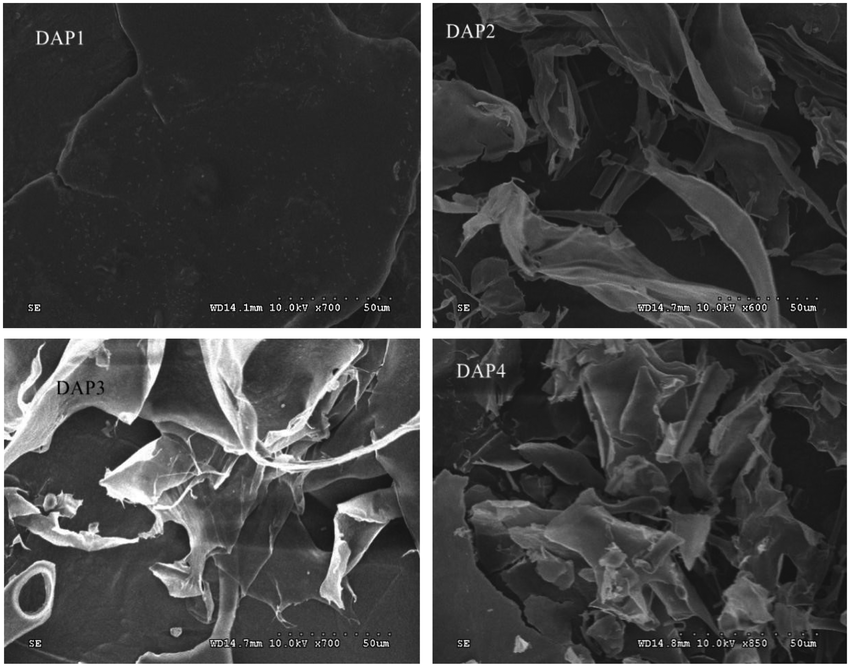
Cao, M. et al. Journal of Food Chemistry, 2020.
Figure 1. Scanning Electron Microscopy of Polysaccharides.
Electron Microscopy Based Polysaccharide Analysis Service at MtoZ Biolabs
MtoZ Biolabs provides clients with precise and visualized analysis services of polysaccharide morphology and structural characteristics through advanced electron microscopy technology, enabling observation of their microstructure, aggregation state, and surface features.
Our analysis provides an intuitive and comprehensive understanding of the structural characteristics and functional properties of polysaccharides, helping researchers gain deeper insight into their morphological basis and roles within biological systems.
Workflow of Electron Microscopy Based Polysaccharide Analysis Service
1. Sample Preparation
Polysaccharide samples are properly purified, dried, and embedded to ensure morphological stability and suitability for electron microscopy observation.
2. Imaging Detection
The appropriate type of electron microscope is selected according to the sample characteristics to obtain high-resolution images.
3. Image Acquisition and Optimization
Acquired micrographs are magnified, focused, and signal-enhanced to ensure image clarity and accurate structural details.
4. Image Analysis
The morphological features, aggregation states, and structural patterns of polysaccharides are identified, and quantitative analysis of size distribution and surface characteristics is performed.
5. Result Reporting
A comprehensive report including micrographs, structural feature descriptions, and analytical conclusions is provided to support polysaccharide structural and functional studies.
Why Choose MtoZ Biolabs?
✅ Ultra-High-Resolution Imaging: Intuitively displays the microscopic structure and morphological details of polysaccharides.
✅ Multi-Dimensional Structural Observation: Supports comprehensive analysis of both two-dimensional and three-dimensional morphologies.
✅ In-Situ Structural Preservation: Observes polysaccharides in their near-native state to reveal authentic morphology.
✅ Reliable and Stable Data: Standardized operational procedures ensure result consistency and reproducibility.
✅ One-Stop Analytical Support: Covers the entire process from sample preparation to imaging detection and data interpretation.
Applications of Electron Microscopy Based Polysaccharide Analysis Service
1. Polysaccharide Microstructural Observation
Visually presents the spatial conformation and surface morphology of polysaccharides, assisting in structural elucidation and feature identification.
2. Polysaccharide Complex Analysis
Used to study the structural characteristics and distribution of polysaccharides when bound to biomolecules such as proteins or nucleic acids.
3. Biological System Imaging Studies
Applicable for localization and morphological analysis of polysaccharides within cells or tissues, revealing their spatial distribution characteristics.
4. Stability and Environmental Response Studies
Observes morphological changes of polysaccharides under variations in temperature, pH, or enzymatic digestion to evaluate stability.
5. Comparative and Differential Analysis
Compares morphological differences of polysaccharides from various sources or under different treatment conditions, providing a basis for structural classification and functional analysis.
Deliverables
1. Comprehensive Experimental Details
2. Materials, Instruments, and Methods
3. High-Resolution Electron Microscopy Image Data
4. Polysaccharide Morphology and Structural Characterization Results
5. Size Distribution and Aggregation State Statistics
6. Comprehensive Analysis Report
7. Raw Data Files
FAQ
Q1: What types of samples are suitable?
A1: The electron microscopy based polysaccharide analysis service provided by MtoZ Biolabs is suitable for various types of polysaccharide samples, including natural polysaccharides, microbial polysaccharides, and their derivatives. To ensure clear imaging and reliable results, samples should have high purity, be free from salts, proteins, and impurities, and possess good dryness and dispersibility.
Q2: What is the service general workflow?
A2:

Q3: What data formats are provided?
A3: The service deliverables include standardized, multi-format data results to facilitate scientific analysis and further applications. Regular deliverables include:
If special analytical requirements exist, data formats can be customized according to project specifications.
Q4: How should I prepare my samples?
A4: To ensure optimal observation and analytical accuracy, it is recommended that sample preparation follow these guidelines:
(1) Sample Form: lyophilized powder or solution forms are acceptable
(2) Purity: avoid samples containing high salt content, proteins, or particulate impurities
(3) Storage Conditions: store at -20℃ for short-term and -80℃ for long-term preservation
(4) Shipping: transport with cold chain or dry ice, ensuring sealed, leak-proof containers
(5) Information Provided: specify sample source, treatment method, and intended observation objectives to optimize imaging parameters
For more information, please refer to Sample Submission Guidelines for Proteomics, Sample Submission Guidelines for Metabolomics.
Start Your Project with MtoZ Biolabs
Contact us to discuss your experimental design or request a quote. Whether you are exploring the morphological characteristics of polysaccharides or studying their aggregation states and structural differences, MtoZ Biolabs can provide you with high-resolution and professional electron microscopy analysis services.
How to order?




