






Edman Sequencing: When N-Terminal Residue Analysis Is Still the Right Choice
Introduction
Protein characterization now offers many mass spectrometry-based options for sequence confirmation, peptide mapping, and de novo assembly. In that landscape, Edman sequencing can appear old-fashioned. Yet N-terminal residue analysis by Edman degradation remains a strong choice in many real projects because it answers a focused question with direct chemistry: what amino acids are present at the free N-terminus, in order, starting from cycle one?
Not every project needs full-length protein sequencing. Some need only confirmation that a recombinant product begins with the expected sequence after signal peptide removal. Others need release testing on a purified peptide, orthogonal terminal evidence for a biologic lot, or a short direct readout when LC-MS/MS would add more complexity than the decision requires. Edman sequencing is still the right choice when the goal is sequential N-terminal confirmation from purified protein or peptide material with an accessible N-terminus.
This article explains how Edman degradation works, where it fits best, and when LC-MS/MS or broader sequencing workflows may be more appropriate instead.
Related Services
| Service Area | Recommended Service |
| Edman degradation sequencing | Protein Sequencing Service by Edman Degradation |
| N-terminal sequencing | N-Terminal Sequencing Service |
| Edman-based N-terminal analysis | Edman Degradation for N-Terminal Sequence Analysis Service |
| Blocked N-terminus handling | N-Terminal Sequencing (N-Terminal Unblocked) Service |
| MS-based N-terminal confirmation | MS-Based Protein N-Terminal Sequence Analysis Service |
| Biopharmaceutical N-terminal QC | Biopharmaceutical N-Terminal Sequencing Service |
Researchers evaluating N-terminal residue analysis options can consult MtoZ Biolabs to review sample purity, N-terminal accessibility, and the expected read length before Edman sequencing begins.
What N-Terminal Residue Analysis Means in Practice
N-terminal residue analysis asks a narrower question than full protein sequencing. It focuses on the amino acid sequence from the free N-terminus outward for a defined number of residues. The answer may be three to five residues for a quick QC check, ten to twenty residues for stronger terminal documentation, or a longer read when sample quality and project needs support additional cycles.
Edman degradation is direct because each cycle removes and identifies one N-terminal residue before the next cycle begins. The result is a sequential read built from chemistry rather than from inference across many digested peptides. That makes Edman sequencing especially useful when the decision depends on the actual start of the chain, such as confirming mature protein processing, verifying a synthetic peptide terminus, or documenting N-terminal identity for release or publication support.
The method is less appropriate when the N-terminus is blocked, when full-length unknown sequence recovery is required, or when the sample is too complex for clean cycle-one signal.
Core Principles of Edman Degradation
Edman sequencing begins with purified protein or peptide material presented in a sequencer- compatible format. In each cycle, phenyl isothiocyanate (PITC) reacts with the free alpha-amino group at the N-terminus. The terminal residue is cleaved, converted to a phenylthiohydantoin (PTH) amino acid, and identified, typically by reversed-phase HPLC comparison with standards. The shortened chain exposes a new N-terminus for the next cycle.
A typical automated Edman workflow includes:
1. feasibility review of purity, N-terminal accessibility, and target read length
2. sample loading or blot preparation
3. repeated coupling, cleavage, and PTH identification cycles
4. assembly of the N-terminal read from cycle data
5. QC review of signal strength and ambiguous cycles
6. report delivery with sequence and confidence notes
Sample purity and a free N-terminus strongly affect outcome. Highly pure material usually gives the cleanest early-cycle data. Blocked, modified, or contaminated samples may show weak cycle one signal or rapid signal loss in later cycles.
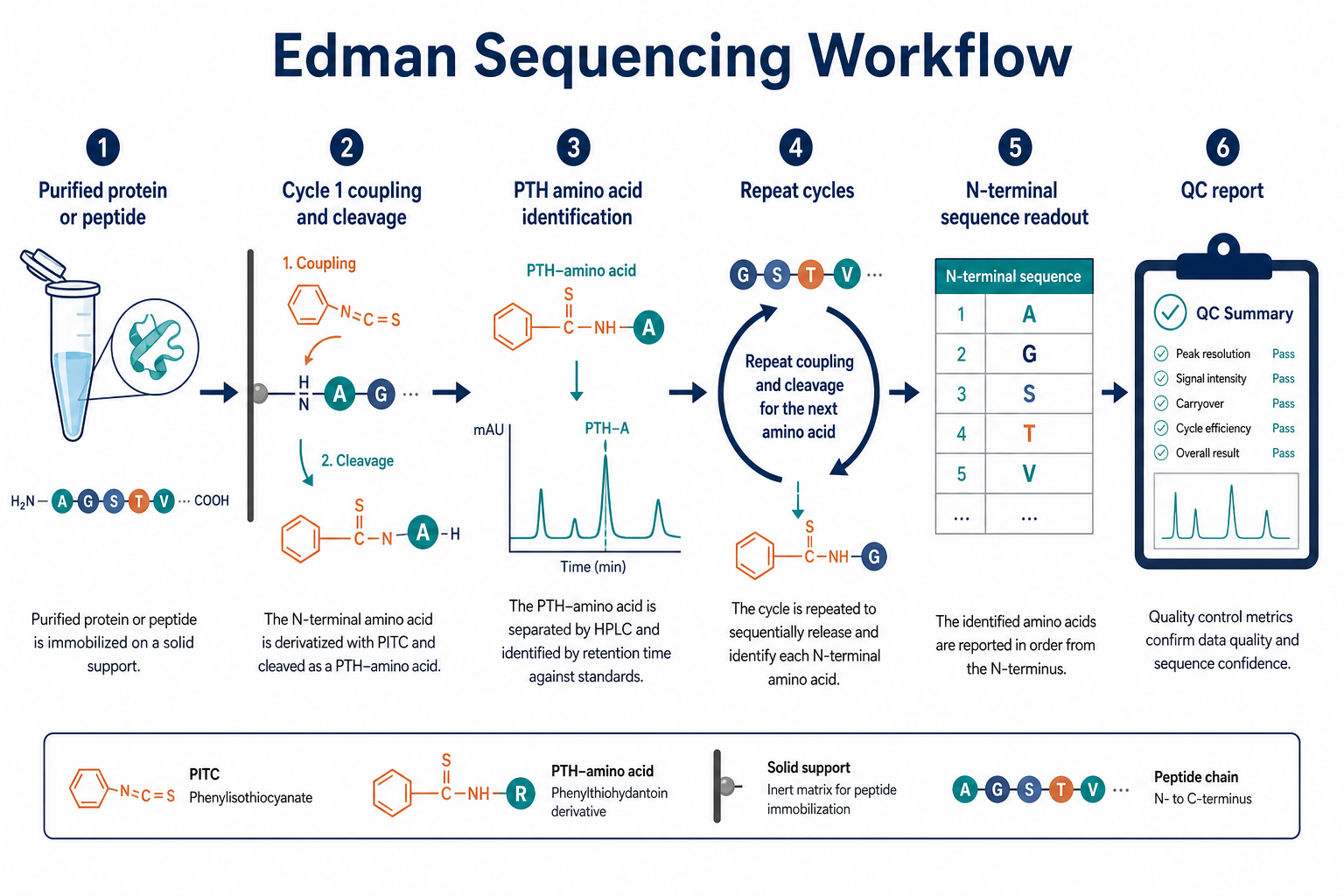
Figure 1. Edman sequencing builds N-terminal sequence evidence through repeated coupling, cleavage, and PTH amino acid identification cycles.
When Edman Sequencing Is Still the Right Choice
Edman degradation remains the right choice when the project needs direct, cycle-based N- terminal evidence from purified material and only a terminal region must be read.
1. Short N-terminal Confirmation on Purified Protein
When the goal is to confirm the first few residues of a recombinant protein, Edman sequencing is often the most efficient route. The question is specific, the sample is purified, and a short read may be enough to support processing verification or internal QC.
2. Synthetic or Purified Peptide Release Testing
For peptides where N-terminal identity is a release criterion, Edman degradation provides a direct readout without requiring full LC-MS/MS interpretation. This is especially useful when the peptide is short and the N-terminus is unblocked.
3. Mature Start-site and Processing Verification
Recombinant proteins may require confirmation that signal peptide removal, leader sequence cleavage, or other processing events produced the intended N-terminus. Edman sequencing reads the actual mature start site directly from the protein.
4. Orthogonal Terminal Evidence in Biopharmaceutical QC
Biologic characterization often benefits from orthogonal evidence. Edman sequencing can complement intact mass analysis, peptide mapping, or MS-based terminal workflows by providing a direct chemical readout of the N-terminal sequence.
5. Targeted Documentation with Modest Read Depth
Some publication, patent, or tech transfer files require documented N-terminal sequence evidence without full primary structure reconstruction. A defined Edman read length may satisfy that need efficiently.
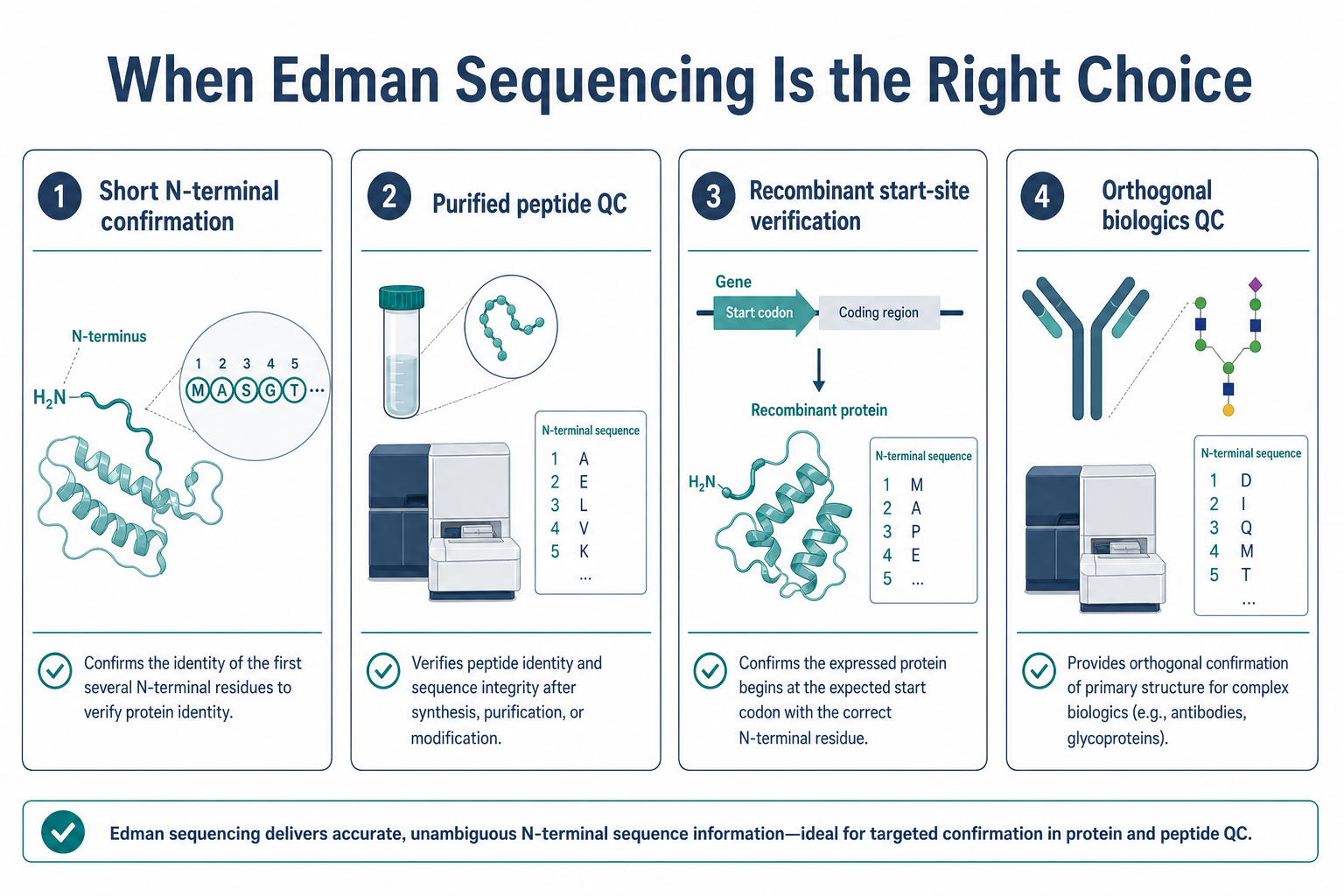
Figure 2. Edman sequencing remains a strong fit for short N-terminal confirmation, peptide QC, mature start-site verification, and orthogonal biologics documentation.
When Another Method May Be Better Edman sequencing is not the best choice for every terminal question.
LC-MS/MS or MS-based N-terminal analysis may be preferable when:
-
the N-terminus is blocked by acetylation, pyroglutamate formation, or other modifications
-
the project requires integration with a broader peptide mapping or comparability package
-
only trace material is available in a complex matrix without prior purification
-
the goal is full-length unknown protein sequencing rather than terminal confirmation
-
reference-backed confirmation across the whole protein is more important than direct cycle readout
In these cases, a hybrid or MS-led workflow may provide better fit even though Edman chemistry remains valuable for accessible N-termini on purified material.
Edman Sequencing vs MS-Based N-Terminal Analysis
The choice is not about which technology is newer. It is about which workflow best matches the sample and the decision required.
| Dimension | Edman Sequencing | MS-Based N-Terminal Analysis |
| Core question | What is the sequential N- terminal read from cycle one? | What terminal peptide or modification pattern does MS evidence support? |
| Best sample type | Purified protein or peptide with free N-terminus | Purified or mapped material, including some blocked termini |
| Readout style | Direct cycle-by-cycle residue identification | Peptide-centric MS interpretation |
| Best read depth | Short to moderate N-terminal regions | Flexible, often integrated with broader QC |
| Main strength | Direct chemistry-based terminal readout | Handles blocked termini and broader mapping context |
| Main limitation | Blocked N-termini and signal loss over long reads | More complex setup for simple terminal checks |
| Typical use | QC, peptide release, mature start verification | Blocked terminus investigation, hybrid QC packages |
This comparison shows why Edman sequencing remains relevant. It is optimized for direct N- terminal residue analysis on purified material, while MS-based routes are often better when the terminus is blocked or when terminal evidence must sit inside a larger analytical package.
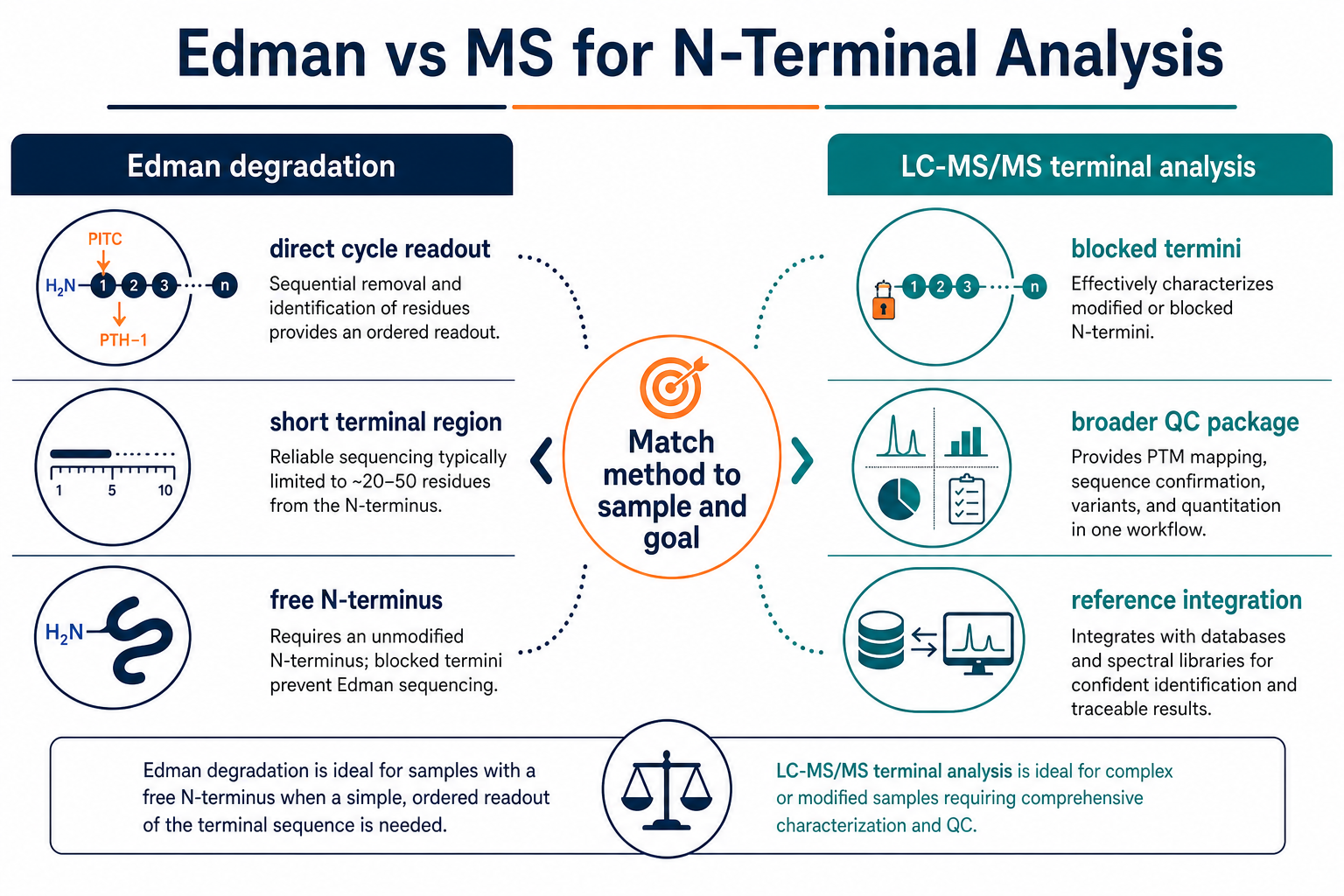
Figure 3. Edman sequencing fits direct short N-terminal readout, while MS-based analysis is often preferred for blocked termini or broader QC integration.
Application Scenarios by Project Type
The table below links common project types to the cases where Edman sequencing is still the preferred first approach.
| Project Type | Why Edman Is Often the Right Choice | Caveat |
| Recombinant protein start-site QC | Direct read of mature N- terminus | N-terminus must be accessible |
| Synthetic peptide release | Short direct confirmation is often sufficient | Purity and free N-terminus are required |
| Enzyme or cytokine N- terminal check | Efficient terminal evidence on purified material | Long reads may show signal loss |
| Biosimilar or biologic lot documentation | Orthogonal N-terminal evidence alongside other assays | Reporting depth should be scoped in advance |
| Patent or publication terminal support | Direct sequential read is easy to document | Not a substitute for full- length sequencing |
| Early feasibility on purified target band | Quick terminal read before broader MS work | Band purity must be high enough for clean cycles |
These scenarios explain why Edman sequencing continues to be selected even in MS-rich laboratories.
Core Advantages and Current Limitations
1. Core Advantages
(1) Direct N-terminal readout
Each cycle identifies a specific residue from the actual chain terminus.
(2) Strong fit for short confirmation tasks
Many QC and release decisions require only a limited N- terminal read.
(3) Established interpretive framework
Cycle data are straightforward to review for purified samples with clean early signals.
(4) Useful orthogonal evidence
Edman results can support biopharmaceutical and recombinant product documentation alongside MS data.
2. Current Limitations
(1) Blocked or modified N-termini
Acetylation, pyroglutamylation, and other modifications can prevent efficient cycle one chemistry.
(2) Signal loss over long reads
Yield declines as cycles increase, making long full-length sequencing inefficient.
(3) Purity dependence
Mixed proteins or heavy contamination can compromise cycle interpretation.
(4) Not a full unknown protein sequencing solution
Edman degradation confirms the N-terminus but does not reconstruct the entire protein sequence by itself.
Researchers should define the required read length and evidence level before choosing Edman sequencing over broader MS workflows.
3. Sample and Reporting Considerations
A strong Edman sequencing project begins with feasibility review. Useful inputs include sample purity, estimated amount, buffer compatibility, expected N-terminal state, and the number of cycles required for the decision.
A useful report should include:
-
cycle-by-cycle residue calls
-
signal strength or confidence notes for each cycle
-
documentation of weak, ambiguous, or failed cycles
-
comparison against expected N-terminal sequence when a reference exists
-
recommendations for repeat analysis or MS-based follow-up if needed
Transparent reporting is especially important when the Edman result will support lot release, publication, or expression troubleshooting.
Future Outlook
Edman sequencing continues to occupy a defined niche in protein characterization. It is not replaced by LC-MS/MS for every terminal question. Instead, it remains the preferred direct route for many short N-terminal confirmation tasks on purified material. Laboratories increasingly use Edman data as orthogonal evidence within broader biopharmaceutical and recombinant QC packages, while MS-based methods handle blocked termini and more complex terminal investigations.
For many teams, the most efficient approach is not to choose one technology in isolation. It is to match the terminal workflow to sample state, required read depth, and the level of proof needed for the next decision.
Frequently Asked Questions
1. Is Edman sequencing still used in modern protein labs?
Yes. It remains widely used for N-terminal confirmation, peptide QC, and orthogonal biologics documentation when a direct terminal read is needed.
2. How many N-terminal residues can Edman sequencing read reliably?
This depends on sample purity, N-terminal accessibility, and instrument performance. Short to moderate reads are most common. Long reads may show increasing signal loss.
3. When should MS be chosen instead of Edman sequencing?
MS-based N-terminal analysis is often better when the N-terminus is blocked, when the sample requires broader mapping context, or when terminal evidence must be integrated into a larger LC-MS/MS QC package.
4. Can Edman sequencing replace full protein sequencing?
No. It is a terminal method. Full-length or unknown protein sequencing usually requires LC- MS/MS and broader assembly strategies.
5. What sample quality is needed for Edman sequencing?
Purified protein or peptide material with a free N-terminus and limited contamination generally gives the best cycle data.
Conclusion
Edman sequencing remains the right choice for many N-terminal residue analysis projects because it provides direct, cycle-based confirmation from purified protein or peptide material. It is especially strong for short terminal QC, peptide release testing, mature start-site verification, and orthogonal biologics documentation. It is less appropriate for blocked termini, complex mixtures, or full unknown protein sequencing. The best decision matches the method to N-terminal accessibility, required read depth, and the evidence standard behind the project. Researchers planning N-terminal confirmation can contact MtoZ Biolabs to review sample suitability and determine whether Edman degradation is the most efficient route for their terminal analysis goal.
How to order?




