






Edman Sequencing vs LC-MS/MS: Which Method Better Answers Your N-Terminal Sequence Question?
Introduction
N-terminal sequence projects fail less often because no method exists than because the wrong method is chosen for the question being asked. One team may need to know the first five residues of a purified recombinant protein after signal peptide removal. Another may need to determine whether an N-terminus is blocked. A third may need terminal evidence integrated into a broader peptide mapping or comparability package.
Edman sequencing and LC-MS/MS can both contribute to N-terminal characterization, but they answer slightly different questions. Edman degradation provides a direct, cycle-based read from the free N-terminus of purified protein or peptide material. LC-MS/MS analyzes N-terminal peptides, often after digestion or enrichment, and interprets mass spectrometric evidence in a broader analytical context. Neither method is universally better. The better method is the one that matches the N-terminal sequence question, the sample state, and the evidence standard required for the next decision.
Related Services
| Service Area | Recommended Service |
| Edman degradation sequencing | Protein Sequencing Service by Edman Degradation |
| N-terminal sequencing | N-Terminal Sequencing Service |
| Edman-based N-terminal analysis | Edman Degradation for N-Terminal Sequence Analysis Service |
| Blocked N-terminus handling | N-Terminal Sequencing (N-Terminal Unblocked) Service |
| MS-based N-terminal confirmation | MS-Based Protein N-Terminal Sequence Analysis Service |
| Biopharmaceutical N-terminal QC | Biopharmaceutical N-Terminal Sequencing Service |
Researchers comparing Edman sequencing and LC-MS/MS for N-terminal analysis can consult MtoZ Biolabs to review sample chemistry, expected read depth, and reporting goals before choosing a workflow.
When Researchers Face This Decision
This comparison usually appears when a project needs N-terminal evidence, but the exact question has not been defined clearly enough to select a method.
Common situations include:
1. Direct N-terminal confirmation
Does the purified product begin with the expected sequence?
2. Blocked or modified N-terminus
Why did Edman cycle one fail despite acceptable purity?
3. Processing verification
Was the signal peptide removed correctly to expose the intended mature start site?
4. Broader QC documentation
Is terminal evidence needed as part of a larger comparability or release package?
In each case, the practical issue is not simply "N-terminal sequencing" in general. It is which N- terminal sequence question must be answered and what level of proof is required.
Four Comparison Dimensions That Matter Most
A useful comparison should focus on the question each method answers best.
1. Question Type
Edman degradation asks what residues are present sequentially from the free N- terminus. LC-MS/MS often asks which N-terminal peptides or modified forms are supported by mass spectrometric evidence.
2. N-terminal Accessibility
Edman chemistry requires a free alpha-amino group at cycle one. LC- MS/MS can sometimes address blocked or modified termini through alternative digestion, enrichment, or interpretation strategies.
3. Sample Context
Edman sequencing is strongest on purified protein or peptide material with limited contamination. LC-MS/MS can integrate terminal analysis into broader peptide mapping or proteomics workflows.
4. Evidence Standard
A short direct read may be enough for internal QC. Biopharmaceutical or documentation-driven projects may require orthogonal terminal evidence or broader contextual support.
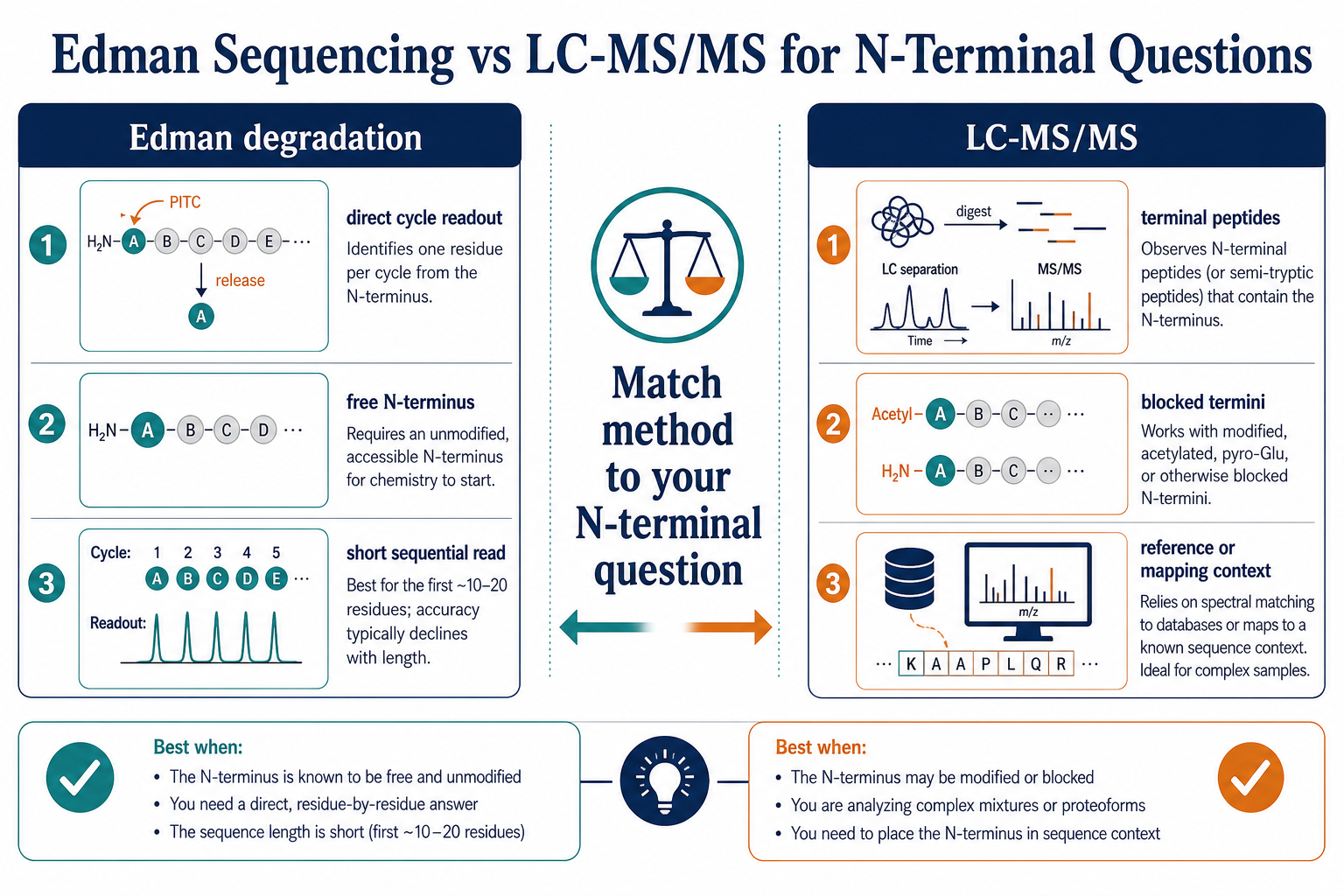
Figure 1. Edman sequencing fits direct sequential N-terminal readout, while LC-MS/MS often fits blocked termini and broader QC context.
What Question Edman Sequencing Answers Best
Edman degradation is optimized for a focused question: what is the amino acid sequence from the free N-terminus outward for a defined number of cycles?
The method removes and identifies one N-terminal residue per cycle using phenyl isothiocyanate chemistry and PTH-amino acid analysis. This makes Edman sequencing especially strong when:
-
purified protein or peptide material is available
-
the N-terminus is expected to be free and unblocked
-
the project needs direct cycle-based evidence
-
a short to moderate N-terminal read is sufficient
-
the decision depends on the actual start of the chain
Edman sequencing is widely used for recombinant start-site verification, synthetic peptide release testing, and direct N-terminal QC on purified material.
Its main limits appear when the N-terminus is blocked, when the sample is impure, or when the project requires broader sequence context beyond the terminal region.
What Question LC-MS/MS Answers Best
LC-MS/MS-based N-terminal analysis is optimized for a different set of questions: which N- terminal peptides are present, how do they relate to the expected sequence, and can modified or blocked termini be characterized in a broader analytical framework?
The workflow may include digestion, enrichment of N-terminal peptides, LC separation, tandem mass spectrometry, and interpretation against a reference or through targeted de novo analysis. This route is often stronger when:
-
the N-terminus is blocked or modified
-
a trusted reference sequence exists and confirmation is the goal
-
Edman cycle one fails despite acceptable purity
-
terminal evidence must be integrated with peptide mapping or comparability data
-
multiple N-terminal forms or processing variants must be evaluated
LC-MS/MS is flexible, but it is usually more complex than Edman degradation for a simple direct terminal read on clean unblocked material.
Side-by-Side Comparison
| Dimension | Edman Sequencing | LC-MS/MS N-Terminal Analysis |
| Core question | What is the sequential N-terminal read from cycle one? | What N-terminal peptides or forms does MS evidence support? |
| Best sample type | Purified protein or peptide with free N-terminus | Purified or mapped material, including some blocked termini |
| Readout style | Direct cycle-by-cycle residue identification | Peptide-centric MS interpretation |
| Best read depth | Short to moderate N-terminal regions | Flexible, often tied to enrichment and coverage design |
| Main strength | Direct chemistry-based terminal readout | Handles blocked termini and broader QC integration |
| Main limitation | Blocked N-termini and cycle signal loss | More complex setup for simple terminal checks |
| Reference need | Low for direct readout | Often useful or required for efficient interpretation |
| Typical deliverable | Cycle-based N-terminal sequence | N-terminal peptide evidence and interpretation report |
This comparison shows why the decision should begin with the N-terminal question, not with platform preference alone.
Which Method Better Answers Different N-Terminal Questions?
The comparison above defines the general tradeoffs. The table below maps common N-terminal questions to the method that usually answers them more directly.
| N-Terminal Sequence Question | Better First Method | Why |
| What are the first residues of this purified protein? | Edman sequencing | Direct cycle read from the N- terminus |
| Does this peptide begin with the expected sequence? | Edman sequencing | Efficient short confirmation on purified peptide |
| Was the intended mature start site exposed after processing? | Edman sequencing | Reads the actual chain start directly |
| Why does cycle one fail on an otherwise pure sample? | LC-MS/MS | Better suited to blocked or modified termini |
| Does the N-terminus match the reference after expression? | LC-MS/MS or hybrid workflow | Reference-backed peptide evidence may be more efficient |
| Are there truncations or alternate N-terminal forms? | LC-MS/MS | Broader peptide context helps detect variants |
| What terminal evidence is needed for biologics documentation? | Hybrid or MS- led package | Orthogonal support may be required |
| Is only a quick internal QC read needed? | Edman sequencing | Often the most direct route |
These recommendations are starting points. Sample purity, amount, and reporting urgency can shift the final plan.
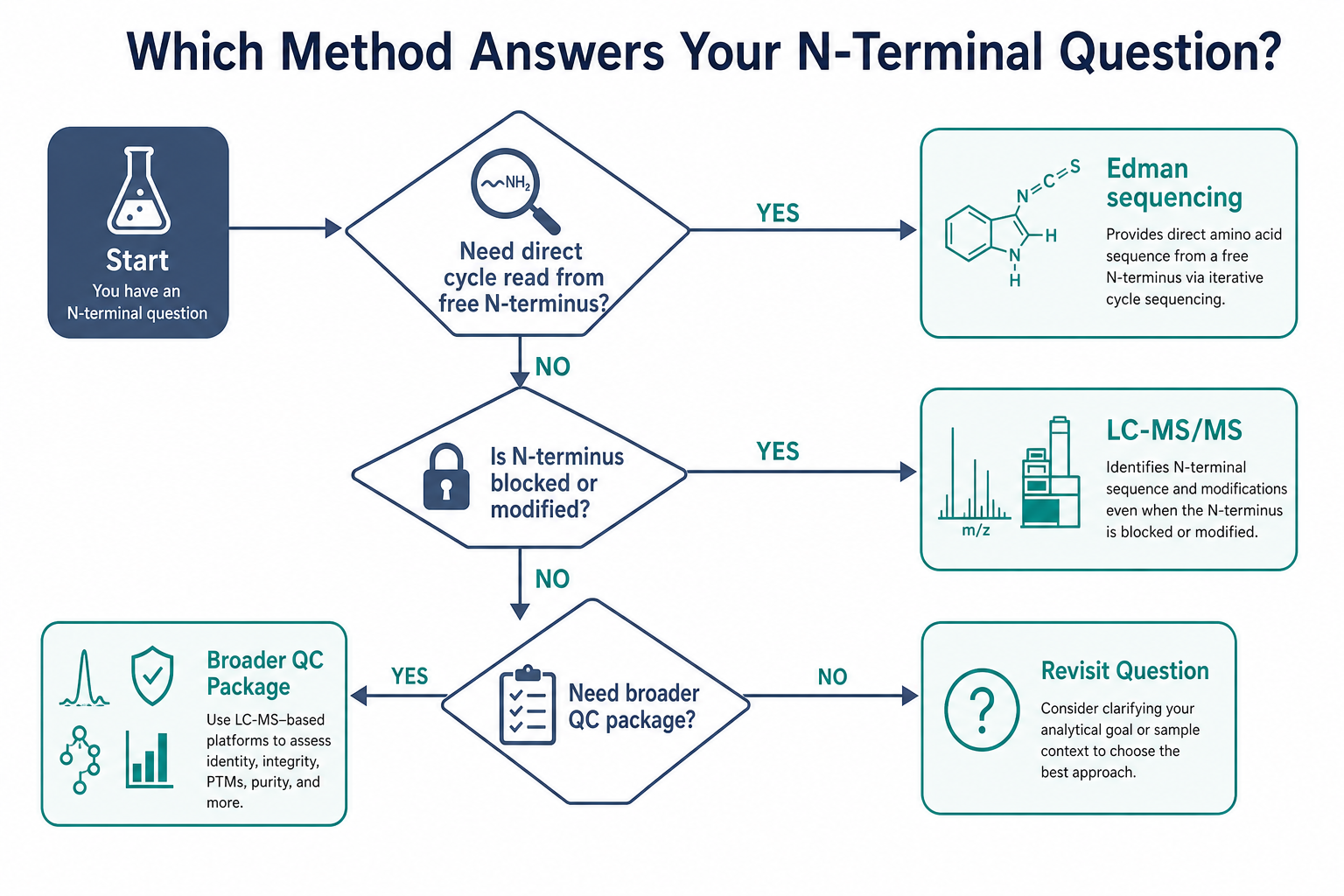
Figure 2. The N-terminal question, terminus accessibility, and evidence standard determine whether Edman sequencing or LC-MS/MS is the better first method.
Decision Recommendations by Project Goal
Choose Edman sequencing when the project needs a direct sequential N-terminal read from purified material, the N-terminus is expected to be accessible, and a short read is sufficient for QC, release, or processing verification.
Choose LC-MS/MS when the N-terminus may be blocked, the project depends on reference- backed terminal peptide evidence, or terminal analysis must be integrated into a broader mapping or comparability workflow.
Choose a hybrid workflow when the product is high value, documentation standards require orthogonal terminal evidence, or Edman and MS together provide a more complete answer than either method alone.
Researchers should also define the required read length and reporting format before selecting a route. A three-cycle internal check is not the same project as a documentation-grade terminal QC package.
Combined N-Terminal Strategies
A strict either-or decision is not always necessary. Some projects benefit from both routes.
A common combined strategy is to use Edman sequencing for direct cycle-based N-terminal evidence and LC-MS/MS to evaluate blocked termini, truncated forms, or reference-backed terminal peptides that Edman alone cannot explain. This approach is especially useful in biopharmaceutical QC, biosimilar comparability, and high-value recombinant product review.
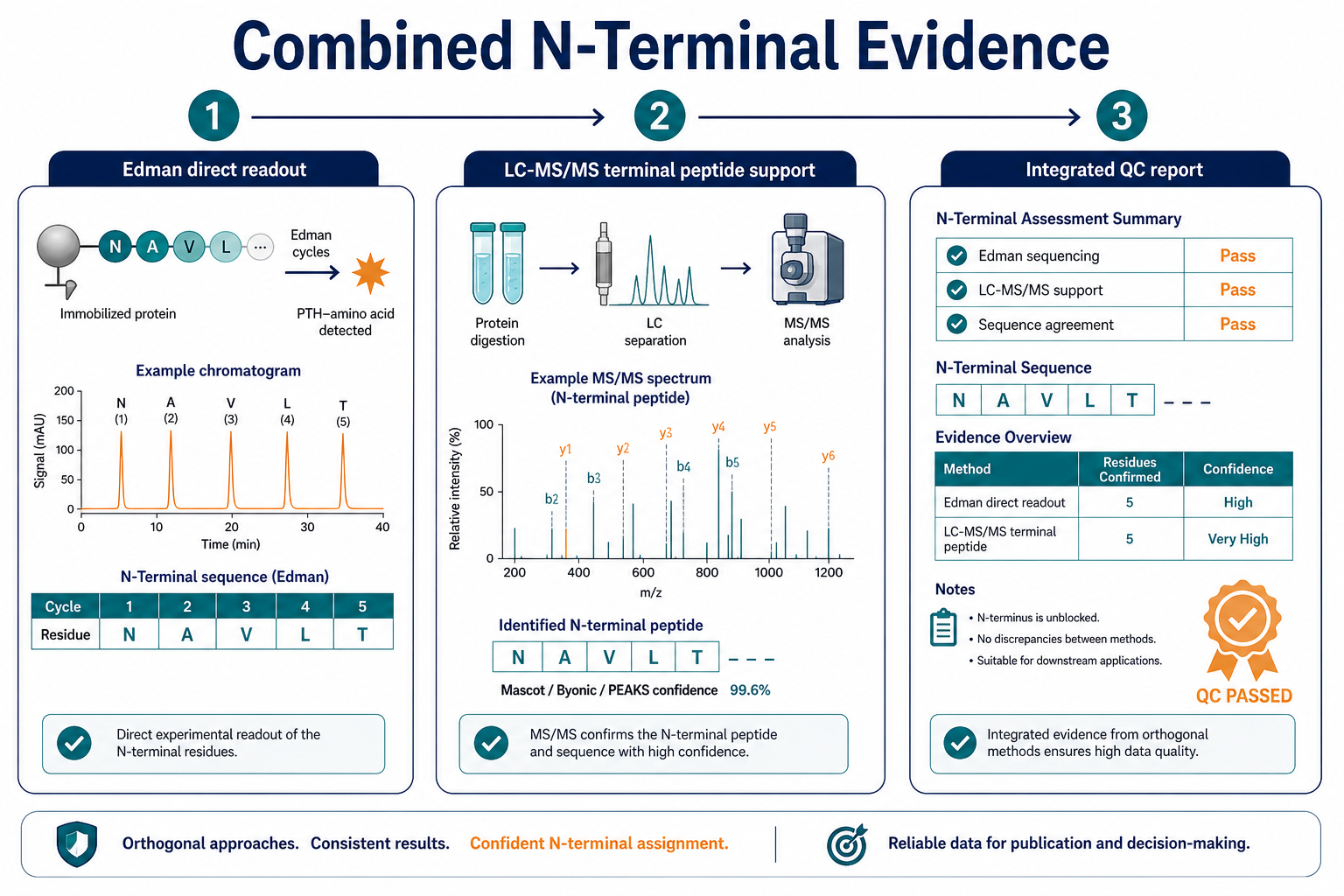
Figure 3. Combined Edman and LC-MS/MS analysis can provide stronger N-terminal evidence when documentation standards require orthogonal support.
For example, Edman sequencing may confirm the first several residues of a recombinant product, while LC-MS/MS reveals a minor N-terminal truncation or modified peptide form present at low abundance. In such cases, the methods answer related but not identical questions.
Limitations to Keep in Mind
Edman sequencing depends on a free N-terminus, sample purity, and acceptable cycle yield. Blocked termini, contamination, and long read requirements can limit usefulness even when the project question seems simple.
LC-MS/MS depends on digestion or enrichment design, spectral quality, and interpretation strategy. It is not automatically better simply because it is newer or more flexible. For a straightforward unblocked N-terminal read, it may add unnecessary complexity.
Researchers should also avoid comparing methods only by turnaround time or cycle count. The better method is the one that answers the actual N-terminal question with the required evidence standard.
Practical Selection Checklist
Before choosing between Edman sequencing and LC-MS/MS, answer these questions:
1. What exact N-terminal sequence question must be answered?
2. Is the N-terminus expected to be free or blocked?
3. Is the sample purified enough for direct Edman chemistry?
4. Does a trusted reference sequence already exist?
5. Is a short direct read enough, or is broader QC documentation required?
6. Would orthogonal terminal evidence strengthen the final decision?
If the question is a direct read from an accessible N-terminus on purified material, Edman sequencing is often the better first choice. If the terminus may be blocked or the project requires broader peptide context, LC-MS/MS should be planned from the start.
Frequently Asked Questions
1. Is Edman sequencing still better for N-terminal QC?
It is often the better first choice for direct short N-terminal confirmation on purified, unblocked material. LC-MS/MS becomes preferable when the terminus is blocked or broader contextual evidence is required.
2. Can LC-MS/MS replace Edman sequencing completely?
Not for every project. LC-MS/MS is more flexible in some cases, but Edman degradation remains valuable for direct cycle-based terminal readout.
3. What if Edman cycle one fails?
That often indicates a blocked N-terminus, low sample load, or contamination. LC-MS/MS or a blocked-terminus workflow may be the better next step.
4. Which method is better for biopharmaceutical N-terminal documentation?
It depends on the SOP and evidence standard. Some projects use Edman alone. Others require combined Edman and MS-based terminal support.
5. How should teams avoid choosing the wrong method?
Define the N-terminal question first, then match the workflow to terminus accessibility, sample purity, and reporting needs.
Conclusion
Edman sequencing and LC-MS/MS answer related but distinct N-terminal sequence questions. Edman degradation is usually the better first method when the goal is a direct sequential read from a free N-terminus on purified material. LC-MS/MS is often the better first method when the terminus may be blocked, when reference-backed peptide evidence is needed, or when terminal analysis must sit inside a broader QC package. Combined workflows can provide the strongest evidence when documentation standards are high. The best decision begins with the N-terminal question itself. Researchers comparing these options for recombinant QC, peptide release, or biopharmaceutical documentation can contact MtoZ Biolabs to select the workflow best aligned with their N-terminal sequence question and reporting needs.
How to order?




