Differential Peptide Expression Analysis Service
MtoZ Biolabs provides Differential Peptide Expression Analysis Service to identify peptide abundance changes across biological conditions using LC-MS/MS-based quantitative peptidomics workflows. The service supports peptide-level comparison, statistical evaluation, and biological interpretation for diverse research designs.
From quantitative peptide data generation to differential analysis and downstream interpretation, MtoZ integrates mass spectrometry and bioinformatics expertise to characterize condition-associated peptide changes and support peptide-focused research.
- LC-MS/MS-based quantitative peptide comparison
- Label-Free, TMT, and iTRAQ quantification options
- Statistical identification of differential peptide changes
- Integrated peptide annotation and biological interpretation
Overview
Differential peptide expression analysis identifies peptide abundance changes across biological groups, treatment conditions, or experimental states using quantitative LC-MS/MS peptidomics data. Unlike protein-level differential analysis, which evaluates changes at the protein level, differential peptide analysis focuses on individual peptides detected by mass spectrometry. This peptide-level approach provides additional information about endogenous peptide regulation and condition-associated peptide changes.
By integrating peptide-level quantitative measurement, statistical comparison, and biological annotation, the analysis helps identify differential peptides and supports further interpretation of peptide-related biological changes.
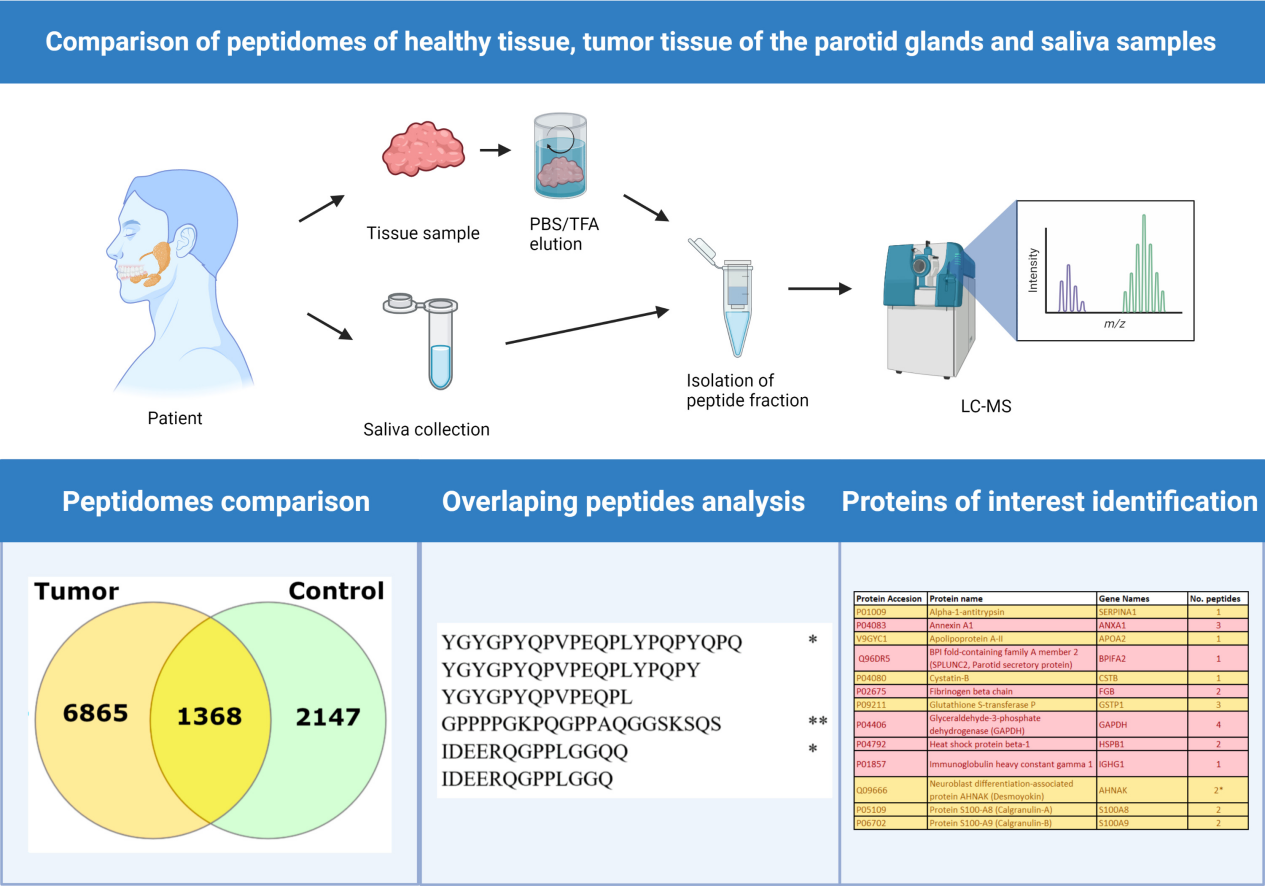
Puchalski, M. et al. Int. J. Mol. Sci. 2024.
Figure 1. Peptide Expression Comparison Across Tumor and Healthy Tissue Samples
Service at MtoZ Biolabs
MtoZ Biolabs provides Differential Peptide Expression Analysis Service within LC-MS/MS-based quantitative peptidomics workflows. The service integrates peptide-level quantitative measurement, statistical analysis, and biological interpretation to identify peptides showing significant abundance differences between biological conditions.
Depending on study design, quantitative peptide datasets can be generated using label-free or isobaric labeling strategies, including TMT and iTRAQ. MtoZ supports projects from quantitative LC-MS/MS acquisition to differential peptide analysis and downstream interpretation.
Analysis Workflow
1. Quantitative Peptide Data Generation
Peptide-level quantitative data are generated using appropriate LC-MS/MS acquisition and quantification strategies.
2. Data Processing and Quality Evaluation
Peptide identification, abundance processing, and data quality assessment are performed before differential analysis.
3. Differential Peptide Analysis
Peptide differences between experimental groups are evaluated using study-specific statistical approaches, and differential peptides are identified according to predefined criteria.
4. Biological Interpretation
Differential peptides can be further evaluated through annotation, clustering, pathway analysis, and other downstream bioinformatics approaches.
Applications of Differential Peptide Expression Analysis
Differential peptide expression analysis supports studies where peptide-level changes provide additional information beyond protein-level measurements.
Common applications include:
- identifying peptides associated with biological conditions or phenotypes;
- evaluating peptide responses to treatments or experimental interventions;
- comparing endogenous peptide profiles between sample groups;
- screening candidate peptides for further validation;
- monitoring peptide patterns during biological processes.
Deliverables
1. Quantitative Peptide Results
Peptide identification, abundance data, and quantitative comparison results.
2. Statistical Analysis
Differential peptide screening, statistical evaluation, and significance assessment.
3. Bioinformatics Analysis
Clustering, annotation, pathway analysis, and biological interpretation where applicable.
4. Data Files and Reports
Processed datasets, visualization results, analysis files, and final report.
Why Choose MtoZ Biolabs?
1. LC-MS/MS-Based Peptide Quantification
Quantitative peptide data are generated through high-resolution mass spectrometry-based workflows.
2. Flexible Quantification Strategies
Label-free, TMT, and iTRAQ approaches are available according to study requirements.
3. Peptide-Level Data Interpretation
Analysis focuses on peptide changes while considering biological context and experimental objectives.
4. Integrated Proteomics Expertise
Mass spectrometry, quantitative analysis, and bioinformatics expertise are combined within one workflow.
5. Transparent Scope and Pricing
Service scope, deliverables, and pricing are clearly defined before analysis.
Sample Submission Suggestions
Sample requirements depend on peptide abundance, sample matrix, quantitative strategy, and experimental design.
Before submission, please provide:
- sample type and biological source;
- number of experimental groups and biological replicates;
- available sample amount;
- quantitative objectives;
- quantitative peptide data generated from compatible LC-MS/MS workflows, if available.
MtoZ Biolabs can review these details and recommend an appropriate analysis strategy before the study begins.
FAQ
Q1. What is differential peptide expression analysis?
Differential peptide expression analysis identifies peptides showing significant abundance differences between biological groups or experimental conditions based on quantitative peptidomics data.
Q2. What is the difference between differential peptide and differential protein analysis?
Differential protein analysis evaluates protein-level abundance changes, while differential peptide analysis focuses on individual peptide changes detected by LC-MS/MS.
Q3. What quantitative strategies can be used for differential peptide analysis?
Differential peptide analysis can be performed using quantitative peptidomics datasets generated by label-free, TMT, iTRAQ, or other suitable LC-MS/MS-based approaches.
Q4. Can existing quantitative peptide datasets be analyzed?
MtoZ primarily supports differential peptide analysis within LC-MS/MS-based quantitative peptidomics workflows. Existing datasets can be evaluated depending on data quality, format, and project requirements.
Q5. Can differential peptide analysis identify potential biomarkers?
Differential peptides can serve as candidates for further investigation, but additional validation is required before biological or clinical conclusions are established.
Q6. Can differential peptide analysis be combined with quantitative peptidomics?
Yes. Differential peptide expression analysis is commonly performed as a downstream analysis component of quantitative peptidomics studies.
Start Your Project with MtoZ Biolabs
MtoZ Biolabs provides Differential Peptide Expression Analysis Service for quantitative peptidomics studies requiring peptide-level comparison and biological interpretation.
Contact our technical team to discuss your sample type, experimental design, and quantitative objectives.
MtoZ Biolabs, an integrated chromatography and mass spectrometry (MS) services provider.
Related Services
Comparative Peptidomics Analysis Service
