






Determining Disulfide Bond Position by Peptide Mapping with LC-MS/MS
Introduction
Disulfide bond architecture is a core higher-order structural attribute for monoclonal antibodies, fusion proteins, enzymes, and many other biotherapeutics. Incorrect pairing can affect folding, stability, aggregation, and biological activity even when the primary amino acid sequence is correct. Intact mass analysis may confirm overall mass but often cannot assign which cysteine residues are linked. A development team may therefore need residue-level disulfide mapping before a comparability package is complete.
Determining disulfide bond position by peptide mapping with LC-MS/MS uses bottom-up mass spectrometry to identify peptides that retain native disulfide linkages or to compare reduced and non-reduced digest profiles against an expected connectivity pattern. The workflow links observed disulfide-linked peptides, modified mass shifts, and fragment ion evidence to specific cysteine pairs in the reference sequence. When executed with appropriate sample handling and review standards, peptide mapping can support disulfide confirmation, mispairing investigation, and CMC documentation for disulfide-rich biologics.
For teams planning disulfide mapping, the first decision is whether the project requires non-reduced peptide mapping, reduced versus non-reduced comparison, multi-enzyme coverage, or orthogonal confirmation alongside standard sequence mapping.
What Disulfide Bond Mapping by Peptide Mapping Means
Disulfide bond mapping by peptide mapping identifies which cysteine residues are covalently linked in a protein by analyzing peptides generated under conditions that preserve or selectively disrupt disulfide bonds. In LC-MS/MS peptide mapping, proteolytic digestion produces peptide fragments that are separated by liquid chromatography and identified by tandem mass spectrometry.
Under non-reduced conditions, disulfide-linked peptides remain connected and appear as single species with mass consistent with the combined peptide pair plus the crosslink. Under reduced and alkylated conditions, the same regions are observed as separate peptides because disulfide bonds have been cleaved and cysteines blocked to prevent refolding. Comparing these datasets helps confirm expected linkages and detect unexpected pairings or free cysteine forms.
For IgG antibodies, the classical pattern includes interchain disulfides between heavy and light chains and intrachain disulfides within each immunoglobulin domain. For other biologics, disulfide architecture may be more complex, with multiple domains, fusion partners, or engineered linkers requiring broader digestion and review strategies.
Why Disulfide Bond Position Matters in Biologics
Disulfide bonds stabilize tertiary and quaternary structure by constraining local folding. In biotherapeutics, disulfide connectivity is often treated as a critical quality attribute because mispairing or partial reduction can alter product behavior.
Disulfide position matters for several development and quality reasons.
Structural confirmation supports identity review when a product is defined by both sequence and native connectivity.
Folding and stability assessment depends on correct cysteine pairing, especially in multi-domain fusion proteins and engineered antibodies.
Comparability review after process, cell line, or manufacturing changes may require evidence that disulfide architecture remains unchanged.
Investigation of aggregation, activity loss, or unexpected mass features often includes disulfide mapping when mispairing is suspected.
Regulatory characterization packages for disulfide-rich products commonly include peptide-level evidence of expected linkages.
Peptide mapping does not replace higher-order structural methods such as HDX or NMR when full conformational analysis is required, but it provides direct cysteine-pair evidence at peptide resolution.
Core Principles of Disulfide Mapping with LC-MS/MS
Disulfide mapping by peptide mapping combines controlled sample preparation, digestion design, LC-MS/MS acquisition, and expert spectral interpretation.
Non-reduced digestion preserves native linkages
When reduction is omitted or minimized, disulfide-linked peptides survive digestion and are detected as crosslinked species. Their observed mass and retention behavior differ from the corresponding reduced peptides, providing direct evidence of connectivity.
Reduced and alkylated mapping provides complementary coverage
Standard reduced peptide mapping confirms sequence coverage and cysteine locations but does not by itself prove native pairing. Combining reduced and non-reduced workflows strengthens assignment by showing which peptides exist only when disulfides remain intact.
Enzyme selection affects disulfide-linked peptide recovery
Trypsin is widely used, but disulfide-linked regions may produce large or poorly ionizing peptides. Alternative enzymes such as Lys-C, Glu-C, Asp-N, or multi-enzyme strategies may improve coverage across disulfide-bridged segments.
MS/MS fragmentation supports linkage assignment
Disulfide-linked peptide identification depends on accurate precursor mass and interpretable fragment ions that support the proposed cysteine pair. Manual review is often required because crosslinked peptides can produce complex spectra and because software tools may not assign linkages automatically with sufficient confidence.
Reference sequence defines expected connectivity
Disulfide mapping is reference-driven. The expected bond pattern must be documented from product knowledge, sequence design, or prior structural data before observed peptides are interpreted.
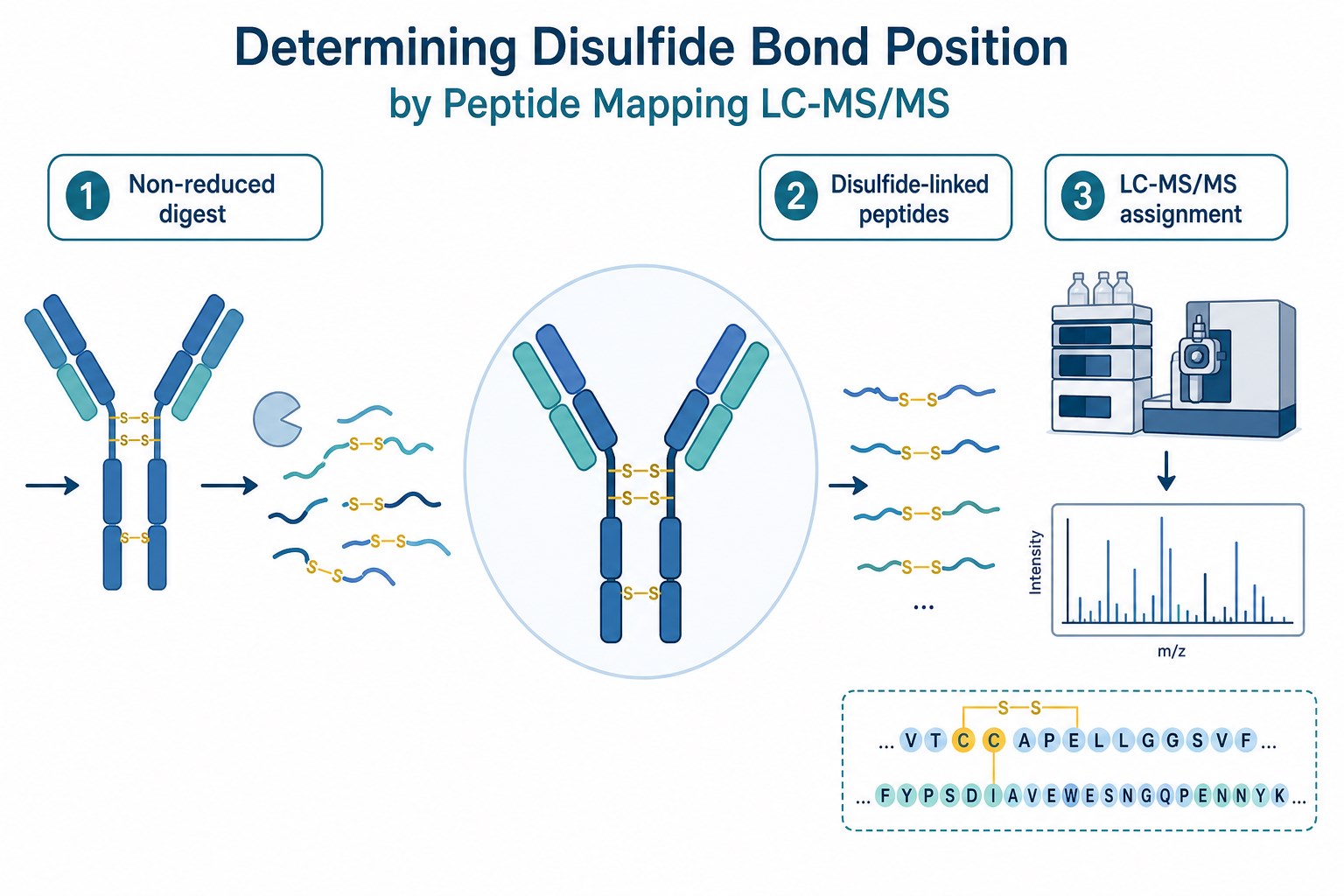
Figure 1. Disulfide bond position determination by peptide mapping relies on non-reduced digestion, detection of disulfide-linked peptides, and LC-MS/MS-based assignment.
Standard Workflow for Disulfide Bond Mapping
A practical disulfide mapping workflow using LC-MS/MS peptide mapping follows a defined sequence of steps.
Reference setup documents the mature sequence, expected disulfide pairs, chain composition, and any known variants or engineered features. Sample feasibility review confirms purity, concentration, buffer compatibility, and whether drug product matrix requires cleanup before digestion. Non-reduced sample preparation preserves native disulfide bonds through controlled digestion conditions and avoids reducing agents that would collapse linkages before analysis. Enzyme selection and digestion generate peptides suited to LC-MS/MS while retaining disulfide-linked species where possible. LC-MS/MS acquisition captures high-quality precursor and fragment data for both non-reduced and, when applicable, reduced control digests. Data analysis identifies disulfide-linked peptides, assigns cysteine pairs, compares observed connectivity to the expected pattern, and documents unsupported or ambiguous regions.
Reduced and alkylated mapping is often performed in parallel to improve sequence coverage and distinguish free cysteine forms from disulfide-linked species.
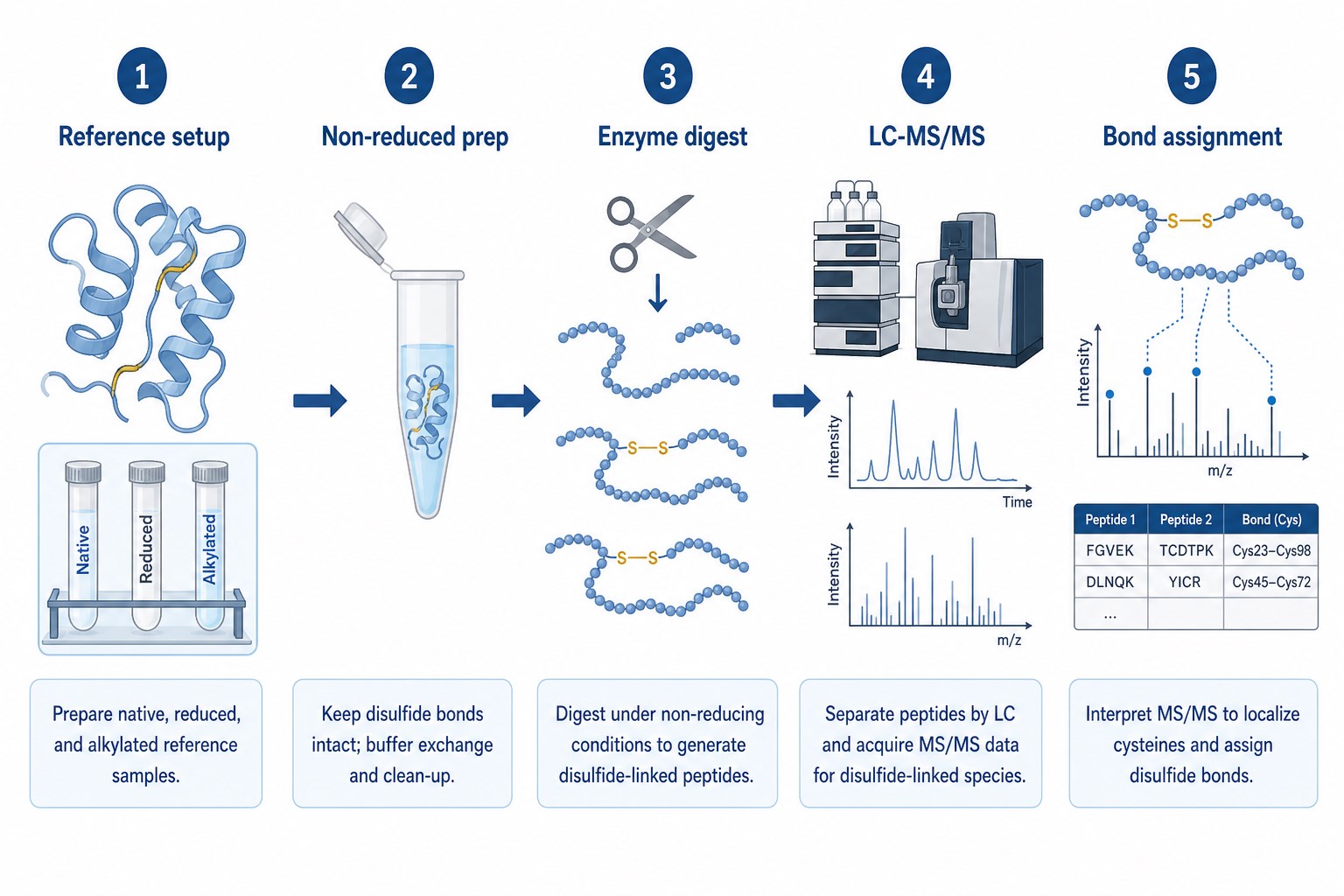
Figure 2. A disulfide mapping workflow covers reference setup, non-reduced preparation, enzyme digestion, LC-MS/MS analysis, and disulfide bond assignment.
Related Services
Disulfide Bond Analysis Service
Protein Disulfide Bond Analysis Service
Biopharmaceutical Disulfide Bond Analysis Service
Comprehensive Peptide Mapping Service
Primary Structure Analysis Service
Teams planning disulfide bond mapping by peptide mapping can consult MtoZ Biolabs to review sample type, expected connectivity, and the LC-MS/MS strategy best suited to the biologic format.
Reduced vs Non-Reduced Peptide Mapping for Disulfide Assignment
Reduced and non-reduced workflows answer different questions and are often used together in disulfide mapping projects.
|
Workflow Type |
Sample Treatment |
Primary Output |
Role in Disulfide Mapping |
|---|---|---|---|
|
Non-reduced mapping |
Disulfides preserved during digestion |
Disulfide-linked peptide detection |
Direct connectivity evidence |
|
Reduced and alkylated mapping |
Disulfides cleaved, cysteines blocked |
Linear peptide coverage |
Sequence support and cysteine localization |
|
Paired comparison |
Both workflows on same material |
Difference in peptide profile |
Confirm expected linkages and detect shifts |
|
Multi-enzyme mapping |
Alternate proteases or combinations |
Broader disulfide-peptide coverage |
Resolve large or difficult linked regions |
Non-reduced mapping provides the strongest direct evidence for disulfide position when linked peptides are recovered and confidently assigned. Reduced mapping alone confirms cysteine-containing peptides but not native pairing.
Method Selection by Product Type
Disulfide mapping strategy varies with biologic architecture and project goal.
|
Product Type |
Common Disulfide Mapping Focus |
Typical Workflow Emphasis |
|---|---|---|
|
IgG monoclonal antibody |
Interchain and intrachain IgG disulfides |
Non-reduced tryptic mapping with paired reduced control |
|
Fusion protein |
Domain junction and linker cysteines |
Multi-enzyme mapping and broader coverage |
|
Enzyme or cytokine |
Internal domain disulfide pairs |
Non-reduced digest with alternative enzymes if needed |
|
Comparability study |
Connectivity consistency across lots |
Same-batch reduced and non-reduced comparison |
|
Mispairing investigation |
Unexpected linkages or free cysteine |
Targeted review of anomalous peptide masses |
Standard mAb disulfide mapping is often more predictable than complex fusion proteins with multiple domains and non-native linker chemistry.
Applications in Biotherapeutic Characterization
Disulfide bond mapping by peptide mapping supports several biologics development and quality scenarios.
Monoclonal antibody structure confirmation.
Confirms expected heavy-light and intrachain disulfide linkages during candidate characterization and CMC documentation.
Fusion protein and multi-domain product review.
Maps connectivity across fused domains where incorrect pairing can disrupt function or stability.
Comparability and process change assessment.
Compares disulfide patterns before and after manufacturing, purification, or formulation changes.
Investigation of quality deviations.
Supports root-cause review when aggregation, activity loss, or mass anomalies suggest disulfide scrambling or partial reduction.
Regulatory and QC documentation.
Provides peptide-level evidence of disulfide architecture in characterization packages for disulfide-rich products.
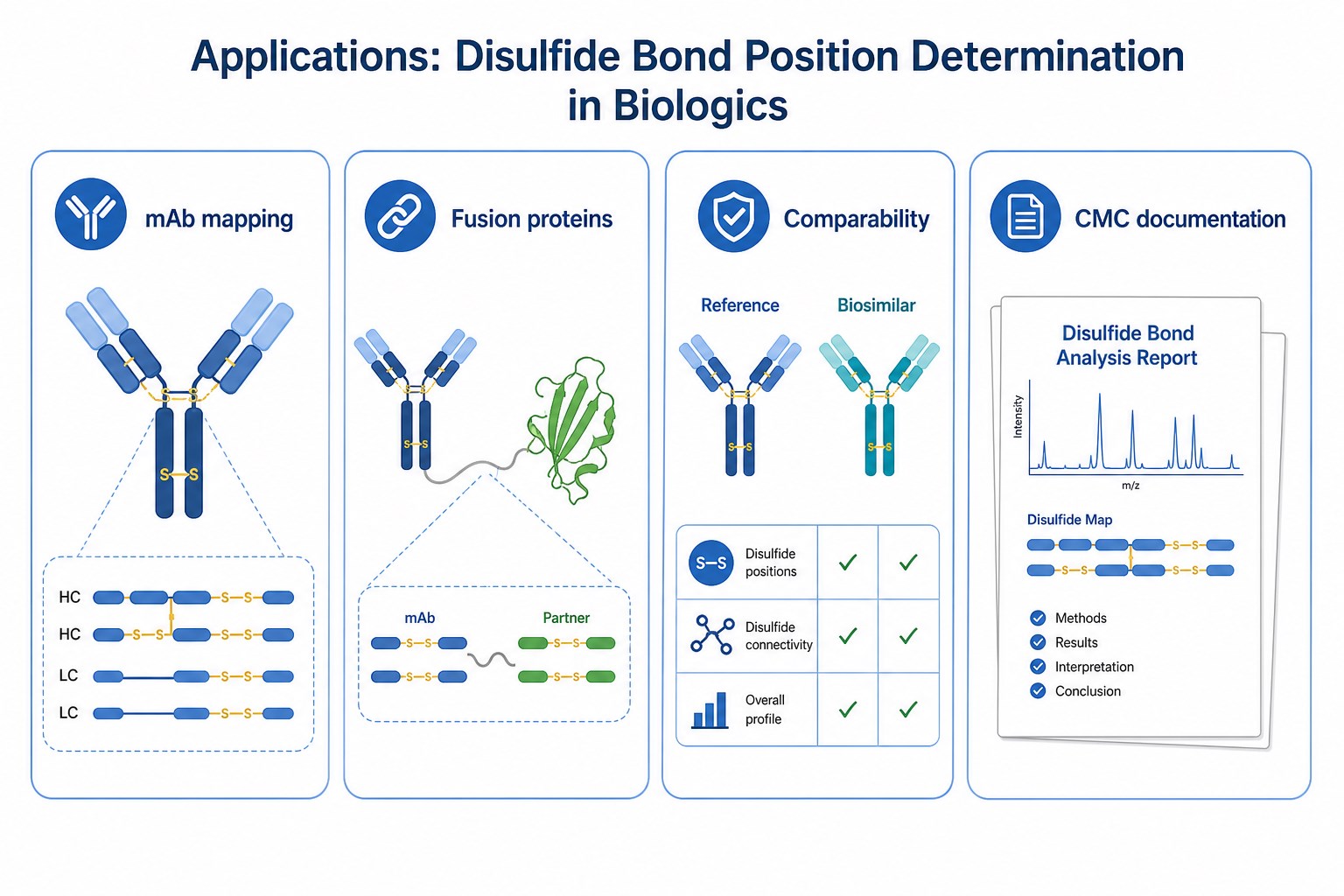
Figure 3. Disulfide bond mapping by peptide mapping supports mAb characterization, fusion protein review, comparability assessment, and CMC documentation.
Core Technical Advantages and Current Limitations
Core Technical Advantages
Direct peptide-level connectivity evidence.
Non-reduced LC-MS/MS can identify disulfide-linked peptides corresponding to specific cysteine pairs.
Integration with standard peptide mapping workflows.
Disulfide mapping extends existing bottom-up characterization rather than requiring a separate platform.
Support for comparability and investigation.
Paired reduced and non-reduced datasets help detect connectivity changes between lots or conditions.
Applicable across many biologic formats.
Antibodies, fusion proteins, enzymes, and other disulfide-rich products can be analyzed with adapted digestion strategies.
Complements intact mass and primary structure data.
Disulfide mapping adds linkage detail to sequence confirmation and global mass review.
Current Limitations
Large disulfide-linked peptides can be difficult to analyze.
Poor ionization or incomplete fragmentation may leave some linkages unsupported.
Automatic software assignment may be insufficient.
Expert manual review is often required for confident disulfide pair calling.
Sample handling sensitivity is high.
Partial reduction or scrambling during preparation can introduce artifacts.
Complex products may need multi-enzyme strategies.
Single-enzyme digests may not cover all disulfide-bridged regions adequately.
Disulfide mapping does not fully define tertiary structure.
Connectivity assignment differs from complete conformational characterization.
Sample and Project Planning Considerations
Disulfide mapping projects should define several inputs before analysis begins.
- mature protein sequence and expected disulfide pairs
- product format: mAb, fusion protein, enzyme, or other biologic
- sample type: research material, drug substance, or drug product
- need for reduced versus non-reduced comparison
- prior evidence of mispairing, free cysteine, or mass anomaly if applicable
- required reporting depth for QC, comparability, or regulatory use
- orthogonal methods such as intact mass or higher-order analysis if needed
Feasibility review is especially important for formulated samples and disulfide-sensitive matrices where preparation conditions strongly affect results.
Expected Deliverables
A useful disulfide mapping report by LC-MS/MS peptide mapping typically includes:
- list of assigned disulfide-linked peptides with proposed cysteine pairs
- comparison of observed connectivity to expected disulfide architecture
- reduced digest coverage summary when paired analysis is performed
- annotated spectra or confidence notes for critical linkages
- documentation of ambiguous, unsupported, or anomalous regions
- method summary covering digestion, LC-MS/MS conditions, and review criteria
- interpretation relative to project goal such as confirmation, comparability, or investigation
Reporting depth should match project stage. Early development may require confirmation of major expected linkages. Late-stage CMC packages may require fuller documentation of review logic and QC commentary.
Frequently Asked Questions
1. How are disulfide bond positions determined by peptide mapping?
Disulfide positions are determined by identifying disulfide-linked peptides in non-reduced LC-MS/MS digests and assigning observed masses and fragment ions to specific cysteine pairs in the reference sequence.
2. Is reduction used in disulfide bond mapping?
Non-reduced digestion is used to preserve native linkages. Reduced and alkylated mapping is often performed in parallel for sequence coverage and comparison but does not by itself prove native pairing.
3. Which enzymes are used for disulfide peptide mapping?
Trypsin is common, but Lys-C, Glu-C, Asp-N, or multi-enzyme combinations may be used when disulfide-linked peptides are too large or poorly recovered under standard digestion.
4. Can peptide mapping detect incorrect disulfide pairing?
Yes. Unexpected disulfide-linked peptide masses or changes between reduced and non-reduced profiles can indicate mispairing or scrambling when supported by spectral review.
5. Is disulfide mapping required for all biologics?
It is most critical for disulfide-rich products where connectivity affects structure, stability, or activity and where CMC or comparability packages require linkage confirmation.
6. Does disulfide mapping replace higher-order structural analysis?
No. Peptide mapping assigns cysteine connectivity at the peptide level. Full conformational analysis may still require orthogonal higher-order methods when needed.
Conclusion
Determining disulfide bond position by peptide mapping with LC-MS/MS provides residue-level evidence of cysteine connectivity in antibodies and other biotherapeutics. Non-reduced digestion, detection of disulfide-linked peptides, paired reduced mapping, and expert spectral review form the core of a reliable workflow. When matched to product architecture and project goal, disulfide mapping supports structure confirmation, comparability review, deviation investigation, and CMC documentation for disulfide-rich biologics.
Successful projects define expected connectivity early, control sample preparation to preserve native linkages, and apply digestion and LC-MS/MS strategies suited to the product format. Teams planning disulfide bond mapping by peptide mapping can contact MtoZ Biolabs to review sample status, expected disulfide architecture, and the LC-MS/MS workflow best matched to their biologic program.
How to order?




