






Determining Disulfide Bond Position by Peptide Mapping
Introduction
Peptide mapping is one of the most practical routes to disulfide bond position determination in proteins and biotherapeutics. Sequence confirmation shows which cysteines are present, but mapping shows how those cysteines are connected in the folded product. A monoclonal antibody program may need hinge and interchain linkage confirmation for CMC documentation. A fusion protein team may need to verify domain junction disulfides after cell line change. A comparability study may require peptide-level evidence that connectivity remains unchanged between reference and test lots.
Determining disulfide bond position by peptide mapping uses controlled proteolytic digestion, peptide separation, and mass spectrometric detection to identify disulfide-linked peptides and assign cysteine pairs in the reference sequence. Non-reduced digestion preserves native linkages, while reduced and alkylated mapping provides complementary sequence coverage. Together they support confident connectivity assignment when sample handling, enzyme selection, and data review are matched to product architecture.
For teams starting a disulfide mapping project, the key planning step is to define expected connectivity, select a peptide mapping strategy that preserves informative linkages, and set reporting standards before the first digest is prepared.
What Peptide Mapping for Disulfide Position Determination Means
Peptide mapping for disulfide position determination analyzes proteolytic fragments to identify which cysteine residues remain covalently linked in the sample. The protein is digested into peptides under defined conditions, separated by liquid chromatography, and detected by mass spectrometry. Peptides that still contain intact disulfide bridges appear as disulfide-linked species with characteristic mass and chromatographic behavior.
The analytical output is a connectivity map that links observed peptides to specific cysteine pairs. For antibodies, this typically includes heavy-light interchain disulfides and intrachain Fab and Fc linkages. For other proteins, mapping may span multiple domains, fusion junctions, or engineered linker regions.
Peptide mapping differs from standard reduced sequence mapping because disulfide position determination requires workflows that preserve or selectively compare native linkages rather than collapsing all cysteine bonds before analysis.
Why Peptide Mapping Is Used for Disulfide Bond Assignment
Disulfide connectivity affects folding, stability, aggregation, and biological activity. Peptide mapping is widely used for disulfide assignment because it integrates with existing biologics characterization workflows and delivers residue-level evidence.
Peptide mapping can detect disulfide-linked peptides directly when native bonds are preserved during digestion.
Bottom-up workflows are compatible with mAbs, fusion proteins, enzymes, and many recombinant biologics.
Reduced and non-reduced digests from the same sample support both sequence coverage and connectivity comparison.
Mapping results can be documented in formats suitable for development, comparability, and QC review.
Peptide mapping can investigate suspected mispairing or scrambling when paired with controlled sample preparation and expert spectral review.
Peptide mapping does not define full three-dimensional structure, but it provides direct cysteine-pair evidence at the fragment level.
How Disulfide Position Is Determined from Peptide Mapping Data
Disulfide position determination follows a logical sequence from peptide detection to connectivity assignment.
Expected connectivity is defined from the reference sequence and product knowledge. Non-reduced digestion generates peptides with disulfide bonds intact. Chromatographic separation resolves linear and disulfide-linked peptides before mass spectrometric detection. Mass measurement identifies candidate disulfide-linked peptides whose observed mass matches predicted crosslinked pairs. Fragment analysis and manual review support assignment of specific cysteine residues when MS/MS data quality allows. Connectivity mapping summarizes confirmed bonds, provisional assignments, and unsupported regions relative to the expected architecture.
A disulfide-linked peptide observed only in the non-reduced digest strongly suggests native connectivity between the corresponding cysteines. The same regions appear as separate peptides after reduction and alkylation.
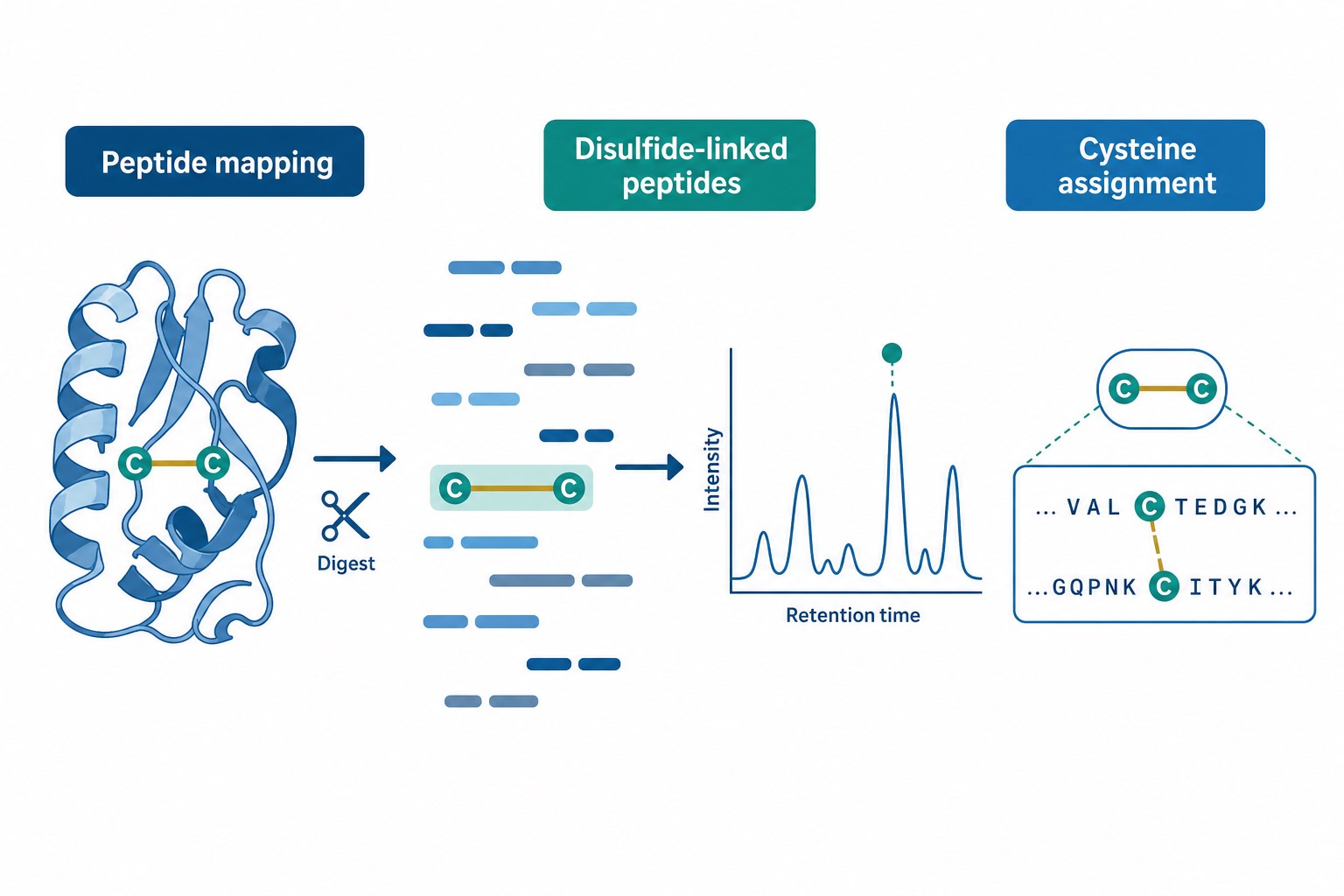
Figure 1. Disulfide bond position determination by peptide mapping relies on disulfide-linked peptide detection and cysteine pair assignment from mapping data.
Standard Peptide Mapping Workflow for Disulfide Bonds
A reliable workflow aligns digestion design, separation, detection, and reporting with the connectivity question under study.
Reference sequence setup documents mature chain sequences, cysteine locations, and expected disulfide pairs. Sample preparation preserves native disulfide bonds and addresses buffer or formulation interference before digestion. Non-reduced digestion uses protease conditions selected to produce informative disulfide-linked peptides without unnecessary reduction. Peptide separation by LC improves resolution of crosslinked species before mass spectrometric detection. Bond mapping assigns observed peptides to cysteine pairs and compares results across reduced and non-reduced datasets when paired analysis is performed.
Multi-enzyme mapping may be added when standard tryptic digestion does not adequately cover bridged hinge or domain regions.
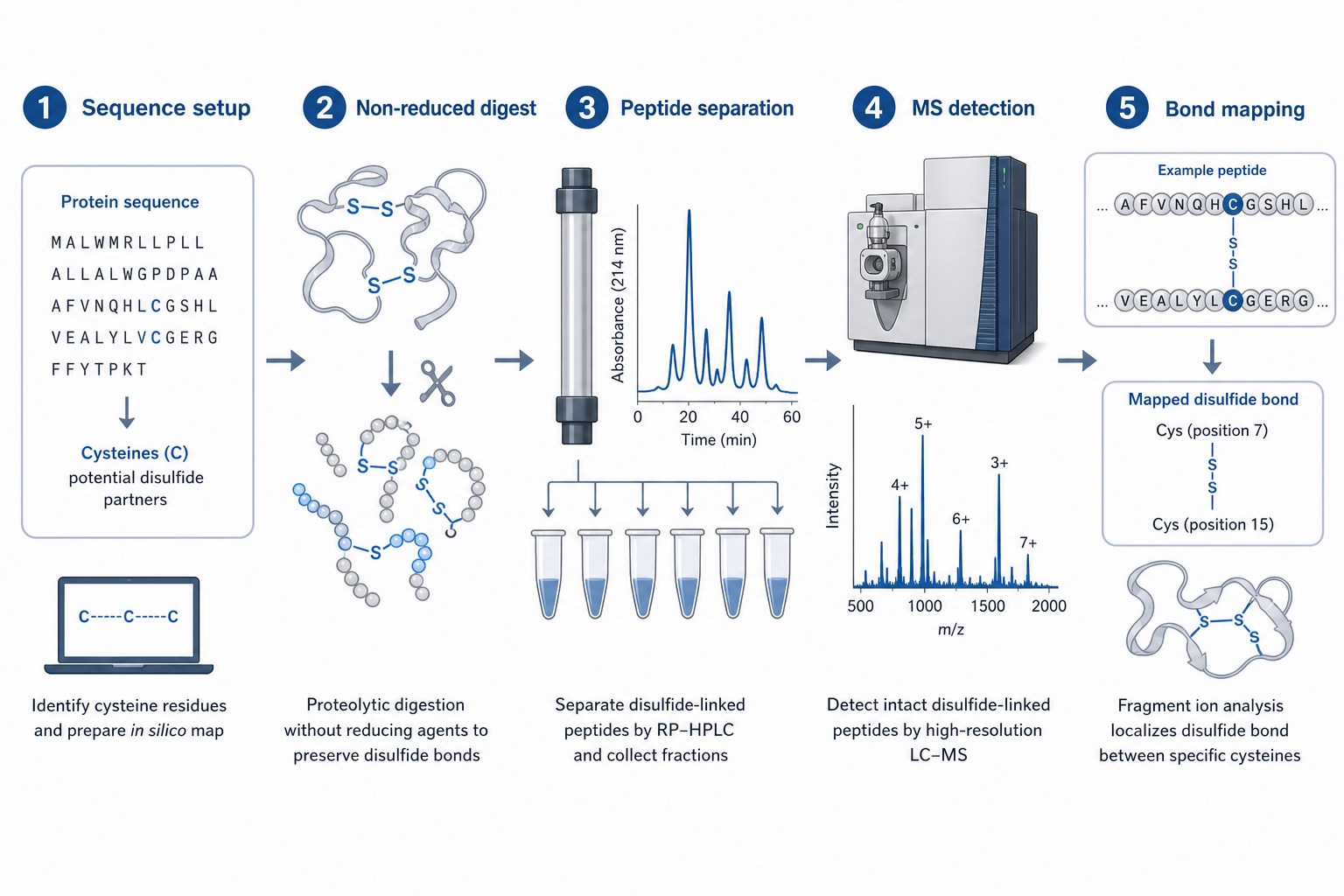
Figure 2. A peptide mapping workflow for disulfide position determination covers sequence setup, non-reduced digestion, peptide separation, MS detection, and bond mapping.
Related Services
Comprehensive Peptide Mapping Service
Disulfide Bond Analysis Service
Protein Disulfide Bond Analysis Service
Biopharmaceutical Disulfide Bond Analysis Service
Primary Structure Analysis Service
Teams planning disulfide bond mapping by peptide mapping can consult MtoZ Biolabs to review protein format, expected connectivity, and the mapping strategy best suited to the project goal.
Peptide Mapping Strategies for Disulfide Assignment
Different mapping strategies address different disulfide characterization needs.
|
Mapping Strategy |
How It Works |
Best Used When |
|---|---|---|
|
Non-reduced peptide mapping |
Digests protein without reducing disulfide bonds |
Direct connectivity assignment is required |
|
Reduced and alkylated mapping |
Cleaves and blocks cysteines before digestion |
Sequence coverage and comparison control are needed |
|
Paired reduced/non-reduced mapping |
Runs both workflows on the same sample |
Confirming native linkages and detecting shifts |
|
Multi-enzyme peptide mapping |
Uses additional proteases beyond trypsin |
Bridged regions produce oversized or weak peptides |
|
Targeted re-analysis of hinge peptides |
Focuses review on critical linked peptides |
Hinge or domain junction bonds need stronger evidence |
Strategy selection should follow product architecture rather than a fixed one-enzyme protocol for every protein.
Mapping Considerations That Affect Disulfide Assignment
Several practical considerations strongly influence the success of disulfide position determination by peptide mapping.
Controlled sample handling reduces disulfide scrambling and partial reduction that can create false connectivity differences.
Enzyme choice affects whether disulfide-linked peptides are small enough for robust chromatography and mass spectrometry.
LC gradient and MS acquisition depth influence recovery of low-abundance linked peptides in hinge or domain-bridged regions.
Reference accuracy is essential because misannotated sequences lead to incorrect predicted crosslinked masses.
Expert review is often required for disulfide-linked peptides because automated assignment may not reach project confidence standards.
Paired reduced and non-reduced datasets improve interpretability when comparability or investigation is the goal.
Applications in Protein and Biologics Characterization
Peptide mapping for disulfide position determination supports multiple development and quality applications.
Antibody characterization confirms interchain and intrachain linkages during candidate selection and CMC review.
Fusion protein mapping verifies connectivity across fused domains where incorrect pairing can disrupt function.
Comparability assessment compares disulfide patterns before and after process, purification, or site changes.
QC and investigation workflows support root-cause review when mass anomalies or activity changes suggest disulfide alteration.
Regulatory documentation provides peptide-level connectivity evidence in characterization packages for disulfide-rich products.
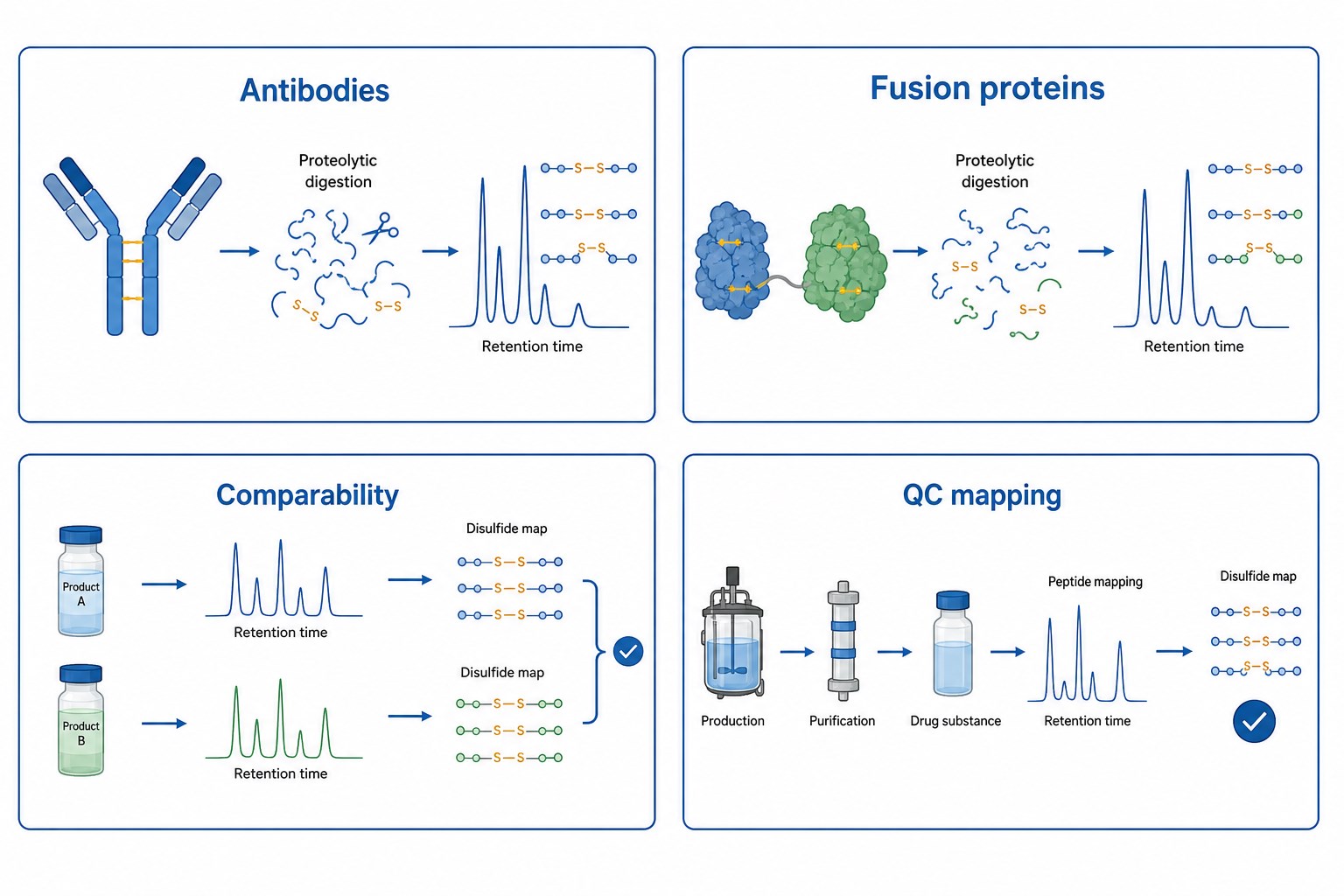
Figure 3. Peptide mapping for disulfide position determination supports antibody review, fusion protein mapping, comparability assessment, and QC documentation.
Core Advantages and Practical Limits
Core Advantages
Direct peptide-level connectivity evidence.
Non-reduced mapping detects disulfide-linked peptides corresponding to specific cysteine pairs.
Integration with standard biologics workflows.
Disulfide mapping extends peptide mapping already used for sequence and PTM review.
Flexible strategy design.
Paired digests and multi-enzyme approaches adapt to product complexity.
Support for comparability decisions.
Mapping data can compare connectivity across lots and conditions when workflows are controlled.
Actionable reporting for development teams.
Connectivity maps provide structured evidence for identity and quality review.
Practical Limits
Large linked peptides can be difficult to analyze.
Poor ionization or fragmentation may leave some bonds unsupported.
Sample prep artifacts can mislead assignment.
Scrambling or partial reduction during handling remains a major risk.
Automated tools may be insufficient alone.
Expert spectral review is often needed for confident bond calling.
Complex isoforms may coexist.
Some products contain more than one connectivity pattern requiring careful reporting.
Peptide mapping does not replace full structural analysis.
Connectivity assignment differs from complete conformational characterization.
Sample and Project Planning
Before peptide mapping for disulfide position determination, teams should define:
- mature sequence and expected disulfide architecture
- product format and chain or domain composition
- sample type and buffer matrix
- primary goal: confirmation, comparability, or investigation
- need for paired reduced and non-reduced mapping
- enzyme strategy and reporting depth required
Feasibility review before digestion helps prevent repeat analysis caused by incompatible formulation or unclear connectivity expectations.
Expected Deliverables
A useful peptide mapping report for disulfide position determination typically includes:
- assigned disulfide-linked peptides and proposed cysteine pairs
- connectivity map compared with expected architecture
- reduced digest coverage summary when paired analysis is performed
- confidence notes or annotated spectra for critical linkages
- documentation of ambiguous or unsupported bonds
- method summary covering digestion, separation, detection, and review criteria
Deliverables should clearly distinguish confirmed assignments from provisional or unsupported connectivity calls.
Frequently Asked Questions
1. How is disulfide bond position determined by peptide mapping?
Disulfide position is determined by detecting disulfide-linked peptides in non-reduced digests and assigning their masses and fragment ions to specific cysteine pairs in the reference sequence.
2. Why is non-reduced digestion required?
Non-reduced digestion preserves native disulfide bonds so linked peptides can be observed and mapped.
3. Is reduced peptide mapping also needed?
Reduced mapping is often performed in parallel for sequence coverage and comparison, but it does not alone prove native disulfide pairing.
4. Which enzymes are commonly used?
Trypsin is most common, but Lys-C, Glu-C, Asp-N, or multi-enzyme strategies may be used when bridged regions are difficult to map.
5. Can peptide mapping detect incorrect disulfide pairing?
Yes. Unexpected linked peptide masses or profile differences between reduced and non-reduced digests can indicate mispairing when supported by review.
6. Which products benefit most from this approach?
Monoclonal antibodies, fusion proteins, enzymes, and other disulfide-rich biologics where connectivity affects structure or function.
Conclusion
Determining disulfide bond position by peptide mapping provides a practical bottom-up route to cysteine connectivity assignment in proteins and biotherapeutics. Non-reduced digestion, peptide separation, mass spectrometric detection, and expert mapping review combine to link observed disulfide-linked peptides with specific residue pairs in the product sequence.
Successful projects define expected connectivity early, select mapping strategies matched to product architecture, and use paired reduced and non-reduced datasets when comparability or investigation requires stronger evidence. Peptide mapping delivers actionable connectivity maps that support development, QC, and documentation decisions without replacing full higher-order structural analysis. Teams planning disulfide bond mapping by peptide mapping can contact MtoZ Biolabs to review sample status, mapping strategy, and reporting depth for their program.
How to order?




