



Introduction
A relative proteomics result may show that a protein increases two-fold after treatment, but that readout cannot answer whether a biomarker exceeds a clinical threshold, whether a host cell protein remains below a ppm limit, or whether a product-related peptide meets a specification. A biomarker program may need plasma concentration in ng/mL. A biopharmaceutical team may need impurity reporting in defined units. A pharmacology group may need stoichiometric comparison across doses rather than fold change alone.
An absolute protein quantification assay addresses that need by converting selective peptide measurement into concentration-level reporting through calibrated standards, matrix-aware assay design, and validated LC-MS acquisition. Workflows commonly use stable isotope-labeled peptides such as AQUA (Absolute QUAntification) standards, matrix-matched calibrators, and MRM or PRM on predefined proteotypic peptides.
Weak absolute quantitation outcomes usually trace back to design gaps: undefined reporting units, poorly chosen surrogate peptides, calibration ranges that do not bracket sample concentrations, or cohort analysis launched before matrix validation is complete. A structured assay design workflow reduces rework, protects standard investment, and improves the chance of obtaining a concentration report suitable for the intended decision. Teams that must first separate absolute amount MS from relative discovery readouts can review Absolute Protein Quantification Mass Spectrometry for standard-level and assay-scope context before AQUA standards are ordered.
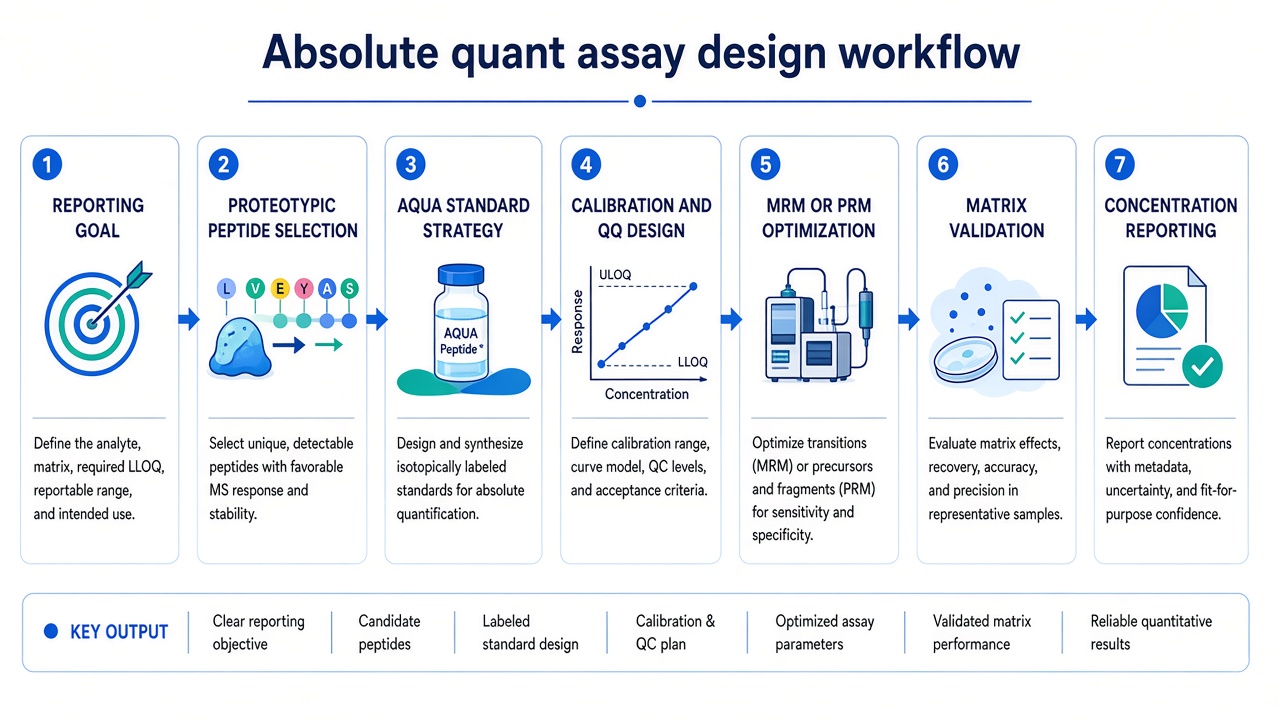
Figure 1. Assay design moves from reporting goal definition through peptide selection, AQUA standard strategy, calibration design, platform optimization, matrix validation, and QC reporting.
Absolute protein quantification is a calibrated targeted assay project; it is not a relative fold-change workflow with labeled peptides added without range and matrix planning.
Common Pain Points Before Starting
Researchers often begin assay design after encountering one or more of these problems:
- stakeholders require ng/mL or ppm reporting, but the current workflow only supports relative abundance
- AQUA standards were ordered before proteotypic peptide performance was tested in the project matrix
- calibration curves look acceptable in buffer but fail when study samples are introduced
- MRM transitions work on synthetic peptides yet show interference or poor precision in plasma or lysate
- sample concentrations fall outside the validated calibration range
- QC documentation was not planned before the first cohort run
These issues are common in biomarker quantitation, host cell protein monitoring, and biopharmaceutical peptide assays. The practical question is not whether absolute protein quantification is theoretically possible. The question is whether the current target peptide, standard strategy, calibration model, and QC plan can support concentration reporting in the matrix where the decision must be made.
Why Absolute Quant Assays Fail Early
Most early failures come from design gaps rather than from LC-MS instrumentation alone.
- Undefined Reporting Goal
Teams may request absolute quantitation without deciding whether results must be reported as ng/mL, fmol, ppm, or amount per input unit.
- Poor Proteotypic Peptide Choice
A surrogate peptide that ionizes well on standards may not represent the target protein reliably or may be masked by matrix interference.
- Calibration Range Mismatch
Calibrator levels that do not bracket expected sample concentrations produce extrapolated values with weak interpretability.
- Wrong Spike Timing
AQUA peptides added at the wrong preparation step can distort recovery estimates for whole-protein versus post-digestion quantitation.
- Platform Choice Without Matrix Review
MRM may be efficient in clean matrices, but complex backgrounds sometimes require PRM-level fragment confirmation.
- No QC Acceptance Criteria
Without predefined rules for linearity, precision, and recovery, it is difficult to judge whether the assay is ready for sample reporting.
Understanding these issues helps teams design the assay before labeled standards, sample material, and project budget are committed to the wrong quantitative model.
Step 1: Define the Reporting Goal and Decision Use
Before peptide or standard design begins, define what the absolute protein quantification assay must support.
- Must results be reported in ng/mL, fmol, ppm, or per microgram of total protein?
- Is the assay for biomarker concentration, host cell protein monitoring, product-related peptide tracking, or pathway stoichiometry?
- Will the output support internal research review, method transfer, publication, or specification comparison?
- Is a full validation package required, or is a feasibility-level absolute readout sufficient for the next decision?
- Must the assay remain comparable across batches, operators, or sites?
If the decision use is unclear, standard design, calibration depth, and QC documentation cannot be scoped accurately. A biomarker plasma assay and a biopharmaceutical impurity assay may both use AQUA peptides, but they require different matrix handling, calibration design, and reporting plans.
Step 2: Select Proteotypic Peptides for Absolute Quantitation
An absolute protein quantification assay depends on surrogate peptides that represent the target protein reliably in the project matrix.
1. Start from the Protein Target
Translate each protein of interest into one or more candidate proteotypic peptides. Prioritize sequence uniqueness, expected ionization, chromatographic behavior, and prior evidence from discovery or targeted data when available.
2. Evaluate Matrix Compatibility Early
Test candidate peptides in the actual sample matrix, not only in synthetic standard runs. Peptides that are precise on paper can be weak or interfered with in plasma, tissue lysate, or formulation extract.
3. Confirm Surrogate Validity
Absolute quantitation reflects the measured peptide, not necessarily every isoform, splice variant, or modified form of the protein. Document surrogate assumptions during assay design.
The table below summarizes how project type often influences peptide selection.
Project Type |
Typical Peptide Focus |
Main Design Priority |
|---|---|---|
Plasma biomarker assay |
Unique abundant surrogate in biofluid |
Detectability and calibration range in plasma |
Host cell protein monitoring |
Selective proteotypic peptide in product matrix |
Selectivity and ppm-level range design |
Biopharmaceutical peptide tracking |
Product-related or comparability surrogate |
Matrix interference control |
Pathway stoichiometry |
Predefined signaling protein surrogate |
Precision and normalization strategy |
Low-abundance target |
Alternate peptide or enrichment route |
Realistic limit of quantitation in matrix |
Completing this step before AQUA standard synthesis prevents investing in an assay built around a peptide the matrix cannot support.
Step 3: Choose the AQUA or Labeled-Standard Strategy
Most absolute protein quantification assays use stable isotope-labeled peptide standards that match the target sequence.
Key design decisions include:
- whether AQUA peptides will serve as internal standards, external calibrators, or both
- whether standards will be spiked before digestion or after digestion
- how many labeled peptides are required for a single-protein versus multiplex assay
- whether absolute reporting depends on one surrogate peptide or multiple peptides per protein
Pre-digestion spiking is often chosen when whole-protein recovery must be tracked through sample preparation. Post-digestion spiking is common when the assay quantifies a defined proteotypic surrogate after consistent proteolysis.
If multiple proteins must be quantified absolutely, standard cost and multiplexing scope should be reviewed during feasibility planning rather than after standards are ordered.
Step 4: Design the Calibration Curve and QC Levels
Calibration design is the quantitative core of an absolute protein quantification assay.
1. Set Calibrator Levels Across the Expected Range
Prepare multiple standard concentrations that bracket the anticipated sample range. Samples that fall outside the validated interval may require dilution, enrichment, or curve revision.
2. Use Matrix-Matched or Surrogate Matrix Calibrators
Calibrators prepared in a background similar to study samples improve accuracy when ion suppression, recovery effects, or digestion variability affect peptide signal.
3. Include QC Samples Within the Validated Range
Quality control levels at low, mid, and high concentrations within the calibrated interval support precision and recovery review during assay validation.
4. Define Acceptance Criteria Before Sample Reporting
Linearity, replicate precision, recovery, and carryover limits should be agreed during assay design so the team knows when the method is ready for cohort analysis.
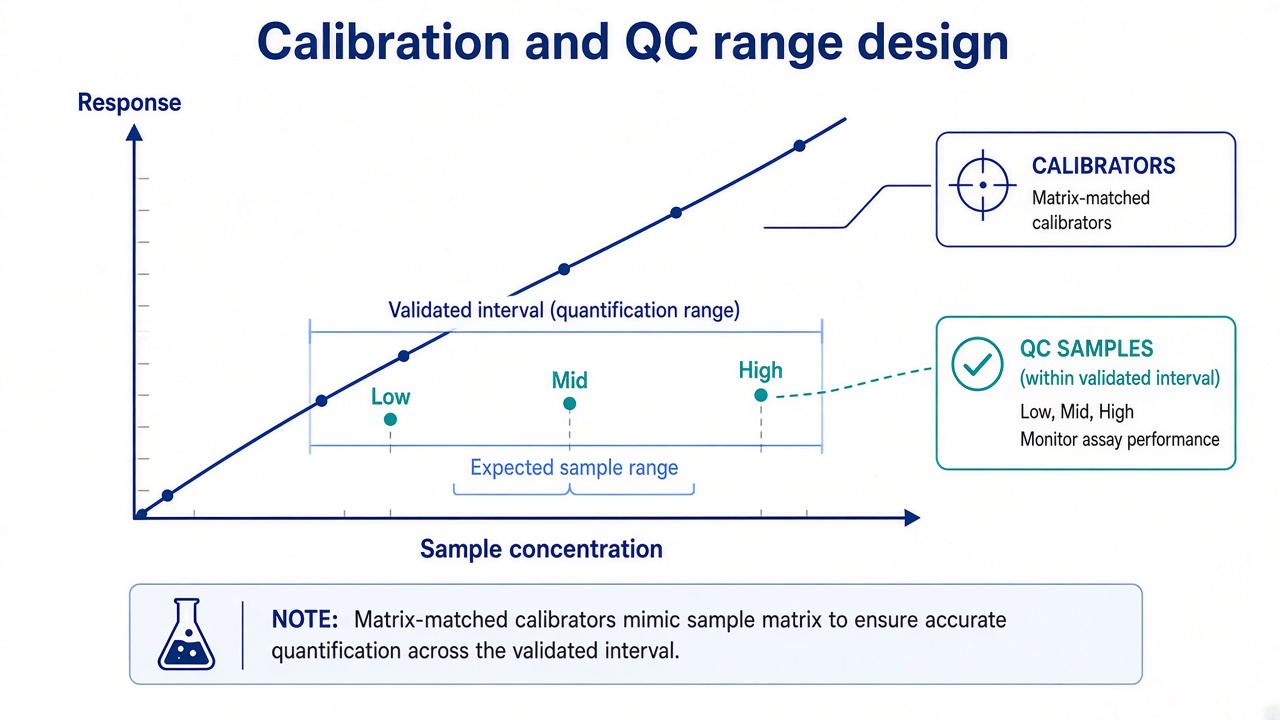
Figure 2. Calibration design should bracket the expected sample range and include QC levels within the validated interval.
Step 5: Optimize MRM or PRM Acquisition
Absolute quantitation in proteomics usually depends on selective LC-MS acquisition of light and heavy peptide pairs.
- Use MRM when transitions are stable, throughput is high, and matrix interference is manageable.
- Use PRM when co-eluting background limits MRM performance or fragment-level confirmation adds value.
- Optimize transitions or isolation windows on labeled and unlabeled peptide standards before project samples are run.
- Review retention time stability, signal quality, and interference during matrix pilot testing.
Platform choice should follow matrix complexity and confirmation needs, not instrument preference alone. When the intended readout is a closed targeted panel with calibrated amount units rather than fold change alone, Absolute Quantification in Targeted Proteomics outlines how MRM and PRM assays differ in confirmation depth and matrix use during assay design.
Step 6: Validate the Assay in Project Matrix
A designed assay is not ready for reporting until it performs in the matrix where decisions will be made.
Useful validation steps include:
- confirming peptide detectability in study-relevant samples
- reviewing calibration fit and QC precision across replicate runs
- checking recovery at low, mid, and high QC levels
- documenting failed or borderline transitions or precursors
- testing whether sample dilution is needed to keep values inside the validated range
Matrix pilot testing is often the highest-value step in absolute assay design because it reveals whether the peptide, calibration model, and platform choice work together in practice.
Step 7: Define Reporting Format and Sample Analysis Plan
Before the full sample set is analyzed, define what the deliverable must include.
A useful absolute protein quantification report often contains:
- concentration tables with agreed units across samples
- calibration curve data and fit summary
- AQUA standard and acquisition method notes
- QC recovery and precision summaries
- flags for samples outside the validated range
- comments on surrogate peptide assumptions and matrix limitations
Define acceptance criteria during scoping. A regulated QC workflow may require fuller calibration documentation than an exploratory absolute screen tied to a single decision gate.
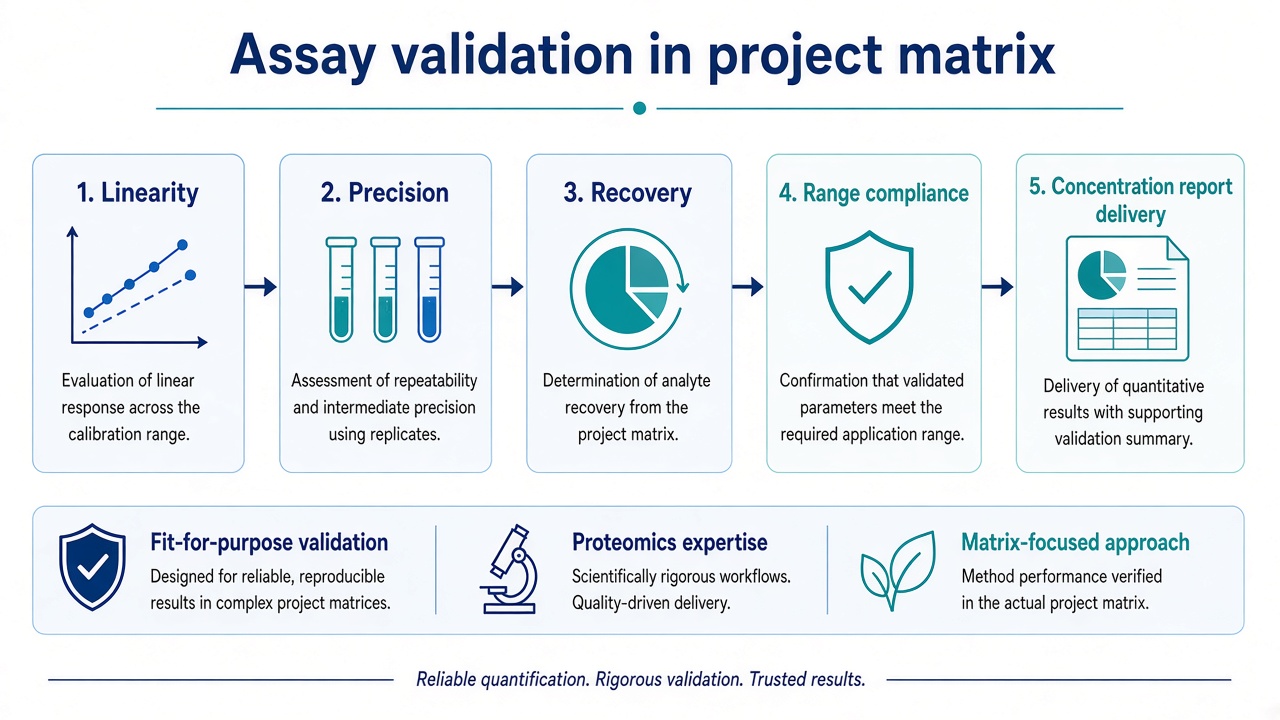
Figure 3. Assay validation should cover linearity, precision, recovery, range compliance, and concentration report delivery.
Step 8: Prepare a Feasibility-Ready Assay Design Package
Before AQUA standards are synthesized or samples are submitted, assemble the information a service provider needs for accurate scoping.
A feasibility-ready package often includes:
- target protein list and intended reporting units
- sample matrix type and preparation method
- expected concentration range and number of samples
- preferred platform if known: MRM or PRM
- spike-timing preference: pre-digestion or post-digestion
- QC and documentation requirements
- prior failed attempts or partial assay data
A complete package improves quote accuracy, reduces rework, and helps the provider recommend an appropriate absolute quantitation workflow.
Pre-Design Planning Checklist
Planning Item |
What to Decide |
Common Mistake |
|---|---|---|
Reporting goal |
Define units and decision use |
Requesting absolute values without specifying ng/mL, ppm, or fmol |
Surrogate peptide |
Select matrix-tested proteotypic peptide |
Ordering AQUA standards before matrix review |
Standard strategy |
Choose spike timing and calibrator role |
Mixing pre- and post-digestion designs without planning |
Calibration range |
Bracket expected sample concentrations |
Building a curve that samples exceed |
Platform choice |
Select MRM or PRM based on matrix |
Assuming MRM will work in every background |
QC criteria |
Set linearity, precision, and recovery rules |
Running cohort samples before validation is complete |
Reporting scope |
Define tables, QC notes, and documentation |
Expecting specification-ready output from minimal scope |
This checklist helps teams move from a concentration reporting need to a scoped absolute protein quantification assay with fewer surprises.
Expected Results and How to Judge Success
A successful absolute protein quantification assay may deliver one of several outcomes depending on the goal.
- Validated Concentration Reporting in Defined Units
The most common deliverable for biomarker or impurity monitoring.
- Documented Calibration and QC Performance
Useful when the assay must support method review or transfer.
- A Matrix-Tested Assay Ready for Cohort Expansion
Useful when pilot validation confirms the peptide and calibration model before larger sample sets are analyzed.
- A Revised Assay Design with Documented Limitations
Useful when pilot testing shows that surrogate peptide, range, or platform choice must be adjusted before reporting proceeds.
Success should be judged by evidence quality and fit with the stated use, not by whether a calibration curve can be generated in buffer alone. A transparent concentration report with documented range limits is more valuable than overconfident values from an unvalidated matrix assay.
Troubleshooting Common Design Mistakes
Problem |
Likely Cause |
Recommended Fix |
|---|---|---|
Calibration works in buffer but not in samples |
Matrix mismatch or surrogate interference |
Rebuild calibrators in project matrix and review peptide choice |
High variability across replicates |
Unstable preparation or normalization |
Standardize digestion, spike timing, and QC sample placement |
Samples fall outside calibrated range |
Range underestimated |
Dilute samples or extend calibrator levels after pilot review |
Heavy-to-light ratios drift |
Incorrect spike amount or digestion inconsistency |
Revisit AQUA spike level and preparation protocol |
MRM interference in complex matrix |
Background co-elution |
Move affected peptides to PRM or revise surrogate peptide |
Report rejected by reviewers |
QC documentation not scoped early |
Align validation package with decision use during design |
If design mistakes are corrected early, many absolute quantitation projects can avoid reordering standards and repeating cohort analysis.
Key Precautions
Do not order AQUA standards before proteotypic peptide performance is reviewed in the project matrix.
Do not treat relative targeted quantitation and absolute quantitation as the same assay scope.
Do not launch cohort reporting before calibration range, QC criteria, and recovery review are defined.
Do not assume one surrogate peptide represents every protein form unless that assumption is documented.
Do not skip feasibility review when the matrix is plasma, formulation, or another complex background.
For difficult matrices or low-abundance targets, a phased assay design with documented range limits may be more realistic than expecting full validation from the first pilot run. Teams without in-house calibrated assay experience can work with MtoZ Biolabs during feasibility review to align standard design, QC criteria, and reporting scope before standards are synthesized.
1. What is the first step in designing an absolute protein quantification assay?
Define the reporting goal and units. Concentration reporting in ng/mL, ppm, or fmol requires different calibration and documentation planning than relative fold-change analysis.
2. When should AQUA peptides be ordered?
After proteotypic peptide selection and matrix feasibility review. Ordering standards too early can waste time and cost if the surrogate peptide fails in project samples.
3. How many calibrator levels are usually needed?
Most assays require multiple levels across the expected sample range plus QC samples at low, mid, and high concentrations within the validated interval.
4. Can PRM be used instead of MRM for absolute quantitation?
Yes. Both platforms can support absolute assays when fragment ions or transitions are validated and calibration is performed in the study matrix.
5. What should be included in a feasibility review?
Target list, reporting units, matrix type, expected concentration range, spike-timing plan, platform preference, QC needs, and prior assay results should all be reviewed before standard synthesis begins.
Conclusion
Designing an absolute protein quantification assay requires more than adding AQUA peptides to a relative targeted workflow. Teams should define reporting units and decision use, select matrix-compatible proteotypic peptides, choose an appropriate labeled-standard strategy, design calibration and QC levels that bracket sample concentrations, optimize MRM or PRM acquisition, validate the assay in project matrix, and align reporting scope with the intended decision before cohort analysis begins. More reliable outcomes come from treating absolute quantitation as a calibrated assay design project rather than a standard add-on to relative quantitation. Researchers who already have a target list, reporting units, and matrix requirements defined for biomarker measurement, host cell protein monitoring, or biopharmaceutical peptide tracking can also review the MtoZ Biolabs Absolute Quantitative Analysis (AQUA) Service for project-specific feasibility review, standard design alignment, and selective LC-MS validation planning before AQUA synthesis begins.
