






De Novo Peptide Sequencing vs. Database Search: Which Method Fits Your Peptide Sequence Analysis Project?
Introduction
Peptide sequence analysis projects often reach a method decision before the first LC-MS/MS file is interpreted. A laboratory may have thousands of spectra from a digested protein sample, yet only a subset truly determines whether the project succeeds. Some peptides will match a reference database cleanly. Others will remain unmatched because the parent protein is absent from the search space, because the sequence is novel, or because modifications and sequence differences were not represented correctly. At that point, the practical question is whether database search alone is enough or whether de novo peptide sequencing is required.
Database search matches experimental MS/MS spectra to predicted peptides from a known sequence library. De novo peptide sequencing interprets fragment ion patterns directly to infer amino acid order without relying on a prior database entry. Both methods are widely used in protein research, proteomics, and biologics support workflows, but they solve different problems. Selecting the wrong route can produce false confidence, missed identifications, or repeat analysis after the first report fails review.
Understanding how database search and de novo sequencing differ helps teams define the right peptide sequence analysis strategy before sample amount, acquisition time, and reporting deadlines are committed.
When Researchers Face This Method Decision
This comparison usually appears when a project needs peptide-level sequence evidence but the best interpretation route is not yet clear.
Common scenarios include recombinant protein confirmation, where a known construct sequence suggests database search as the first route; proteomics discovery in poorly annotated organisms, where many spectra may not map to available references; investigation of unmatched or unexpected peptides in a mapping project, where follow-up de novo analysis may be needed; synthetic peptide or impurity verification, where direct sequence confirmation may require de novo or targeted MS/MS review; and biologics comparability work, where reference-based searching is usually primary but unusual peptides may still need independent sequence assignment.
In each case, the decisive variables are reference availability, spectral quality, reporting standard, and whether the project goal is confirmation against a known sequence or determination of an unknown peptide.
Four Comparison Dimensions That Matter Most
A useful comparison should focus on analytical fit rather than software preference alone.
Reference sequence dependence.
Database search requires a relevant sequence library. De novo sequencing is designed for cases where that reference is missing, incomplete, or untrusted.
Primary analytical question.
Database search asks which known peptide best explains a spectrum. De novo sequencing asks what amino acid order is supported by the fragment evidence itself.
Confidence and review burden.
Database search can scale efficiently when references are strong, but false matches still require review. De novo sequencing can solve unmatched spectra yet often needs expert validation of residue calls.
Project throughput and reporting goal.
Large proteomics studies often prioritize database search with false discovery rate control. Targeted investigations of a few critical unmatched peptides may justify de novo follow-up instead of expanding the search database blindly.
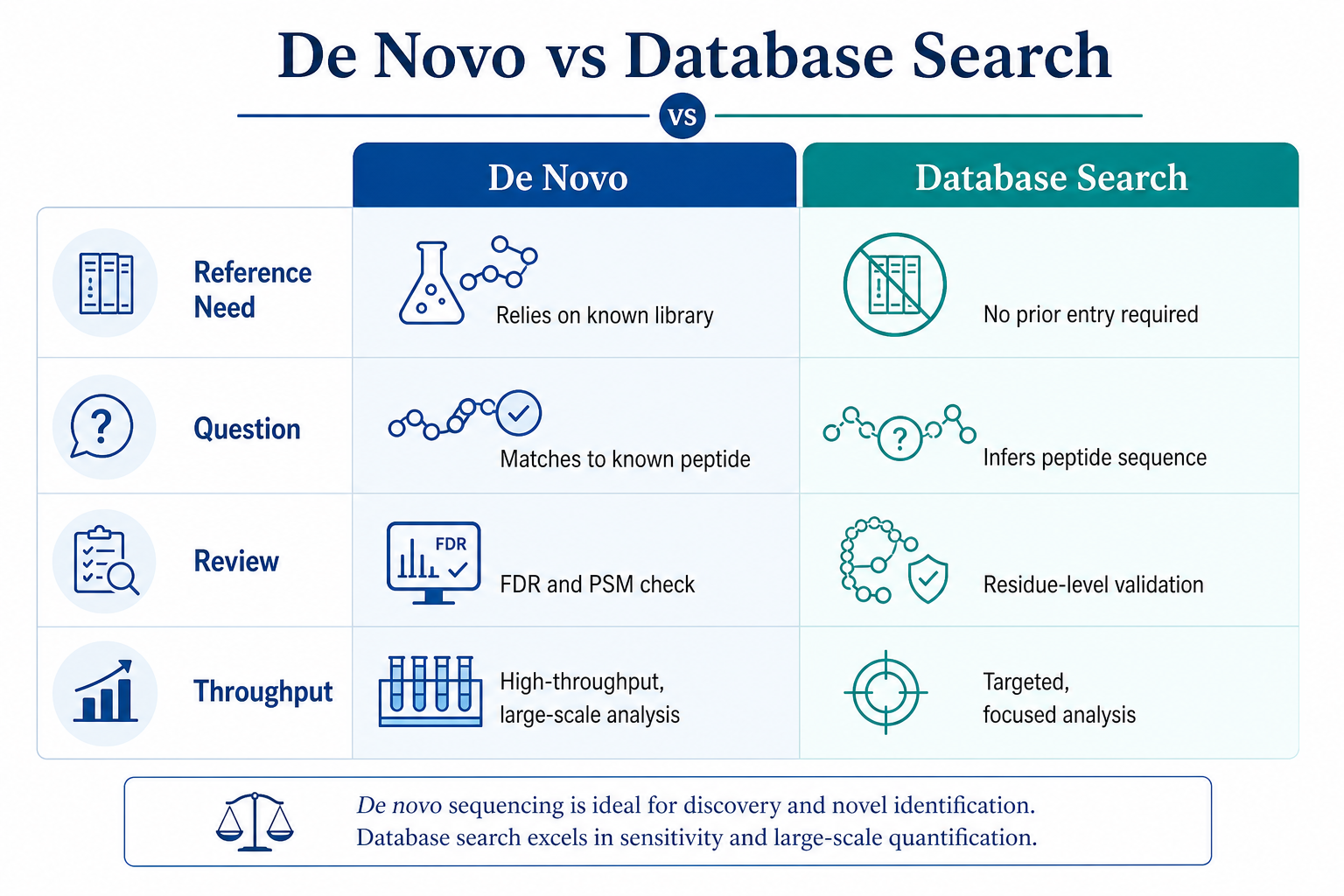
Figure 1. De novo peptide sequencing and database search differ most in reference dependence, analytical goal, review burden, and project fit.
How Database Search Works in Peptide Sequence Analysis
Database search begins with a protein or peptide sequence library and enzyme digestion rules. Experimental MS/MS spectra are compared with in silico fragment predictions, and candidate peptide-spectrum matches are scored using precursor mass accuracy, fragment agreement, retention time when available, and false discovery rate filtering.
This route is efficient when the parent protein is represented in the database and digestion produces predictable peptides. It supports protein inference, coverage mapping, modification searching, and batch comparison across replicate runs. The main limitation is reference dependence. If the correct sequence is absent, misannotated, or insufficiently modified in the search parameters, valid spectra may remain unassigned or be assigned incorrectly.
How De Novo Peptide Sequencing Works
De novo peptide sequencing interprets MS/MS fragment ladders, usually b-type and y-type ions, to reconstruct amino acid order without requiring a matching database entry. Software or expert review evaluates sequence tags, residue confidence, and modification-related mass shifts directly from spectral evidence.
This route is valuable for unmatched spectra, novel peptides, synthetic sequence verification, poorly annotated organisms, and follow-up analysis of unexpected features in a reference-based project. Success depends on spectrum quality, peptide length, isoleucine/leucine ambiguity, and the presence of labile modifications. De novo results should be reviewed cautiously before they are used for biological claims, patent support, or resynthesis decisions.
Related Services
Teams comparing database search and de novo peptide sequencing often evaluate both interpretation routes before finalizing project scope. Relevant options include:
De Novo Peptide Sequencing Service
De Novo Peptide Sequencing Services
Peptide Sequencing Service by Mass Spectrometry
Peptide Identification Service
Mass Spectrometry-Based Peptide Identification Service
Researchers deciding between database search and de novo sequencing can consult MtoZ Biolabs to review reference availability, sample complexity, and the reporting depth required for the project.
Side-by-Side Comparison
The method descriptions above show why database search and de novo sequencing are complementary rather than interchangeable. The table below summarizes practical differences for peptide sequence analysis planning.
|
Dimension |
Database Search |
De Novo Peptide Sequencing |
|---|---|---|
|
Core question |
Which known peptide matches this spectrum? |
What sequence do the fragment ions support? |
|
Reference requirement |
Strong dependence on sequence library quality |
No prior sequence entry required |
|
Best sample context |
Known protein, construct, or annotated proteome |
Unmatched spectra, novel peptides, poor annotation |
|
Throughput |
High for large datasets |
Lower and more review-intensive |
|
Modification handling |
Strong when parameters are set correctly |
Sensitive to labile or unexpected modifications |
|
Main deliverable |
PSM tables, coverage maps, protein inference |
Assigned peptide sequences or sequence tags |
|
Main limitation |
Misses peptides absent from database |
Weak on poor spectra and complex mixtures |
|
Review standard |
FDR control plus manual inspection of key PSMs |
Expert residue-level validation often required |
This comparison shows why many projects use database search as the primary route and reserve de novo sequencing for unmatched or high-priority spectra.
Which Method Fits Different Project Goals
Choose database search when
a reliable reference sequence or proteome database is available, the project requires broad peptide identification or coverage mapping, the sample comes from a well-annotated system, and reporting depends on scalable PSM assignment with false discovery rate control.
Choose de novo peptide sequencing when
key spectra remain unmatched after database searching, the peptide sequence is unknown or must be independently verified, the sample comes from a poorly annotated organism or novel protein context, or a small number of critical peptides require direct sequence assignment.
Use both in sequence when
database search handles the majority of peptides efficiently and de novo analysis is applied afterward to unmatched features, unexpected modifications, or regions that require independent confirmation before reporting.
Researchers should decide whether the project goal is to confirm a known protein context or to recover sequence information outside the current reference set. That distinction usually determines the primary method more clearly than instrument type alone.
Decision Recommendations by Project Type
|
Project Type |
More Suitable First Method |
Why |
|---|---|---|
|
Recombinant construct confirmation |
Database search |
Expected sequence is known and coverage is the main goal |
|
mAb or biologic peptide mapping |
Database search |
Reference-based PSM and coverage reporting are usually required |
|
Proteomics in model organisms |
Database search |
Annotated proteome supports efficient identification |
|
Metaproteomics or environmental sample |
De novo sequencing or hybrid |
Reference databases are often incomplete |
|
Synthetic peptide verification |
De novo sequencing or targeted MS/MS |
Direct sequence confirmation is the decision point |
|
Unmatched gel band investigation |
De novo sequencing |
Parent protein may not be in the search database |
|
Biomarker candidate follow-up |
Hybrid workflow |
Database search first, de novo for unresolved critical peptides |
|
Novel protein discovery |
De novo sequencing |
Sequence tags may be needed before annotation exists |
These recommendations are starting points. Spectral quality, modification profile, sample purity, and reporting urgency can shift the final workflow.
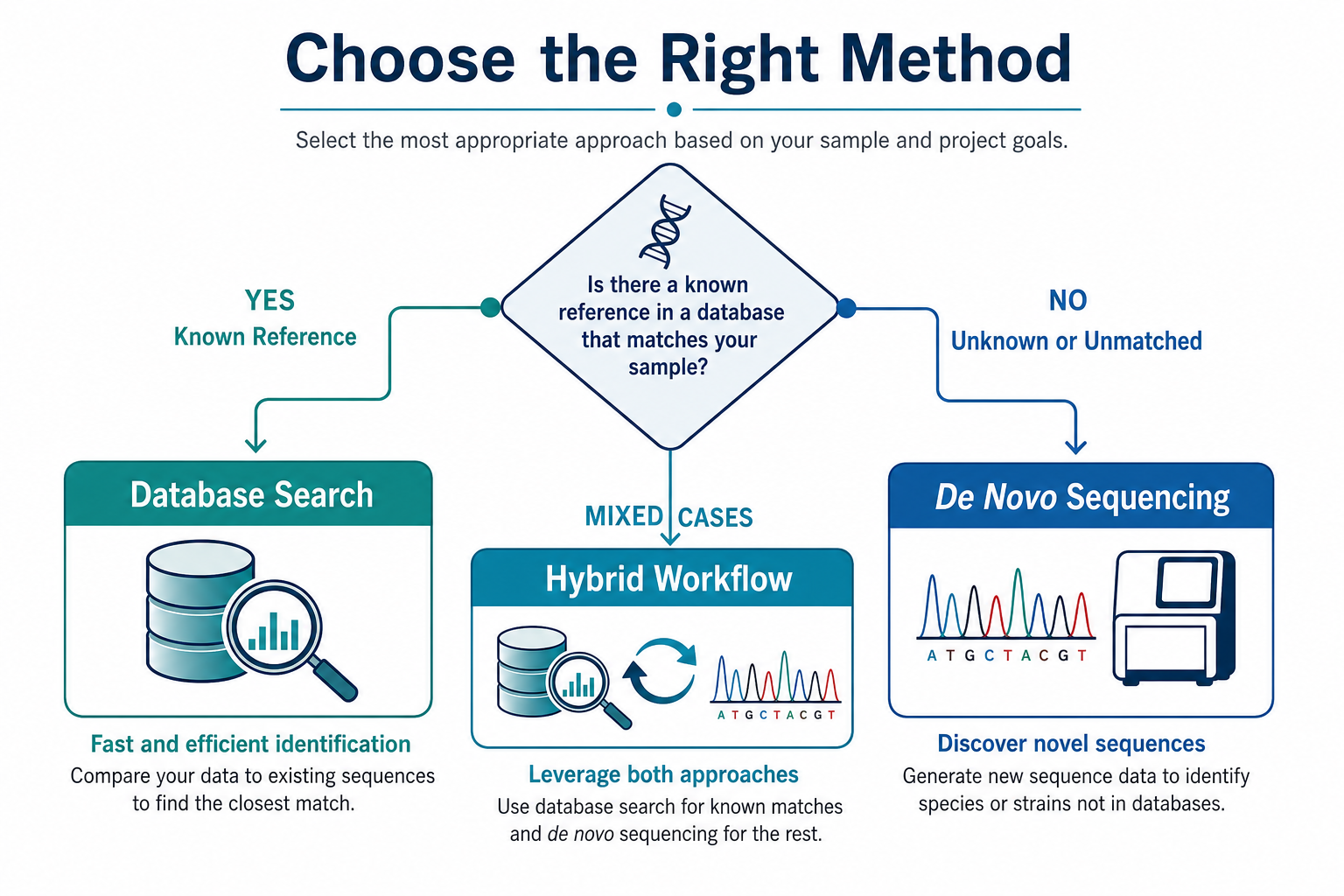
Figure 2. Reference availability and project goal are the main factors in choosing database search or de novo peptide sequencing.
Combined Strategies and Practical Limits
A strict either-or decision is not always necessary. Many peptide sequence analysis projects benefit from a staged workflow. Database search identifies the majority of peptides efficiently and produces the coverage or protein inference framework. De novo sequencing is then applied to unmatched spectra, low-confidence PSMs, or peptides that are biologically critical even if they are low in abundance.
Database search is not a substitute for de novo interpretation when the reference is wrong or incomplete. De novo sequencing is not the most efficient first step for routine comparability on a well-characterized product when a qualified reference-based map is the accepted deliverable. The better method is the one that produces the evidence format required for the next decision with the least rework.
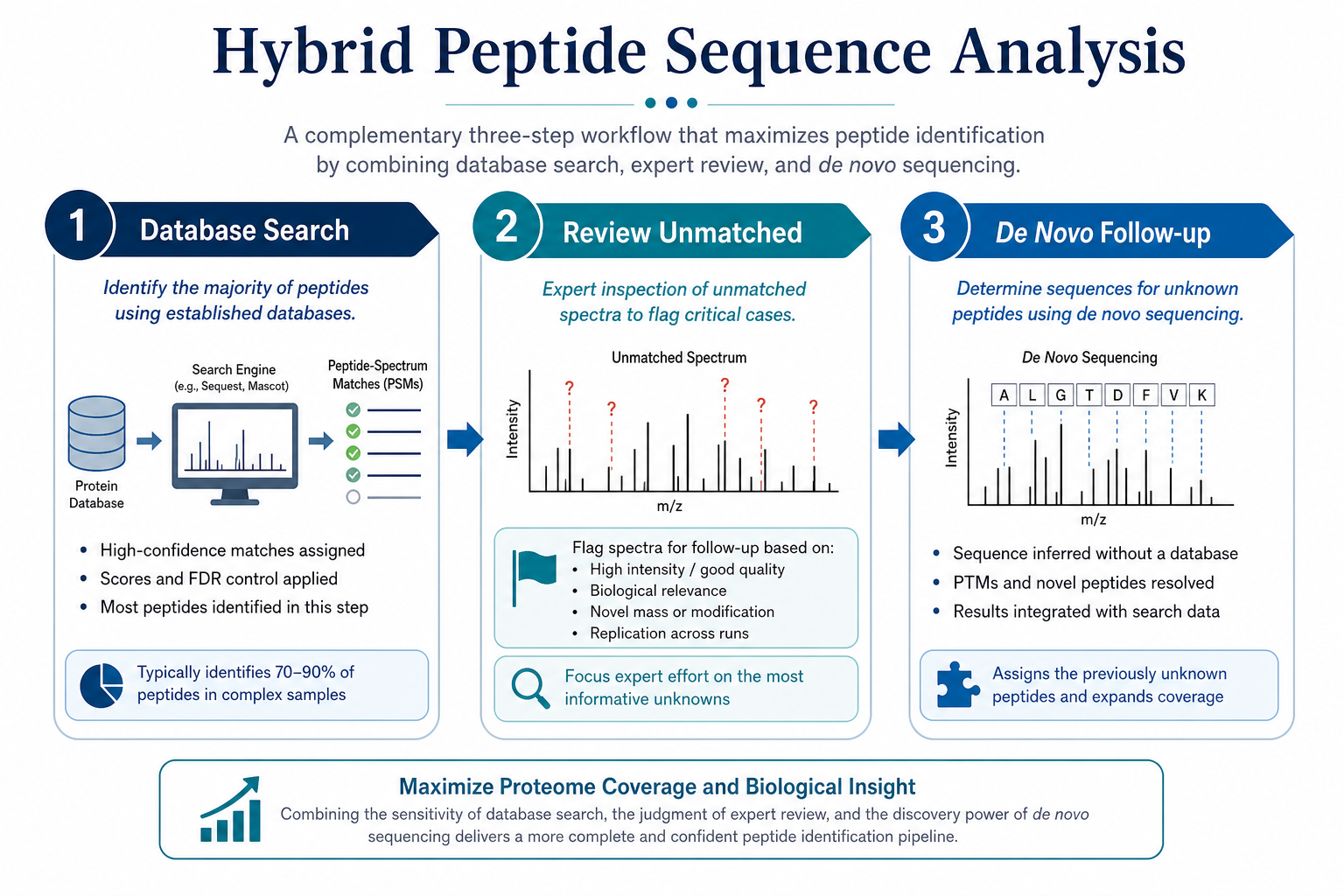
Figure 3. A hybrid peptide sequence analysis workflow often uses database search first and de novo sequencing for unmatched or critical peptides.
Frequently Asked Questions
1. What is the main difference between de novo peptide sequencing and database search?
Database search matches spectra to known peptide sequences from a reference library. De novo peptide sequencing infers amino acid order directly from fragment ion evidence without requiring a prior database match.
2. Should I always run de novo sequencing after database search?
Not always. De novo follow-up is most useful when unmatched spectra, unexpected peptides, or low-confidence assignments are central to the project decision.
3. Can database search identify novel peptides?
Only if the correct sequence or close homolog is present in the search database with appropriate parameters. Truly novel peptides often require de novo interpretation.
4. Which method is better for biologics peptide sequence analysis?
Database search is usually the better first method when the product sequence is known. De novo sequencing becomes important when unexpected peptides or unsupported regions require independent assignment.
5. Can one provider support both database search and de novo peptide sequencing?
Yes. Integrated service workflows can use reference-based identification for the main dataset and de novo analysis for unresolved peptides that require additional confirmation.
Conclusion
Database search and de novo peptide sequencing address different bottlenecks in peptide sequence analysis. Database search is the efficient primary route when a reliable reference sequence or proteome is available and the project requires broad identification, coverage mapping, or protein inference. De novo peptide sequencing is the better choice when spectra remain unmatched, the peptide sequence is unknown, or independent confirmation is required for critical features. Many successful projects use a hybrid workflow that combines both methods rather than forcing one approach for every spectrum. The most suitable strategy becomes clear once reference availability, reporting goal, and validation standard are defined. Researchers comparing database search and de novo peptide sequencing for an upcoming project can contact MtoZ Biolabs to review sample type, reference data, and the interpretation depth required before analysis begins.
How to order?




