






Confident peptide mapping and disulfide bond analysis of an IgG2 monoclonal antibody
Introduction
IgG2 monoclonal antibodies present a more demanding peptide mapping and disulfide bond analysis challenge than many IgG1 products. Sequence confirmation alone is not enough when hinge-region connectivity, disulfide isoforms, and heavy-light chain pairing must be documented for CMC review. An intact mass profile may show the expected IgG2 mass yet leave hinge disulfide architecture unresolved. A standard reduced tryptic map may confirm coverage without proving which cysteines remain linked in the native molecule.
Confident peptide mapping and disulfide bond analysis of an IgG2 monoclonal antibody requires a workflow designed for IgG2 structural features. IgG2 molecules contain additional hinge-region cysteines and can exist as disulfide isoforms with different interchain connectivity patterns. Peptide mapping with LC-MS/MS must therefore combine robust sequence coverage with non-reduced digestion, disulfide-linked peptide identification, and expert spectral review that distinguishes expected IgG2 connectivity from scrambling or partial reduction artifacts.
For biologics teams working with IgG2 therapeutics, the analytical goal is not only to list peptides but to deliver traceable evidence that supports identity confirmation, disulfide architecture review, and comparability assessment with confidence appropriate to the project stage.
Why IgG2 Monoclonal Antibodies Require Specialized Mapping
IgG2 is structurally distinct from IgG1 in the hinge and disulfide architecture. While IgG1 typically follows a well-defined interchain disulfide pattern, IgG2 contains additional cysteine residues in the hinge region that can form alternative disulfide linkages. This gives rise to disulfide isoforms that differ in heavy-heavy and heavy-light connectivity while retaining the same primary sequence.
These features affect analytical strategy in several ways.
Hinge-region peptides may be larger and more complex than corresponding IgG1 segments, reducing ionization efficiency and complicating MS/MS interpretation.
Non-reduced digestion is essential because reduced mapping alone cannot assign native disulfide pairs in the hinge.
Disulfide isoform populations may coexist in a single product lot, requiring reporting of major connectivity patterns rather than a single simplistic linkage diagram.
Comparability review must distinguish true connectivity change from analytical variability or sample handling effects.
Peptide mapping projects that use IgG1-default workflows without IgG2-specific planning often produce incomplete disulfide evidence even when overall sequence coverage appears acceptable.
What Confident Peptide Mapping Means for an IgG2 mAb
Confident peptide mapping for an IgG2 monoclonal antibody means that observed peptides are matched to the reference sequence with sufficient spectral evidence to support identity, modification placement, and batch comparison when applicable. Confidence depends on coverage depth, peptide spectrum match quality, manual review of critical regions, and consistency across replicate runs.
For IgG2 products, confidence also requires explicit attention to hinge-proximal peptides, cysteine-containing segments, and regions where missed cleavages or disulfide linkage alter peptide mass and retention behavior. A confident map is not defined by peptide count alone. It is defined by whether critical chain segments, including those involved in disulfide architecture, are supported by interpretable LC-MS/MS evidence.
Reduced and alkylated mapping remains the foundation for sequence coverage. Non-reduced mapping provides the complementary connectivity layer needed for disulfide bond analysis. Together they support a more complete IgG2 characterization package than either workflow alone.
IgG2 Disulfide Architecture and Analytical Implications
IgG2 monoclonal antibodies contain intrachain disulfides within Fab and Fc domains as well as interchain disulfides connecting heavy and light chains. The hinge region is the main source of IgG2-specific complexity because additional cysteines can participate in alternative disulfide patterns.
Analytical teams typically review several connectivity categories.
Interchain heavy-light disulfides linking each light chain to a heavy chain.
Intrachain Fab disulfides stabilizing variable and constant domains.
Fc domain disulfides maintaining CH2 and CH3 structural integrity.
Hinge-region disulfides that define IgG2 isoform patterns and are most likely to require non-reduced peptide evidence for confident assignment.
IgG2 disulfide isoforms have been described in the literature with different hinge disulfide arrangements. Product-specific reference architecture should be defined from sequence design, prior characterization, or structural knowledge before observed peptides are interpreted. Reporting should describe major connectivity patterns and note any isoform heterogeneity relevant to the development stage.
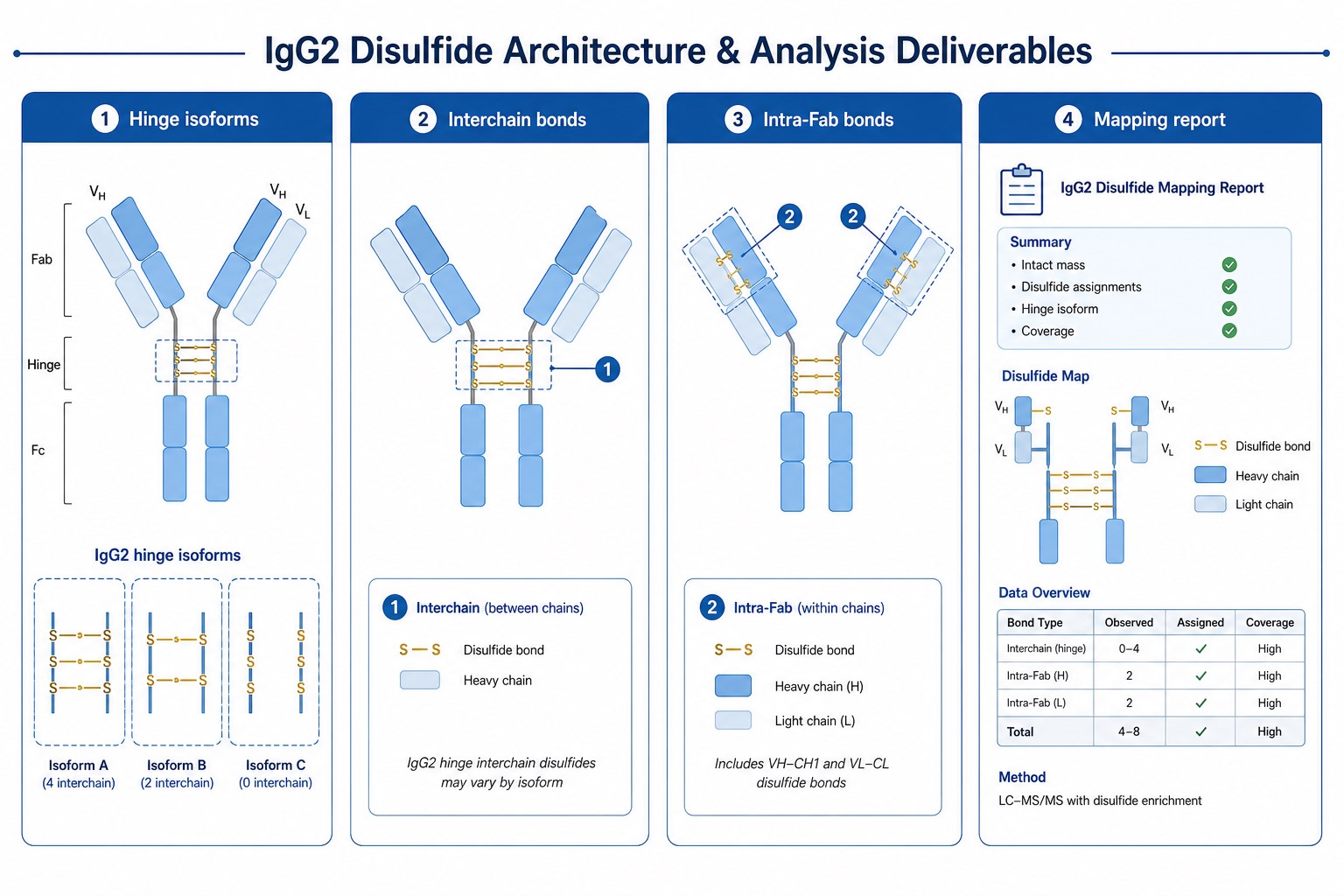
Figure 1. IgG2 disulfide bond analysis focuses on hinge isoforms, interchain linkages, intrachain Fab bonds, and structured mapping deliverables.
Standard Workflow for IgG2 Peptide Mapping and Disulfide Analysis
A confident IgG2 workflow integrates sequence mapping and disulfide bond analysis from project scoping through expert review.
IgG2 scoping defines the mapping goal, expected disulfide architecture, chain sequences, and whether comparability or CMC documentation is required. Reference sequence setup provides mature heavy and light chain sequences, hinge context, and expected cysteine pairings used for database searching and disulfide assignment. Dual digest planning prepares both reduced and non-reduced samples using enzyme strategies suited to IgG2 hinge complexity, often with trypsin and complementary enzymes if coverage gaps are anticipated. LC-MS/MS acquisition collects high-quality MS/MS data for linear and disulfide-linked peptides with sufficient gradient length and replicate depth for critical hinge regions. Disulfide identification assigns disulfide-linked peptide masses and fragment patterns to specific cysteine pairs and compares results to expected IgG2 connectivity. Confidence QC applies predefined review thresholds for PSM quality, disulfide assignment support, unsupported regions, and comparability commentary when reference and test lots are analyzed.
Sample feasibility review should confirm purity, buffer compatibility, and handling conditions that minimize partial reduction or disulfide scrambling before digestion begins.
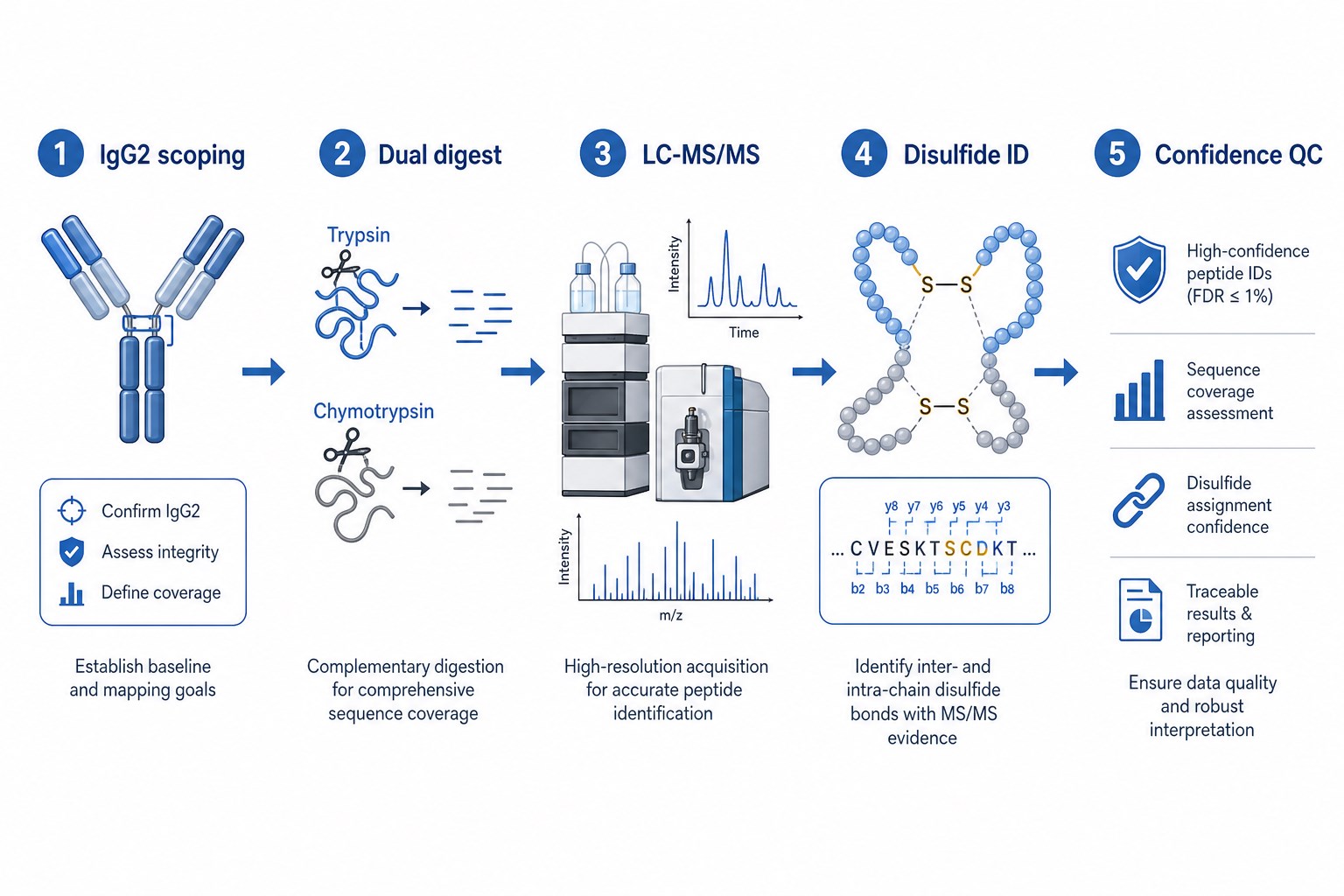
Figure 2. An IgG2 workflow integrates scoping, dual reduced and non-reduced digestion, LC-MS/MS, disulfide identification, and confidence QC.
Related Services
Comprehensive Peptide Mapping Service
Biopharmaceutical Peptide Mapping Analysis Service
Disulfide Bond Analysis Service
Biopharmaceutical Disulfide Bond Analysis Service
Primary Structure Analysis Service
Teams characterizing IgG2 monoclonal antibodies can consult MtoZ Biolabs to review sample type, expected disulfide architecture, and the peptide mapping strategy best suited to confident disulfide bond analysis.
Reduced vs Non-Reduced Mapping for IgG2 Confidence
IgG2 projects benefit from paired reduced and non-reduced LC-MS/MS peptide mapping because the two workflows answer different structural questions.
|
Workflow |
Sample State |
Primary IgG2 Output |
Confidence Contribution |
|---|---|---|---|
|
Reduced and alkylated mapping |
Disulfides cleaved |
Linear peptide coverage across chains |
Sequence identity and cysteine localization |
|
Non-reduced mapping |
Native linkages preserved |
Disulfide-linked peptide detection |
Direct hinge and interchain connectivity evidence |
|
Paired comparison |
Both on same lot |
Differential peptide profile |
Supports isoform assignment and anomaly detection |
|
Multi-enzyme follow-up |
Alternate proteases if needed |
Improved hinge-region coverage |
Resolves large or weakly ionizing linked peptides |
Confidence increases when the same sample lot is analyzed under controlled paired conditions rather than when reduced and non-reduced datasets come from unrelated preparations.
Method and Review Factors That Strengthen Confidence
Several technical choices have an outsized effect on IgG2 mapping confidence.
Controlled non-reduced sample handling reduces artifactual scrambling and partial reduction that can mimic true isoform change.
Enzyme selection matched to hinge peptide size improves recovery of informative disulfide-linked peptides.
Extended LC gradients and replicate injections strengthen MS/MS support for low-abundance hinge species.
Accurate reference database setup with correct chain pairing prevents misassignment of heavy and light chain peptides.
Manual expert review of disulfide-linked spectra is often necessary because automated tools may not confidently assign IgG2 hinge connectivity.
Predefined acceptance criteria for PSM score, fragment coverage, and disulfide assignment support consistent QC across batches.
Orthogonal intact mass or subunit analysis can confirm global mass consistency while peptide mapping delivers linkage detail.
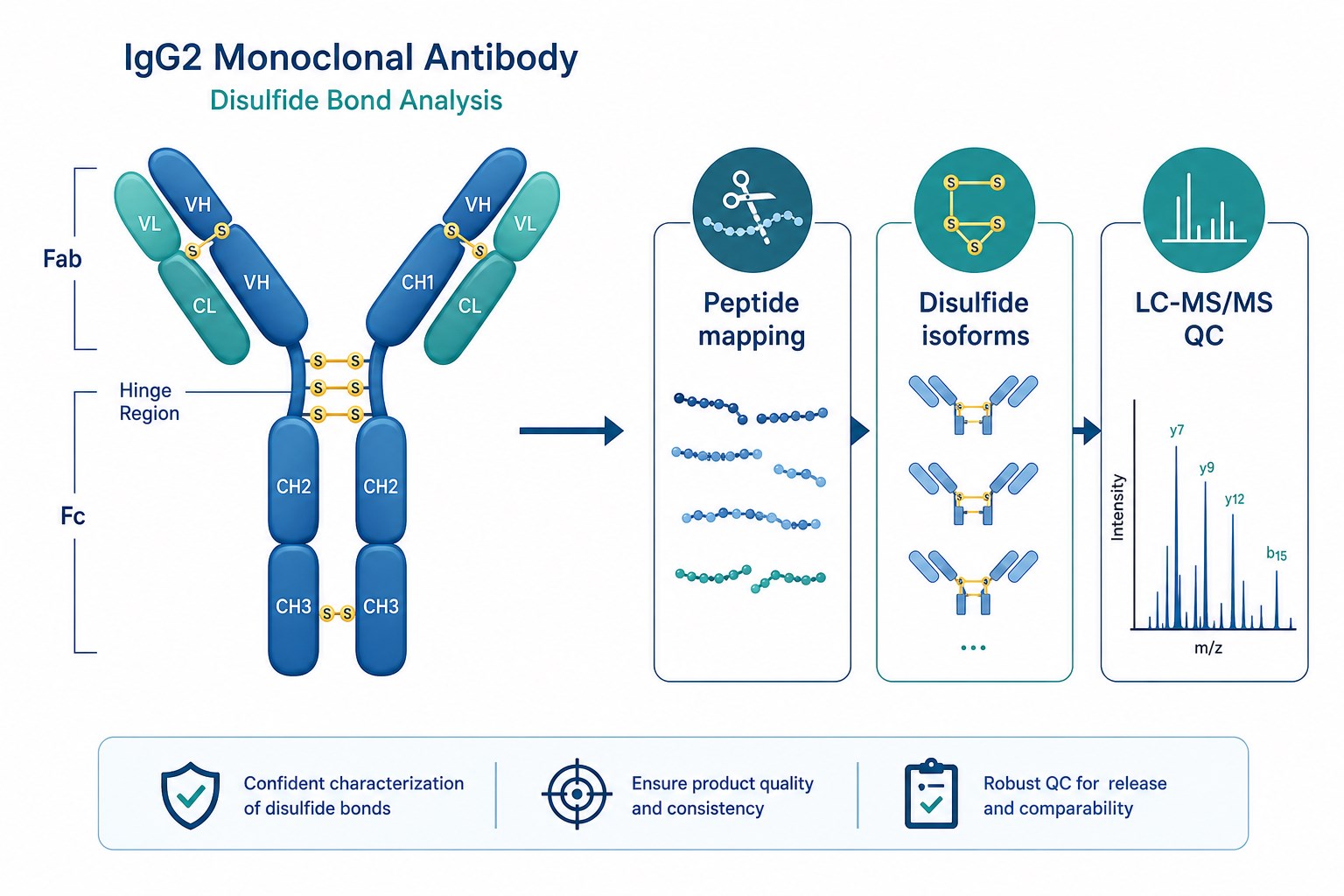
Figure 3. Confident IgG2 characterization combines peptide mapping, disulfide isoform review, and structured LC-MS/MS QC.
Applications in IgG2 Biotherapeutic Characterization
Confident IgG2 peptide mapping and disulfide analysis support several development and quality applications.
Candidate and cell line selection support.
Documents sequence identity and major disulfide architecture for early IgG2 lead materials.
CMC and release characterization.
Provides peptide-level and disulfide-level evidence for identity review in regulatory packages.
Comparability after process change.
Compares IgG2 peptide profiles and disulfide patterns before and after manufacturing or purification changes.
Investigation of mass or activity deviations.
Helps determine whether unexpected behavior relates to hinge connectivity change, clipping, or modification drift.
Biosimilar or reference product alignment.
Supports analytical similarity review when IgG2 disulfide architecture is part of the comparability assessment.
Reporting depth should increase with project stage, from confirmation of major linkages in early development to fuller documentation of review logic in late-stage CMC packages.
Core Technical Advantages and IgG2-Specific Limits
Core Technical Advantages
Residue-level identity and connectivity evidence.
LC-MS/MS peptide mapping links sequence and disulfide architecture at peptide resolution.
IgG2 isoform discrimination when supported by data.
Non-reduced workflows can reveal hinge connectivity patterns not visible in reduced maps alone.
Comparability-ready paired analysis.
Reduced and non-reduced datasets support lot comparison with stronger interpretability.
Integration with broader biologics characterization.
Results complement intact mass, charge variant, and glycosylation review in IgG2 packages.
Expert review improves decision quality.
Manual inspection of hinge peptides reduces false confidence from automated assignment alone.
IgG2-Specific Limits
Hinge-region complexity increases interpretation burden.
IgG2 disulfide isoforms require more careful review than standard IgG1 mapping.
Large disulfide-linked peptides may fragment poorly.
Some hinge-linked species remain difficult even with optimized digestion and LC conditions.
Sample handling artifacts can mimic isoform change.
Partial reduction during prep remains a major reproducibility risk.
Coexisting isoforms complicate reporting.
Products may contain mixtures rather than a single connectivity state.
Peptide mapping alone does not define full tertiary structure.
Connectivity evidence differs from complete conformational analysis.
Sample and Project Planning for IgG2 Mapping
Before analysis begins, teams should define:
- IgG2 heavy and light chain sequences and expected hinge disulfide architecture
- sample type: research material, drug substance, or drug product
- whether identity confirmation, disulfide mapping, or comparability is the primary goal
- need for paired reduced and non-reduced analysis
- reference lot or comparator availability for comparison studies
- reporting standard for isoform heterogeneity and unsupported regions
- orthogonal methods such as intact mass or subunit analysis if required
Early feasibility review is especially valuable for formulated IgG2 samples and for products with prior evidence of hinge heterogeneity.
Expected Deliverables
A confident IgG2 peptide mapping and disulfide bond analysis report typically includes:
- sequence coverage maps for heavy and light chains
- peptide identification tables with review notes for critical regions
- assigned disulfide-linked peptides and proposed cysteine pairs
- comparison to expected IgG2 connectivity and isoform patterns
- reduced versus non-reduced differential summary when paired analysis is performed
- annotated spectra or confidence commentary for hinge-linked peptides
- QC summary of unsupported regions, ambiguous assignments, and repeatability observations
- interpretation relative to identity, comparability, or investigation goals
Deliverables should clearly separate confirmed assignments from provisional or unsupported connectivity calls.
Frequently Asked Questions
1. Why is IgG2 disulfide analysis more complex than IgG1?
IgG2 hinge regions contain additional cysteines and can form disulfide isoforms with alternative connectivity patterns, requiring non-reduced peptide mapping and careful review.
2. Is reduced peptide mapping sufficient for IgG2 disulfide confirmation?
No. Reduced mapping supports sequence coverage but does not prove native disulfide pairing in the hinge and interchain regions.
3. Which enzymes are used for IgG2 peptide mapping?
Trypsin is commonly used, but Lys-C, Glu-C, or multi-enzyme strategies may be added when hinge-region coverage is insufficient.
4. Can IgG2 disulfide isoforms be reported in the same analysis?
Yes. Major isoform patterns can be reported when supported by non-reduced disulfide-linked peptide evidence and appropriate QC review.
5. What increases confidence in disulfide assignment?
Controlled sample handling, paired reduced and non-reduced workflows, strong MS/MS fragment support, and expert manual review of hinge-linked peptides.
6. How does this analysis support CMC documentation?
It provides peptide-level identity evidence and disulfide connectivity documentation suitable for IgG2 characterization and comparability packages when review standards are met.
Conclusion
Confident peptide mapping and disulfide bond analysis of an IgG2 monoclonal antibody requires more than a standard reduced tryptic map. IgG2 hinge architecture, disulfide isoform potential, and complex interchain connectivity demand paired reduced and non-reduced LC-MS/MS workflows, IgG2-aware digestion design, and rigorous spectral review. When these elements are integrated, peptide mapping delivers both sequence confirmation and disulfide-level evidence suitable for development, comparability, and CMC characterization.
Successful IgG2 programs define expected connectivity early, protect native disulfides during sample preparation, and apply confidence-based QC rather than relying on automated peptide lists alone. Teams planning IgG2 peptide mapping and disulfide bond analysis can contact MtoZ Biolabs to review sample status, product format, and the analytical workflow best matched to their characterization goal.
How to order?




