






Comprehensive Overview of Bottom-Up Proteomics Using Mass Spectrometry
Introduction
A proteomics laboratory can run a modern LC-MS/MS system for days and still struggle to explain why two samples produce peptide lists with similar length but very different biological meaning. One dataset may contain many low-scoring spectra that never pass identification thresholds. Another may identify peptides confidently yet fail to support stable quantitative comparison across replicates. A biologics peptide mapping run may show strong coverage while modified peptides near the detection limit remain unassigned. In bottom-up proteomics, these outcomes usually reflect how mass spectrometry was used across digestion, separation, acquisition, and data analysis rather than a single instrument setting alone.
Bottom-up proteomics using mass spectrometry is a widely used route for large-scale protein identification, post-translational modification mapping, and comparative quantification. Proteins are digested into peptides, peptides are separated by liquid chromatography, and tandem mass spectrometry generates fragment evidence that supports database searching, protein inference, and optional quantification. The method is mature, scalable, and supported by extensive software, yet its performance still depends on matching MS workflow design to sample complexity and reporting goals.
What Bottom-Up Proteomics Means in Mass Spectrometry
Bottom-up proteomics is a peptide-centric strategy in which mass spectrometry measures digested peptides rather than intact proteins. The analytical chain begins with enzymatic cleavage, usually with trypsin, to generate peptides suited to reversed-phase LC and MS/MS fragmentation. Each peptide precursor produces a tandem mass spectrum that can be matched to a predicted sequence from a protein database or against an experimental spectral library.
In routine practice, bottom-up proteomics overlaps with shotgun proteomics because complex mixtures are analyzed without isolating individual proteins first. The mass spectrometer therefore receives a large peptide pool rather than a narrow set of intact protein ions. Protein-level results are inferred from the peptides identified, which makes MS performance at the peptide level central to the success of the entire project.
The Role of Mass Spectrometry in the Workflow
Mass spectrometry is not simply the final detection step in bottom-up proteomics. It defines what type of evidence is captured and how confidently that evidence can be interpreted.
The first MS role is peptide detection in the survey scan. Precursor m/z values and intensities establish which ions are present during the LC run and which features may be selected for fragmentation or window-based acquisition.
The second MS role is sequence generation through fragmentation. In tandem mass spectrometry, selected precursor ions are isolated and fragmented to produce product ions. The resulting pattern supports peptide sequence assignment when sufficient fragment coverage is observed.
The third MS role is comparative measurement. Precursor intensities, fragment intensities, reporter ions, or extracted ion chromatograms can support quantification when the acquisition design and normalization strategy are matched to the study.
The fourth MS role is quality control. Mass accuracy, chromatographic peak shape, replicate reproducibility, and spectral completeness all influence whether peptide calls are strong enough for protein inference and downstream interpretation.
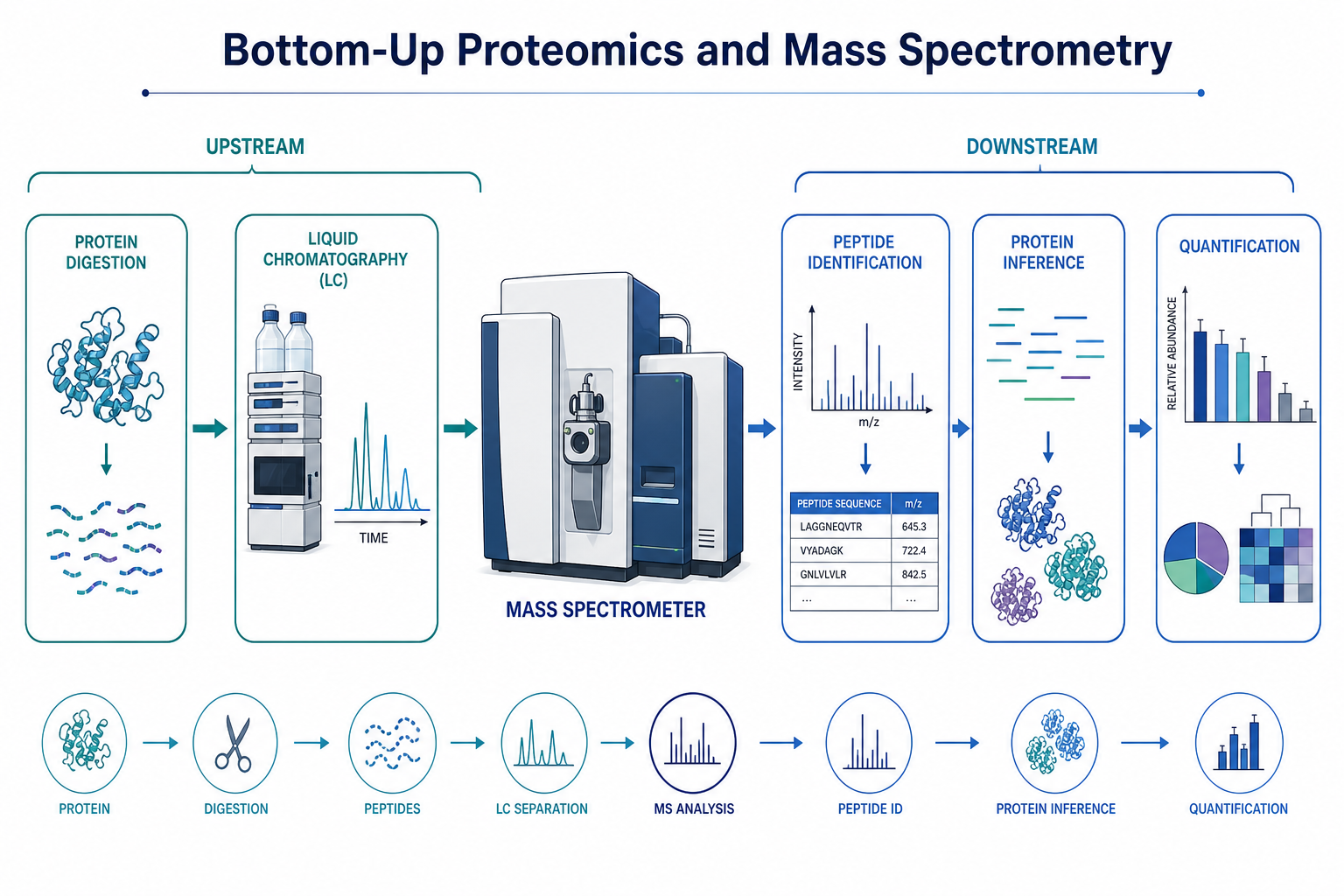
Figure 1. Mass spectrometry sits at the center of bottom-up proteomics, connecting digestion and LC separation to peptide identification, protein inference, and quantification.
From Protein Digest to LC-MS/MS Measurement
The path from sample to interpretable MS data includes several steps that affect spectral quality.
Protein extraction and digestion determine which peptides enter the mass spectrometer. Reduction and alkylation improve access to cysteine-containing regions. Cleanup removes salts, detergents, and other interferents that suppress ionization or destabilize chromatography. Missed cleavages, over-digestion, and chemical modifications during handling can create extra peptide features that complicate searching if preparation is inconsistent.
Reversed-phase LC separates peptides before they reach the ion source. Gradient length, column chemistry, and loading amount influence how many peptides are sampled and how cleanly precursors are resolved. Longer gradients often improve identification depth in complex mixtures, while shorter methods may be sufficient for focused peptide mapping on purified products.
Online LC-MS coupling allows the mass spectrometer to analyze peptides as they elute. This time-resolved measurement is essential in bottom-up proteomics because the peptide mixture is too complex for meaningful interpretation without chromatographic separation before MS analysis.
MS/MS Fragmentation and Peptide Identification
Peptide identification in bottom-up proteomics depends on the relationship between precursor mass and fragment ion pattern.
In a typical LC-MS/MS experiment, the instrument performs a survey scan to detect precursor ions, selects eligible precursors or predefined acquisition windows, isolates a precursor, and induces fragmentation to generate product ions. Sequence assignment is based on agreement between observed fragment ions and predicted ions from a candidate peptide sequence.
Common fragmentation approaches produce backbone cleavages that yield b-type and y-type ions. These ions support residue-level assignment when enough consecutive fragments are detected. Modified peptides require additional care because labile modifications can redistribute fragment intensity and reduce localization confidence if spectral quality is weak.
Database searching compares experimental spectra with in silico predictions generated from a protein reference set. Search parameters must reflect enzyme specificity, allowed modifications, precursor and fragment tolerances, and instrument-specific scoring behavior. Spectral library matching is often used in DIA workflows or when experimental reference spectra improve reproducibility across runs.
False discovery rate control is essential because large search spaces can produce plausible but incorrect matches. Target-decoy estimation and score filtering help separate confident peptide-spectrum matches from random assignments, especially in modification-enriched experiments.
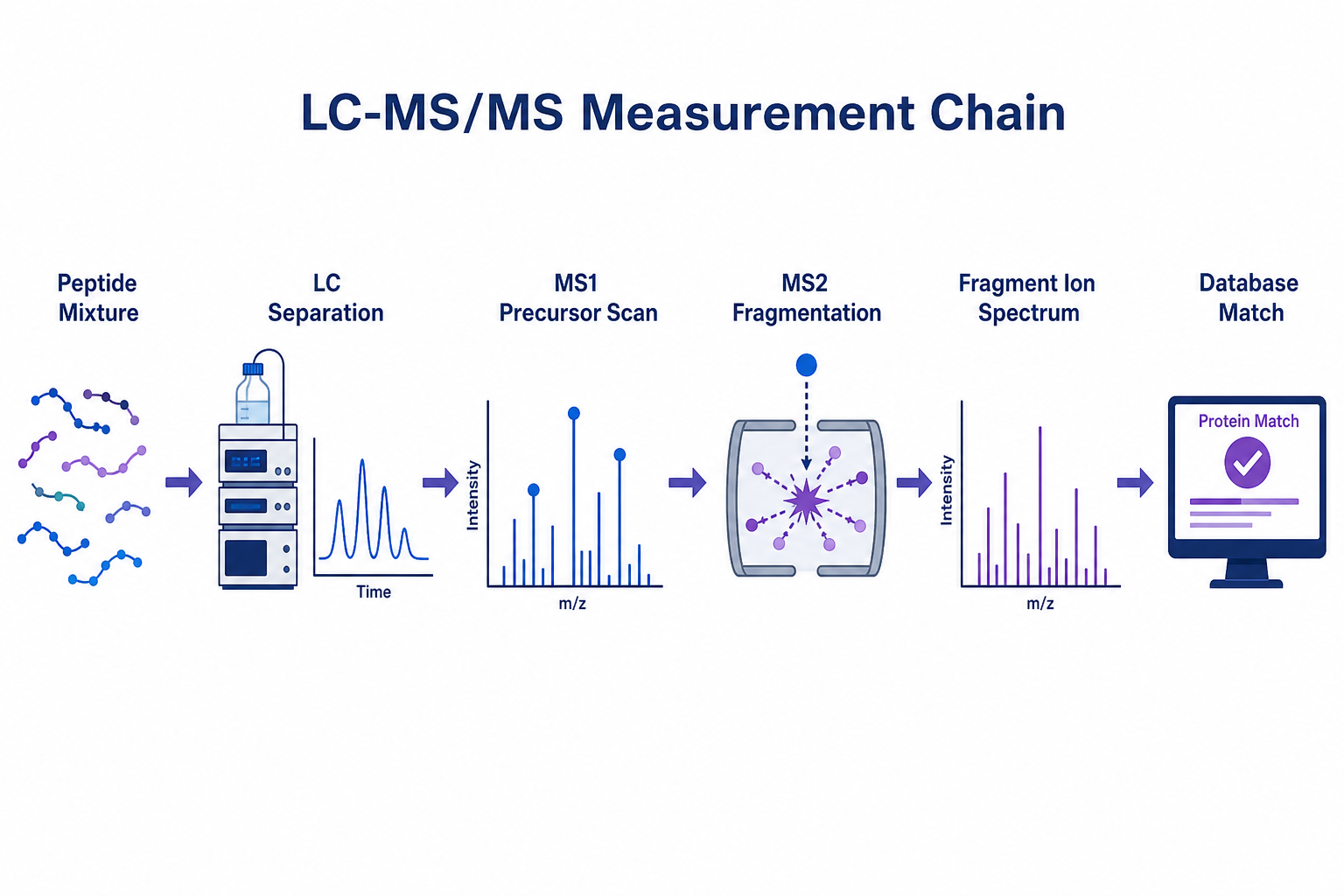
Figure 2. Bottom-up proteomics using mass spectrometry depends on a linked LC-MS/MS chain from peptide separation to fragment matching.
Related Services
Bottom-up proteomics projects using mass spectrometry often combine identification, quantification, and reporting services matched to the sample and study goal. Relevant options include:
Protein Identification Service
Mass Spectrometry-Based Protein Identification Service
Label-Free Quantitative Proteomics Service, MS Based
SWATH Based Protein Quantitative Service
Quantitative Proteomics Service
Proteomics Bioinformatic Analysis Service
Researchers planning bottom-up proteomics using mass spectrometry should define sample matrix, acquisition strategy, and reporting depth before phase 1 sample intake and phase 2 data acquisition begin.
MS-Based Quantification Strategies
Quantification extends bottom-up proteomics from identification to comparison. The right MS strategy depends on sample number, dynamic range, and the level of reproducibility required.
Label-free quantification uses precursor or fragment intensities across LC-MS runs. It is flexible and requires no chemical labeling, but reproducibility depends on stable digestion, chromatography, and normalization across samples.
Isobaric labeling with TMT or iTRAQ encodes sample identity in reporter ions released during fragmentation. This approach supports multiplexed comparison in a single MS run, but reporter ion balance and ratio compression should be reviewed during analysis.
SILAC and other metabolic labeling strategies embed quantitative differences during cell growth. They can improve internal normalization in cell-based systems when labeling efficiency is verified.
DIA and SWATH acquire fragment data across defined mass windows in a systematic manner. These approaches are often chosen when cohort-scale reproducibility matters more than one-off identification depth in a single run.
Targeted PRM or MRM follows discovery by monitoring selected peptide transitions with higher analytical specificity for repeated measurement.
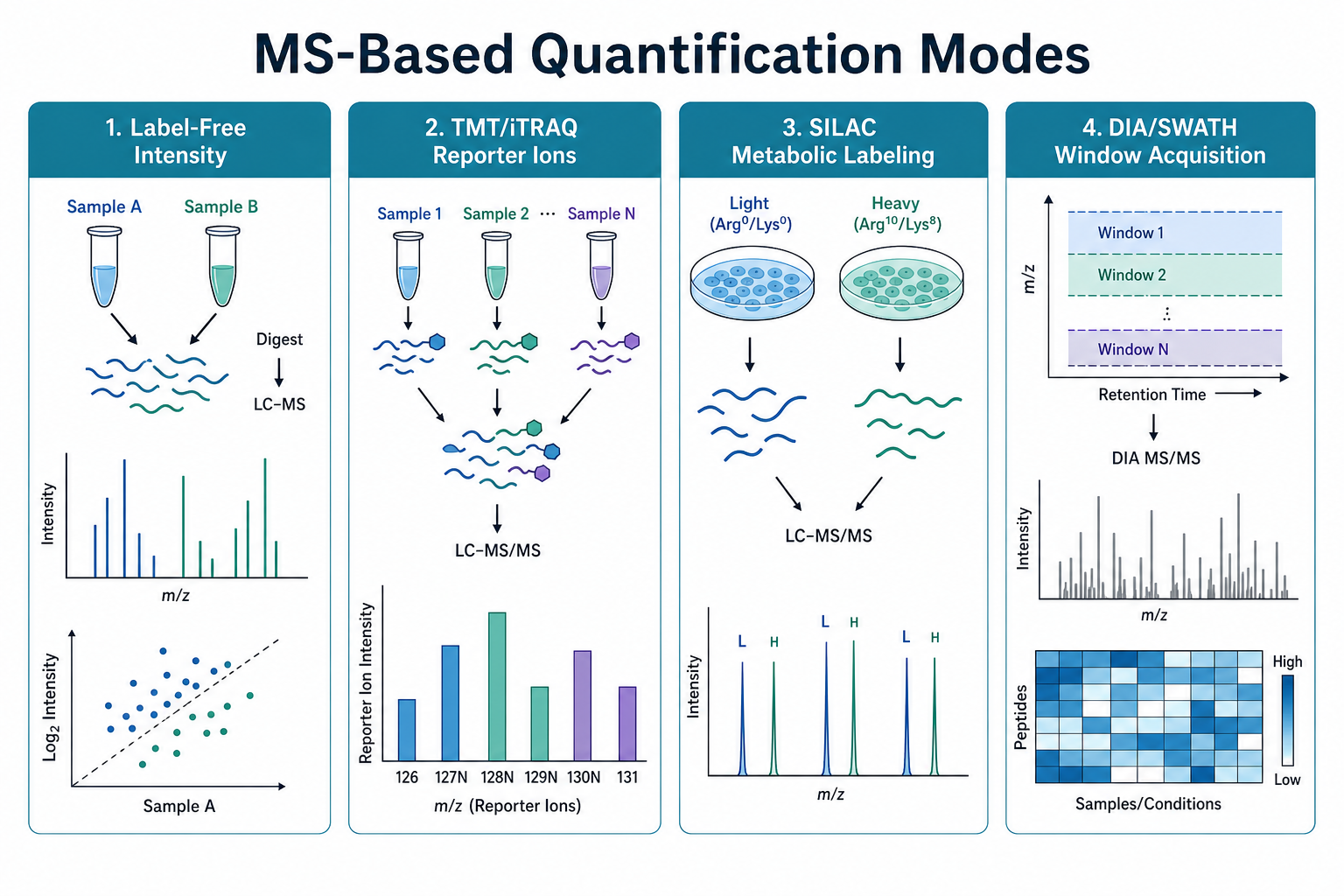
Figure 3. Bottom-up proteomics using mass spectrometry supports multiple quantification modes matched to study design and sample type.
Acquisition Mode and MS Platform Considerations
Different project goals place different demands on mass spectrometry performance. The table below summarizes common pairings without reducing platform choice to a single universal setup.
|
Study Goal |
Common MS Acquisition Approach |
Key MS Performance Needs |
Typical Output |
|---|---|---|---|
|
Deep discovery identification |
DDA with long LC gradient |
Reliable MS/MS sampling and accurate precursor mass |
Protein groups and peptide table |
|
Cohort quantification |
DIA, SWATH, or label-free LC-MS |
Reproducible fragmentation and stable chromatography |
Quant matrix with QC metrics |
|
PTM site mapping |
DDA after enrichment |
Rich fragment coverage around modified residues |
Modified peptide and site list |
|
Biologics peptide mapping |
Focused LC-MS/MS on digested product |
Accurate mass and confident modified peptide calls |
Coverage map and PSM table |
|
Targeted confirmation |
PRM or MRM |
Selective monitoring of defined peptide transitions |
Verified peptide panel |
High-resolution accurate-mass systems improve precursor and fragment assignment confidence. Ion transmission, acquisition speed, and chromatographic matching still matter because identification quality depends on the full LC-MS/MS system rather than mass accuracy alone.
Protein Inference and Reporting from MS Data
Peptide-spectrum matches are the primary experimental readout in bottom-up proteomics, but most projects require protein-level reporting. Protein inference groups peptides into protein groups according to shared peptide evidence and parsimony rules. Shared peptides across protein families create ambiguity that should be documented clearly in the final report.
A useful MS-based report usually includes raw or converted spectral files, searchable peptide-spectrum match tables, protein group summaries, quantification matrices when applicable, and QC notes on identification depth, replicate agreement, and modification localization confidence. Projects intended for publication or regulatory review should define these deliverables before acquisition begins.
Applications Supported by MS-Based Bottom-Up Proteomics
Bottom-up proteomics using mass spectrometry supports a broad set of research and biopharmaceutical applications when workflow design matches the question.
In discovery proteomics, LC-MS/MS is used to identify proteins in cell and tissue lysates, compare abundance across treatment groups, and generate candidate lists for follow-up validation. In signaling research, phosphoproteomics enrichment combined with modified peptide searching supports site-level activation mapping.
In biopharmaceutical analysis, peptide mapping by LC-MS/MS documents sequence coverage, localized modifications, and batch-to-batch comparability for therapeutic proteins. Host cell protein analysis and impurity tracing also rely on peptide-level MS evidence in many development programs.
In targeted follow-up, discovery experiments often lead to PRM assay development for repeated measurement of selected proteins or modification sites across larger sample sets.
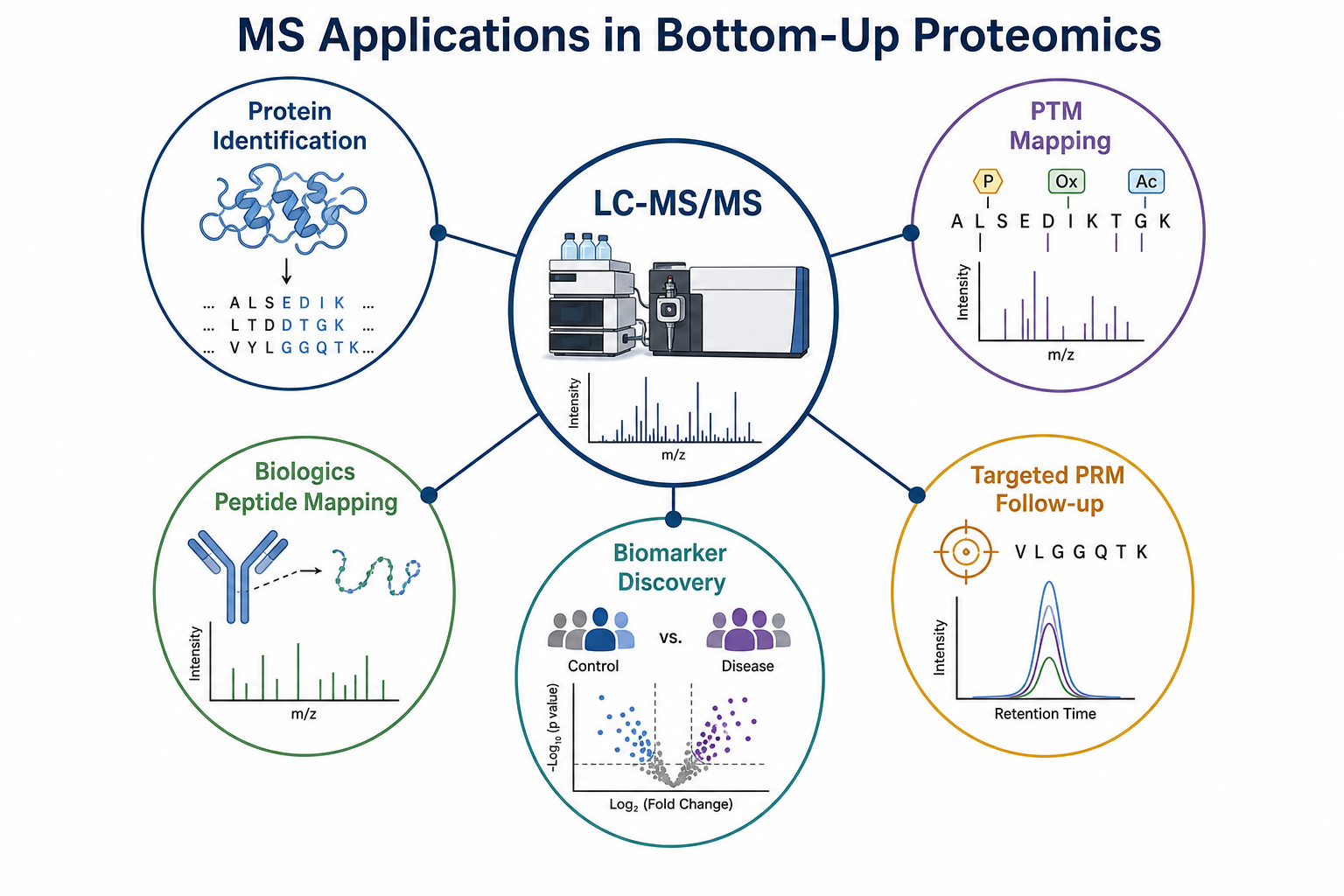
Figure 4. Mass spectrometry supports bottom-up proteomics across identification, modification mapping, biologics characterization, and targeted follow-up.
Current Limits of MS-Centered Bottom-Up Analysis
Mass spectrometry-centered bottom-up proteomics is powerful, but several limits remain important in project planning.
Dynamic range in complex lysates and biofluids can prevent low-abundance proteins from generating enough high-quality MS/MS spectra without enrichment or fractionation. Protein inference ambiguity can persist even when peptide identification is strong. Digestion removes intact proteoform context, so modification coexistence on one molecule may require indirect reconstruction from peptide evidence. Quantitative distortion can occur when sample preparation, loading, or acquisition depth differs across runs.
These limits do not invalidate the workflow, but they define where reporting should remain conservative and where complementary strategies such as enrichment, fractionation, or targeted confirmation may be required.
Frequently Asked Questions
Why is mass spectrometry central to bottom-up proteomics?
Bottom-up proteomics depends on MS/MS spectra to assign peptide sequences and support protein inference. Without tandem mass spectrometry, digestion alone cannot produce the fragment evidence required for confident identification in complex mixtures.
What is the difference between LC-MS and LC-MS/MS in bottom-up proteomics?
LC-MS measures peptide precursor ions. LC-MS/MS selects precursors for fragmentation and records product ions that support sequence assignment. Bottom-up identification usually depends on LC-MS/MS rather than survey scans alone.
When should a project use DDA versus DIA?
DDA is widely used when the priority is deep peptide identification in discovery settings. DIA is often chosen when reproducible quantification across many samples is more important than maximizing identification depth in a single run.
Can bottom-up proteomics using mass spectrometry support biologics characterization?
Yes. LC-MS/MS peptide mapping is widely used for sequence coverage, modification localization, and comparability review on therapeutic proteins with defined reference sequences.
What deliverables should an MS-based bottom-up proteomics report include?
A strong report typically includes peptide-spectrum match evidence, protein group results, quantification tables when applicable, QC summaries, and interpretation notes that separate confident calls from provisional features.
Conclusion
Bottom-up proteomics using mass spectrometry provides a scalable route from complex protein mixtures to peptide-level evidence and protein-level interpretation. Digestion simplifies the sample for peptide measurement. LC separation reduces ionization competition before MS analysis. Tandem mass spectrometry generates the fragment patterns that drive identification, modification mapping, and many quantitative comparisons. Database searching, false discovery rate control, and protein inference convert raw spectra into reporting layers that support discovery, biologics characterization, and targeted follow-up.
Successful projects treat mass spectrometry as part of an integrated system rather than a standalone detector. Sample preparation shapes the peptide pool entering the instrument. Acquisition mode determines whether the dataset prioritizes depth, reproducibility, or targeted confirmation. Analysis choices determine whether the final protein report is fit for the biological or quality decision that motivated the experiment.
Teams planning bottom-up proteomics using mass spectrometry can contact MtoZ Biolabs to review sample type, LC-MS/MS strategy, and reporting depth before acquisition begins.
If a project requires both deep identification and cohort-scale quantification, MtoZ Biolabs can help align digestion design, acquisition mode, and analysis deliverables with the study objective.
Researchers preparing MS-based bottom-up proteomics for publication or biologics review can request a project assessment from MtoZ Biolabs to define phase 1 workflow scope and phase 2 reporting requirements.
How to order?




