






Biological Fluid Antibody Analysis vs ELISA: Method Selection and Research Use Cases
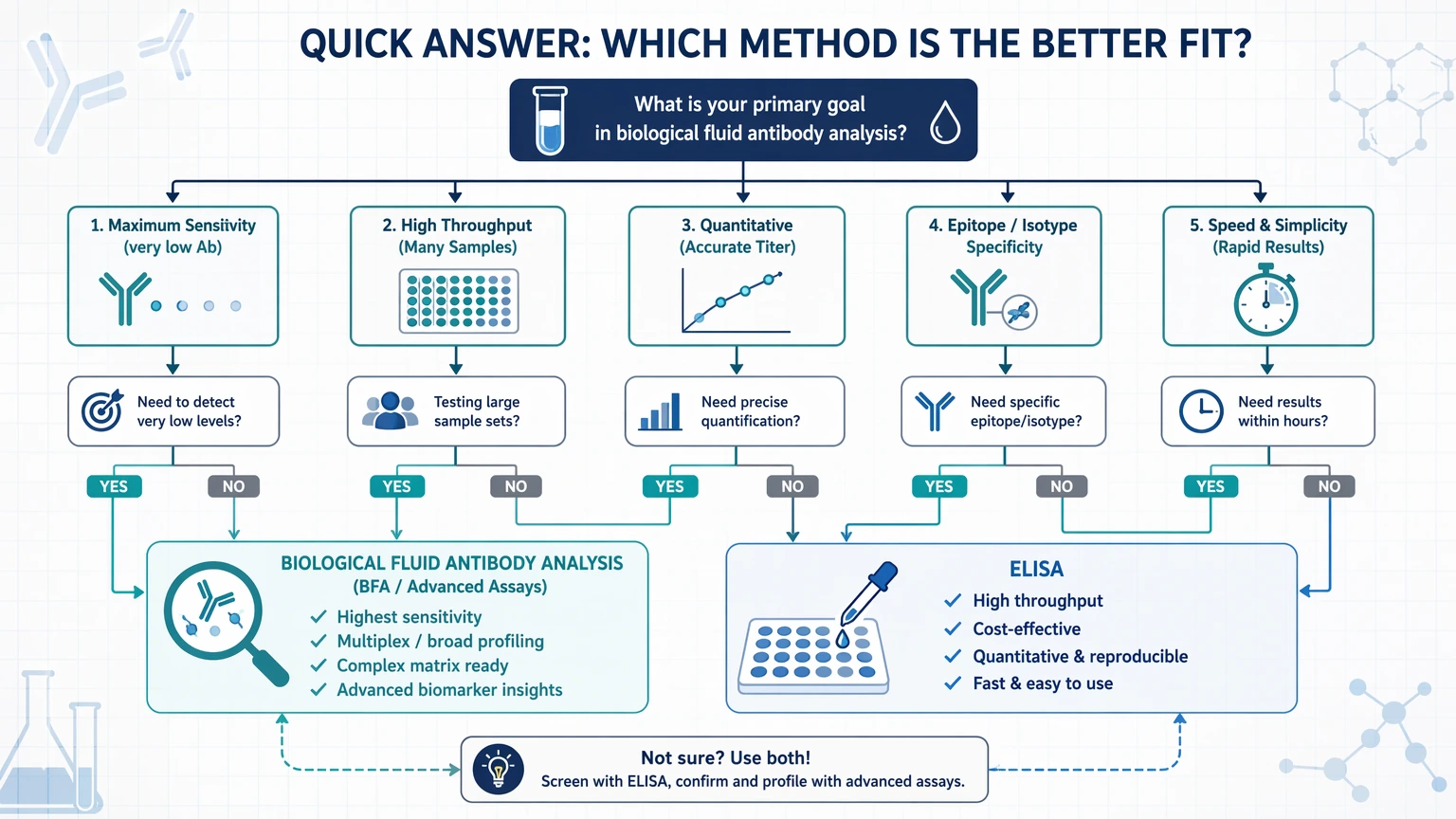
Quick Answer: Which Method Is the Better Fit?
Choose ELISA when you need a focused answer about a predefined antigen-specific antibody, titer, or relative binding signal in a known sample set. Choose a broader biological fluid antibody analysis workflow when the question extends beyond one target and one endpoint—for example, when you need isotype, subclass, specificity, comparative response patterns, or a more matrix-aware design for complex biological fluid samples such as serum, plasma, cerebrospinal fluid (CSF), or bronchoalveolar lavage fluid (BALF). In many translational research programs, the most efficient choice is a staged plan: screen with a targeted assay, then expand selected samples into deeper antibody analysis.
Biological Fluid Antibody Analysis and ELISA Are Not the Same Type of Choice
A common source of confusion is the assumption that ELISA and biological fluid antibody analysis are direct opposites. They are not. ELISA is one targeted assay format within the broader category of antibody analysis.
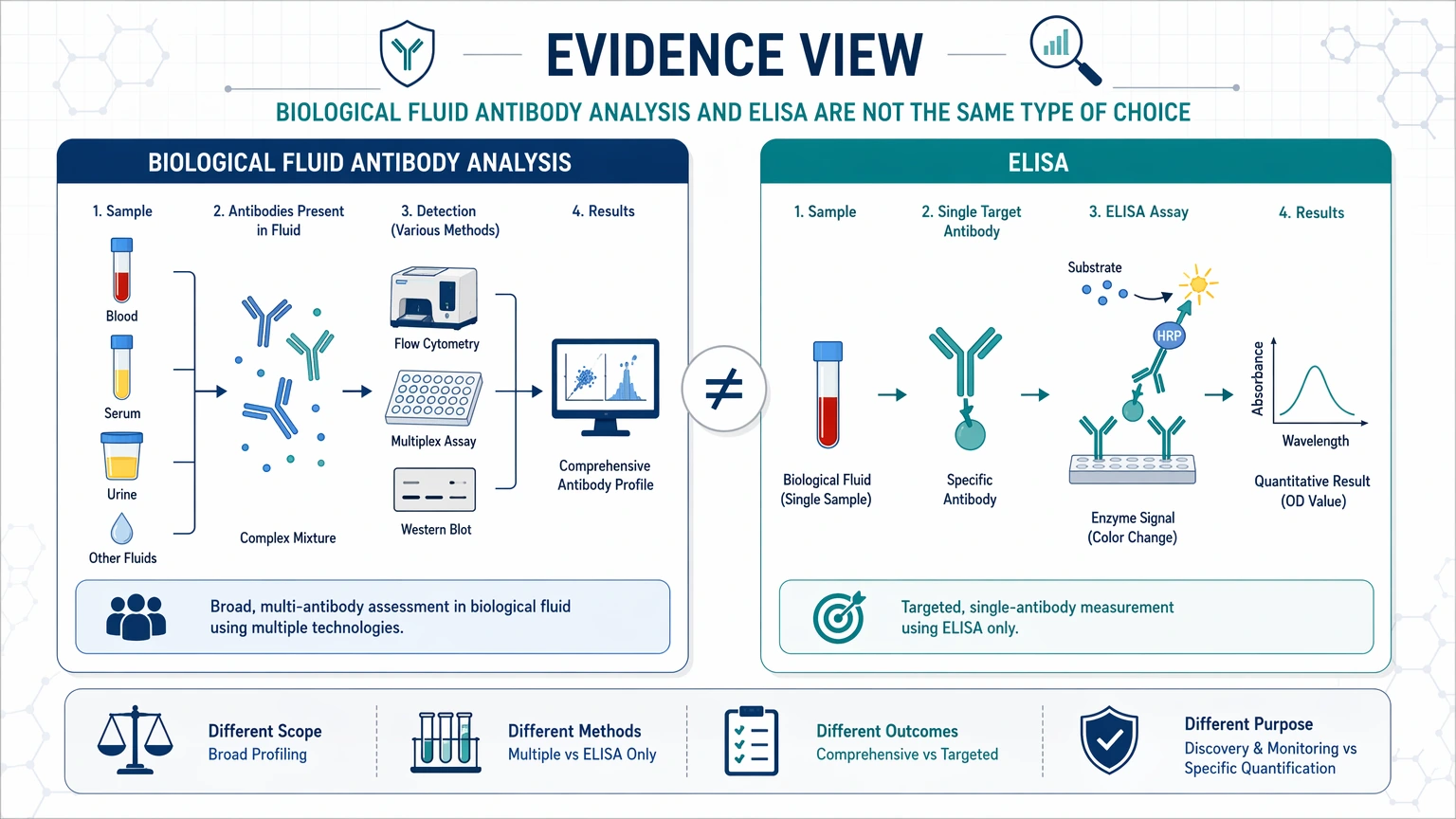
In a research-service setting, biological fluid antibody analysis usually means a study-specific analytical workflow built around the biological question, sample matrix, and reporting needs. That workflow may include one or more assay formats to assess antibody abundance, antigen binding, class distribution, subclass distribution, comparative patterns across cohorts, or behavior in difficult matrices. The output may be narrow and confirmatory or broader and exploratory.
By contrast, ELISA is typically used when the target is already defined. Under standardized plate-based conditions, the assay is designed to measure a known analyte or a known antibody response against a specific antigen. It is often a practical choice when the team needs a clear comparative readout, titer ranking, or batch screening result rather than a broader immune profile.
This difference in scope matters. If the real question is, “How much antibody against this known antigen is present?” ELISA may be sufficient. If the question is, “How do antibody responses differ across matrices, subclasses, or binding patterns between study groups?” a broader workflow usually provides more decision-relevant information.
What ELISA Measures Well in Biological Fluid Samples
ELISA is most useful when the measurement goal is tightly defined. Typical research uses include:
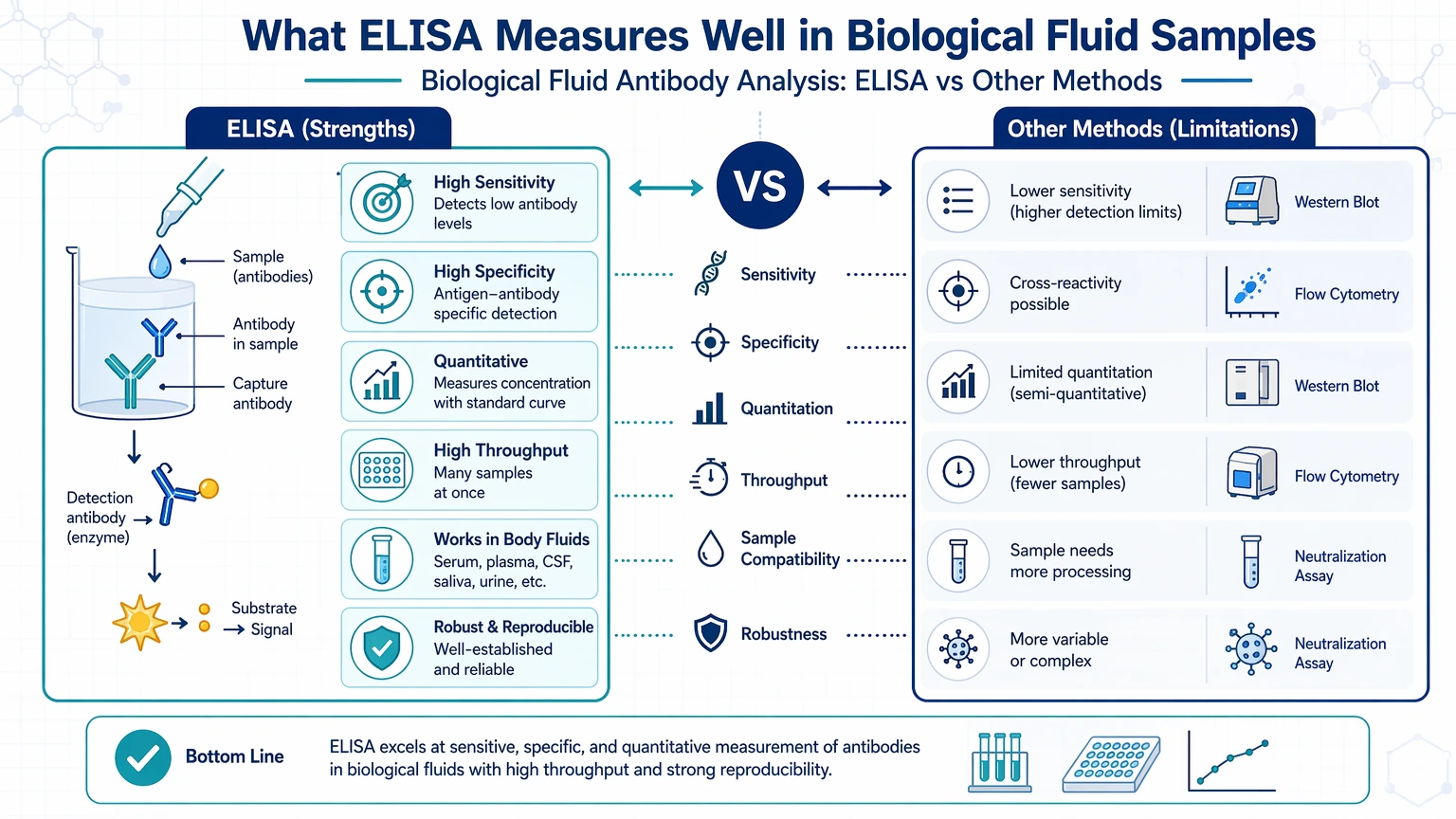
- measuring or semi-quantifying an antigen-specific antibody
- comparing titer across treatment groups
- confirming the presence or relative abundance of a known response
- screening larger cohorts with a consistent readout
- following up on targets identified in an earlier discovery phase
A well-matched ELISA offers several practical advantages:
The table below summarizes the main planning implications for the method choice.
| Dimension | ELISA Strength |
|---|---|
| Primary purpose | Focused measurement of a predefined antibody target |
| Readout style | Endpoint optical signal, relative concentration, or titer-style comparison |
| Throughput | Efficient for plate-based cohort screening |
| Assay setup | Often simpler when antigen and controls are already defined |
| Reporting utility | Useful for ranking, confirmation, and direct group comparison |
Use these differences to align the analytical method with the biological question and validation plan.
In biological fluid samples, ELISA is especially effective when the study already has a clear hypothesis. For example, a vaccine-response study may need only comparative anti-antigen titers across animal groups. A therapeutic antibody program may need a targeted readout for a known anti-drug antibody trend in a preclinical sample set. In those settings, a broader profiling workflow may add cost and interpretive complexity without changing the next project decision.
ELISA still has limits. Its output is usually narrower than what mechanism-focused or exploratory work requires. A plate signal shows that antibodies bind the coated antigen under the assay conditions, but it does not automatically resolve broader specificity, competing reactivities, detailed subclass patterns, or the extent to which the matrix is influencing apparent signal intensity.
What Broader Biological Fluid Antibody Analysis Can Add
Broader biological fluid antibody analysis becomes useful when one plate readout cannot answer the actual study question. In practice, that may include:
- profiling multiple antibody-related readouts in parallel
- distinguishing isotype or subclass distributions
- comparing antibody patterns across several antigens or conditions
- examining specificity through a more customized design
- working with nonstandard matrices that require closer attention to matrix effect and background interference
- generating data that guide follow-up assay design rather than only providing endpoint screening
This category does not refer to a single platform. It refers to a fit-for-purpose research workflow that may involve custom assay planning, orthogonal confirmation, matrix adaptation, or multiplexing when several targets must be assessed from limited input.
That broader approach is often more informative in translational research, where sample context shapes interpretation. A signal observed in serum may not behave the same way in plasma, CSF, BALF, or another low-volume or protein-rich biological fluid. If the question requires comparing immune response patterns across matrices or reading out more than total antibody abundance, a broader workflow usually gives more interpretive depth than a standard ELISA alone.
Biological Fluid Antibody Analysis vs ELISA: Key Differences
The table below summarizes the main planning implications for the method choice.
| Selection Factor | ELISA | Broader Biological Fluid Antibody Analysis |
|---|---|---|
| Primary purpose | Targeted measurement of a known antibody or antigen response | Customized assessment of antibody behavior, profile, or comparative patterns |
| Typical readout | Titer, endpoint signal, relative abundance | Multi-parameter output such as isotype, subclass, specificity pattern, or comparative binding profile |
| Target flexibility | Strongest when the target is predefined | Better suited to broader targets, conditions, or analytical goals |
| Sample matrix handling | Works best in compatible, well-characterized matrices | More adaptable when matrix effect or background interference needs extra attention |
| Multiplexing potential | Usually limited relative to broader workflows | More suitable when several antibody questions must be addressed in parallel |
| Method customization | Lower when established conditions are available | Higher, often involving custom assay development |
| Throughput orientation | Strong for large-batch screening | Better for selective deep analysis or focused panels |
| Interpretive depth | Focused and confirmatory | Richer, comparative, and sometimes exploratory |
| Best-fit study types | Confirmation, ranking, routine comparative screening | Exploratory profiling, translational comparison, mechanism-oriented studies |
| Common limitations | Narrow scope and less contextual detail | Higher setup effort and more planning |
Use these differences to align the analytical method with the biological question and validation plan.
The practical takeaway is straightforward: ELISA answers a narrower question efficiently, while broader antibody analysis supports wider biological interpretation at the cost of additional design work.
When ELISA Is the More Practical Option
ELISA is often the better fit when the study has already narrowed the decision to a single target or a small number of predefined targets.
Use ELISA when:
- the antigen is known and relevant to the study question
- the team needs a targeted readout for a go/no-go comparison
- the main output is titer or relative level rather than detailed characterization
- sample numbers are high and screening efficiency matters
- the matrix is familiar and behaves acceptably under standard assay conditions
- the project is confirmatory rather than exploratory
A common example is routine group comparison in serum or plasma, where the goal is to rank responses across control and treated cohorts. Another is a focused follow-up study in which candidate antigens have already been identified and the next step is to measure selected responses at scale.
A useful checkpoint is this: Would one predefined signal be enough to support the next project decision? If the answer is yes, ELISA is often the leaner choice.
When Broader Antibody Analysis Is Worth the Extra Design Effort
Broader antibody analysis becomes worthwhile when a simple plate signal does not match the biological question.
Choose this route when:
- one target is not enough to describe the immune response
- the team needs exploratory profiling before narrowing targets
- isotype or subclass differences are biologically important
- specificity must be examined more closely than a single binding format allows
- the biological fluid is nonstandard, low-volume, or especially prone to background interference
- comparative interpretation across groups matters as much as signal intensity
- the results will be used to build a second-stage assay plan
This situation is common in preclinical immunogenicity-related research, translational cohort comparison, and antibody-engineering studies where the question is not simply “how much binds?” but “what kind of response is present, how selective is it, and how does it differ between groups or matrices?”
If your team is weighing sample type, target definition, and reporting depth, you can submit your requirements for method review before locking the study into a single assay path.
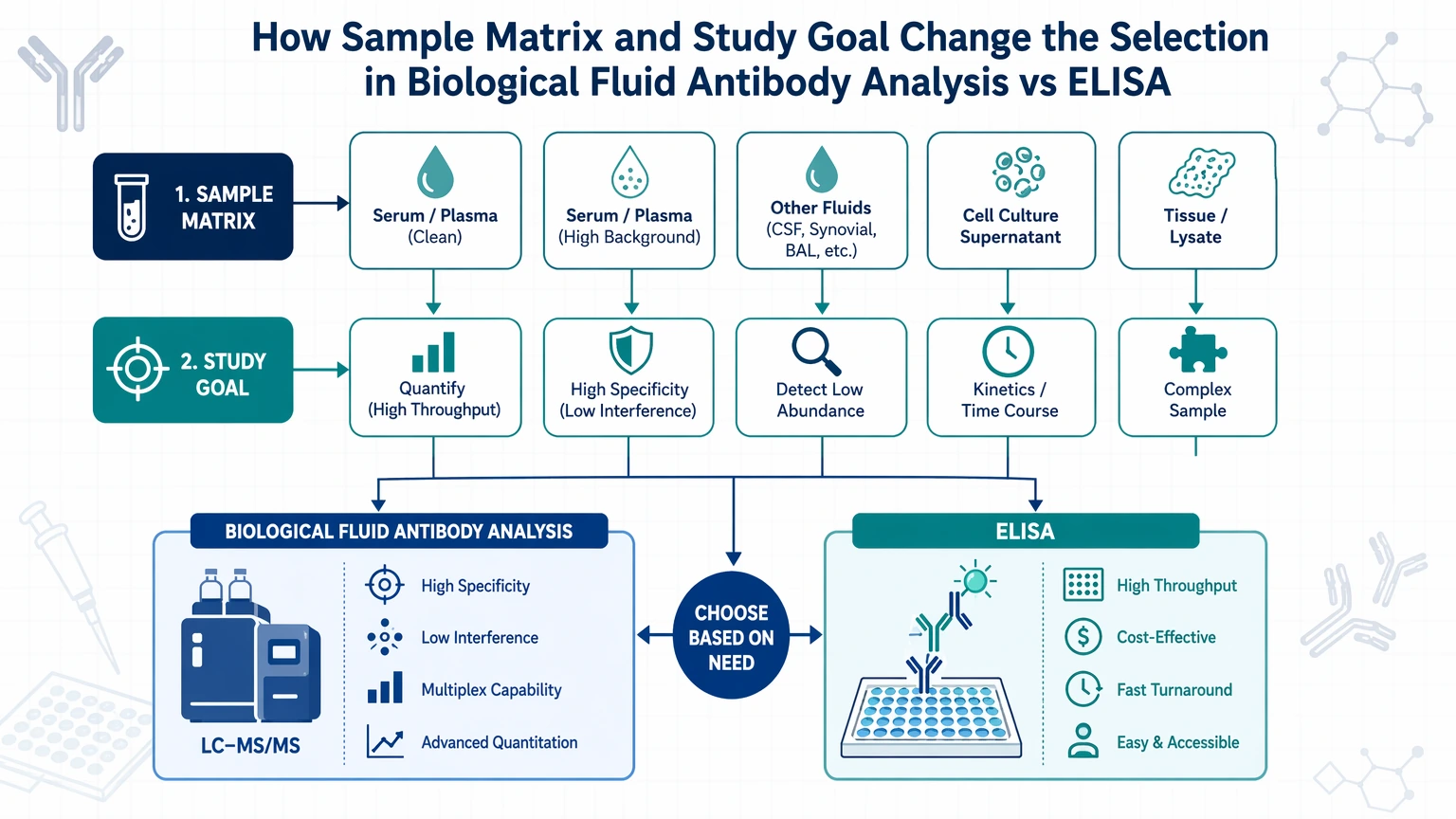
How Sample Matrix and Study Goal Change the Selection
Sample type often determines whether a routine ELISA-only plan will hold up.
Serum and Plasma
Serum and plasma are often compatible with standard targeted assays, especially when the target is known and the matrix has been handled consistently across groups. Even so, proteins, lipids, hemolysis, or anticoagulant-related effects can alter binding signal or increase background. If the study needs only relative comparison, ELISA may still be appropriate. If matrix behavior is distorting interpretation, a broader matrix-aware workflow becomes more useful.
Cerebrospinal Fluid (CSF)
Cerebrospinal fluid (CSF) presents a different balance: lower sample volume, lower antibody abundance, and less tolerance for repeated optimization cycles. Here, assay selection depends on how much information must be extracted from limited input. If only one predefined antibody question matters, a targeted assay may be enough. If the team needs several readouts from scarce CSF, broader planning often makes more sense.
Bronchoalveolar Lavage Fluid (BALF)
Bronchoalveolar lavage fluid (BALF) can introduce dilution effects, variable background, and inconsistent recovery across studies. Those features can complicate direct interpretation of a single endpoint readout. A customized antibody analysis workflow may be preferable when BALF data require matrix-aware normalization logic or comparative profiling across antigens or antibody classes.
Other Research Matrices
Synovial fluid, tissue-derived fluids, and other research matrices may contain viscosity-related issues, particulate material, endogenous proteins, or interfering components that change assay behavior. In those settings, method selection is less about the assay name and more about whether the workflow can manage the matrix without reducing the question to an unstable signal.
A Stepwise Strategy for Screening, Profiling, and Follow-Up
Many projects do not need to commit to only one method at the outset. A staged strategy can preserve throughput while adding depth where it changes interpretation.
A practical sequence often looks like this:
1. Initial screening with ELISA Use a targeted assay to screen a broad cohort for antigen-specific antibody presence, relative titer, or group-level differences.
2. Select informative subsets Identify outliers, responders, nonresponders, or matrix-challenging samples for deeper work.
3. Expand into broader antibody analysis Add isotype, subclass, specificity checks, comparative binding behavior, or panel-based analysis where the first-stage result is not sufficient.
4. Return to targeted follow-up if needed Once the most informative pattern is identified, convert that output into a scalable targeted assay for larger sample sets.
This hybrid approach is often more efficient than forcing exploratory questions into one ELISA format or building an extensive broader workflow for every sample from the beginning.
How to Evaluate a Research Service for Antibody Analysis Projects
When comparing external support options, the main question is not just which platform is available. It is whether the assay plan matches the study objective.
Ask whether the provider can define:
- the exact question the assay will answer
- whether the output is confirmatory or exploratory
- how the biological fluid matrix may affect signal interpretation
- whether multiplexing is necessary or simply attractive on paper
- what level of custom assay development is justified
- whether orthogonal confirmation is needed for specificity-related questions
- how the final report will support the next study decision
For teams comparing ELISA with a broader workflow, MtoZ Biolabs can evaluate your project around sample type, assay scope, and reporting expectations so the design stays aligned with a research-use-only objective rather than defaulting to a familiar format.
Conclusion: Match the Assay to the Decision, Not the Other Way Around
For a known target and a clear endpoint, ELISA is often the more practical option. It is efficient, focused, and well suited to comparative screening or confirmatory measurement in compatible matrices. For broader questions involving isotype, subclass, specificity, multi-target comparisons, or matrix-sensitive interpretation, biological fluid antibody analysis offers a wider analytical framework.
The main limitation of ELISA is not that it is too simple; it is that it answers a narrower question. The main limitation of broader antibody analysis is not complexity by itself; it is that the extra design work only makes sense when the study truly needs richer output.
If your team is comparing serum, plasma, CSF, BALF, or other research matrices against throughput, data depth, and follow-up study needs, contact us at MtoZ Biolabs to discuss whether a targeted ELISA, a broader antibody analysis workflow, or a staged combination better fits your project.
FAQ
Is ELISA part of biological fluid antibody analysis, or is it a separate category?
ELISA is best understood as one assay format within biological fluid antibody analysis. The broader term describes the overall analytical approach used to answer antibody-related questions in biological fluid samples. In some studies, that approach may consist only of ELISA. In others, ELISA is one step within a larger workflow.
Can ELISA be used to assess isotype or subclass differences?
Yes, if the assay is designed with the appropriate capture and detection strategy. The limitation is not whether ELISA can be adapted, but whether the adapted format remains efficient once the study starts comparing multiple isotypes, subclasses, antigens, or sample groups. At that point, a broader customized workflow may be easier to interpret.
Why does matrix effect matter so much in antibody studies?
A matrix effect matters when components in serum, plasma, CSF, BALF, or another biological fluid change the observed signal in ways that complicate interpretation. That may appear as suppressed signal, elevated background, or inconsistent behavior between sample types. The more complex the matrix, the more the assay plan should account for interference rather than assuming conditions will transfer cleanly from a standard sample type.
Is multiplexing always the best choice when sample volume is limited?
No. Multiplexing can conserve sample volume and expand readouts, but it also introduces assay-planning tradeoffs such as cross-reactivity management, signal balancing, and more complex data interpretation. If the study needs only one decisive answer, a single targeted assay may remain the clearest option.
When should a team move from exploratory profiling back to a targeted assay?
That shift usually makes sense after exploratory work identifies the antibody features that actually drive the next decision. Once the team knows which target, class pattern, or comparative signal is most informative, a focused follow-up assay can be used for larger-scale screening or routine comparison.
Service Routes for Study Planning
For teams moving from method selection into execution, these service paths connect assay design, validation, and interpretation needs.
How to order?




