






AP-MS vs BioID and TurboID How Should You Choose?
Introduction
Protein interaction studies no longer stop at co-immunoprecipitation and western blot. Teams studying signaling complexes, membrane organizers, and compartment-restricted assemblies often choose between classical enrichment MS and proximity labeling proteomics. AP-MS enriches a bait and identifies co-purifying proteins after lysis. BioID and TurboID fuse a bait to a biotin ligase, label proximal proteins in live cells, then identify biotinylated proteins after capture.
These methods are not interchangeable labels for the same experiment. AP-MS reports proteins that remain associated through affinity capture and washing. BioID and TurboID report proteins that were near the bait during labeling in living cells. The difference affects which interactions are visible, how bait fusions must be designed, and what type of claim the data can support. This article compares AP-MS vs BioID and TurboID so you can choose the route that matches your interaction biology, bait design constraints, and validation plan.
What Question Each Method Answers
Method selection starts with the evidence type the project requires. AP-MS asks which proteins co-purify with this bait under defined enrichment and wash conditions after cell lysis. BioID asks which proteins were in proximity to this bait during biotin labeling in live cells, typically within a short radius around the fusion protein. TurboID asks the same proximity question as BioID but supports shorter labeling windows because the engineered ligase works faster under typical experimental conditions.
None of these methods directly proves binary binding affinity or permanent complex membership. AP-MS returns co-enrichment evidence, while BioID and TurboID return proximity evidence. Strong interaction claims still require orthogonal validation in most programs.
How AP-MS, BioID, and TurboID Work at a High Level
AP-MS depends on affinity capture of a bait from lysate or extract. Associated proteins that survive binding and washing are identified by LC-MS/MS with control-based filtering. BioID uses a bait fused to a promiscuous biotin ligase: after biotin is supplied in live cells, nearby proteins become biotinylated, cells are lysed, biotinylated proteins are captured, and LC-MS/MS identifies labeled candidates.
TurboID follows the same proximity labeling logic with a faster ligase variant. Shorter labeling periods can reduce exposure to labeling artifacts and improve time-resolved experiments, but bait localization and background control remain central to interpretation. The practical distinction is timing and physical basis: AP-MS reflects complex stability during purification, while BioID and TurboID reflect neighborhood proximity before lysis disrupts cellular organization.
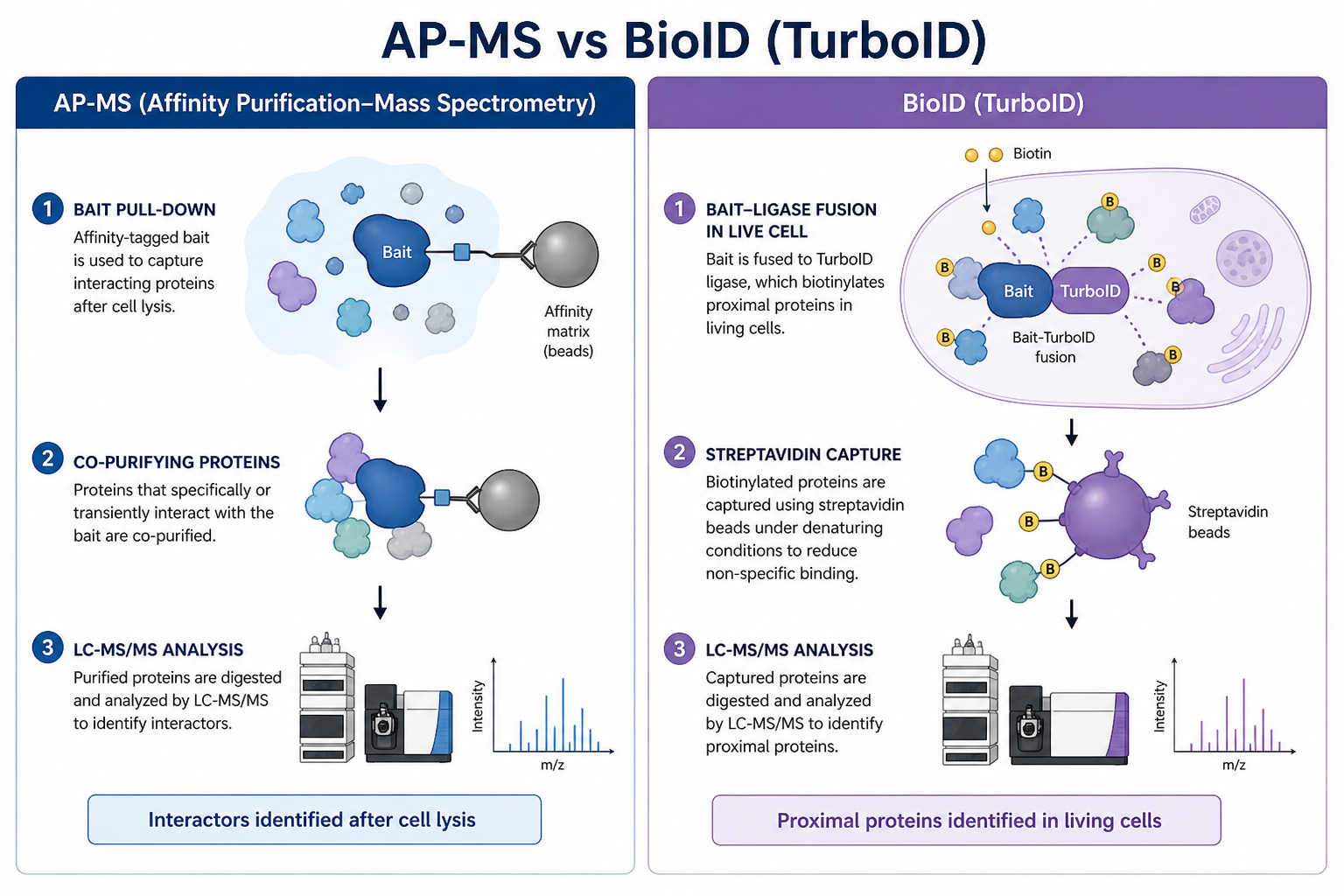
Figure 1. AP-MS identifies co-purifying proteins after bait enrichment, while BioID and TurboID identify proteins labeled near the bait in live cells.
Core Comparison Dimensions
A useful AP-MS vs BioID vs TurboID comparison should focus on decision-relevant differences rather than generic platform language:
- Physical basis: AP-MS measures co-purification after lysis, while BioID and TurboID measure proximity labeling in live cells
- Interaction class bias: AP-MS favors associations that survive detergent lysis and wash stringency, whereas proximity labeling can detect weaker or more transient neighbors that dissociate during purification
- Bait design: AP-MS commonly uses epitope tags or antibody capture, while BioID and TurboID require fusion to a biotin ligase with attention to bait orientation and localization
- Temporal control: classic BioID labeling windows are longer, and TurboID supports shorter labeling periods that can help time-resolved or low-background designs when bait expression and localization are controlled
- Background profiles: AP-MS often shows bead binders and abundant sticky proteins, while proximity labeling shows spatially broad labeling, ligase mislocalization, or biotin-route artifacts if controls are weak
All three routes produce candidate evidence that usually requires follow-up before direct binding or mechanism claims are made.
Side-by-Side Method Comparison
|
Decision factor |
AP-MS |
BioID |
TurboID |
|---|---|---|---|
|
Primary evidence |
Co-purification after enrichment |
Proximity labeling in live cells |
Faster proximity labeling in live cells |
|
Best for |
Stable or wash-resistant associations |
Compartment or membrane-proximal mapping |
Short-window proximity mapping |
|
Typical bait format |
Tag or antibody capture |
Bait-ligase fusion |
Bait-ligase fusion |
|
Lysis impact |
Central to what is recovered |
Labeling occurs before lysis |
Labeling occurs before lysis |
|
Transient interactions |
Often lost during washing |
More likely to be detected if proximity occurred |
Same, with shorter labeling time option |
|
Time-resolved studies |
Limited by purification timing |
Possible with labeling windows |
Often easier with shorter labeling |
|
Main interpretation risk |
Indirect copurification |
Proximity is not direct binding |
Same as BioID, plus fast-label background control |
The table supports method routing. It does not replace bait-specific pilot planning or control design review.
When AP-MS Is the Better Choice
AP-MS fits projects that need bait-centered co-purification evidence from affinity enrichment under defined wash conditions, especially when associations are expected to survive immunopurification or tagged pull-down. It also supports comparative designs across mutant baits, treatments, or baits in a panel when capture chemistry can be matched, and it suits teams that already have tagged baits or validated capture antibodies without live-cell labeling infrastructure.
AP-MS is often less appropriate when the primary interaction biology is transient, membrane-proximal, or highly sensitive to harsh lysis, even if those partners are biologically meaningful. In those cases, proximity labeling may reveal neighbors that dissociate before enrichment is complete.
When BioID Is the Better Choice
BioID fits when the project needs proximal proteome mapping around a bait in live cells rather than proteins that survive post-lysis washing. It is particularly useful for compartment-restricted interaction questions where bait localization matters to interpretation, and for membrane-associated or organelle-associated baits when classical AP-MS recovery is poor under required lysis conditions.
BioID can tolerate longer labeling windows and still provide proximity evidence before complex dissociation during purification. It may be less ideal when very short labeling times are essential or when ligase fusion disrupts bait function or localization.
When TurboID Is the Better Choice
TurboID addresses the same proximity question as BioID when shorter labeling windows are experimentally important. It fits time-resolved stimulation or inhibitor studies where labeling should occur during a defined short interval, and projects where faster labeling may reduce exposure to background labeling relative to longer BioID windows, provided bait localization and controls are robust.
TurboID still requires the same interpretive caution as BioID: faster labeling does not convert proximity evidence into direct binding proof. It may be less suitable when bait expression, biotin handling, or localization control is not yet validated for any ligase fusion format.
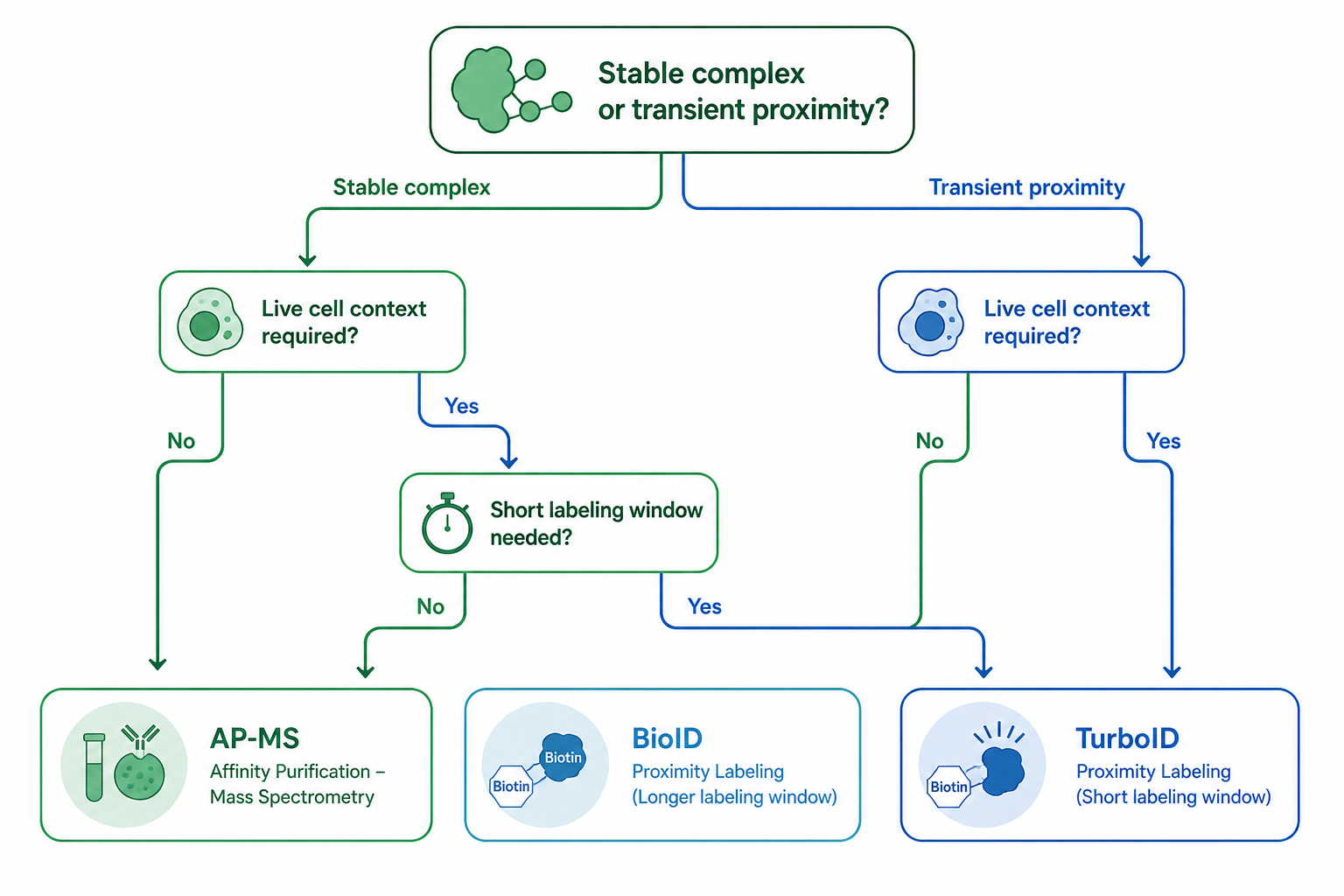
Figure 2. Choose AP-MS for co-purification under enrichment conditions and BioID or TurboID for live-cell proximity mapping.
When a Combined Strategy Makes Sense
Some interaction programs benefit from more than one method because co-purification and proximity measure different association properties. AP-MS can identify proteins that form wash-stable associations with a bait, while BioID or TurboID can identify proteins that localize near the bait in live cells even if they dissociate during lysis. A combined plan can prioritize proteins supported by both routes or use proximity labeling to expand candidate discovery before AP-MS or Co-IP validation.
Combined designs should be planned before construct engineering when possible. Tag choice, ligase fusion position, and control lines must be compatible with the full workflow rather than added after the first dataset is generated.
Affinity Purification-Mass Spectrometry Service
Proximity Dependent Biotin Identification (BioID) Service
Related Services
Alternative
Proximity Dependent Biotin Identification (BioID) Service
Use when live-cell proximity mapping fits the interaction question better than post-lysis co-purification by AP-MS.
Complementary
Use when proximity labeling is required and shorter labeling windows are a priority over classic BioID timing.
Next Step
Proximity Labeling Mass Spectrometry Service
Review broader proximity labeling MS options after confirming that BioID or TurboID matches the bait and compartment context.
Controls and Interpretation Limits for All Three Routes
Weak controls undermine every method in this comparison. AP-MS requires matched empty-tag, bead-only, or equivalent background purifications to filter sticky proteins. BioID and TurboID require ligase-only, non-labeled, or other project-appropriate controls to separate bait-proximal signal from labeling background.
All three methods produce candidate lists, not confirmed binding partners. Proximity labeling identifies neighbors; AP-MS identifies co-enriched proteins. Localization matters for BioID and TurboID more directly than for many AP-MS designs, because a mislocalized ligase fusion can redefine what proximity means in the dataset. Comparative claims across treatment or genotype arms require matched labeling or purification conditions in each arm, since technical differences in bait expression or capture can mimic biological interaction changes.
What to Prepare Before Choosing a Method
Prepare project information that supports a real method decision rather than a name preference. State whether the interaction is expected to be stable through lysis and washing or transient and proximity-dependent in live cells. Confirm whether the bait can be engineered as a ligase fusion without disrupting function or localization, and define whether short labeling windows are biologically important for the experiment.
Also identify the compartment context if the bait is membrane-associated or organelle-restricted, and describe the validation assay that will test top candidates after the first discovery dataset. MtoZ Biolabs can review bait design, control options, and whether AP-MS, BioID, TurboID, or a combined plan best matches the current interaction question.
Frequently Asked Questions
1. Is TurboID just a faster version of BioID?
TurboID is a faster biotin ligase variant used in the same proximity labeling workflow as BioID. Both identify proteins near a bait in live cells, but TurboID supports shorter labeling windows in typical experimental designs.
2. Does AP-MS detect the same proteins as BioID or TurboID?
Not necessarily. AP-MS detects proteins that co-purify after lysis and washing. BioID and TurboID detect proteins labeled near the bait before lysis. Overlap can occur, but the candidate lists are not expected to be identical.
3. Can proximity labeling prove direct protein-protein binding?
No. BioID and TurboID support proximity evidence. Direct binding usually requires orthogonal assays such as reciprocal Co-IP, pairwise binding tests, or structural approaches.
4. Which method is better for membrane protein interaction studies?
Proximity labeling is often considered when membrane or compartment context is central and classical AP-MS recovery is limited by lysis or wash conditions. The best choice still depends on bait design and controls.
5. Can AP-MS and TurboID be used in the same project?
Yes. Some teams use proximity labeling for live-cell neighborhood mapping and AP-MS or targeted Co-IP for follow-up on prioritized candidates. Combined planning early in the project improves construct and control design.
Conclusion
AP-MS, BioID, and TurboID answer related but distinct interaction questions. AP-MS is built for bait-centered co-purification after affinity enrichment. BioID and TurboID are built for live-cell proximity labeling around a bait-ligase fusion, with TurboID offering a faster labeling option in many designs.
AP-MS fits wash-stable co-purification evidence. BioID fits live-cell proximity mapping with longer labeling windows. TurboID fits the same proximity question when shorter labeling control matters. Many projects benefit from treating proximity and co-purification as complementary evidence types rather than competing brand names.
Researchers choosing among these routes can review the Affinity Purification-Mass Spectrometry Service, BioID, or TurboID service pages, or contact MtoZ Biolabs with bait design, compartment context, and validation goals for method selection support.
How to order?




