






TurboID Service
MtoZ Biolabs offers a comprehensive TurboID Service based on proximity-dependent biotinylation and high-resolution mass spectrometry to enable rapid and sensitive mapping of protein interaction environments in living cells. This service supports the identification of transient protein interactions and dynamic local proteomes that are difficult to capture using conventional affinity-based approaches.
What Is TurboID?
TurboID is an advanced proximity labeling technology developed as an enhanced variant of BioID. It is based on a highly active, engineered form of the bacterial biotin ligase BirA. TurboID addresses a key limitation of earlier proximity-based approaches by allowing efficient labeling of nearby proteins within a short time window, making it well suited for studying dynamic and condition-dependent biological processes.
In many cellular systems, protein associations change rapidly in response to stimuli, signaling events, or environmental perturbations. Conventional interaction analysis methods often fail to capture these transient relationships due to their reliance on stable binding or prolonged experimental procedures. TurboID overcomes this challenge by providing a time-resolved strategy to interrogate local proteomes and protein proximity networks under near-physiological conditions.
Principle of TurboID
The TurboID approach is based on an engineered, highly active biotin ligase that is genetically fused to a protein of interest. When expressed in living cells and supplied with exogenous biotin, the enzyme rapidly generates a reactive biotin intermediate capable of covalently modifying primary amines on proteins located in close physical proximity to the fusion protein.
Because the reactive biotin species has a short lifetime and limited diffusion distance, labeling is confined to a defined spatial radius around the bait protein. This ensures that only proteins residing within the immediate molecular environment are tagged, while distal proteins remain unlabeled.
Following proximity-dependent biotinylation, cells are lysed under stringent conditions that disrupt noncovalent interactions. Biotinylated proteins are selectively enriched using streptavidin-based affinity purification and subsequently identified and quantified by liquid chromatography-mass spectrometry. This workflow enables robust detection of proximity-labeled proteins and accurate characterization of local protein environments.
TurboID Service at MtoZ Biolabs
MtoZ Biolabs' TurboID Service combines rapid proximity-dependent biotinylation with high-resolution mass spectrometry to profile local protein environments in living cells. Compared with BioID approaches, TurboID enables efficient labeling within a substantially shorter time window, allowing more effective capture of transient and stimulus-dependent protein associations while reducing secondary effects caused by prolonged labeling.
The TurboID Service at MtoZ Biolabs follows a well-defined and standardized workflow designed to ensure efficient proximity labeling, reliable protein enrichment, and robust mass spectrometry analysis.
1. Design and expression of TurboID-bait fusion constructs
2. Short-duration biotin labeling in living cells
3. Cell lysis and enrichment of biotinylated proteins
4. LC-MS/MS-based protein identification and quantification
5. Bioinformatics analysis and data reporting
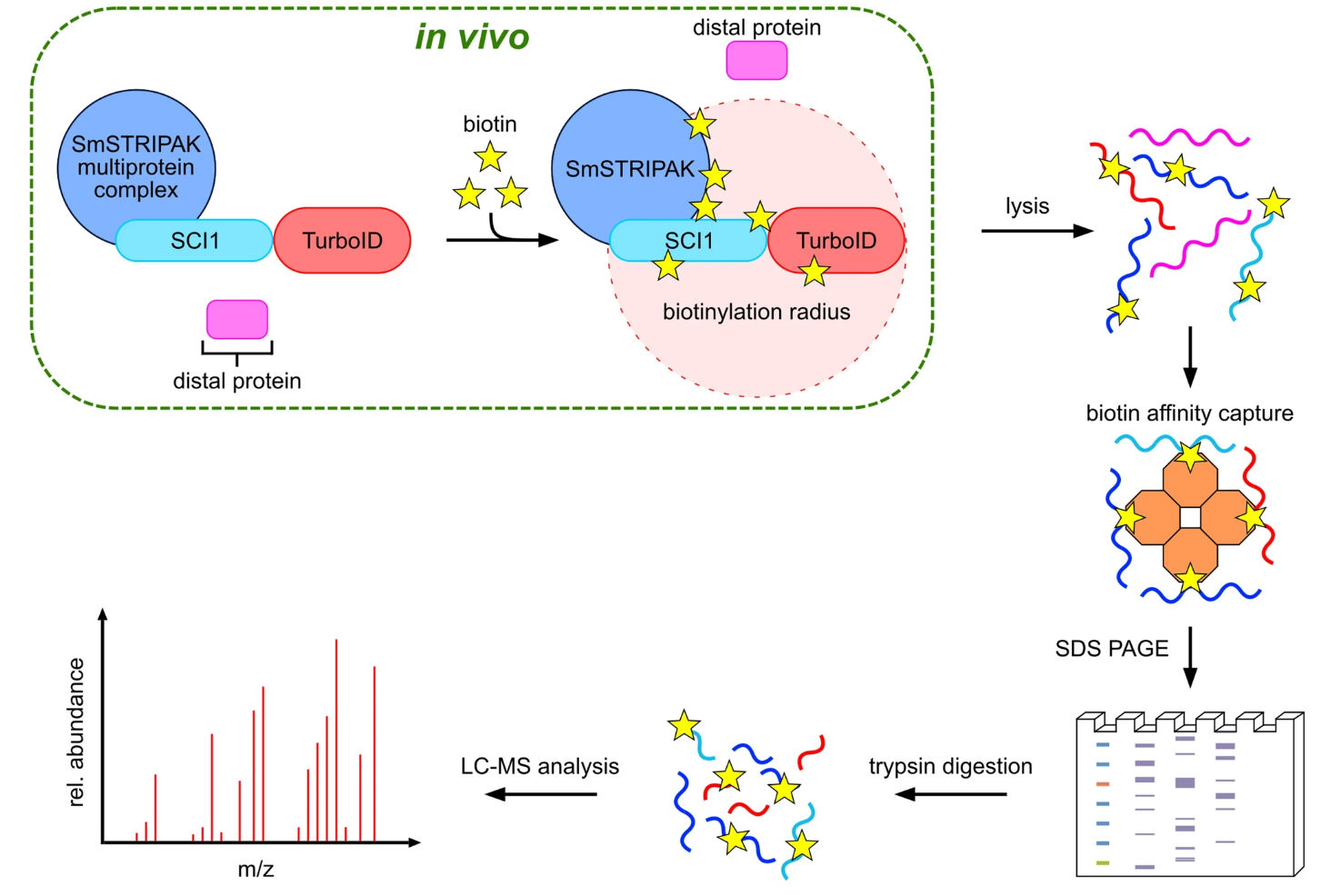
Hollstein, L. S. et al. Sci Rep. 2022.
Figure 1. Workflow of TurboID Experiment with SCI1 as Bait
Why Choose MtoZ Biolabs
MtoZ Biolabs combines technical expertise, advanced instrumentation, and rigorous quality control to deliver reliable TurboID results.
☑️Extensive experience in mass spectrometry-based proteomics
☑️Deep expertise in protein-protein interaction analysis and proximity biotinylation technologies
☑️Optimized TurboID workflows validated across multiple experimental systems
☑️High-resolution LC-MS platforms for sensitive protein detection
☑️Flexible project customization based on specific research objectives
☑️Efficient project turnaround to support time-sensitive studies
Applications of TurboID Service
The TurboID Service supports a broad range of research applications requiring rapid and sensitive detection of protein proximity relationships.
🔸Identification of transient or stimulus-dependent protein interactions
🔸Mapping of local protein environments within subcellular compartments
🔸Analysis of signaling pathway dynamics
🔸Characterization of protein networks associated with membrane proteins
🔸Investigation of protein organization under changing cellular conditions
🔸Comparative analysis of interaction landscapes across treatments or time points
FAQ
Q1: What types of samples are suitable?

If you have special or limited material, we can assess feasibility and optimize a suitable workflow.
Q2: How should I prepare my samples?
1. Ensure samples are freshly prepared or snap-frozen.
2. Avoid detergents, salts, and reducing agents that may interfere with LC-MS/MS analysis.
3. Store samples at -80 °C before shipment.
4. Transport samples on dry ice to maintain stability during delivery.
For more information, please refer to Sample Submission Guidelines for Proteomics and Sample Submission Guidelines for Metabolomics
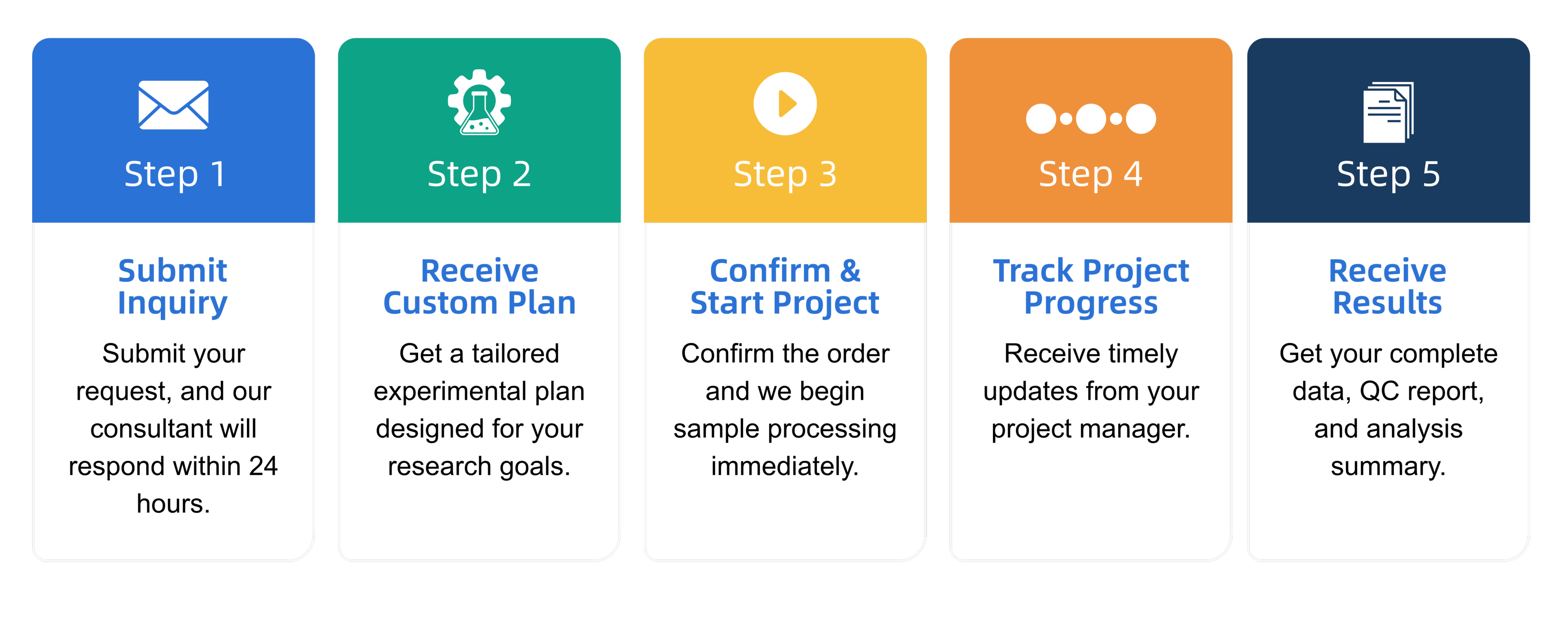
Q3: What is the service general workflow?
Q4: What data formats are provided?
1. Raw mass spectrometry data provided in vendor-specific formats (e.g., .raw)
2. Tabulated result files in Excel or CSV format, including protein identification results, interaction metrics, and statistical analysis outputs
3. Visualization files in high-resolution image formats (PNG or TIFF), including quantitative result plots (such as heatmaps and comparative diagrams) and protein interaction network visualizations
4. Comprehensive analysis reports provided in PDF format, summarizing experimental workflows, analytical methods, and key findings
5. Additional formats can be provided upon request to meet specific analysis or publication requirements.
Start Your Project with MtoZ Biolabs
By combining rapid proximity labeling with sensitive mass spectrometry analysis, the TurboID Service at MtoZ Biolabs enables researchers to explore protein networks that are otherwise difficult to access.
Contact us to discuss your project and develop a customized strategy tailored to your scientific objectives.
Supporting Antibody Products for Protein Interaction Studies
MtoZ Biolabs offers antibody products for IP, Co-IP, IP-MS, and related protein interaction workflows, complementing protein interaction analysis services and supporting target enrichment and downstream mass spectrometry analysis.
IP-MS Validated Antibodies
Explore antibodies evaluated for target enrichment and downstream mass spectrometry applications, with product information available to support antibody selection.
View IP-MS Validated AntibodiesOther Supporting Products
How to order?




