






Proximity Dependent Biotin Identification (BioID) Service
MtoZ Biolabs provides a comprehensive Proximity Dependent Biotin Identification (BioID) Service based on advanced mass spectrometry workflows to map protein-protein interactions and local proteomes in living cells. This service enables the systematic identification of transient, weak, and spatially restricted protein associations that are difficult to capture using conventional interaction analysis approaches.
What Is Proximity Dependent Biotin Identification (BioID)?
Deciphering protein interaction landscapes within their native cellular context remains a central challenge in molecular and cell biology. Many biologically meaningful protein associations are transient or weak interactions, making them difficult to detect using conventional affinity-based interaction assays. Proximity-Dependent Biotin Identification (BioID) was developed to address these limitations by enabling in vivo labeling of proteins based on spatial proximity rather than stable physical binding.
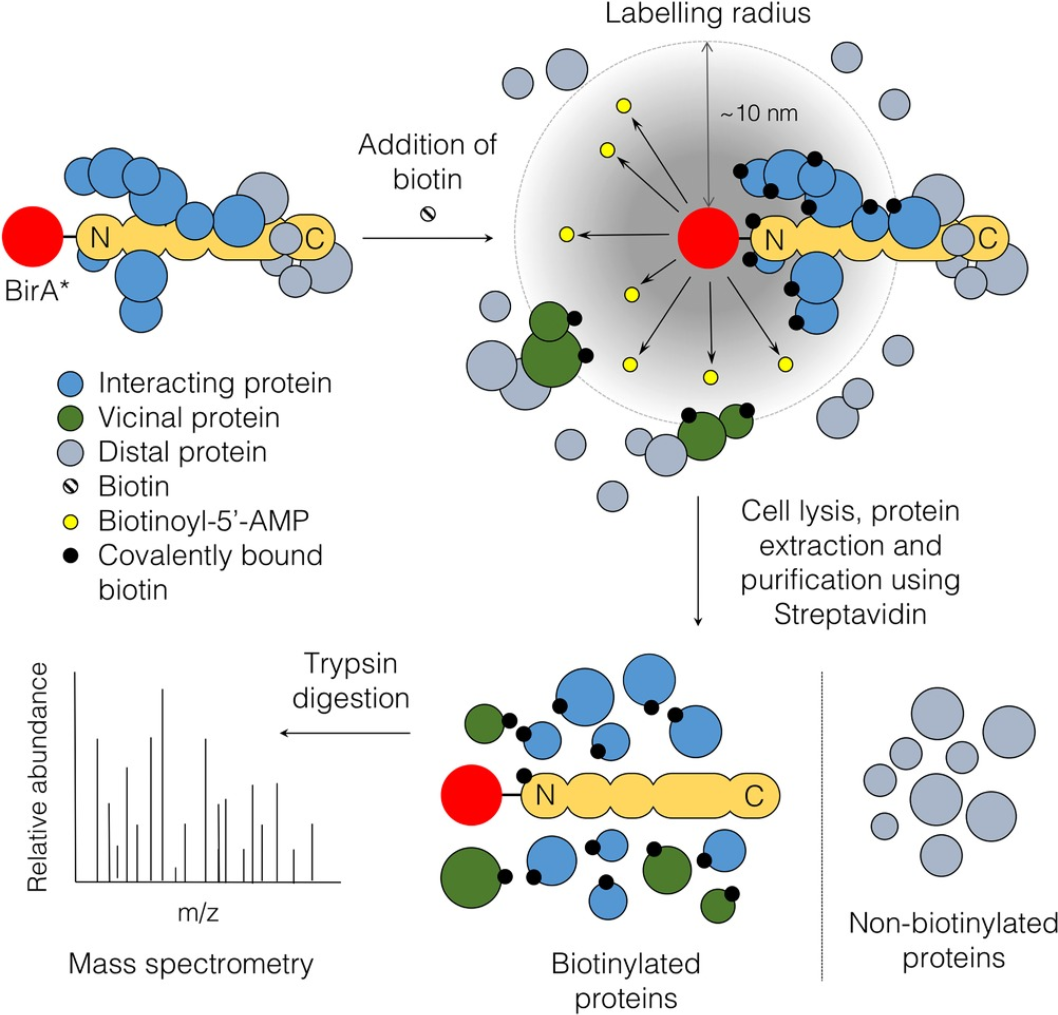
The core concept of BioID relies on fusing the protein of interest to a mutated, promiscuous form of the bacterial biotin ligase BirA, commonly referred to as BirA*. This fusion protein is expressed in living cells, where BirA* catalyzes the conversion of exogenously supplied biotin into a highly reactive biotin-activated intermediate. BirA* releases this reactive species from its active site, allowing it to diffuse over a short distance and covalently label primary amines on nearby proteins.
Biotinylation occurs within a confined spatial range, typically on the order of several nanometers, defining a local labeling radius around the bait protein. As a result, proteins that are in close physical proximity to the bait, whether they interact directly, associate indirectly through protein complexes, or simply reside within the same subcellular microenvironment, can be selectively tagged. Proteins located beyond this effective radius remain unlabeled, providing intrinsic spatial specificity to the approach.
Following biotin labeling, biotinylated proteins are enriched using streptavidin affinity purification and identified by high-resolution mass spectrometry. This approach enables unbiased, system-level interrogation of protein interaction landscapes and local proteomes.
Varnaitė, R. et al. Proteomics. 2016.
Figure 1. Mapping Local Protein Interactomes by Proximity-Dependent Labeling with BioID
Proximity Dependent Biotin Identification (BioID) Service at MtoZ Biolabs
MtoZ Biolabs offers an end-to-end BioID Service that integrates experimental design, sample processing, mass spectrometry analysis, and bioinformatics interpretation. Our workflows are optimized to ensure high specificity, reproducibility, and biological relevance across diverse research applications.
1. Design and expression of biotin ligase–bait fusion constructs
2. Live-cell biotin labeling under optimized conditions
3. Cell lysis and enrichment of biotinylated proteins
4. LC-MS/MS-based protein identification and quantification
5. Bioinformatics analysis and data reporting
Why Choose MtoZ Biolabs
MtoZ Biolabs combines technical expertise, advanced instrumentation, and rigorous quality control to deliver reliable BioID results.
☑️Extensive experience in mass spectrometry-based proteomics
☑️Optimized BioID workflows validated across multiple systems
☑️High-resolution LC-MS platforms for sensitive protein detection
☑️Deep expertise in protein-protein interaction analysis and advanced proximity biotinylation technologies
☑️Flexible project customization based on research objectives
☑️Efficient project turnaround to accelerate discovery timelines and reduce experimental delays
Applications of Proximity Dependent Biotin Identification (BioID) Service
The BioID Service provided by MtoZ Biolabs supports a wide range of research applications across life sciences and biotechnology.
🔸Mapping protein-protein interaction networks in living cells
🔸Identification of transient or weak protein interactions
🔸Characterization of subcellular protein microenvironments
🔸Investigation of signaling pathway components
🔸Functional annotation of uncharacterized proteins
🔸Comparative analysis of protein interactions under different conditions
🔸Study of disease-associated protein network alterations
FAQ
Q1: What types of samples are suitable?
Commonly supported samples of Proximity-Dependent Biotin Identification (BioID) Service include:

If you have special or limited material, we can assess feasibility and optimize a suitable workflow.
Q2: How should I prepare my samples?
1. Use freshly harvested cells or tissues
2. Ensure complete cell lysis or tissue homogenization while minimizing protein degradation
3. Avoid excessive contaminants such as salts, detergents, or debris that may interfere with protein enrichment and MS analysis
4. Store samples at −80°C and ship on dry ice in leak-proof containers to preserve integrity.
5. Avoid repeated freeze-thaw cycles
For more information, please refer to Sample Submission Guidelines for Proteomics and Sample Submission Guidelines for Metabolomics
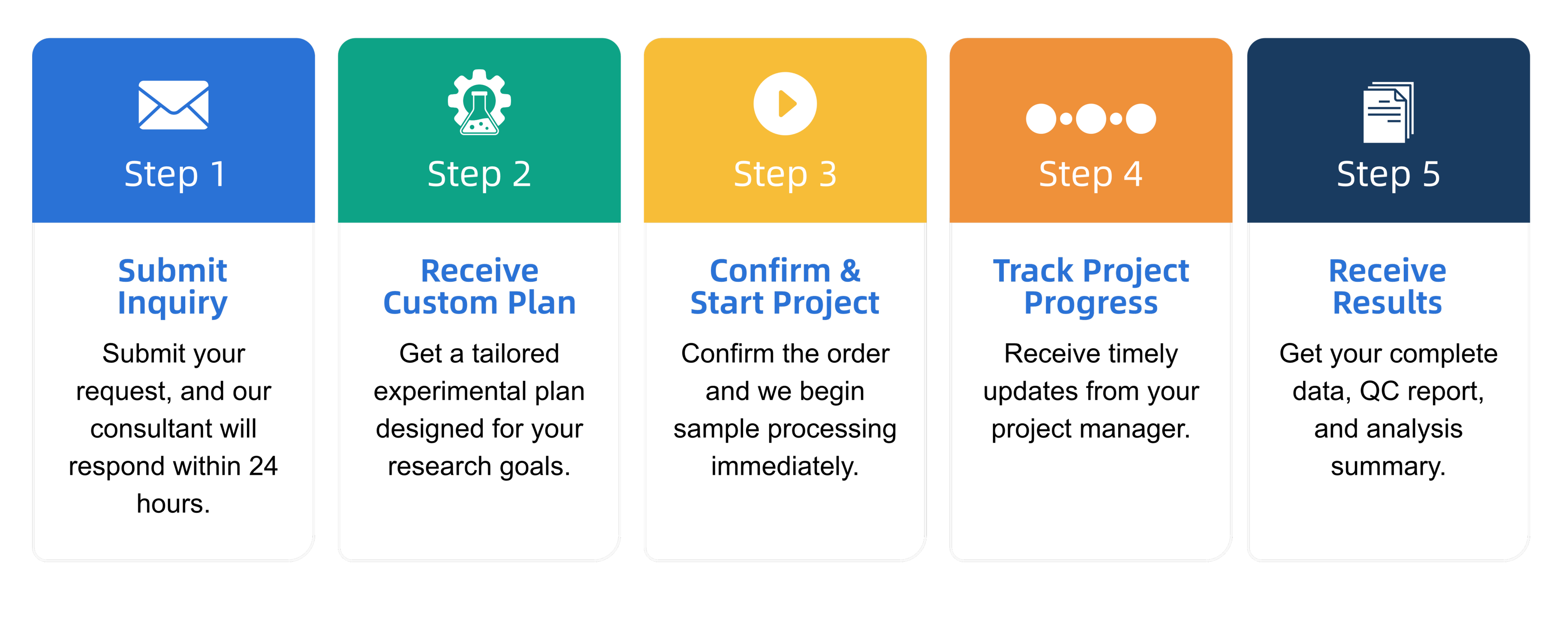
Q3: What is the service general workflow?
Q4: What data formats are provided?
1. Raw mass spectrometry data provided in vendor-specific formats (e.g., .raw)
2. Protein identification result tables in Excel or CSV format
3. Interaction and statistical analysis tables, including quantitative metrics and significance evaluation, provided in Excel or CSV format
4. Quantitative result visualizations, such as heatmaps and comparative plots, delivered in high-resolution image formats (PNG or TIFF)
5. Protein interaction network visualizations provided as publication-ready images (PNG or TIFF)
6. Comprehensive analysis reports supplied in PDF format summarizing workflows and key findings
7. Additional formats can be provided upon request to meet specific analysis or publication requirements.
Start Your Project with MtoZ Biolabs
Proximity-Dependent Biotin Identification offers a powerful approach for uncovering protein interaction landscapes and spatial proteomes in living cells. Whether you are investigating signaling pathways, cellular organization, or disease-related protein networks, MtoZ Biolabs provides the technical expertise and analytical depth to support your BioID research.
Contact us to discuss your project and develop a customized Proximity-Dependent Biotin Identification strategy tailored to your scientific objectives.
Supporting Antibody Products for Protein Interaction Studies
MtoZ Biolabs offers antibody products for IP, Co-IP, IP-MS, and related protein interaction workflows, complementing protein interaction analysis services and supporting target enrichment and downstream mass spectrometry analysis.
IP-MS Validated Antibodies
Explore antibodies evaluated for target enrichment and downstream mass spectrometry applications, with product information available to support antibody selection.
View IP-MS Validated AntibodiesOther Supporting Products
How to order?




