






Antibody Glycosylation Analysis: Methods, Workflow, and Applications in Biotherapeutic Characterization
Introduction
Biotherapeutic antibodies are glycoproteins whose Fc-associated N-glycans can affect effector function, pharmacokinetic behavior, stability, and lot-to-lot consistency. During development, a monoclonal antibody program may need baseline Fc glycan profiling before process optimization begins. After a manufacturing change, a comparability team may require site-specific glycopeptide data to assess similarity between pre-change and post-change lots. A biosimilar developer may need quantitative glycan comparison between reference product and candidate material as part of analytical similarity review.
Antibody glycosylation analysis in biotherapeutic characterization applies defined analytical methods and structured workflows to profile glycan structures, identify glycosylation sites, quantify major glycoforms, and compare glycan distributions across development batches and lifecycle events. The output supports internal CMC review, process control, comparability assessment, biosimilar evaluation, and regulatory documentation when glycosylation is a relevant quality attribute.
For biotherapeutic teams, effective glycosylation analysis starts with scoping the critical quality attributes under review, selects methods matched to the characterization decision, and delivers reporting appropriate to the development stage and intended use of the data.
Scope of Antibody Glycosylation Analysis in Biotherapeutics
Biotherapeutic glycosylation analysis characterizes carbohydrate structures on monoclonal antibodies and related immunoglobulin formats intended for therapeutic use. On standard IgG biotherapeutics, the primary site of interest is the conserved N-linked glycosylation position at Asn297 in the Fc CH2 domain on each heavy chain. Bispecific antibodies, Fc fusion proteins, and glycoengineered formats may contain additional N-linked or O-linked sites that require site-specific mapping beyond canonical Fc review.
Because mammalian expression systems produce glycoform mixtures, analysis reports distributions rather than a single uniform glycan structure. Commonly monitored Fc attributes include core fucosylation, galactosylation, sialylation, high-mannose content, and site occupancy. The analytical scope should reflect product strategy. An effector-enhanced biotherapeutic may prioritize fucose and galactose monitoring. An effector-modulated product may emphasize glycan features linked to reduced Fc receptor engagement.
Biotherapeutic characterization often uses three complementary analytical layers. Intact or subunit mass spectrometry reports global glycoform populations. Released N-glycan profiling quantifies glycan composition after cleavage from the protein. Glycopeptide LC-MS/MS assigns glycan structures to specific peptide sequences and residues. Programs with stringent quality requirements frequently combine at least two layers when both composition and site linkage matter.
Why Glycosylation Analysis Matters for Biotherapeutic Programs
Glycosylation is widely regarded as a critical quality attribute because it reflects manufacturing process, expression platform, and potential functional behavior. Glycan profiles can shift with cell line, culture conditions, purification strategy, scale-up, storage, and tech transfer before binding or potency assays detect a change.
Antibody glycosylation analysis supports biotherapeutic development in several practical ways.
Early characterization establishes baseline Fc glycan profiles for lead candidates in the intended expression system.
Process development monitoring detects glycan drift during media, feed, or purification optimization.
Comparability exercises evaluate glycan similarity before and after manufacturing changes or site transfers.
Biosimilar programs compare glycan profiles between reference and test biotherapeutics within analytical similarity packages.
Control strategy and lifecycle management use glycan data to define monitored attributes, build batch history, and support release or stability decisions when glycosylation is part of the control framework.
Glycan analysis provides structural evidence that complements peptide mapping, intact mass review, charge variant profiling, and functional assays in integrated biotherapeutic characterization.
Key Analytical Methods
Biotherapeutic glycosylation analysis is method-selective. The appropriate approach depends on sample matrix, development stage, and reporting depth.
Released N-glycan profiling
N-linked glycans are released using PNGase F or suitable release chemistry, then profiled by LC-MS, MALDI-MS, or fluorescent labeling with UPLC or HPLC separation. This method delivers strong glycan class and composition data and is widely applied to lot comparison, process monitoring, and development-stage profiling.
Glycopeptide LC-MS/MS
Proteolytic digestion produces peptides retaining glycans at glycosylation sites. Enrichment via HILIC, lectin affinity, or graphitized carbon chromatography improves glycopeptide recovery before LC-MS/MS. Fragmentation modes such as HCD, ETD, or EThcD enable site-specific glycan assignment and occupancy review on Fc peptides and any additional sites in complex biotherapeutic formats.
Intact and subunit glycoform analysis
Intact mass spectrometry of the whole antibody or Fc subunit reveals major glycoform populations without digestion. This supports rapid comparability screening and confirms global heterogeneity before deeper site-specific mapping.
Site identification and occupancy analysis
Site analysis confirms glycosylated residues and estimates occupied versus unoccupied site proportions. This is essential for bispecific, fusion, or multi-site biotherapeutics and for regulatory packages requiring documented site occupancy.
Orthogonal CMC methods
Peptide mapping, charge variant analysis, and functional assays such as Fc receptor binding or ADCC may complement glycan data when a glycan shift requires broader quality context. Method depth should match the decision, not default to maximum complexity for every sample.
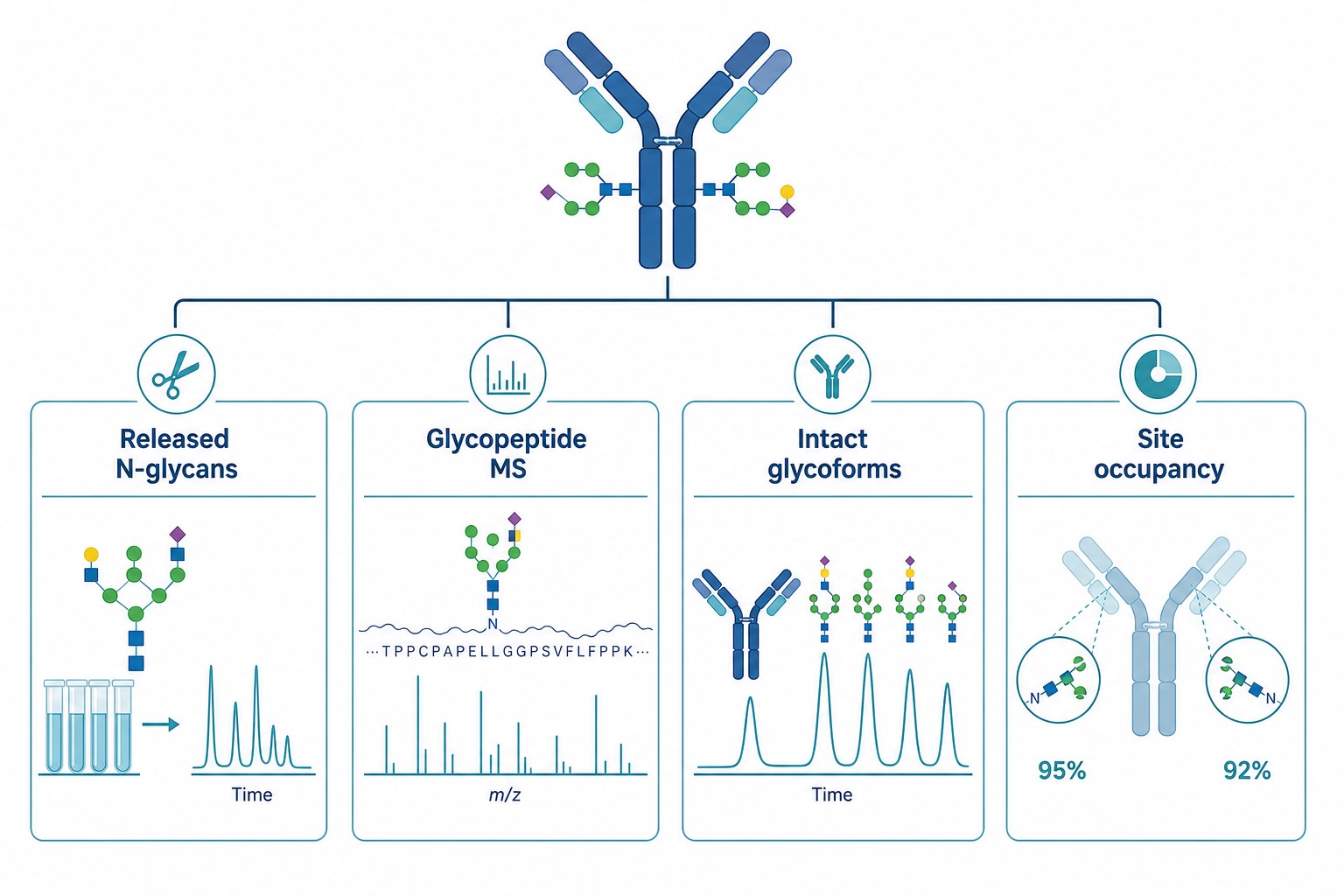
Figure 1. Biotherapeutic antibody glycosylation analysis applies released N-glycan profiling, glycopeptide MS, intact glycoform analysis, and site occupancy review based on characterization scope.
Standard Biotherapeutic Workflow
A structured workflow aligns glycosylation analysis with CMC objectives and quality decisions.
Critical quality attribute scoping identifies which glycan features matter for the biotherapeutic based on mechanism of action, effector strategy, and control needs. Sample feasibility review confirms antibody format, purity, buffer compatibility, concentration, sample type, and reference lot availability. Method selection determines whether released glycan profiling, glycopeptide mapping, intact analysis, or a combined package best fits the study goal. Sample preparation may require buffer exchange or cleanup when drug substance or drug product matrix interferes with digestion or glycan release. LC-MS/MS acquisition and data analysis assign glycan compositions, localize sites, summarize occupancy, and compare monitored attributes across lots or conditions. Reporting delivers glycan summaries, glycopeptide tables when applicable, method context, and interpretation notes for internal review, comparability packages, or regulatory support.
Method validation or qualification may be required when data support release testing, formal comparability, or submission-related characterization.
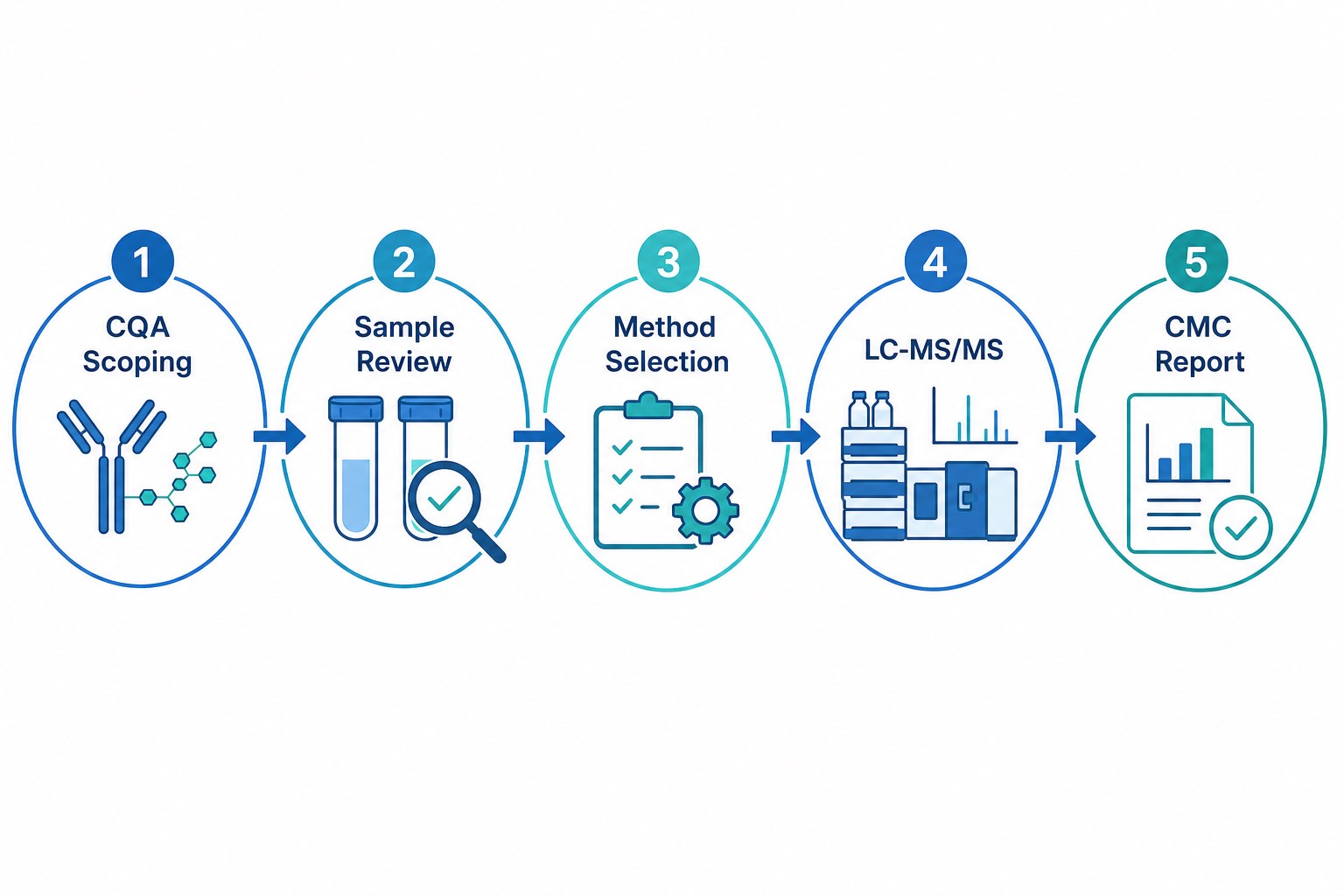
Figure 2. A biotherapeutic glycosylation analysis workflow covers CQA scoping, sample review, method selection, LC-MS/MS analysis, and CMC reporting.
Related Services
Protein Drug Glycosylation Analysis Service
Protein Glycosylation Analysis Service
Glycosylation Site Analysis Service
Glycosylation Site Analysis Services
Comprehensive Glycosylation Analysis Service
Biotherapeutic teams planning antibody glycosylation analysis can consult MtoZ Biolabs to review sample type, CMC stage, and the analytical package best suited to characterization or comparability goals.
Matching Methods to Characterization Goals
Different biotherapeutic goals favor different analytical emphasis.
|
Characterization Goal |
Preferred Method Emphasis |
Typical Use |
|---|---|---|
|
Early candidate profiling |
Intact screen or released glycan profile |
Baseline Fc glycan documentation |
|
Process change monitoring |
Released glycan and glycopeptide comparison |
Detect glycan drift after optimization |
|
Comparability exercise |
Combined intact, released, and site-specific data |
Pre- and post-change similarity review |
|
Biosimilar similarity |
Quantitative glycoform comparison to reference |
Lot and product comparison |
|
Control strategy support |
Qualified profiling with batch history |
Define monitored glycan attributes |
|
Stability or lifecycle review |
Trend comparison to qualified baseline |
Shelf-life and tech transfer support |
Released glycan profiling, glycopeptide mapping, and intact analysis are complementary. Strong biotherapeutic packages often integrate multiple methods when both glycan composition and site linkage inform the quality decision.
Applications Across the Biotherapeutic Lifecycle
Antibody glycosylation analysis supports multiple applications from early development through commercial lifecycle management.
Lot release and specification support
When glycosylation is part of the control strategy and qualified methods exist, glycan profiling can support release decisions within validated method context and product-specific acceptance criteria.
Comparability and process change review
Scale-up, purification changes, and site transfers may alter glycan profiles. Glycosylation analysis supplies structured evidence for comparability protocols when Fc glycans are relevant quality attributes.
Biosimilar and reference product comparison
Biosimilar programs compare glycan profiles between reference and test products as part of analytical similarity. Differences require interpretation with appropriate follow-up rather than automatic failure assignment.
Process validation and control strategy
Glycan data from validation batches help define operating ranges and select monitored attributes for ongoing process control.
Stability studies
Glycan shifts may be tracked during long-term, accelerated, or stress stability studies when glycosylation is stability-indicating or correlates with other quality trends.
Regulatory characterization packages
Glycosylation analysis contributes to quality documentation when glycan structure, site occupancy, or glycoform distribution are part of the product characterization narrative.
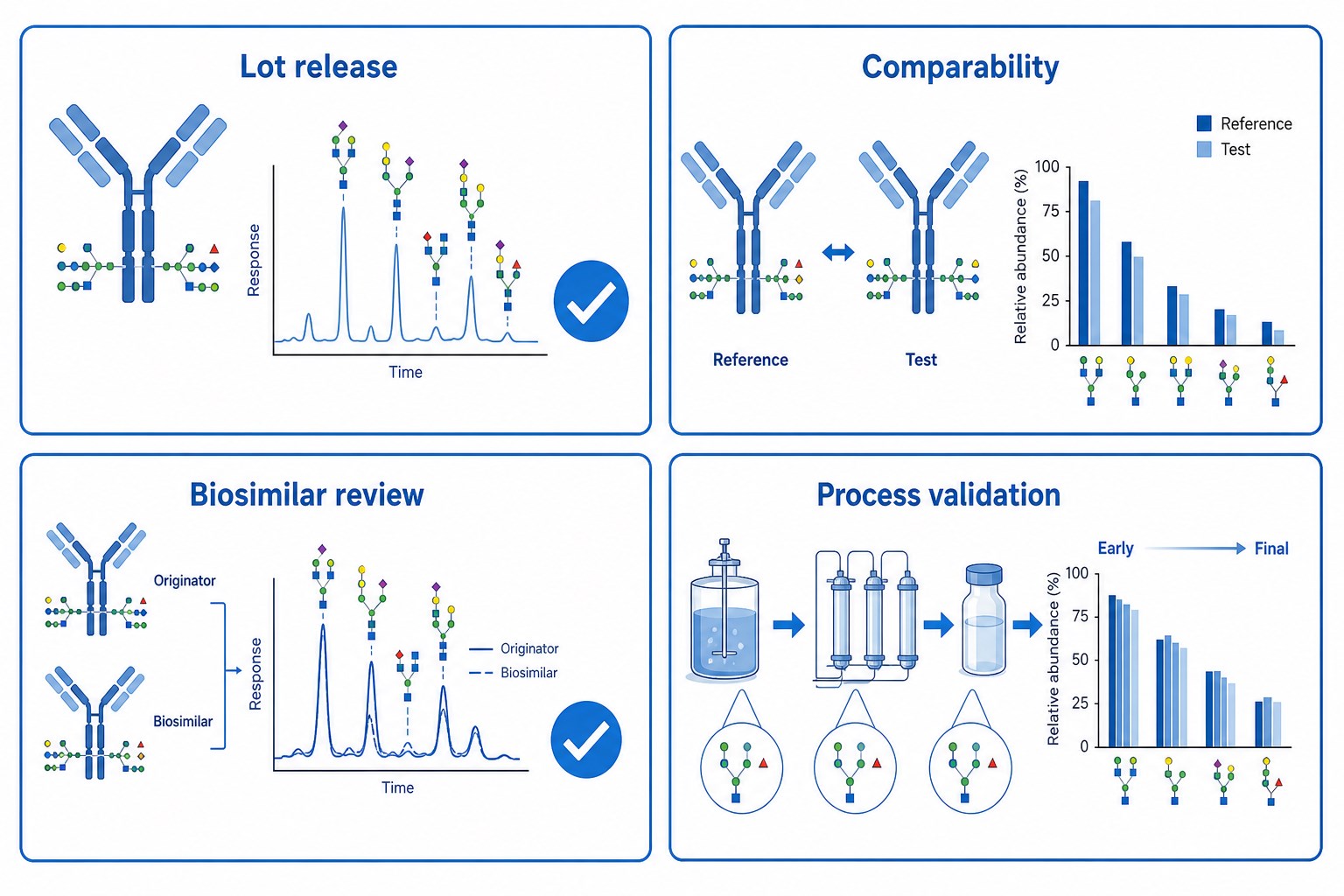
Figure 3. Antibody glycosylation analysis supports lot release, comparability review, biosimilar assessment, and process validation in biotherapeutic characterization.
Technical Strengths and Practical Limits
Technical Strengths
Connects glycan structure to CMC decisions.
Glycosylation analysis links carbohydrate heterogeneity with comparability, control strategy, and quality review.
Provides multi-layer evidence.
Intact, released, and site-specific methods supply complementary data within one program.
Supports batch and lifecycle comparison.
Quantitative glycoform comparison aids process monitoring, stability review, and biosimilar assessment.
Integrates with orthogonal workflows.
Glycan data complement peptide mapping, intact mass analysis, and functional assays.
Documents product-critical Fc attributes.
Site-specific Fc profiling supports effector function risk review when glycosylation affects therapeutic performance.
Practical Limits
Regulatory utility depends on method qualification.
Exploratory workflows may not support release or comparability without defined acceptance logic.
Sample matrix can interfere.
Excipients, detergents, and salts in drug product may require cleanup before analysis.
Heterogeneity complicates specifications.
Biotherapeutics exist as glycoform mixtures, requiring product-specific reporting and acceptance rationale.
Functional impact needs confirmation.
Glycan profiling alone does not verify ADCC, CDC, or pharmacokinetic effects when function is critical.
Low-abundance glycoforms need sensitive methods.
Minor species relevant to function or clearance may be missed in shallow profiling.
CMC Planning and Expected Deliverables
Before sample submission, biotherapeutic teams should define:
- biotherapeutic format, subclass, and Fc engineering status
- sample type: research material, drug substance, drug product, or reference standard
- development stage and intended use of glycan data
- reference, baseline, or comparator lot availability
- comparability, stability, release, or biosimilar context
- required glycan attributes and need for site-specific mapping
- orthogonal or functional follow-up requirements
A biotherapeutic glycosylation report should match program stage. Typical deliverables include major Fc glycoform summaries, released glycan profiles, glycopeptide tables with site assignment, site occupancy notes, lot comparison tables for comparability studies, method summaries, and interpretation against product strategy with recommended next steps.
Frequently Asked Questions
1. Why is glycosylation analysis important in biotherapeutic characterization?
Glycosylation can influence effector function, pharmacokinetics, stability, and lot consistency, making it a core quality attribute for many antibody biotherapeutics.
2. Which methods are most commonly used?
Released N-glycan profiling, glycopeptide LC-MS/MS, and intact or subunit glycoform analysis are the most common approaches, often applied in combination.
3. Which site is most monitored on IgG biotherapeutics?
The conserved Fc N-glycosylation site at Asn297 is the primary monitoring position on standard IgG biotherapeutics.
4. Can glycosylation analysis support biosimilar programs?
Yes. Glycan profile comparison is routinely used to evaluate analytical similarity between reference and test biotherapeutic products.
5. Does glycosylation analysis replace functional assays?
No. Glycan analysis characterizes structure and distribution. Functional assays remain necessary when effector activity or clearance must be confirmed.
6. What should be defined before analysis begins?
Teams should define the CMC objective, sample type, reporting depth, comparator availability, and whether site-specific mapping or batch comparison is required.
Conclusion
Antibody glycosylation analysis delivers the methods, workflow, and applications needed for robust biotherapeutic characterization across development, comparability, biosimilar review, and lifecycle management. Released N-glycan profiling, glycopeptide LC-MS/MS, intact glycoform analysis, and site occupancy review each provide distinct evidence layers and are often combined when Fc glycosylation is a relevant quality attribute.
Successful programs scope critical quality attributes early, select methods aligned with the characterization decision, and interpret glycan data within CMC and functional context. Structured feasibility review, stage-appropriate reporting, and orthogonal follow-up when needed help teams build reliable glycan evidence into biotherapeutic quality packages. Development teams planning antibody glycosylation analysis can contact MtoZ Biolabs to review sample status, analytical scope, and the reporting strategy best matched to their program stage.
How to order?




