






Antibody Characterization Methods: Principles, Applications, and Method Considerations
Short Answer
The most effective way to choose antibody characterization methods is to start with the exact analytical question, then select the smallest set of orthogonal methods that can answer it at the current project stage. For identity and sequence confirmation, teams often use LC-MS, intact mass analysis, subunit analysis, and peptide mapping. For purity and antibody heterogeneity, SEC, CE-SDS, and icIEF or cIEF are commonly used to assess aggregation, fragmentation, size variants, and charge variants. For antigen binding, binding affinity, and epitope behavior, SPR, BLI, ELISA, and epitope mapping approaches are more informative. For higher-order structure or conformational change, HDX-MS and selected structural methods can add detail. For thermal stability and developability, DSF, DSC, DLS, and related biophysical assays are usually interpreted together rather than as standalone proof.
The practical rule is straightforward: do not order more assays than the decision requires, but do not expect one method to answer questions about identity, function, stability, and developability at the same time.
What Is Antibody Characterization?
Antibody characterization is the analytical process used to define what an antibody is, how pure it is, how heterogeneous it is, how it binds, how stable it is, and which molecular features may affect downstream use. For a monoclonal antibody, characterization often includes primary structure, post-translational modifications, glycosylation, aggregation, charge variants, antigen binding, and higher-order structure.
This scope is broader than discovery screening and different from validation or potency testing. Screening may identify binders. Functional assays may show whether a candidate activates, blocks, or neutralizes a biological response. Antibody characterization instead asks whether the molecule itself is structurally and biophysically consistent with the research or development decision at hand.
No single method captures all relevant attributes. LC-MS can support sequence confirmation and PTM analysis, but it does not replace binding kinetics. SEC can show aggregation and size variants, but it cannot localize oxidation or deamidation. SPR and BLI can quantify binding affinity and association-dissociation behavior, but they do not establish glycan composition or clipping profiles. As a result, antibody characterization is usually built as an analytical workflow rather than a single assay request.
Key Analytical Dimensions in Antibody Characterization
A practical way to organize antibody characterization methods is by the attribute being measured.
Identity and sequence-related confirmation
Identity questions ask whether the sample matches the expected antibody construct. Common outputs include molecular mass, subunit masses, sequence coverage, and peptide map match. LC-MS, intact mass analysis, reduced or subunit analysis, and peptide mapping are central methods here. These approaches can also reveal processing differences such as C-terminal lysine variants or incomplete digestion artifacts.
Purity and size heterogeneity
Purity is not limited to the presence of a single major peak or band. Teams often need to examine aggregation, low-molecular-weight fragments, clipping, and other size variants. SEC separates monomer from higher-molecular-weight species, while CE-SDS helps resolve intact, reduced, and fragmented forms under denaturing conditions. Used together, these methods give a clearer view of antibody heterogeneity than either one alone.
Charge variants and post-translational modifications
Charge variants may arise from deamidation, sialylation, C-terminal lysine processing, glycation, or other chemical changes. icIEF or cIEF is often used to profile pI-related distributions, while LC-MS-based methods help assign likely molecular causes. Ion-exchange chromatography can also support charge heterogeneity analysis when separation-based comparison is needed.
Glycosylation attributes
Glycosylation characterization becomes especially important when Fc-related behavior, stability, or comparability is under review. Teams may need released glycan profiling, glycopeptide-level information, or a broader glycoform distribution readout. Glycosylation is not a cosmetic feature; it is a major contributor to antibody heterogeneity and can influence how other analytical results are interpreted.
Binding, affinity, and epitope behavior
Antigen binding can be measured in several ways, but the value of the data depends on the readout. ELISA may answer a presence-or-absence binding question. SPR and BLI add kinetic detail, including association rate, dissociation rate, and equilibrium binding affinity constants such as KD. Epitope mapping and competition experiments help determine whether candidates recognize the same region or distinct binding surfaces.
Stability and developability
Thermal stability, colloidal stability, and self-association tendency become more relevant as programs move from early discovery into candidate ranking and formulation planning. DSF and DSC examine thermal transitions, while DLS can flag changes in particle size distribution and solution behavior. These readouts are useful for screening and comparison, but they do not by themselves prove downstream performance.
Higher-order structure
Higher-order structure questions arise when teams need to investigate conformational integrity, stress-induced structural perturbation, or the physical basis of antibody-antigen interactions. HDX-MS is especially useful for conformational comparison and interface-level interpretation, while cryo-EM or other structural methods may be considered when more detailed complex characterization is needed.
Major Antibody Characterization Methods and Their Principles
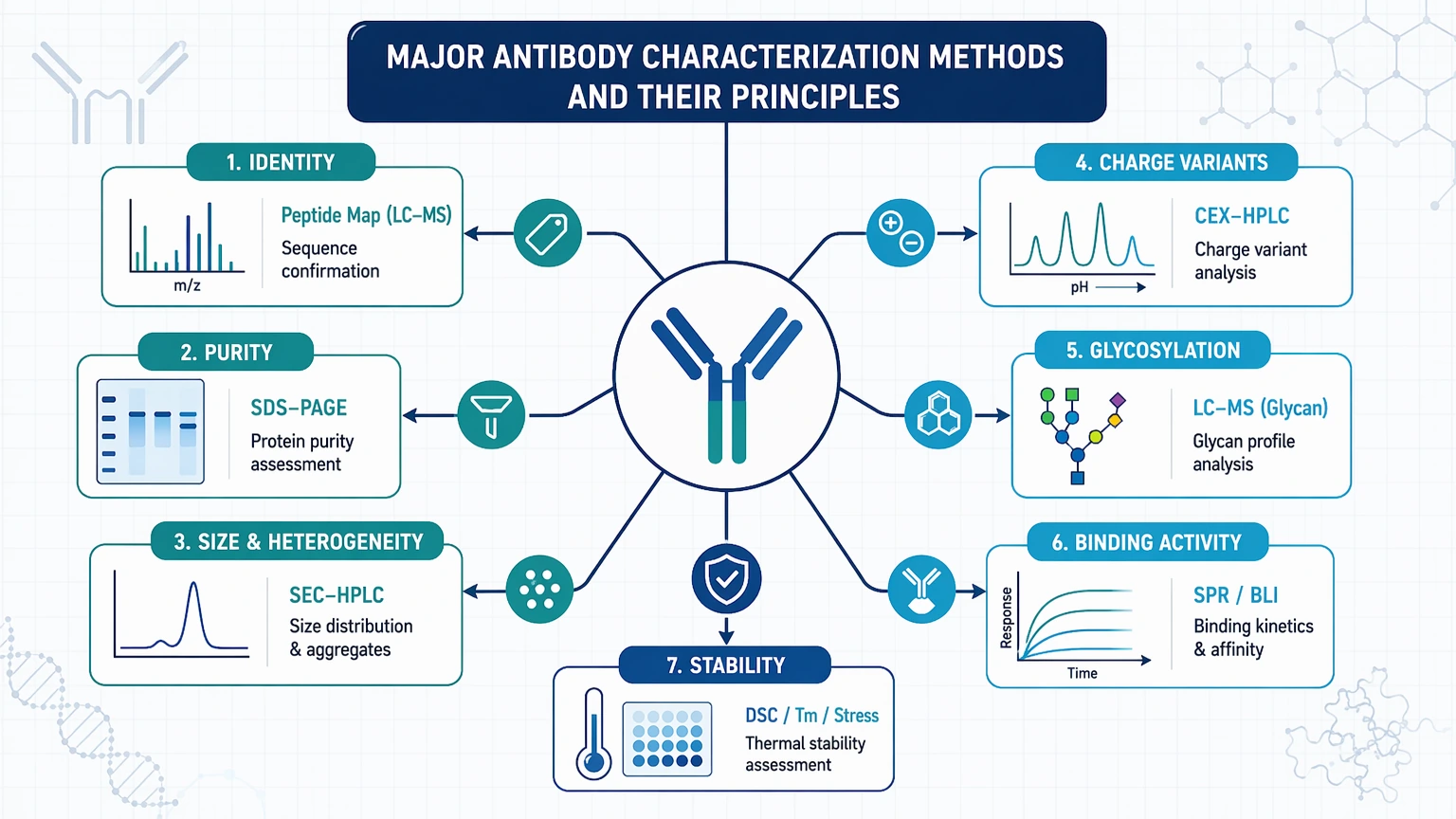
LC-MS, intact mass analysis, and peptide mapping
LC-MS-based methods address identity-focused and modification-focused questions. Intact mass analysis measures the molecular mass of the whole antibody and can quickly reveal gross mismatches, conjugation changes, or unexpected mass shifts. Subunit analysis improves interpretability by simplifying the molecule into heavy and light chains or defined fragments. Peptide mapping goes deeper by digesting the protein and comparing peptide-level features, which supports sequence confirmation, localization of post-translational modifications, and relative abundance assessment for oxidation, deamidation, and other sequence-adjacent changes.
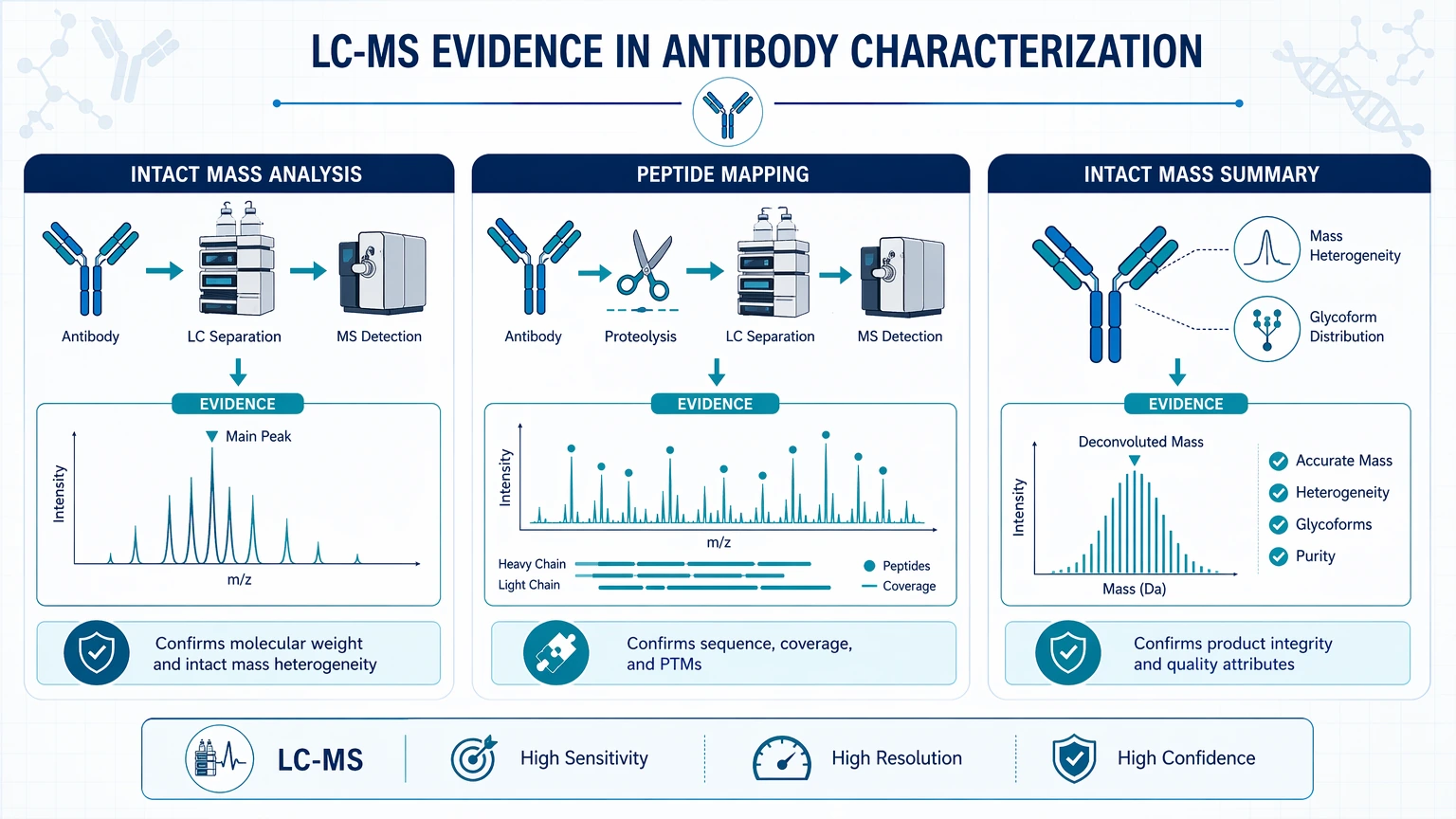
A key limitation is that peptide mapping is information-rich but sensitive to digestion conditions, sample handling, and data interpretation strategy.
SEC, CE-SDS, icIEF/cIEF, HIC, and RP-HPLC
These methods characterize physicochemical heterogeneity from different analytical angles.
- SEC separates by hydrodynamic size and is commonly used to assess aggregation and size variants.
- CE-SDS resolves intact and fragmented species under denaturing conditions and is useful for fragmentation or clipping profiles.
- icIEF/cIEF profiles charge variants and provides a pI-related distribution.
- HIC can distinguish hydrophobic differences that may matter in some conjugates or developability studies.
- RP-HPLC is more denaturing and can support selected purity or variant assessments.
The main limitation is interpretive scope. A separation shift describes changed behavior in that method, but not always the root cause. For example, a charge shift observed by icIEF may still require LC-MS follow-up for molecular assignment.
SPR, BLI, and ELISA
These methods support antibody binding characterization.
- SPR provides real-time interaction data and can quantify association, dissociation, and binding affinity.
- BLI addresses similar questions and is often used for comparative ranking or assay-flexible kinetic studies.
- ELISA is useful for screening and relative binding assessment when full kinetic analysis is not required.
A key limitation is assay context. Immobilization format, antigen presentation, avidity effects, and buffer composition can change the observed result. Binding data should therefore be interpreted in the context of assay design rather than as a format-independent property.
DSC, DSF, and DLS
These are biophysical methods used to examine stability-related behavior.
- DSC measures heat capacity changes and can resolve thermal unfolding events.
- DSF tracks thermal transitions with fluorescent readouts and is often used for comparative screening.
- DLS measures solution size distribution and can flag aggregation trends or colloidal instability.
These methods are useful, but each has limits. A favorable thermal stability signal does not automatically predict low aggregation across formulations, and a single DLS profile does not explain the chemical basis of instability.
HDX-MS and structural methods
HDX-MS measures hydrogen-deuterium exchange behavior and is useful for mapping solvent accessibility changes, conformational shifts, and antibody-antigen interaction regions. It can support epitope mapping and higher-order structure comparison when peptide-level dynamics matter. Structural methods such as cryo-EM may be considered when complex architecture, binding orientation, or conformational state must be visualized more directly.
These methods are specialized and are usually most informative when paired with binding data and MS-based identity data.
Service Routes for Study Planning
For teams moving from method selection into execution, these service paths connect assay design, validation, and interpretation needs.
Applications of Antibody Characterization Methods Across the Workflow
In discovery, characterization is often used to remove weak candidates and compare clones. Teams may begin with intact mass analysis, peptide mapping, SEC, and a binding assay to confirm that each candidate matches expectations and behaves consistently.
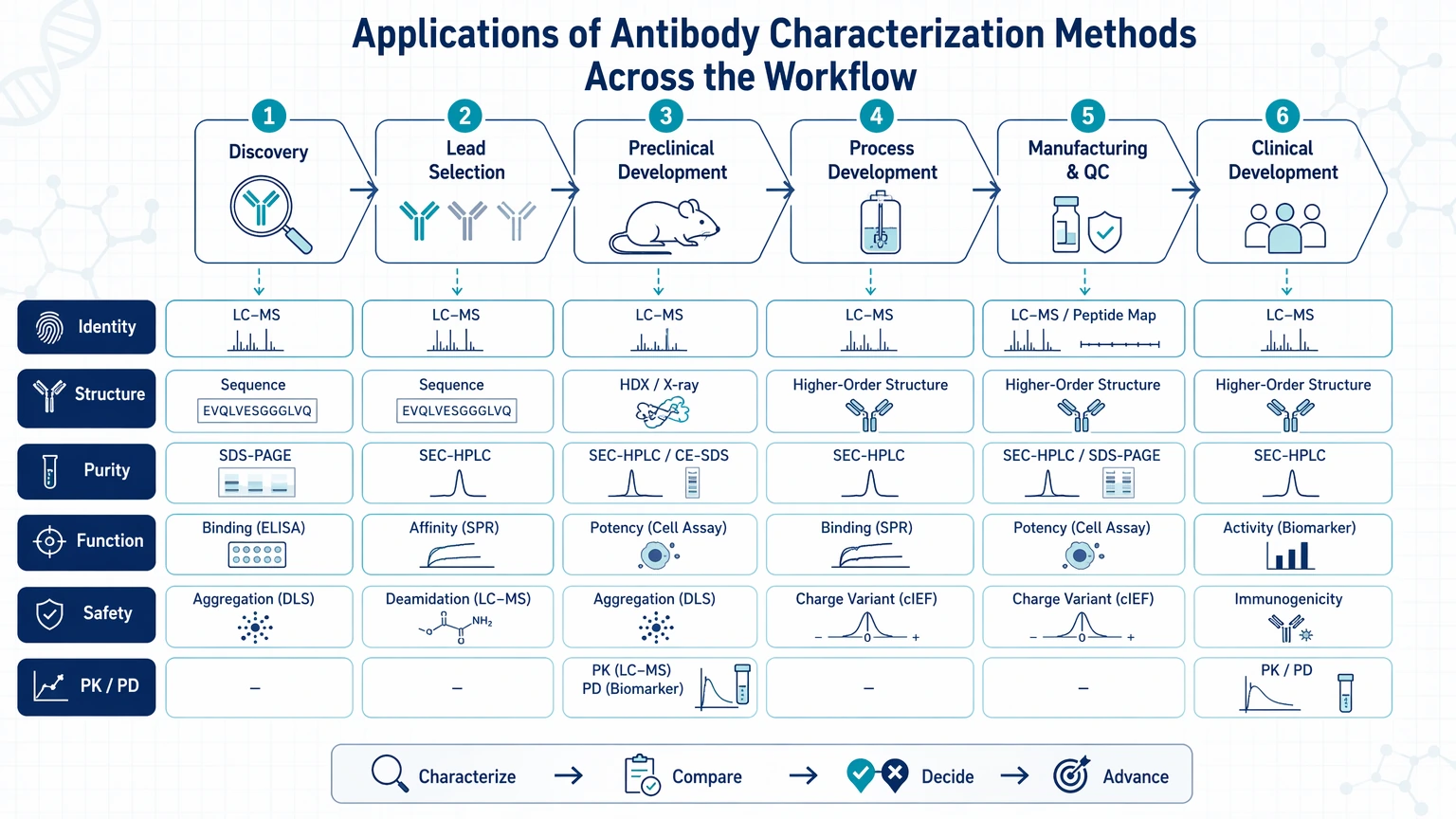
For lead selection, the emphasis broadens. Candidate ranking may include antigen binding kinetics by SPR or BLI, orthogonal aggregation assessment, charge variant profiling, and early developability indicators such as thermal stability or colloidal stability. At this stage, the goal is not to assemble a full CMC package. The goal is to avoid advancing candidates with obvious liabilities or poorly understood behavior.
In analytical development and comparability studies, the workflow becomes more attribute-specific. Glycosylation, post-translational modifications, clipping, fragmentation, and lot-to-lot differences may all need closer examination. Orthogonal methods matter more at this stage because similar signals can reflect different molecular causes.
Some project types require deeper characterization. Membrane protein antibody programs may face antigen presentation challenges that complicate binding interpretation. ADC-related studies may require intact mass analysis, drug-to-antibody ratio assessment, and heterogeneity analysis beyond a standard monoclonal antibody panel. Antibody-antigen complex projects may need HDX-MS or structural characterization to explain why two candidates with similar KD values behave differently in downstream assays.
How to Choose the Right Characterization Method
A practical method-selection framework starts with the decision that the data must support.
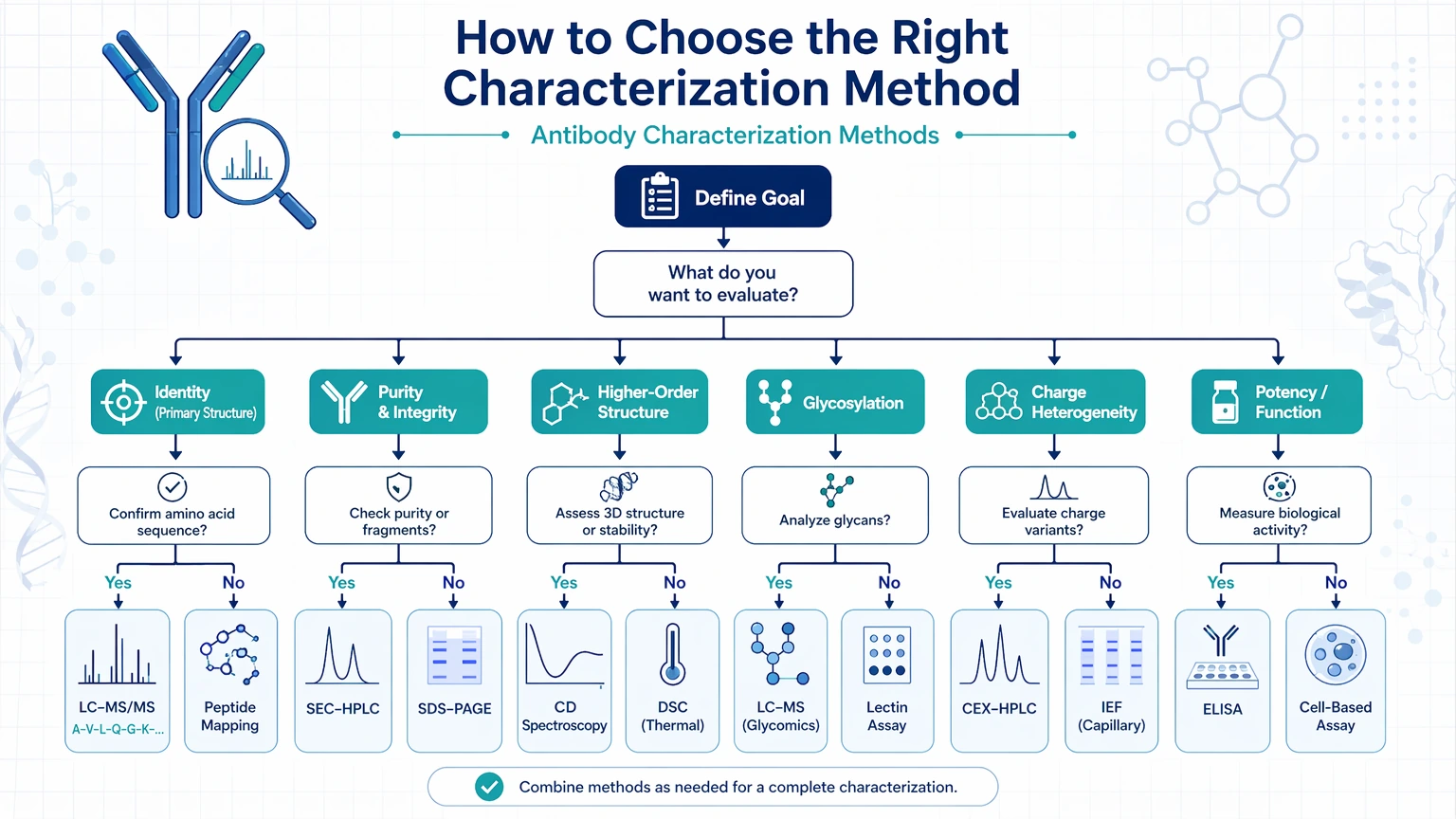
- Define the decision, not just the assay request.
“Check purity” is vague. “Determine whether aggregation differs across clones enough to affect candidate ranking” is actionable.
- Match the method to the attribute class.
Use LC-MS for identity, sequence confirmation, PTM analysis, and glycosylation detail. Use SEC and CE-SDS for aggregation and fragmentation. Use icIEF or cIEF for charge variants. Use SPR or BLI for antigen binding kinetics. Use HDX-MS for conformational and interface questions.
- Match the readout to the project stage.
Discovery-stage decisions often need comparative ranking. Later-stage decisions need stronger attribute assignment and more orthogonal confirmation.
- Check sample state and sample amount early.
Intact, reduced, and digested analyses answer different questions. Matrix complexity, concentration, buffer composition, and sample purity can determine what is interpretable.
- Use orthogonal methods when the risk of misinterpretation is high.
A shift in binding does not show whether the cause is oxidation, aggregation, glycosylation change, or conformational disruption. In many cases, a combined analytical workflow is more efficient than repeating one inconclusive assay.
When a team is still deciding between a screening panel and a decision-grade workflow, service planning should follow the same logic. The Antibody Drug Discovery Service is the most natural starting point for discovery-stage candidate comparison, with additional support from the Membrane Protein Antibody Discovery Service for difficult targets and the Antibody Drug Discovery Services pathway for broader project scoping. If your team is selecting an antibody workflow or assay path, you can submit your requirements to MtoZ Biolabs to evaluate your project before committing to a larger test panel.
Common Method Considerations and Pitfalls
One common mistake is overinterpreting a single metric. A higher Tm does not prove better developability. A clean SEC monomer peak does not rule out charge heterogeneity or subtle conformational change. A strong ELISA signal does not substitute for kinetic binding affinity measurements.
Another issue is mismatch between sample preparation and analytical objective. Reduced analysis may simplify interpretation for chain-level mass shifts, but it can hide information about intact species. Digestion improves localization of post-translational modifications, but poor peptide recovery can distort sequence coverage. Charge variant profiles may also shift with handling conditions, so preanalytical control matters.
Teams also often blur the line between a developability flag and a confirmed liability. DLS, DSF, and related screens are useful for triage, but they should be treated as indicators that guide follow-up rather than final verdicts on candidate suitability.
A further pitfall is forcing all questions into one platform. For example, binding affinity data and higher-order structure data are complementary, not interchangeable. SPR or BLI may show that binding changed, while HDX-MS may help explain where the interaction surface or conformation changed. Likewise, a charge variant profile may suggest heterogeneity, but peptide mapping or intact mass analysis is often needed to identify the source.
When to Use External Antibody Characterization Services
External antibody characterization support becomes useful when the project question is narrow but the underlying analysis is technically complex. Examples include unexplained charge variants, uncertain glycosylation shifts, difficult antigen presentation, epitope mapping needs, or a requirement for combined MS, binding, and higher-order structure interpretation.
A practical way to group service support is by the decision it informs:
- Discovery and candidate advancement: Antibody Drug Discovery Service, Membrane Protein Antibody Discovery Service, and Antibody Drug Discovery Services fit teams comparing candidates, troubleshooting hard targets, or linking binder generation to downstream characterization.
- Developability-focused review: Antibody Drug Developability/Druglikeness Assessment Service fits projects that need to interpret thermal stability, colloidal stability, aggregation tendency, and early liability signals in a candidate-ranking context.
- Interaction and structural follow-up: Antibody-Antigen Interactions Characterization Service | HDX-MS is relevant when KD values alone are not enough and the project needs epitope mapping or interface-level interpretation.
Before requesting a feasibility review, prepare the molecule format, species and isotype information, target type, sample buffer, concentration range, known stress history, and the specific decision the data must support. A precise project question is more useful than a long assay wish list.
FAQ
How is antibody characterization different from functional testing?
Antibody characterization focuses on molecular and biophysical attributes such as identity, heterogeneity, glycosylation, size variants, charge variants, higher-order structure, and binding behavior. Functional testing asks whether the antibody produces a biological effect in a defined system, such as neutralization, receptor blockade, or signaling modulation. A candidate can look analytically clean and still perform weakly in a cell-based assay, or show biological activity while carrying developability concerns.
Which methods are most useful for antibody identity and sequence confirmation?
Common starting points include intact mass analysis, subunit-level LC-MS, and peptide mapping. Intact mass analysis checks whether the whole molecule shows the expected mass behavior. Peptide mapping supports sequence confirmation and localization of post-translational modifications. If the concern is true sequence uncertainty rather than routine confirmation, additional sequencing-oriented approaches may be needed.
How do teams assess aggregation, fragmentation, and charge heterogeneity together?
They usually combine orthogonal methods instead of stretching one assay beyond its strength. SEC is commonly used for aggregation and size variants. CE-SDS helps examine fragmentation and clipping under denaturing conditions. icIEF or cIEF profiles charge variants. LC-MS may then be used to investigate the molecular causes behind the observed distributions.
When should a team choose SPR instead of BLI?
SPR is often chosen when higher-resolution kinetic analysis is needed and the assay design supports stable immobilization and interaction control. BLI is often useful for comparative kinetic ranking, flexible assay setup, or higher sample throughput. The better choice depends on the interaction model, sample availability, and how much mechanistic detail the decision requires.
Is HDX-MS necessary for every antibody-antigen project?
No. HDX-MS is most helpful when the project needs conformational interpretation, epitope mapping, or comparison of interaction surfaces that cannot be resolved by binding affinity data alone. For routine binding confirmation, ELISA, SPR, or BLI may be sufficient. HDX-MS becomes more useful when two antibodies show similar kinetics but appear to recognize different regions or induce different structural effects.
Can one developability assay predict downstream formulation success?
No single assay can do that. Thermal stability, colloidal stability, aggregation tendency, hydrophobic behavior, and chemical modification risk each describe different aspects of developability. Screening assays help narrow the field, but downstream behavior is usually understood more accurately through combined datasets and targeted follow-up studies.
Conclusion
The right antibody characterization strategy starts with the decision that must be made: confirm identity, resolve antibody heterogeneity, measure antigen binding, investigate higher-order structure, or screen for developability risk. Once that question is clear, method selection becomes more disciplined. LC-MS and peptide mapping answer different questions from SEC, CE-SDS, icIEF, SPR, BLI, DLS, or HDX-MS, and the strongest workflows often combine these methods instead of forcing one assay to do everything.
The main service path is most natural when it follows the project stage. Discovery and early candidate comparison align first with the Antibody Drug Discovery Service, while more targeted follow-up may extend to the developability and interaction-focused supporting services listed below. If your group is narrowing assay options, planning orthogonal methods, or deciding whether specialized follow-up is warranted, contact MtoZ Biolabs to evaluate your project and request a feasibility review built around the actual sample question.
How to order?




