






Alloantibodies vs Autoantibodies: Method Selection and Research Use Cases
Quick Answer: Which Workflow Should You Choose?
For alloantibodies, the most efficient research workflow usually starts with targeted antibody screening against a defined or limited set of non-self antigens, followed by antigen panel review and a confirmatory assay if you need to separate true specificity from overlapping or cross-reactive signals. For autoantibodies, the starting point is often different: when the relevant self-antigen space is broad or uncertain, exploratory profiling or a multiplex assay is often more informative first, with targeted detection and orthogonal validation used afterward to confirm priority findings.
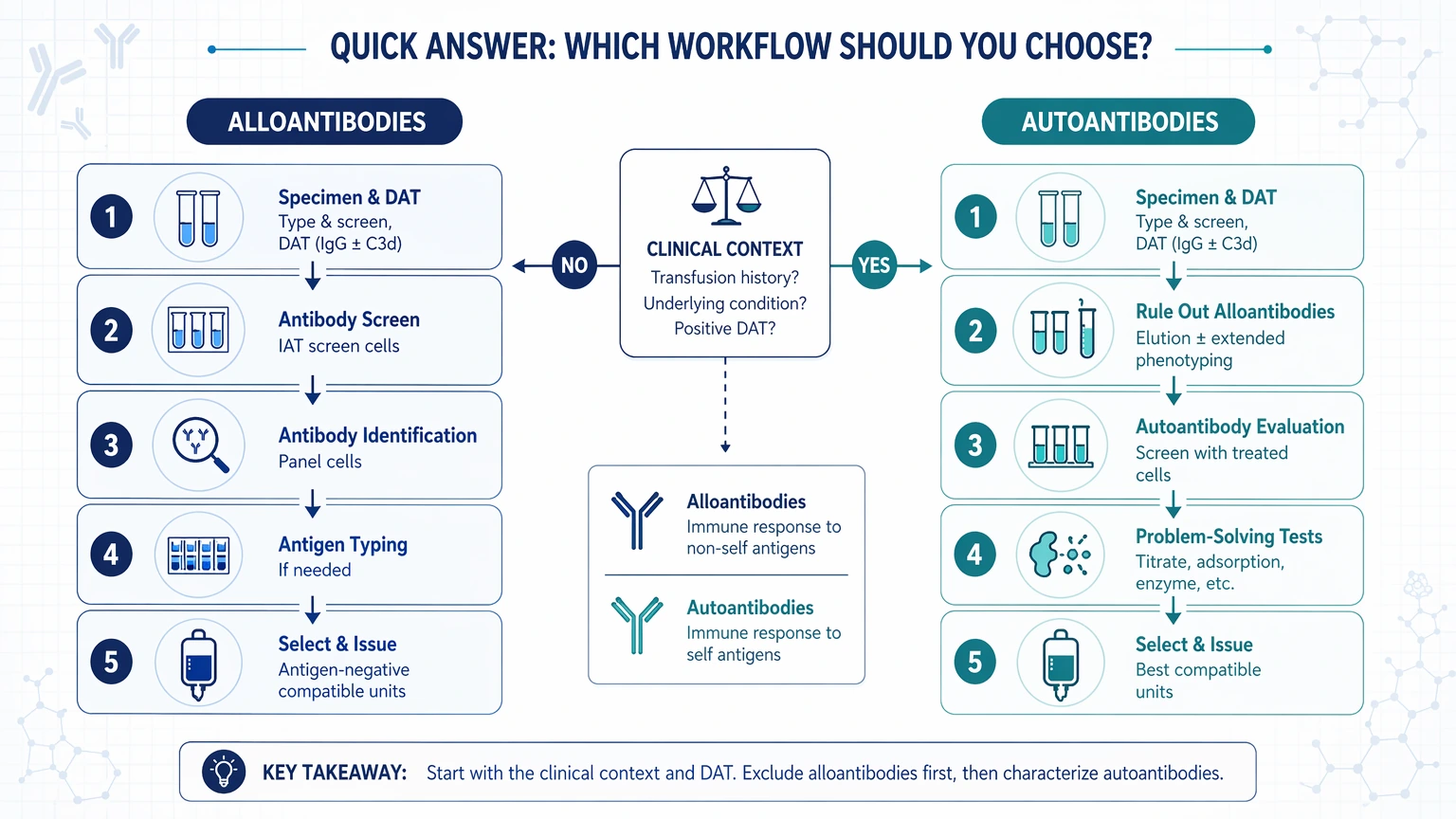
In practice, the choice is driven by four questions: how well the antigen space is defined, how much background reactivity you expect in the serum or plasma matrix, what output the study needs, and whether screening results must be converted into confirmed antigen specificity.
What Is the Difference Between Alloantibodies and Autoantibodies?
An alloantibody is an antibody that recognizes a non-self antigen from another individual of the same species. In research settings, alloantibodies are commonly studied in donor-recipient incompatibility models, transfusion-related antigen recognition, transplantation research, or controlled immunization and exposure studies.
An autoantibody is an antibody that recognizes a self-antigen. In research, autoantibodies are often examined in autoimmune and inflammatory models, mechanistic studies of immune tolerance, or biobanked cohort work focused on self-reactive binding patterns.
That biological distinction creates two different analytical problems:
- Alloantibody research often asks whether a sample reacts against a known or restricted antigen set and which specificity best explains the pattern.
- Autoantibody research often asks whether a broader self-reactive pattern exists, which candidate targets are involved, and which signals remain convincing after confirmation.
For method planning, “antibody-positive” is too broad to be useful. The same positive binding signal can represent narrow antigen-specific reactivity, broad low-level self-reactivity, matrix interference, or cross-reactive binding that requires follow-up.
Alloantibodies vs Autoantibodies: Analytical Comparison Table
The table below summarizes the main planning implications for the method choice.
| Comparison axis | Alloantibodies | Autoantibodies |
|---|---|---|
| Antigen relationship | React against a non-self antigen | React against a self-antigen |
| Typical research context | Donor-recipient mismatch studies, transfusion or transplantation research, exposure-related immune response | Autoimmune mechanism studies, inflammatory biology, cohort-based self-reactivity research |
| Antigen definition level | Often partially known or constrained by prior context | Often broader, less certain, or biologically heterogeneous |
| Main early-stage objective | Antibody screening for presence and antigen-linked reactivity | Exploratory profiling or broad reactivity mapping |
| Common starting formats | Antigen panel, cell-based reactivity assay, targeted immunoassay | Multiplex assay, array-based profiling, or targeted immunoassay when candidate antigens are already defined |
| Main specificity challenge | Distinguishing true specificity from related-antigen cross-reactivity | Separating meaningful self-reactive binding from background or diffuse low-level signal |
| Sample matrix concerns | Mixed titers, prior exposure history, serum or plasma background effects | Polyreactivity, low-abundance signal, heterogeneous background in the serum or plasma matrix |
| Confirmation strategy | Focused confirmatory assay against suspected antigen set | Candidate narrowing followed by confirmatory testing and orthogonal validation |
| Reporting priority | Specificity pattern, antigen-level separation, reactivity map | Candidate target list, comparative binding pattern, follow-up validation plan |
| Typical workflow style | Targeted first, then confirmatory | Discovery first, then targeted confirmation |
Use these differences to align the analytical method with the biological question and validation plan.
Why This Difference Affects Method Selection
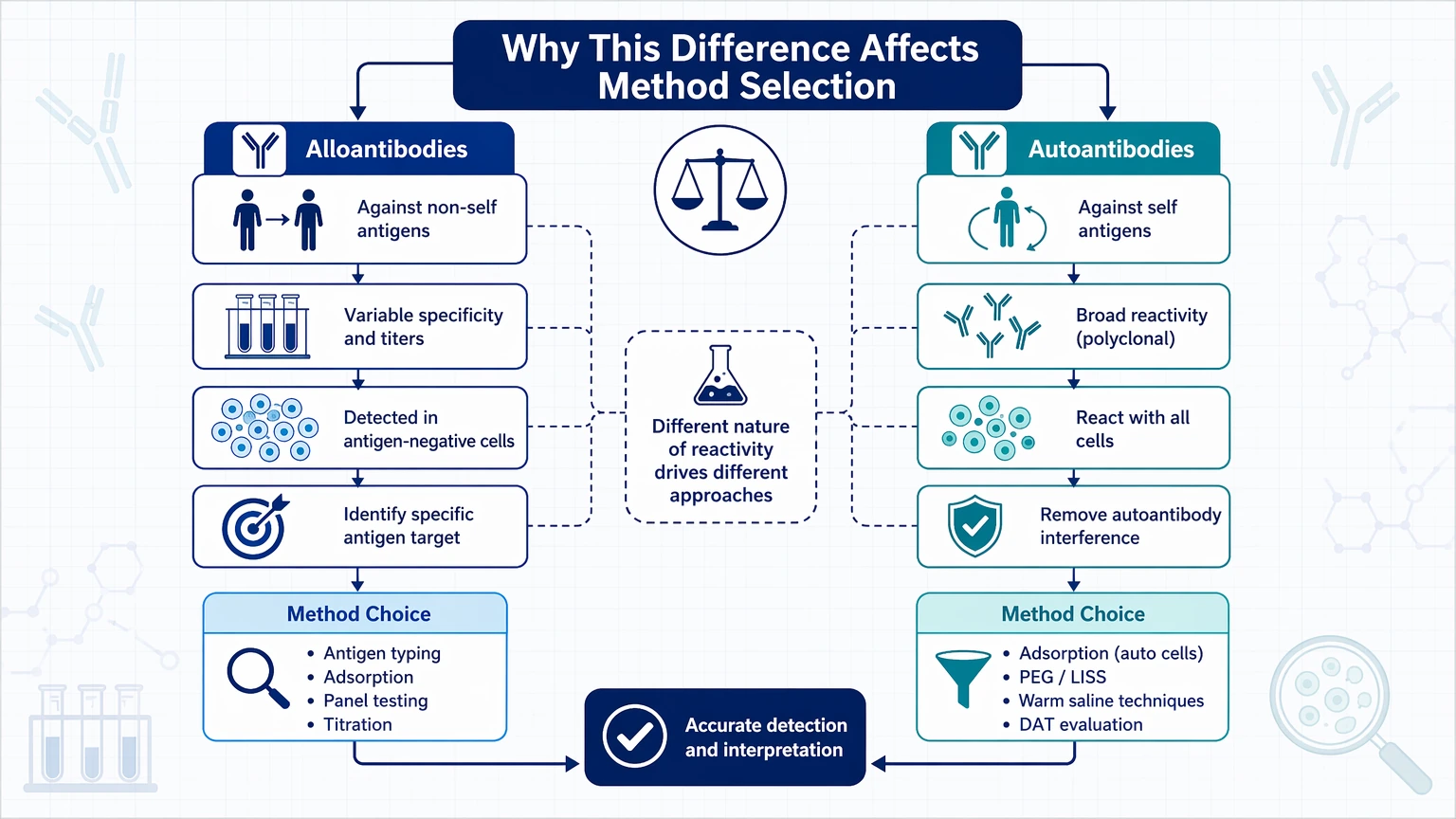
Known antigen panels vs discovery-oriented profiling
The biggest workflow difference is target-space certainty.
In many alloantibody projects, the relevant antigen universe is at least partly constrained before testing starts. Even when the exact alloantibody is unknown, the study may already focus on a donor-recipient context, a limited antigen family, or a preselected panel. That makes a targeted antigen panel an efficient first step.
Autoantibody projects often begin in a less defined space. A phenotype, cohort, or model may suggest self-reactivity, but the actual target list may still be unclear. In that setting, a narrow targeted assay can miss the most informative signals. A multiplex assay or array-based discovery approach often works better early because it helps define which self-antigens deserve focused follow-up.
Screening vs specificity confirmation
A screening result is not the same as a specificity call.
Screening tells you whether a sample generates a measurable binding signal against a substrate, panel, or candidate target set. It does not automatically tell you whether the signal is reproducible, narrowly specific, cross-reactive, matrix-driven, or strong enough to justify downstream work.
That distinction matters in both categories:
- In alloantibody studies, related antigens can produce overlapping patterns that look similar in a first-pass screen.
- In autoantibody studies, weak multi-target reactivity may reflect broad self-reactive background rather than a stable candidate-specific signal.
Background reactivity and matrix complexity
Both project types often use serum or plasma, but they do not always behave the same way analytically.
Alloantibody studies may start from a cleaner target hypothesis but still face mixed-antibody backgrounds, variable titer ranges, and sample-history effects. Autoantibody studies more often encounter diffuse low-level binding, polyreactivity, and less predictable baseline signal across controls and cohorts.
That is why platform choice should align with expected matrix behavior, dilution strategy, control design, and reporting format rather than with antibody class alone.
Methods Commonly Used in Alloantibody Research
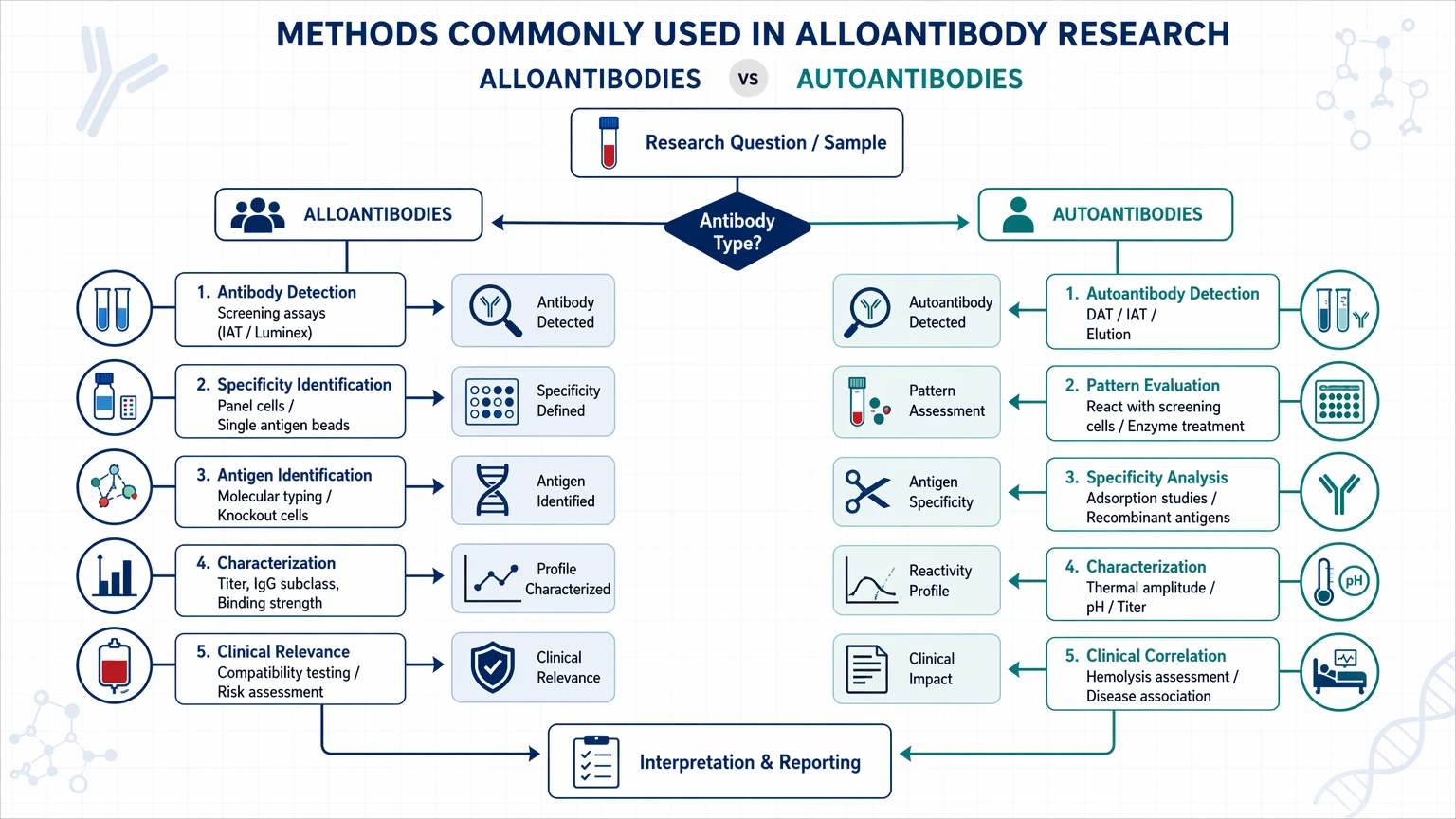
1. Screening assays for defined reactivity questions
When a project asks whether samples react against a known or limited non-self antigen set, targeted antibody screening is usually the clearest starting point. Common research formats include:
- panel-based immunoassays
- cell-based reactivity assays
- targeted binding assays against preselected antigens
These formats are most useful when the study needs a fast read on whether reactivity is present within a constrained antigen space.
2. Antigen panel approaches for specificity assessment
After initial reactivity is detected, the next question is usually antigen specificity. A well-designed antigen panel can help distinguish:
- single-target reactivity
- clustered reactivity across related antigens
- apparent positives shaped by cross-reactivity
- panel-limited negative findings that still justify broader follow-up
Panel design matters as much as assay format. A panel that is too narrow can miss relevant patterns, while a panel that is too broad without the right controls can make interpretation less clear.
3. Confirmatory assays for signal verification
A confirmatory assay becomes important when the initial result will guide target prioritization, sample grouping, or follow-up characterization. Confirmation may include:
- repeat testing in a second assay format
- focused retesting against purified candidate antigens
- comparison under modified assay conditions
- cross-platform review of the same candidate specificity
This step reduces the risk of treating a panel artifact or unstable signal as a true antigen call.
4. Orthogonal characterization when the study needs more than a yes/no answer
Some alloantibody projects need more than presence/absence or first-pass panel assignment. If the goal is to compare patterns across groups, resolve ambiguous cross-reactivity, or support downstream mechanistic studies, orthogonal validation can add a more defensible basis for interpretation.
If your study includes mixed reactivity patterns or uncertain panel coverage, a project review at this stage can save time later. MtoZ Biolabs can evaluate your project by matching target scope, sample volume, and reporting needs to an appropriate screening-plus-confirmation plan.
Methods Commonly Used in Autoantibody Research
1. Exploratory profiling when target scope is unclear
Autoantibody projects often begin with exploratory profiling because the relevant self-antigen repertoire may be broad, partially characterized, or highly model-dependent. Common starting approaches include:
- antigen arrays
- multiplex assay formats
- broad immunoreactivity profiling across candidate self-antigen groups
This approach is useful when the study needs candidate discovery rather than immediate confirmation of a short predefined list.
2. Targeted detection after candidate narrowing
Broad profiling is usually stronger when it is followed by targeted detection for a smaller set of candidate antigens. That second step helps reduce overinterpretation of diffuse discovery signals and makes comparisons across cohorts or experimental groups easier.
Targeted follow-up is especially useful when the project needs to ask:
- Which candidate self-antigens remain reproducibly positive?
- Do the strongest discovery hits persist in a simpler assay format?
- Does the same pattern appear across replicates or related sample groups?
3. Managing cross-reactivity and low-level binding
Autoantibody work often requires closer control of weak and broad signals. Apparent positives can arise from cross-reactivity, matrix noise, or low-intensity binding with unclear biological relevance. For that reason, workflow design should define:
- control sample strategy
- thresholding logic
- replicate structure
- antigen source consistency
- raw versus normalized signal reporting
A positive result in an autoantibody screen identifies a candidate reactivity pattern. It does not, by itself, establish functional relevance or causal importance.
4. Orthogonal validation for credible candidate selection
The strongest autoantibody workflows do not stop at the discovery platform. They use orthogonal validation to test the highest-priority candidates in a different assay context. That helps determine whether an observed signal is:
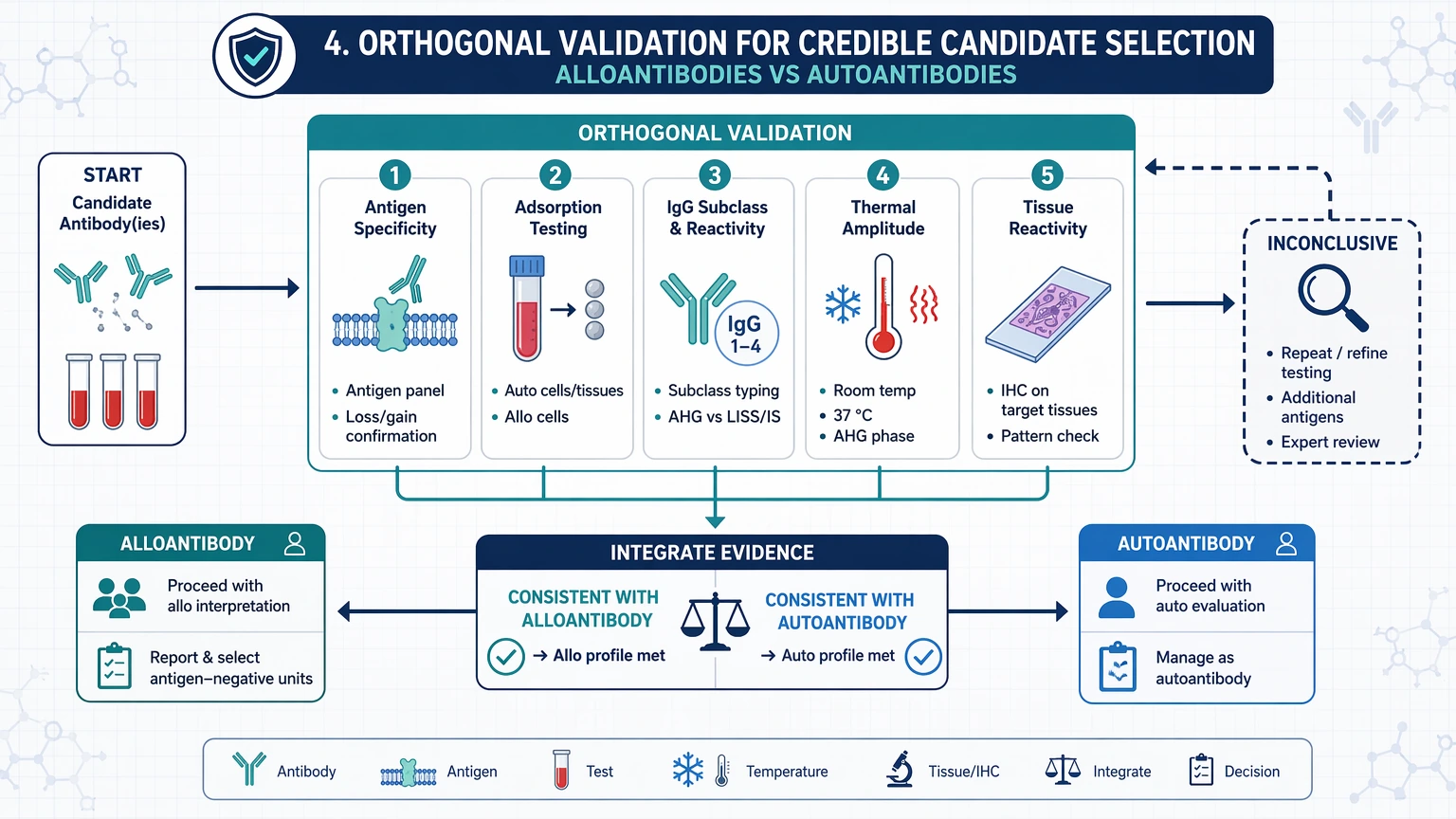
- antigen-specific rather than broadly sticky
- reproducible across platforms
- strong enough for downstream characterization
- suitable for expansion into a larger sample set
Can the Same Method Be Used for Both?
Sometimes, but rarely as the full workflow.
A shared platform can work when both projects ask a narrow question against a known antigen list. For example, a targeted immunoassay may support either alloantibody or autoantibody testing when the antigen set is already defined and the required output is straightforward.
The workflows usually diverge when any of the following is true:
- the autoantibody project starts with an unknown self-antigen repertoire
- the alloantibody project needs fine specificity mapping across related non-self antigens
- matrix background differs enough to change assay tolerance
- one project needs broad discovery while the other needs antigen-level confirmation
A common planning error is choosing one platform for both studies just because the sample type is similar. Similar serum handling does not mean the same assay will answer the same biological question.
How to Choose the Right Platform for Your Research Question
Start with the output you actually need
Before choosing a method, define the output in operational terms:
- presence/absence screening
- comparative binding signal pattern
- antigen-level specificity map
- candidate discovery list
- orthogonally confirmed target set
When the required output is vague, the assay plan often becomes too broad and the report becomes harder to use.
Match platform type to antigen certainty
A simple decision framework is often enough to narrow the options:
- Known target or short candidate list → targeted detection or focused antigen panel
- Known antigen family but uncertain specificity → broader panel plus confirmatory assay
- Unknown or heterogeneous self-antigen space → exploratory profiling first, then targeted confirmation
- Ambiguous primary signal → orthogonal validation before expanding the sample set
Check practical constraints early
Method fit also depends on routine project details that materially affect readout quality:
- available sample volume
- compatibility with the serum or plasma matrix
- expected titer range or low-abundance detection needs
- multiplexing requirements
- cohort size and throughput expectations
- control availability
- reporting depth needed for the next experimental decision
These factors often matter more than whether a platform appears broadly applicable on paper.
A short decision checklist
Before outsourcing or launching an internal workflow, make sure you can answer the following:
1. Is the study centered on a non-self antigen or a self-antigen question? 2. Is the target space known, limited, or unknown? 3. Do you need antibody screening, precise antigen specificity, or both? 4. Is the first platform intended for discovery, triage, or confirmation? 5. How much background signal do you expect in the sample matrix? 6. Will positive findings require a second method for orthogonal validation? 7. What reporting format will support the next step of the project?
When to Use a Specialized Analytical Service
A specialized analytical service becomes more useful when the project has uncertain antigen scope, mixed reactivity patterns, or a need to connect broad screening with disciplined confirmation.
Before contacting a provider, prepare:
- sample type and available volume
- whether samples are serum, plasma, or another matrix
- target certainty level: known, limited panel, or unknown repertoire
- project stage: pilot exploration, specificity follow-up, or cohort expansion
- desired output: raw signal, normalized comparison, candidate list, or confirmatory interpretation
- whether candidate antigens, controls, or prior screening data already exist
It is also worth asking practical workflow questions:
- Which platform is used for screening and which for confirmation?
- Can exploratory profiling and confirmatory work be separated clearly in the report?
- How are background binding and cross-reactive signals annotated?
- What controls or replicate strategies are expected from the client side?
- Is the workflow better aligned with targeted detection or with broad antigen discovery?
For teams comparing service options for alloantibody or autoantibody characterization, MtoZ Biolabs can review your target scope, sample constraints, and reporting goals. To discuss assay fit before launch, submit your requirements and request a workflow evaluation.
FAQ
Why is alloantibody work often more panel-driven than autoantibody work?
Alloantibody studies often begin with a more bounded antigen space. Even if the exact target is not yet known, the relevant non-self antigen set is frequently constrained by donor-recipient context, prior exposure, or panel design. Autoantibody studies more often start with a broader and less certain self-antigen repertoire, so discovery-oriented profiling is a more common first step.
When is a multiplex assay a better choice than a focused antigen panel?
A multiplex assay is usually the better starting point when you need to survey many candidate targets at once, especially in autoantibody projects with uncertain antigen scope. A focused antigen panel is more appropriate when the antigen family is already narrowed and the main task is to separate related reactivity patterns rather than discover new candidates.
Does a positive binding signal confirm biologically meaningful antibody activity?
No. A positive binding signal shows measurable assay reactivity, not proven functional significance. Interpretation can be limited by cross-reactivity, matrix interference, antigen presentation, and platform design. That is why many studies add a confirmatory assay or orthogonal validation before prioritizing a finding.
What project-planning mistakes cause the most trouble later?
Common problems include inadequate sample volume, weak control design, inconsistent sample handling across cohorts, and choosing a narrowly targeted assay before the antigen repertoire is sufficiently defined. Another frequent issue is asking for a simple positive/negative answer when the real study need is specificity mapping or candidate ranking.
How should researchers choose between exploratory profiling and targeted detection?
Use exploratory profiling when the target space is unknown, broad, or hypothesis-generating. Use targeted detection when a defined antigen list already exists and the goal is cleaner confirmation or easier comparison across samples. If a project begins with discovery, it is helpful to plan the confirmation step before the first screen is run.
Service Routes for Study Planning
For teams moving from method selection into execution, these service paths connect assay design, validation, and interpretation needs.
Conclusion
In the alloantibodies vs autoantibodies comparison, the better workflow is usually the one that matches antigen definition and the type of answer your study needs next. Alloantibody projects often fit targeted screening and panel-based specificity assessment because the non-self antigen space is more constrained. Autoantibody projects more often benefit from discovery-first workflows because self-antigen reactivity may be broader, weaker, or harder to interpret from a single focused assay.
Neither category is well served by treating every positive screen as a final answer. If your study needs credible specificity assignment, the workflow should separate screening, confirmation, and interpretation from the start. To compare platform options for your antibody characterization study, contact us at the project team with your sample type, target scope, and reporting goals for a workflow discussion.
How to order?




