






Affinity Selection-Mass Spectrometry for the Discovery of Pharmacologically Active Natural Products
Introduction
Natural product discovery often begins with complex mixtures rather than pure compounds. A plant extract may contain hundreds of metabolites. A microbial fraction may show bioactivity without a clear active constituent. A pharmacology team may know the target protein but lack an efficient way to pull binders from a crude library. Bioassay-guided fractionation can work, yet it is slow when activity is dilute or distributed across many components.
Affinity selection-mass spectrometry, or AS-MS, offers a target-directed path into these mixtures. The method incubates a protein target with a natural product library or extract, separates target-bound ligands from unbound compounds, and identifies the retained binders by mass spectrometry. This article explains what AS-MS is, how it supports discovery of pharmacologically active natural products, where the technique adds value, and which limitations should be planned into the project design.
What Affinity Selection-Mass Spectrometry Means
Affinity selection-mass spectrometry is a ligand discovery approach that combines protein-based affinity capture with MS identification of bound small molecules.
In a typical AS-MS experiment, a purified protein target is mixed with a compound library, natural product extract, or fractionated mixture under binding-compatible conditions. Ligands that bind the target are retained through a separation step that removes unbound compounds. Bound molecules are then released and analyzed by LC-MS or related MS methods to report candidate binders by accurate mass and, when needed, fragmentation support.
AS-MS is therefore a binder-first strategy. It prioritizes compounds that interact with a defined target rather than ranking every metabolite in an extract by abundance alone. For natural product discovery, that shift is useful when pharmacological relevance depends on target engagement more than on the most intense chromatographic peaks.
Why AS-MS Matters for Natural Product Discovery
Natural product libraries are chemically rich and analytically congested. Many components are low abundance, isomeric, or unstable under harsh isolation conditions. Classical isolation campaigns can consume material before the active species is known. Target-blind metabolomics can catalog compounds without showing which ones engage the protein of interest.
AS-MS matters because it links mixture complexity to a pharmacological question. By selecting ligands that bind a chosen target, the method narrows attention to a smaller set of candidate actives for confirmation, isolation, or structure elucidation. This can shorten the path from extract to target-relevant hit list when the protein target is available in suitable quality and quantity.
AS-MS does not replace bioassays. Binding is not the same as cellular activity, selectivity, or therapeutic effect. Its role is to generate target-engaged natural product candidates that can enter orthogonal pharmacological validation.
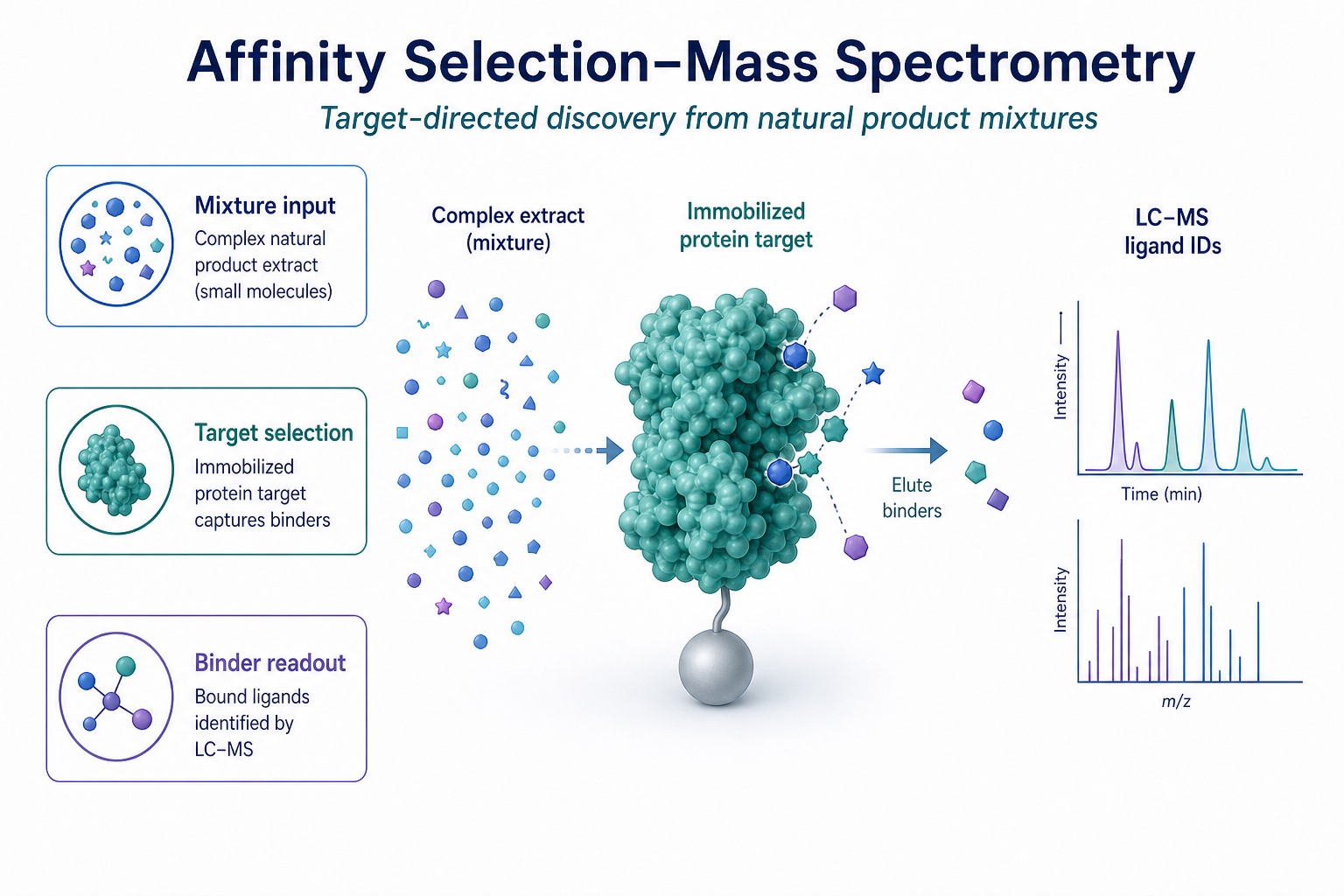
Figure 1. AS-MS uses a protein target to select binders from natural product mixtures, then identifies retained ligands by mass spectrometry.
How AS-MS Works for Natural Product Libraries
An AS-MS natural product project follows a defined analytical sequence.
Target preparation and assay conditions
The protein target must be purified, stable, and compatible with the binding buffer. Concentration, cofactors, pH, and detergent conditions should support ligand binding without blocking MS readout after release.
Incubation with extracts or libraries
Natural product extracts, fractions, or curated compound mixtures are incubated with the target to allow binder association. Mixture complexity, solvent carryover, and compound solubility all influence recovery.
Separation of bound from unbound compounds
Unbound molecules are removed by size-based separation, ultrafiltration, affinity capture of the protein, or related formats depending on method design. The separation step defines how completely free compounds are cleared before MS analysis.
Ligand release and MS detection
Bound ligands are dissociated from the target and analyzed by LC-MS. Accurate mass, retention time, and optional MS/MS spectra support putative compound assignment against libraries or follow-up isolation.
Control comparison and candidate ranking
No-protein controls, scrambled or inactive protein controls, and replicate incubations help distinguish specific binders from sticky compounds or incomplete wash artifacts. Candidates are then prioritized for confirmation.
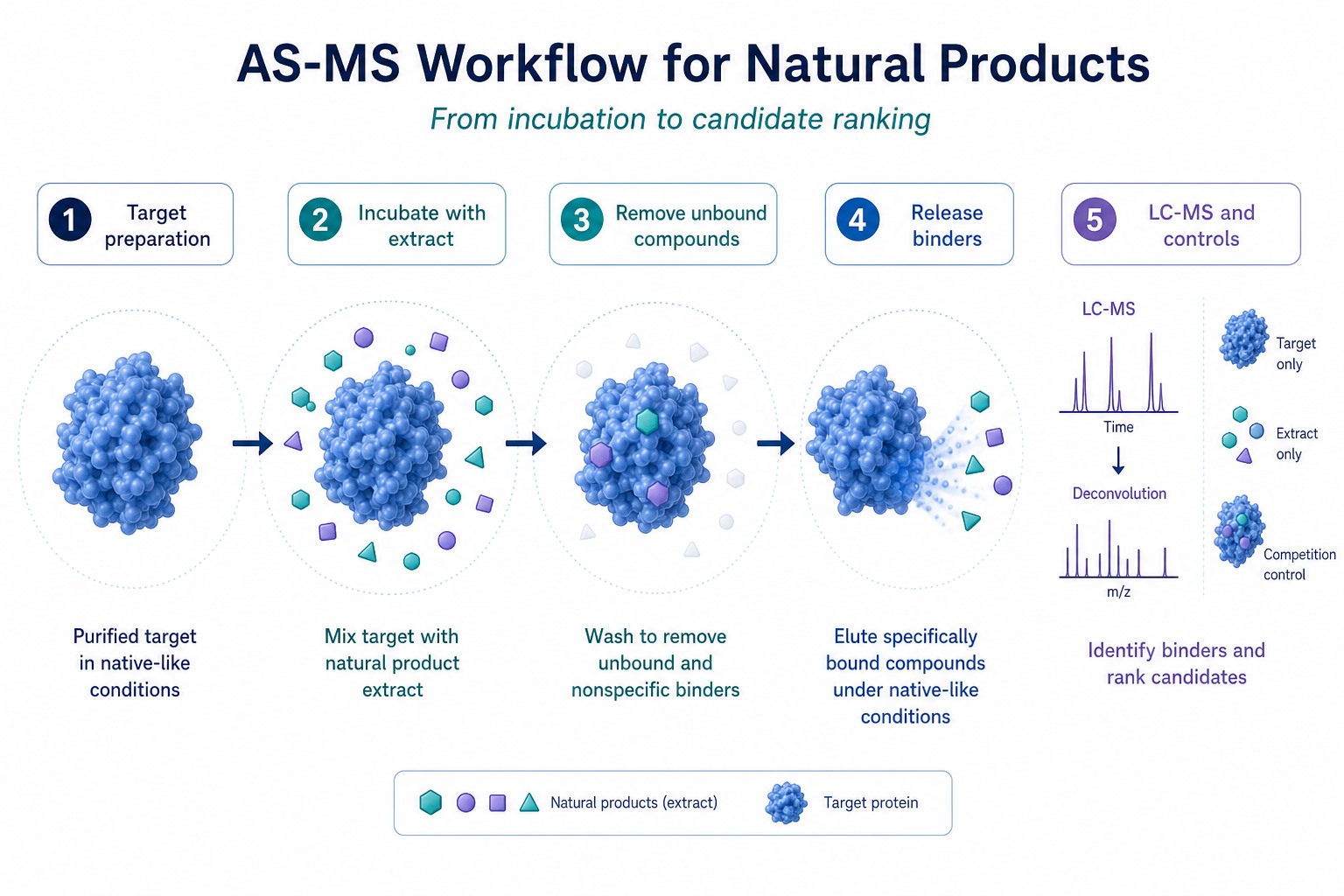
Figure 2. An AS-MS workflow moves from target-ligand incubation and unbound removal to ligand release, LC-MS detection, and control-based candidate ranking.
Technical Advantages of AS-MS in Natural Product Programs
The technical value of AS-MS for pharmacologically oriented natural product discovery comes from target-directed selection inside complex mixtures.
AS-MS can recover binders from extracts without requiring full isolation of every component before screening.
AS-MS reports ligand candidates by mass spectrometry, which supports rapid shortlisting when spectral libraries or follow-up isolation routes are available.
AS-MS focuses discovery effort on target-engaged compounds rather than on the highest-abundance metabolites alone.
AS-MS can be applied to fraction libraries, crude extracts, or defined natural product collections when the target protein is assay-ready.
AS-MS provides a practical bridge between mixture screening and downstream structure confirmation or bioassay validation.
These advantages are technical capabilities. They do not mean every recovered binder is a pharmacologically validated active.
Current Limitations of AS-MS
AS-MS has clear boundaries that affect natural product projects.
Weak or fast-off ligands may be lost during separation. Highly hydrophobic compounds can show non-specific binding to plastics, membranes, or protein surfaces. Isomers may share masses and require chromatographic or orthogonal confirmation. Target conformational state, cofactor occupancy, and buffer conditions can change which ligands are recovered. MS detection favors ionizable species and may under-represent poorly ionizing natural products. Binding evidence still requires pharmacological confirmation in functional assays.
Recognizing these limits helps position AS-MS as a target-engagement discovery layer rather than a complete activity proof package.
Related Services
Affinity Selection-Mass Spectrometry Analysis Service
Active Ingredients Identification and Screening Service
Small Molecule Actives Identification and Quantification
Plant Active Ingredient Analysis Services
Protein-Small Molecule Interaction Analysis Service
Teams screening natural product mixtures against defined protein targets can consult MtoZ Biolabs to review target readiness, extract complexity, and an AS-MS plan matched to the current discovery phase.
Typical Applications in Pharmacologically Active Natural Product Discovery
AS-MS is applied when a protein target is known and mixture-based ligand discovery is needed.
Target-directed screening of plant or microbial extracts
AS-MS can prioritize binders from complex extracts before extensive fractionation.
Fraction library triage
Semi-purified natural product fractions can be screened to identify which pools contain target-engaged compounds.
Hit shortlisting for isolation and structure work
AS-MS candidates guide which peaks or fractions deserve isolation, NMR, or deeper structural assignment.
Complementary support for bioassay-guided campaigns
When bioactivity is observed but the active constituent is unclear, AS-MS against a hypothesized target can propose binder candidates for confirmation.
For programs that combine AS-MS shortlisting with active-ingredient confirmation, MtoZ Biolabs can help align binder discovery with follow-up identification and quantification work.
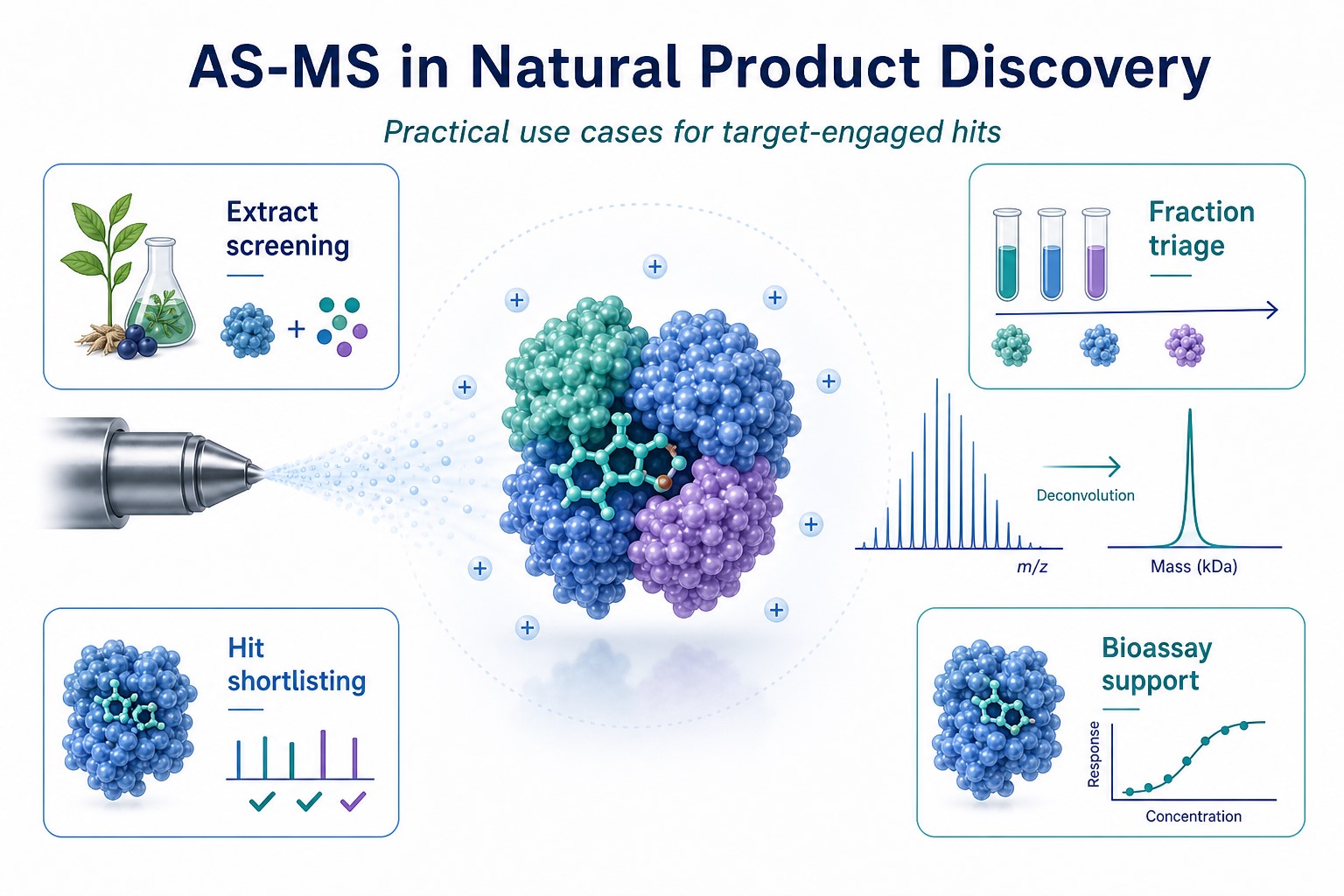
Figure 3. AS-MS is commonly used for extract screening, fraction triage, and target-engaged hit shortlisting in natural product discovery.
Outlook for AS-MS in Natural Product Pharmacology
AS-MS continues to benefit from higher-resolution MS, improved mixture deconvolution, and more robust separation formats for binder recovery. Integration with spectral libraries, bioactivity data, and orthogonal biophysical assays is making candidate triage more decision-ready. At the same time, AS-MS is increasingly used as one layer in multi-method discovery: target-directed binder selection first, then confirmation by bioassay, binding kinetics, or structural methods as needed.
The practical future of AS-MS in natural product work is selective application. When a validated protein target exists and mixture complexity is high, affinity selection-mass spectrometry provides a direct route to pharmacologically relevant binder candidates.
Frequently Asked Questions
1. What is affinity selection-mass spectrometry?
AS-MS is a method that incubates a protein target with a compound mixture, separates bound from unbound ligands, and identifies retained binders by mass spectrometry.
2. How does AS-MS help natural product discovery?
It prioritizes target-engaged compounds inside complex extracts or fractions, reducing reliance on abundance-only metabolomics or fully blind isolation.
3. Does AS-MS prove pharmacological activity?
No. AS-MS reports binding to the selected target under assay conditions. Cellular or functional activity still requires orthogonal assays.
4. What samples are suitable for AS-MS natural product projects?
Common inputs include crude extracts, fraction libraries, and curated natural product collections, provided solvent and matrix conditions are compatible with the protein assay.
5. Why are controls important in AS-MS?
Controls help distinguish specific target binders from compounds that persist through incomplete washing or non-specific surface binding.
6. What usually follows an AS-MS hit list?
Follow-up often includes confirmation of identity, isolation or synthesis support, and pharmacological validation against the intended biological endpoint.
Conclusion
Affinity selection-mass spectrometry supports discovery of pharmacologically relevant natural product candidates by selecting target-bound ligands from complex mixtures and identifying them by MS. The method is valuable when a protein target is available and extract complexity makes blind isolation inefficient. AS-MS advantages include binder-focused shortlisting and efficient triage of mixture components, while limitations include possible loss of weak ligands, isomer ambiguity, and the need for functional confirmation.
Used with clear controls and orthogonal validation, AS-MS provides a practical discovery bridge from natural product mixtures to target-engaged hit lists. Researchers planning AS-MS for natural product or active-ingredient projects can contact MtoZ Biolabs to review target status, mixture type, and the analytical approach matched to the current discovery phase.
How to order?




