






Protein-Small Molecule Interaction Analysis Service
-
Cell lysates, tissue lysates, or fractionated extracts
-
Purified or partially purified proteins, or protein complexes
-
Bioactive small molecules, metabolites, fragments, tool compounds, and lead candidates
MtoZ Biolabs provides a Protein-Small Molecule Interaction Analysis Service to identify protein targets of bioactive compounds, confirm target engagement in relevant biological matrices, and characterize binding-driven stability changes using complementary chemoproteomic and biophysical workflows. By integrating affinity capture and proteome-wide profiling with stability-based assays, we help drug discovery and chemical biology teams generate confident, decision-ready evidence for mechanism of action, selectivity, and off-target risk.
Overview
Small molecules in biological systems are more than passive metabolic intermediates. Beyond serving as substrates, products, and cofactors, many small molecules act as regulators that fine-tune protein activity by binding to specific sites and shifting protein conformation, stability, or interaction behavior. This regulatory layer underlies diverse signaling and physiological processes, spanning nucleotide-derived messengers, hormone-like metabolites, lipid mediators, and vitamin-related compounds.
Despite their broad biological impact, protein–small molecule interactions have historically been harder to study systematically than other interaction types. Proteins are comparatively well annotated, while endogenous metabolites and bioactive small molecules are far more diverse and context dependent, and their binding can be transient, low abundance, or condition specific. As a result, many biologically meaningful interactions remain under-characterized, creating a clear need for practical workflows that can uncover binding partners and provide validation-ready evidence for how small molecules engage proteins in relevant systems.
Protein-Small Molecule Interaction Analysis Service at MtoZ Biolabs
MtoZ Biolabs delivers a practical, end-to-end solution built around two complementary routes. The first route starts from a small molecule and discovers or validates its protein binders. The second route starts from a protein and evaluates small molecule binding through stability-based readouts.
1. Small Molecule to Protein
These approaches are designed for target identification, engagement confirmation, and selectivity or off-target assessment in complex matrices.
💠Affinity-Based Methods
A small molecule is equipped with an affinity handle or immobilized on a matrix to enrich binding proteins, followed by stringent washing and LC-MS/MS identification, with appropriate controls to reduce nonspecific binders.
💠Drug Affinity Responsive Target Stability (DARTS)
Ligand binding can protect a target protein from proteolysis under limited protease conditions, producing measurable stability changes compared with no-ligand controls.
💠Stability of Proteins from Rates of Oxidation (SPROX)
Ligand binding can shift protein folding stability, which is measured by monitoring oxidation behavior across a denaturant gradient to infer stabilization or destabilization patterns.
💠Chemoproteomic Approaches
Proteome-wide strategies evaluate target engagement and selectivity through probe-enabled labeling, competition experiments, or reactivity-based profiling, followed by LC-MS/MS identification and quantification.
2. Protein to Small Molecule
These approaches are designed for ligand screening, formulation support, and rapid binding evidence using protein stability readouts.
💠Differential Static Light Scattering (DSLS)
DSLS monitors changes in light scattering intensity due to protein aggregation during thermal unfolding, enabling detection of ligand-driven stabilization or destabilization that changes protein aggregation onset.
💠Differential Scanning Fluorimetry (DSF)
DSF measures ligand-induced changes in protein thermal stability through fluorescence-based detection during controlled heating.
Why Choose MtoZ Biolabs
✔️Extensive Experience
Our scientists bring deep, hands-on expertise in interaction study design, control strategy selection, and cross-method interpretation.
✔️High-Quality Data
Rigorous QC, reproducible execution, and control-driven filtering deliver clear, decision-ready results with strong confidence logic.
✔️Customizable Service
Modular workflows and flexible deliverables are tailored to your compound class, sample constraints, and target confidence requirements.
✔️Outstanding Customer Support
Responsive communication and practical recommendations help you move efficiently from discovery to validation and follow-up experiments.
Applications of Protein-Small Molecule Interaction Analysis Service
This service is commonly used in programs where binding evidence and target confidence drive next-step decisions.
1. Drug Discovery and Development
Identify targets, confirm engagement, assess selectivity, and support mechanism of action studies for hit-to-lead and lead optimization.
2. Chemical Biology
Map proteome-level interaction landscapes to connect compounds to pathways and phenotypes.
3. Target Validation and Off-Target Risk
Generate evidence that distinguishes primary targets from background binders and potential liabilities.
4. Protein Science and Screening
Prioritize stabilizing ligands and conditions for purified proteins and downstream structural or functional studies.
5. Translational Research
Link compound exposure to protein engagement signatures in disease-relevant models.
FAQ
Q1: What types of samples are suitable?
We accept various sample types, including:
Q2: How should I prepare my samples?
1. Keep samples consistent: Use the same collection, handling, and storage conditions across all groups and replicates to reduce batch effects.
2. Use MS compatible conditions for proteomics modules: Minimize detergents, polymers, and excessive salts that can interfere with enrichment or LC-MS/MS performance, and document full buffer composition.
3. For purified protein assays: Provide protein concentration, purity estimate, buffer formulation, and stability history.
4. Storage and shipping: Store proteins and lysates at -80°C, and avoid repeated freeze–thaw cycles; ship on dry ice, and label tubes clearly with sample ID, group, and replicate information.
For more information, please refer to Sample Submission Guidelines for Proteomics and Sample Submission Guidelines for Metabolomics.
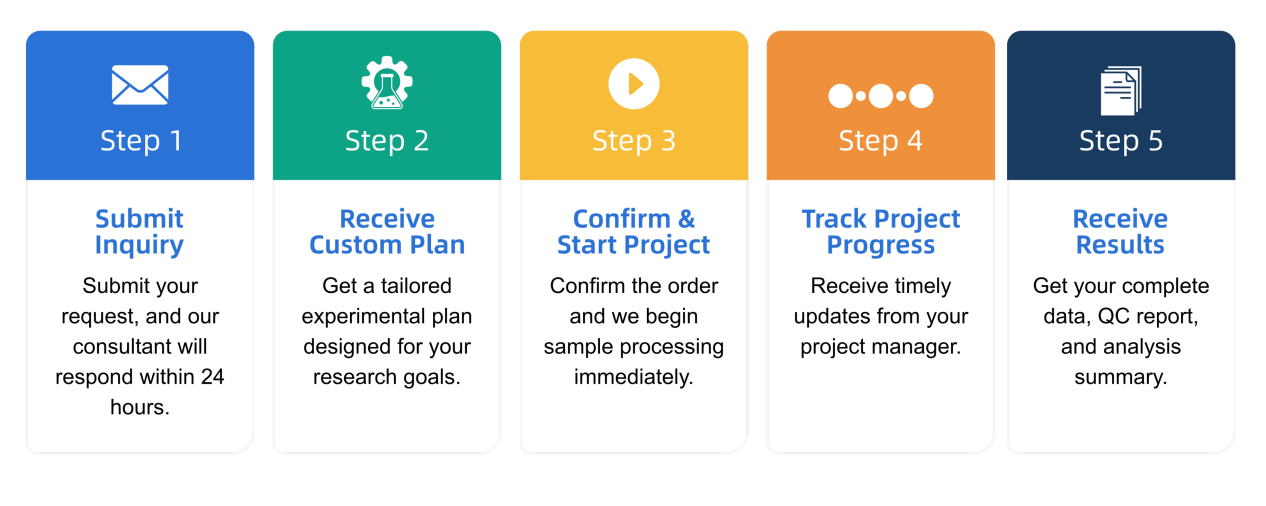
Q3: What is the service general workflow?
Q4: What data formats are provided?
1. Raw Data: Raw instrument files can be provided upon request, depending on the selected workflow.
2. Processed Results: Excel or CSV tables summarizing identified targets and key quantitative comparisons.
3. Reports and Figures: A PDF summary report, plus figures in PNG or TIFF format when included.
Additional formats can be provided upon request to meet specific analysis or publication requirements.
Start Your Project with MtoZ Biolabs
MtoZ Biolabs' Protein-Small Molecule Interaction Analysis Service provides a practical, end-to-end solution for target discovery, engagement confirmation, selectivity profiling, and ligand screening.
Contact us today to discuss your project and request a customized proposal!
Supporting Antibody Products for Protein Interaction Studies
MtoZ Biolabs offers antibody products for IP, Co-IP, IP-MS, and related protein interaction workflows, complementing protein interaction analysis services and supporting target enrichment and downstream mass spectrometry analysis.
IP-MS Validated Antibodies
Explore antibodies evaluated for target enrichment and downstream mass spectrometry applications, with product information available to support antibody selection.
View IP-MS Validated AntibodiesOther Supporting Products
How to order?




