






Acetylated Peptide Analysis Service
-
Uses anti-acetyl-lysine antibodies to selectively capture acetylated peptides and significantly reduce sample complexity
-
Integrates LC-MS/MS for high-resolution fragment detection to achieve site-specific identification and quantification of acetylated peptide
-
Applicable to both large-scale proteomic profiling and targeted protein studies
-
Raw data files generated from LC-MS/MS platforms
-
Processed result tables in Excel or CSV format containing identified and quantified acetylated peptides and modification sites
-
Summary reports in PDF format including analytical methods, quality control data, and key findings
-
High-resolution spectra and chromatographic figures in TIFF or PNG formats
-
Cell lysates and tissue extracts
-
Serum, plasma, and other biological fluids
-
Purified recombinant or endogenous proteins
MtoZ Biolabs provides acetylated peptide analysis service using high-resolution LC-MS/MS platforms combined with acetylation-specific antibody enrichment strategies to accurately identify and quantify acetylated peptides in protein samples. This service is designed for research institutions and biopharmaceutical companies to systematically elucidate the role of acetylation in signal transduction, metabolic regulation, and disease progression, providing reliable support for target discovery, drug development, and epigenetic research.
What is Acetylation
Acetylation is a common form of post-translational modification that primarily occurs on lysine residues or at the N-terminus of proteins. This modification covalently attaches an acetyl group (–COCH₃) to amino groups, altering the protein’s charge distribution and conformation, thereby influencing its stability, activity, and molecular interactions. Acetylation plays a crucial role in regulating gene expression, chromatin remodeling, metabolic control, and signal transduction.
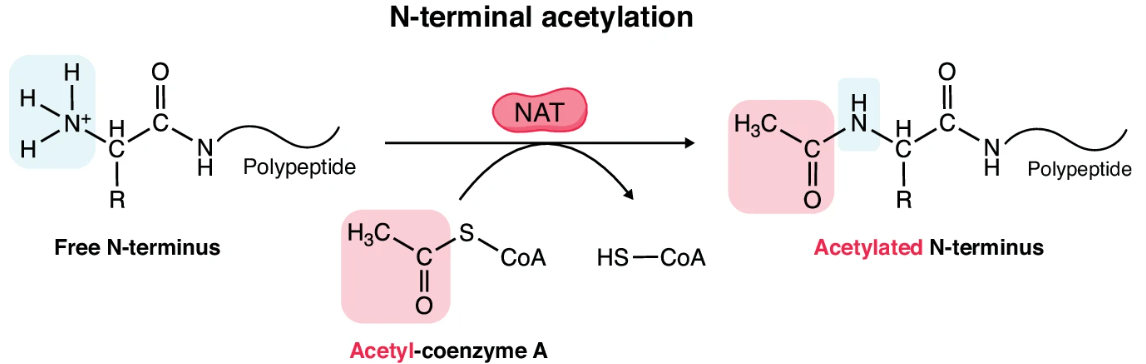
McTiernan, N. et al. Nat Commun. 2025.
Figure 1. Protein N-terminal Acetylation Reaction
Acetylated peptides are peptide fragments carrying acetyl modifications, and their identification and quantitative analysis provide important insights into protein functional changes and the molecular mechanisms underlying cellular regulation and disease development.
Acetylated Peptide Analysis Service at MtoZ Biolabs
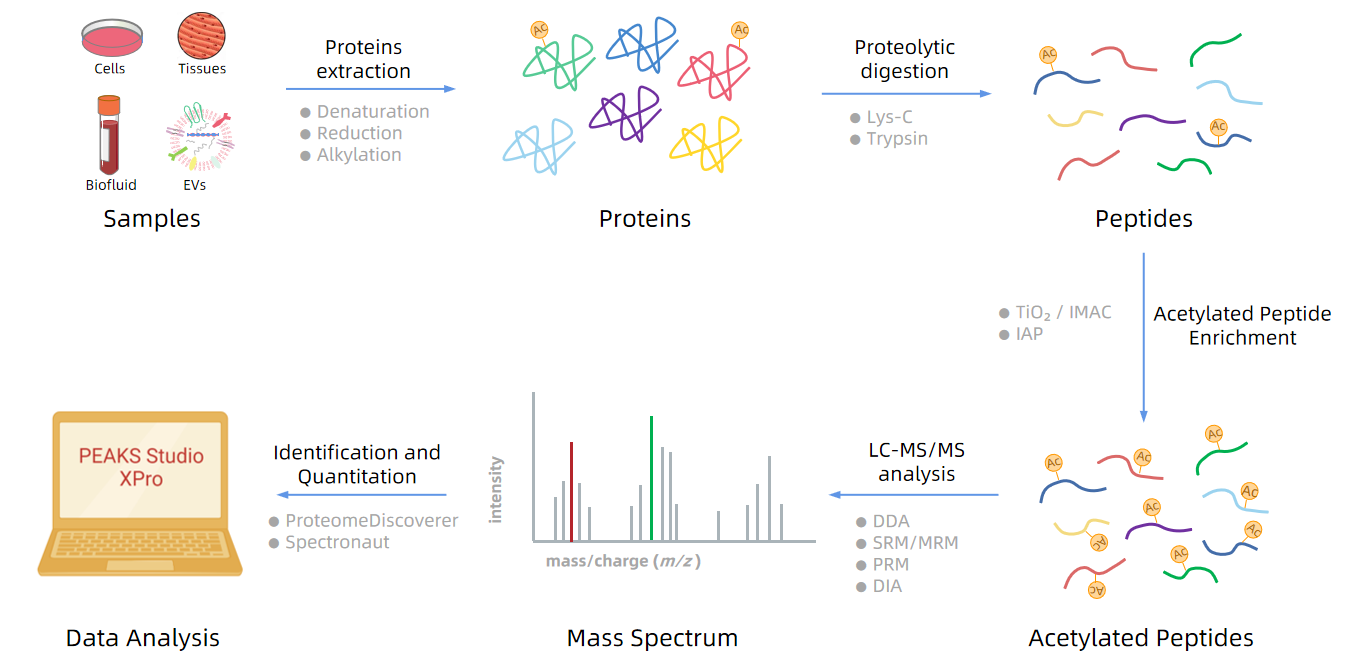
MtoZ Biolabs employs immunoaffinity enrichment combined with high-resolution mass spectrometry to achieve highly sensitive detection of acetylated peptides.
Through standardized workflows and strict quality control, MtoZ Biolabs ensures accurate and reproducible results, providing reliable data for scientific research.
Workflow of Acetylated Peptide Analysis Service
Why Choose MtoZ Biolabs
☑️ High-sensitivity detection platform based on Orbitrap Fusion Lumos and other advanced mass spectrometry systems for high-resolution analysis
☑️ Specific enrichment strategy using immunoaffinity capture to increase detection efficiency of low-abundance acetylated peptides
☑️ Various quantitative approaches such as Label-free, TMT, and iTRAQ can be applied according to research needs to achieve comprehensive quantification and comparison of acetylation modifications
☑️ Experienced research team with strong expertise in post-translational modification and proteomics research
Applications of Acetylated Peptide Analysis Service
1. Epigenetic and chromatin regulation research
2. Signal transduction studies
3. Disease mechanism research
4. Drug development and target validation
5. Metabolic and protein stability research
Deliverables
1. Complete experimental report
2. Raw mass spectrometry data files
3. Tables of identified acetylation sites and quantitative results
4. Statistical and quality control reports
5. Optional bioinformatics analysis including pathway enrichment and functional annotation
FAQs
Q1: What is the service's general workflow?

Q2: What data formats are provided?
MtoZ Biolabs provides results in multiple standard formats to ensure compatibility with various analysis and visualization tools. Deliverables typically include
Additional data formats or customized file structures can be provided upon request to meet specific publication or research requirements
Q3: What types of samples are suitable?
MtoZ Biolabs accepts a broad range of biological samples for acetylated peptide analysis, including:
Samples should be of high purity and contain deacetylase inhibitors to preserve acetylation status. Avoid buffers with high salt or detergents to prevent ionization suppression in mass spectrometry analysis.
Q4: How should I prepare my samples?
To ensure accurate and reproducible results for Acetylated Peptide Analysis Service, MtoZ Biolabs recommends following these preparation guidelines
1. Sample Type We accept various biological samples including cell lysates tissues serum plasma and purified proteins
2. Sample Purity Samples must be free of particulates salts detergents and organic solvents that may interfere with LC separation or ionization efficiency
3. Required Amount Provide at least 100 μg of total protein at a concentration above 1 μg/μL
4. Storage and Shipping Store samples at −80°C and ship on dry ice in sealed containers to maintain sample integrity
5. Documentation Include information such as sample origin treatment conditions buffer composition and analysis objectives
For more information, please refer to Sample Submission Guidelines for Proteomics and Sample Submission Guidelines for Metabolomics.
If you are unsure about your sample preparation, our technical team can provide personalized pre-analysis consultation and a sample submission guide to help you optimize preparation and shipping conditions.
Start Your Project with MtoZ Biolabs
Contact us to discuss your experimental design or request a quote. MtoZ Biolabs is committed to delivering high-quality, reproducible, and scientifically rigorous acetylated peptide analysis solutions that empower innovation in life science research.
How to order?




