



An absolute protein quantification assay can look complete yet still miss the concentration claim the project needs. Calibration curves may fit poorly across the intended range. Spike recovery in matrix may disagree with neat calibrators. Reported amounts may drift between replicates while relative light-to-heavy ratios look stable. Absolute QUAntification (AQUA) style assays convert a known heavy peptide amount into concentration through isotope dilution and a declared calibration model on liquid chromatography-tandem mass spectrometry (LC-MS/MS) (Gerber et al. 2003). When that conversion fails, the usual causes are calibration design, standard handling, digestion yield, or matrix bias, not instrument failure alone.
Relative discovery or light-only targeted tables answer fold-change questions. Absolute reporting needs a closed proteotypic peptide, a matched stable isotope-labeled internal standard (SIS) or AQUA peptide, matrix-aware calibrators, and quality control (QC) points that bracket study samples (Carr et al. 2014). Amount units still reflect the measured surrogate under the stated spike timing. They do not invent every protein isoform or digestion outcome.
In MtoZ Biolabs targeted offerings, absolute assay recovery is scoped when the peptide list, reporting unit, calibration plots, and matrix notes are available. Service intake appears in Absolute Quantitative Analysis (AQUA) Service.
What Absolute Quantification Troubleshooting Covers
Four troubleshooting layers belong in the brief and stay separated.
Symptom layer records curve fit, QC recovery, replicate precision, and whether samples sit outside the calibrated range.
Standard layer reviews AQUA or SIS integrity, assigned concentration, spike amount, and spike timing relative to digestion.
Matrix layer compares neat versus matrix-matched calibrators and inspects suppression, cleanup, and digestion consistency.
Claim layer restates the reporting unit and whether the assay still needs concentration, or can stop at relative confirmation. Diagnostic release or regulatory specification language needs a separately validated method beyond a research pilot.
Absolute troubleshooting repairs calibration, recovery, and matrix bias before the cohort is rerun. Repeating the same acquisition rarely restores concentration units.
Failure Patterns: Calibration Curves, Standard Recovery, and Matrix Bias
Weak absolute performance usually shows a recognizable pattern.
Calibration regression may be nonlinear, too narrow, or driven by outliers from standard handling. QC recovery at low or high levels may drift while mid-level points look acceptable. Matrix spikes may recover differently from buffer-only calibrators. AQUA signal may be unstable or absent while the endogenous peptide remains detectable. Digestion variability may change light peptide yield across replicates before calibration is applied.
Those patterns point to different fixes. Curve geometry problems need bracketing and regression review. Recovery drift needs matrix-matched calibrators or cleanup. Unstable heavy peaks need standard requalification or spike-protocol review. Digestion scatter needs prep lock before acquisition is blamed. Absolute versus relative route framing appears in Absolute Protein Quantification or Relative Quantitation? Matching AQUA, MRM/PRM, and Label-Free Routes to Your Reporting Goal. Assay design checkpoints appear in How to Design an Absolute Protein Quantification Assay.
End-to-End Troubleshooting Workflow
A practical recovery spine usually runs as follows.
- Freeze the reporting unit, acceptance intent, and which peptides are on the absolute panel.
- Collect calibration plots, QC tables, chromatograms, and spike records before changing settings.
- Re-evaluate calibrator levels so they bracket expected sample concentrations with declared lower and upper bounds.
- Compare neat and matrix-matched calibrators; quantify recovery bias before expanding the curve.
- Review AQUA or SIS lot, assigned concentration, storage, and pre- versus post-digestion spike timing.
- Check digestion completeness, missed cleavage, and replicate peptide yield across arms.
- Change one factor at a time; re-run low, mid, and high QC after each change.
- If interference persists after calibration and prep review, test PRM fragment confirmation or an alternate proteotypic peptide.
- Archive revised curve, QC summary, spike protocol, and method version before cohort reacquisition.
Steps 1 through 2 protect the evidence record. Steps 3 through 9 are the recovery and re-lock record. AQUA peptide principle language appears in AQUA Peptides: Principles for Absolute Quantification. When MRM transitions remain unstable after calibration repair, route choice appears in Parallel Reaction Monitoring vs MRM: Which Fits?.
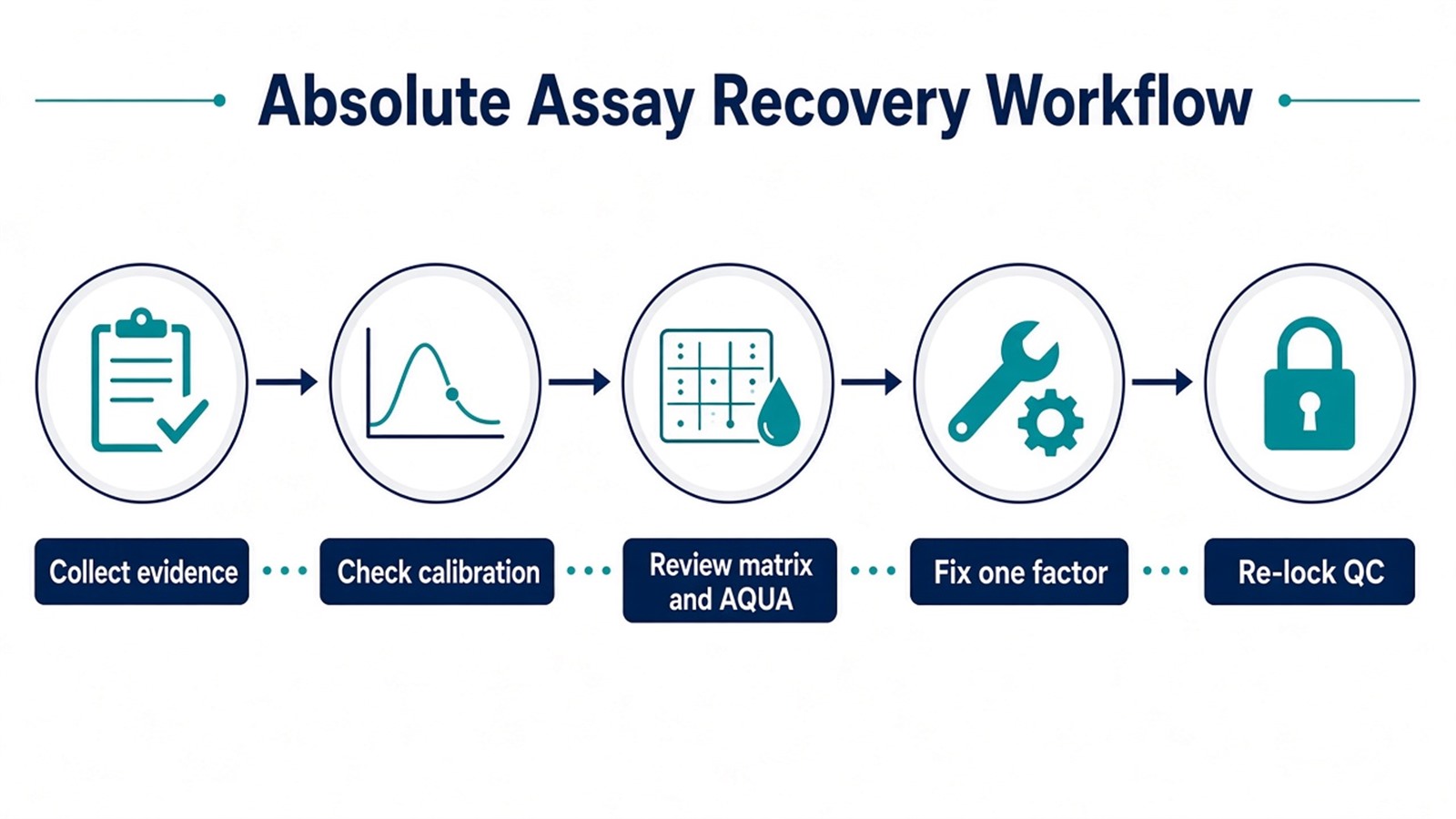
Figure 1. Absolute assay recovery depends on structured review of calibration, matrix recovery, and AQUA spike integrity before the cohort is rerun.
Parameters That Must Be Re-Locked During Recovery
Layer |
Parameter that must be declared |
Failure mode if ignored |
|---|---|---|
Reporting unit |
ng/mL, fmol, or other stated unit |
Relative peaks treated as concentration |
Peptide |
Proteotypic sequence and uniqueness |
Shared peptide as protein amount |
AQUA or SIS |
Lot, assigned concentration, isotope pattern |
Scale error across every sample |
Spike timing |
Pre-digestion or post-digestion rule |
Digestion loss misread as biology |
Calibrators |
Level count and bracketing range |
Samples outside validated interval |
Matrix match |
Neat versus matrix-matched design |
Buffer curve fails in study matrix |
Digestion |
Matched enzyme conditions and yield checks |
Prep scatter as concentration drift |
Acquisition |
MRM transitions or PRM fragment rules |
Interference after curve looks acceptable |
QC |
Low, mid, and high points in range |
Undetected low-end or high-end failure |
Deliverable |
Revised curve, QC table, method notes |
Cohort rerun without a locked fix |
Limits follow the same table. Expanding calibrator range without rechecking low and high QC does not create a valid interval. Copying published curve parameters into a new matrix does not transfer recovery. Relative ratio stability does not prove absolute accuracy.
What Recovery Can Support After Fixes
A repaired absolute assay supports concentration or amount reporting for the locked surrogate peptide under the revised calibration and spike protocol. Protein-level inference still depends on uniqueness and digestion assumptions. Alternate proteotypic peptides may calibrate more reliably in matrix even when they were not the strongest discovery feature.
Orthogonal immunoassays can sanity-check directionality during recovery. Agreement does not replace a matrix-validated LC-MS calibration model. Large directional mismatch often reveals surrogate or matrix problems early.
A successful recovery usually delivers revised calibrator levels, QC summaries against project-defined criteria, and a documented decision to keep MRM, move selected peptides to PRM, dilute, or redesign the surrogate. It does not automatically authorize clinical release or regulated specification decisions without a separately validated method record.
Recovery restores a declared concentration claim for a closed AQUA panel. It does not convert relative discovery tables into absolute units.
How to Choose the Next Action After Absolute Failure
Use failure pattern, matrix evidence, and claim urgency together.
Observed problem |
Action that often fits |
Recheck before committing |
|---|---|---|
Curve too narrow or poorly fit |
Rebuild bracketing calibrators and QC levels |
Rerun cohort on the old curve |
Neat recovery fine, matrix recovery poor |
Matrix-matched calibrators or cleanup revision |
Buffer-only curve in plasma or tissue |
Unstable or missing AQUA peak |
Requalify standard and spike protocol |
Blame acquisition first |
Digestion CV high, AQUA stable |
Lock prep before changing regression |
Curve-only fix |
Persistent MRM interference after curve repair |
PRM pilot or alternate peptide |
Expand panel without matrix retest |
Samples above upper bound |
Dilution plan inside validated range |
Extrapolate beyond the curve |
Relative ratios stable, absolute QC fails |
Recheck calibration and recovery layers |
Treat relative success as absolute proof |
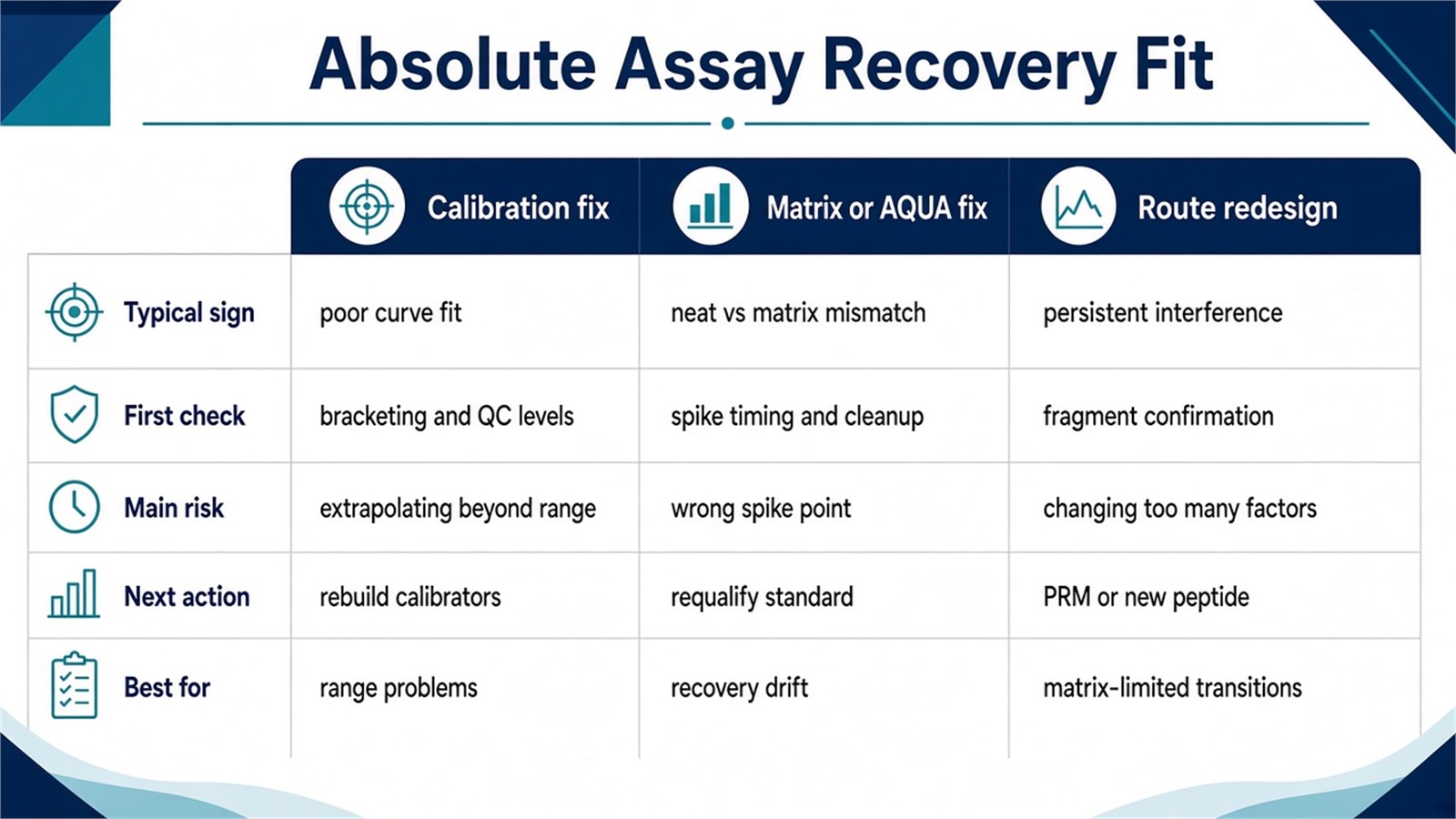
Figure 2. Choose the recovery action from the failure pattern; keep relative-only reporting when concentration units are no longer required.
Teams with calibration plots, QC tables, and matrix notes can review MtoZ Biolabs Absolute Quantitative Analysis (AQUA) Service when absolute recovery is declared in the project record. Targeted acquisition options appear on the Targeted Proteomics Service page when MRM and PRM both remain open.
Frequently Asked Questions
1. Why can relative ratios look stable while absolute concentrations fail QC?
Relative normalization can mask calibration or recovery problems. Absolute reporting depends on the relationship between known standard amount and measured signal across the validated range.
2. Should calibrators always be prepared in study matrix?
Matrix-matched calibrators are often required in plasma, tissue, and formulation backgrounds. Cleaner matrices may allow simpler calibration when recovery is demonstrated.
3. Can a failed calibration be fixed by re-running samples only?
Usually not. Calibration model, standard handling, or matrix prep must be corrected before repeat acquisition will produce acceptable concentration values.
4. When should recovery move from MRM to PRM?
When interference persists after calibration and prep review, and fragment-level confirmation is required for the same closed AQUA panel.
5. What files help scope absolute assay recovery?
Calibration plots, QC recovery tables, spike chromatograms, digestion notes, reporting unit, and matrix type help evaluate the next fix before the cohort is resubmitted.
MtoZ Biolabs can provide absolute quantitative analysis using AQUA or related SIS designs for predefined protein or peptide panels, including calibration review, matrix pilot testing, and targeted LC-MS/MS when study design and QC evidence are available.
If further evaluation of calibration bracketing, standard recovery, matrix bias, or MRM versus PRM acquisition choice is needed, project details can be submitted for a feasibility review.
Reference
- S.A. Gerber, J. Rush, O. Stemman, M.W. Kirschner, S.P. Gygi (2003). Absolute quantification of proteins and phosphoproteins from cell lysates by tandem MS. Proc. Natl. Acad. Sci. U.S.A., 100, 6940-6945. https://doi.org/10.1073/pnas.0832254100
- S.A. Carr, S.E. Abbatiello, B.L. Ackermann, C. Borchers, B. Domon, E.W. Deutsch, R.P. Grant, A.N. Hoofnagle, R. Huttenhain, J.M. Koomen, D.C. Liebler, T. Liu, B. MacLean, D.R. Mani, E. Mansfield, H. Neubert, A.G. Paulovich, L. Reiter, O. Vitek, R. Aebersold, A.J. Smith, et al. (2014). Targeted peptide measurements in biology and medicine: best practices for sample preparation, assay standardization, and assay validation. Mol. Cell. Proteomics, 13, 907-917. https://doi.org/10.1074/mcp.M113.036095
- V. Lange, P. Picotti, B. Domon, R. Aebersold (2008). Selected reaction monitoring for quantitative proteomics: a tutorial. Mol. Syst. Biol., 4, 222. https://doi.org/10.1038/msb.2008.61
- A.C. Peterson, J.D. Russell, A.A. Klammer, P.F. Doubleday, H. Liu, J.N. Anderson, M.J. MacCoss (2012). Parallel reaction monitoring for high resolution and high mass accuracy quantitative, targeted proteomics. Mol. Cell. Proteomics, 11, 1475-1488. https://doi.org/10.1074/mcp.O112.020271
