4D-DIA Quantitative Proteomics Service
MtoZ Biolabs provides 4D-DIA Quantitative Proteomics Service combining trapped ion mobility separation with DIA LC-MS/MS for in-depth protein identification and quantitative comparison across complex biological samples.
TIMS-enabled diaPASEF integrates ion mobility with DIA acquisition, adding an orthogonal separation dimension that supports peptide resolution and quantitative analysis in complex proteomic studies.
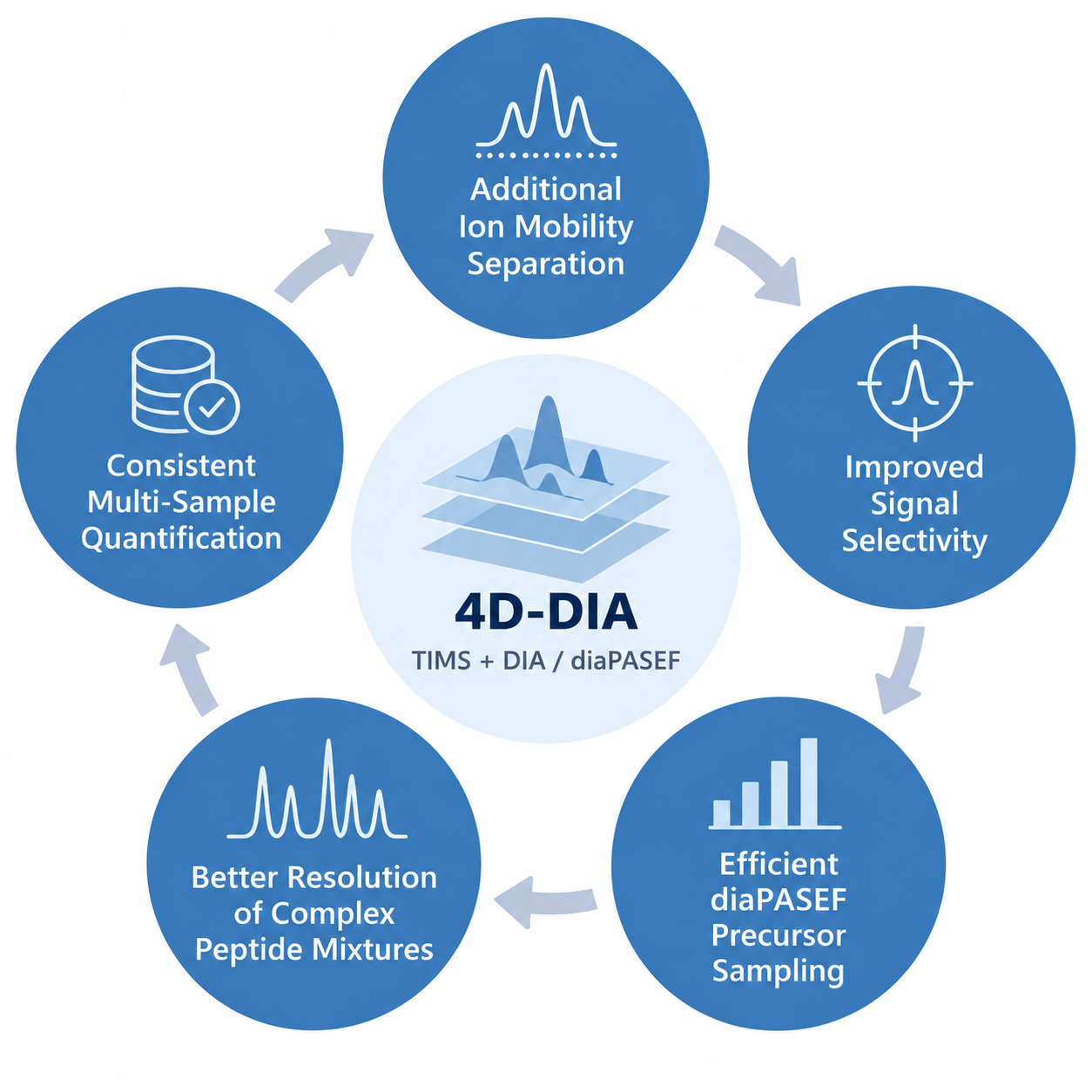
- TIMS-Enabled DIA with Ion Mobility Separation
- Mobility-Aware diaPASEF Precursor Acquisition
- Additional Selectivity for Complex Peptide Mixtures
- Consistent Quantification Across Multiple Sample Groups
Principle of 4D-DIA
4D-DIA combines data-independent acquisition with trapped ion mobility spectrometry (TIMS), adding gas-phase ion mobility as an additional dimension to LC-MS/MS analysis. Peptide features can therefore be characterized using chromatographic retention time, mass-to-charge ratio, ion mobility or collision cross section information, and signal intensity.
On TIMS-enabled platforms, diaPASEF coordinates DIA acquisition across both m/z and ion mobility space. This mobility-aware approach provides additional selectivity for resolving complex peptide populations while retaining the systematic sampling characteristics of DIA.
Key technical advantages include:
- Additional Gas-Phase Separation: TIMS helps distinguish peptide ions with overlapping chromatographic or m/z characteristics.
- Improved Signal Selectivity: Ion mobility provides an additional criterion for separating peptide features and reducing interference during data extraction.
- Efficient diaPASEF Acquisition: Coordinated m/z and mobility windows support efficient precursor sampling during DIA analysis.
- Better Resolution of Complex Mixtures: The additional mobility dimension is particularly useful when peptide congestion limits conventional LC-MS/MS analysis.
4D-DIA Quantitative Proteomics Service at MtoZ Biolabs
MtoZ Biolabs provides 4D-DIA Quantitative Proteomics Service using TIMS-enabled high-resolution LC-MS/MS for discovery-oriented protein identification and relative quantification.
Analytical parameters and quantitative workflows are selected according to sample complexity, experimental grouping, available material, and required analysis depth. The resulting peptide- and protein-level data support comparative analysis and downstream biological interpretation.
When This Service Is a Good Fit
4D-DIA is most valuable when ion mobility separation is expected to provide meaningful analytical benefit beyond a conventional DIA workflow.
The service may be suitable for:
- complex biological samples where additional ion mobility separation can improve analytical selectivity;
- studies requiring deeper discovery-scale peptide and protein profiling;
- multi-group studies requiring consistent quantitative comparison;
- projects where peptide overlap or signal interference limits conventional DIA analysis;
- studies where ion mobility information is relevant to the analytical design.
For less complex samples or studies where conventional DIA already provides sufficient depth and data quality, a standard DIA workflow may be more efficient. MtoZ Biolabs can evaluate study requirements before recommending the appropriate quantitative proteomics strategy.
Analysis Workflow
1. Study Design and Sample Evaluation
Sample type, experimental groups, biological replicates, available material, and quantitative objectives are reviewed before analysis.
2. Protein Extraction and Peptide Preparation
Proteins are extracted according to sample characteristics and processed through reduction, alkylation, enzymatic digestion, peptide cleanup, and quality evaluation as appropriate.
3. LC and TIMS Separation
Peptides are separated chromatographically and subsequently resolved in the gas phase by TIMS before mass analysis.
4. 4D-DIA Acquisition
diaPASEF-based DIA acquisition coordinates precursor m/z selection with ion mobility separation for systematic measurement of peptide populations.
5. Protein Identification and Quantification
LC-MS/MS data are processed for peptide identification, protein inference, normalization, and relative protein quantification across experimental samples.
6. Comparative and Biological Analysis
Quantitative results are evaluated according to the experimental design. Differential protein analysis, clustering, functional annotation, enrichment analysis, and pathway analysis can be performed where applicable.
Deliverables
1. Experimental and Analytical Details (Study design, sample preparation, LC-TIMS-MS/MS workflow, and acquisition information)
2. Peptide and Protein Identification Results (Peptide identification, protein inference, and associated identification information)
3. Quantitative Proteomics Results (Protein abundance matrices, normalization results, and group-wise quantitative comparison)
4. Statistical and Bioinformatics Analysis (Differential protein analysis, clustering, functional annotation, and pathway interpretation where applicable)
5. Data Files and Final Report (Raw LC-MS/MS files, processed quantitative datasets, visualization results, and final analysis report)
Why Choose MtoZ Biolabs?
1. Study-Specific Acquisition Design
Acquisition parameters and quantitative workflows are selected according to sample complexity, experimental grouping, and required analysis depth.
2. Integrated Quantitative Proteomics Workflow
Sample preparation, LC-TIMS-MS/MS acquisition, quantitative analysis, and downstream interpretation are coordinated within one service workflow.
3. Technical Support Across the Study
Our team supports study planning, workflow selection, data analysis, and result interpretation according to the objectives of each project.
4. Transparent Scope and Pricing
Study scope, analytical strategy, deliverables, and pricing are defined before analysis. No additional charges are added within the agreed service scope after quotation.
Sample Submission Suggestions
Sample requirements depend on biological matrix, protein abundance, sample complexity, experimental design, and required analysis depth.
Common sample types include:
- cultured cells;
- animal and plant tissues;
- plasma, serum, urine, and other compatible biofluids;
- microbial samples;
- extracted protein samples.
Before submission, please provide:
- sample type and biological source;
- experimental groups and biological replicates;
- available sample amount;
- sample collection and storage information;
- previous sample treatment, if applicable;
- primary quantitative objectives.
MtoZ Biolabs can evaluate sample feasibility and recommend whether 4D-DIA or another quantitative proteomics workflow is better suited to the study.
FAQ
Q1. How is 4D-DIA different from conventional DIA?
Both approaches use data-independent acquisition for systematic peptide measurement. 4D-DIA additionally incorporates ion mobility separation, providing another level of selectivity for resolving peptide signals in complex samples.
Q2. Is 4D-DIA suitable for multi-sample quantitative studies?
Yes. 4D-DIA can support comparative studies involving multiple biological samples and experimental groups. Study design, quality-control strategy, and acquisition parameters should be selected according to sample number and required proteome depth.
Start Your Project with MtoZ Biolabs
MtoZ Biolabs provides 4D-DIA Quantitative Proteomics Service for studies requiring ion mobility-resolved protein identification and quantitative comparison across complex biological samples.
Contact our technical team with your sample type, experimental groups, available material, and quantitative objectives. We can evaluate whether 4D-DIA or another quantitative proteomics strategy is better suited to your study.
