



Multi-condition proteomics projects often need the same LC-MS/MS run to carry several biological arms so batch drift does not dominate group contrasts. Tandem mass tag (TMT) labeling addresses that need by isobaric multiplexing: peptides from separate samples receive channel-specific tags, digests are pooled, and relative abundance is read from reporter ions after fragmentation rather than from MS1 peak areas alone (Thompson et al. 2003). The workflow below follows the sample-to-matrix path used in tumor heterogeneity studies, drug mechanism work, and biomarker discovery when every arm can enter one kit before mixing. Researchers who already have defined samples, comparison groups, or channel maps to freeze before labeling can also use A Detailed Workflow of TMT-Based Quantitative Proteomics for extended experimental design, prep matching, and fractionation planning.
What Is TMT Labeling? Brief Principle
TMT is an isotope-encoded chemical labeling strategy for relative quantification across multiple samples. Peptides from different samples are labeled with reagents that are isobaric at the MS1 level, yet generate distinct reporter ions upon fragmentation, thereby enabling multiplexed quantification.
Each TMT reagent comprises three key structural components:
- Reporter group: used for MS2- or MS3-based quantification (m/z 126-131; expandable to TMTpro 16-plex or 18-plex)
- Balancer group: offsets mass differences to keep the overall tag isobaric across channels
- Reactive group: reacts with primary amines at peptide N-termini or lysine side-chain amino groups to form covalent labels
Because all labeled samples are pooled and analyzed together within the same LC-MS/MS run, between-batch variability is reduced relative to separate unlabeled injections, which supports more consistent relative ratios when prep and channel assignment stay matched.
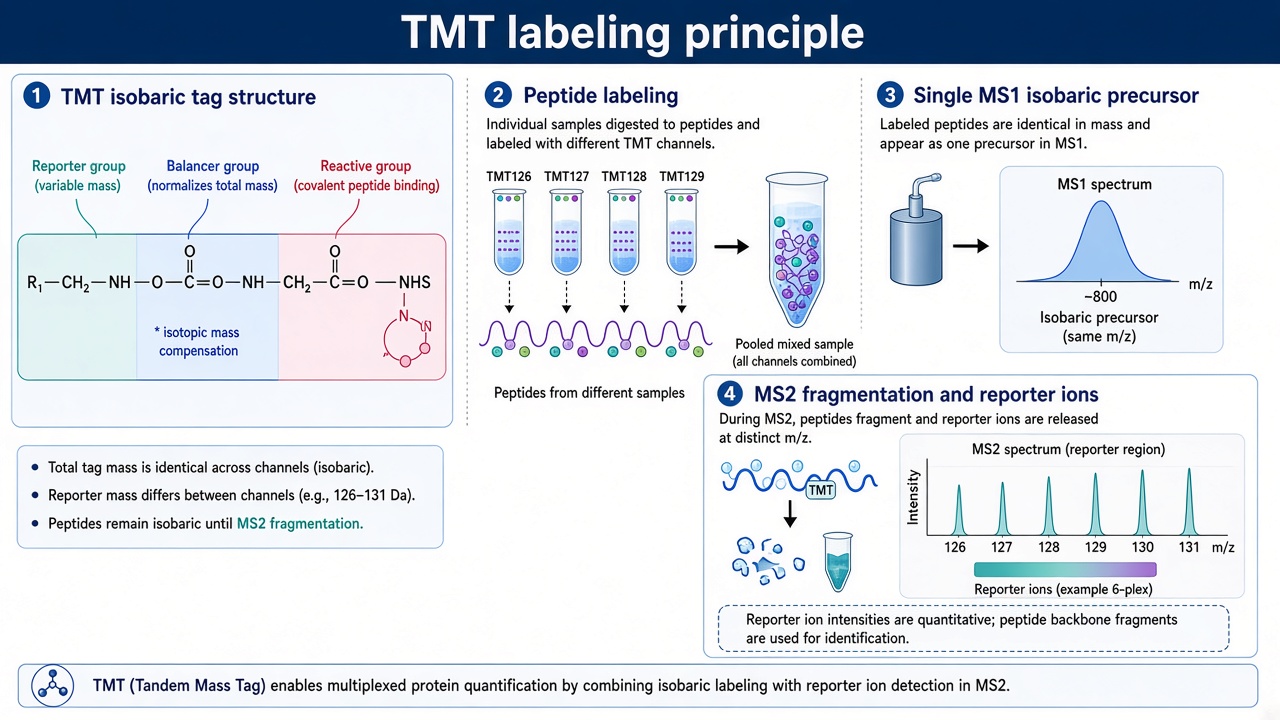
Figure 1. TMT labeling keeps channels isobaric at MS1; quantification comes from reporter ions after fragmentation, not from channel splitting in the survey scan.
TMT workflow quantification is defined by reporter-ion ratios inside a closed multiplex, not by independent MS1 peak-area comparisons across unlabeled runs.
End-to-End Workflow for TMT-Labeled Quantitative Mass Spectrometry
The stages below are sequential. Skipping QC at labeling or mixing usually shows up later as distorted ratios or missing reporters rather than as a search-engine issue alone.
1. Protein Extraction and Quantification
The workflow begins with protein extraction. Lysis conditions are selected according to sample type (e.g., cells, tissues, serum/plasma), using appropriate buffers such as RIPA, SDS, or urea. Efficient solubilization must be balanced against protein integrity across every arm that will share a plex.
Protein concentration is then determined using BCA or Bradford assays to standardize the input amount across samples. A typical starting point is at least 100 ug per channel, though feasible input depends on complexity, enrichment, and instrument time.
2. Proteolytic Digestion (Digestion Efficiency Directly Affects Quantification Quality)
Trypsin-based digestion is commonly used and is frequently combined with Lys-C to improve cleavage efficiency, particularly for samples with high salt content or strong denaturants. Digestion typically includes:
- Protein reduction (DTT)
- Alkylation (IAA)
- Overnight digestion (37°C; enzyme:substrate = 1:50)
This step generates a peptide mixture for subsequent TMT labeling. Uneven digestion across channels can change peptide stoichiometry before the tag is applied, so matched handling across arms matters as much as enzyme ratio.
3. TMT Labeling Reaction
Each sample is labeled with a distinct TMT reagent. Typical labeling conditions include:
- Buffer environment: an amine-free buffer is commonly used (e.g., TEAB)
- Reaction time: 60 minutes at room temperature
- Quenching: ammonium hydroxide solution or amino acids are added to neutralize excess reagent
Labeling efficiency should exceed 95%. In the workflow, MtoZ Biolabs implements dedicated quality-control checkpoints and performs small-scale pilot testing to confirm complete labeling before proceeding. Incomplete labeling leaves unmodified peptides that do not report channel ratios correctly.
4. Sample Mixing and Fractionation
After labeling, equal amounts of each channel are pooled to generate a single composite sample. Because the pooled sample is highly complex, additional fractionation is typically performed, commonly via high-pH reversed-phase chromatography, to improve proteome coverage.
Common fractionation approaches include:
- High-pH reversed-phase chromatography
- Strong cation exchange (SCX)
- Electrophoresis-based methods (SDS-PAGE, OFFGEL)
The number of fractions is generally 8-20, depending on sample complexity and the desired depth of analysis. Fractionation trades instrument time for depth; it does not remove the requirement that every biological arm enter the plex before pooling.
5. LC-MS/MS Analysis (High-Resolution Mass Spectrometry Platform)
For MS acquisition, MtoZ Biolabs employs high-resolution instruments such as Orbitrap Exploris 480, Orbitrap Fusion Lumos, and timsTOF systems, coupled with nanoLC, to perform quantification at the MS2 or MS3 level.
Key acquisition considerations include:
- Electrospray ionization (ESI)
- Positive-ion mode
- DDA acquisition, or a DIA plus DDA hybrid strategy where project design requires it
- TMT quantification mode (MS2 or SPS-MS3)
SPS-MS3 can reduce ratio compression arising from co-isolation and co-fragmentation, thereby improving quantitative accuracy when MS2 reporters are contaminated by neighboring precursors (Ting et al. 2011; McAlister et al. 2014). Scan choice is a throughput versus reporter-purity trade; it does not repair a wrong channel map or samples added after the pool is closed. For how isobaric precursors and MS2 or SPS-MS3 reporter readout fit together in the mass spectrometer, Mass Spectrometry TMT Technology provides a focused explanation of the instrument record that this workflow depends on.
6. Data Analysis and Bioinformatics Interpretation
Raw MS data are processed using commonly applied software platforms, including:
- Proteome Discoverer (Thermo platform)
- MaxQuant (multi-platform compatibility)
- Spectronaut (commonly used for DIA-based analyses)
Database searching is performed against resources such as UniProt or RefSeq, followed by filtering of confident identifications (FDR below 1%) and generation of a protein abundance matrix.
Downstream analyses typically include differential protein identification, GO/KEGG enrichment, clustering, protein-protein interaction (PPI) network analysis, and visualization. Enrichment outputs describe overrepresentation within the quantified background; they do not by themselves prove pathway activity or clinical utility.
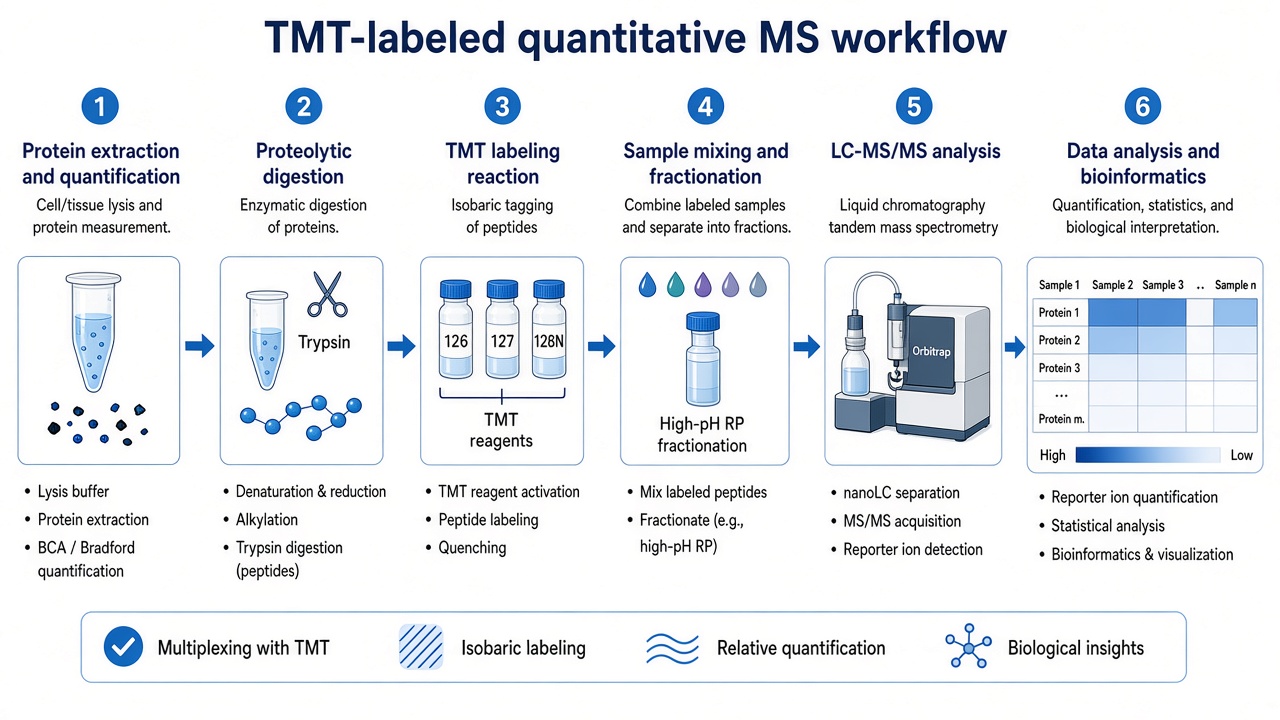
Figure 2. The TMT-labeled quantitative MS workflow links matched prep, multiplex labeling, pooled acquisition, and reporter-based matrix generation.
Workflow Limits Worth Fixing Before Scaling
TMT-labeled quantitative MS inherits isobaric constraints that appear in the data rather than in the search settings alone. Ratio compression at MS2, amine-reactive interferences in certain matrices, and post-mix addition of new arms can all flatten or misassign ratios. Relative reporter output also does not substitute for absolute amount assays without separate calibrated targeted methods.
Typical workflow checkpoints that protect interpretability:
- Channel map and replicate placement frozen before labeling scales
- Pilot labeling efficiency reviewed before full multiplex use
- Fraction count aligned to depth goal and available instrument time
- Scan level (MS2 or SPS-MS3) recorded with the protein matrix
- Predefined contrasts tested with missing-reporter handling documented
MtoZ Biolabs Advantageous TMT Service System
In TMT-based quantitative proteomics, MtoZ Biolabs leverages an in-house high-throughput MS platform and a mature sample-processing pipeline to provide end-to-end, one-stop solutions:
- Extensive experience in sample preparation across diverse complex matrices (FFPE, plasma, limited-input tissue).
- Flexible support for TMT 6/10/11/16/18-plex labeling.
- In-depth data analysis, including pathway analysis, disease enrichment, and target prediction.
- Rigorous quality control throughout the workflow, monitoring labeling efficiency, protein coverage, and technical reproducibility.
- Optional multi-omics integrative analyses in combination with metabolomics and transcriptomics.
TMT-labeled MS has become a central approach for profiling changes in protein expression and is particularly well suited for study designs involving multiple groups, multiple replicates, and clearly defined comparisons. In both basic research and translational applications, accurate and reproducible quantification is fundamental to data credibility. MtoZ Biolabs continues to refine its TMT quantitative MS platform to deliver datasets that match the workflow decisions described above. Researchers who already have defined samples, plex size, and contrast structure can also review the MtoZ Biolabs TMT Quantitative Proteomics Analysis Service for project-specific sample evaluation, feasibility assessment, and workflow planning.
Reference
- A. Thompson, J. Schafer, K. Kuhn, et al. (2003). Tandem mass tags: a novel quantification strategy for comparative analysis of complex protein mixtures by MS/MS. Anal. Chem., 75, 1895-1904. https://doi.org/10.1021/ac0262560
- L. Ting, R. Rad, S.P. Gygi, W. Haas (2011). MS3 eliminates ratio distortion in isobaric multiplexed quantitative proteomics. Nat. Methods, 8, 937-940. https://doi.org/10.1038/nmeth.1714
- G.C. McAlister, D.P. Nusinow, M.P. Jedrychowski, M. Wuhr, E.L. Huttlin, B.K. Erickson, R. Rad, W. Haas, S.P. Gygi (2014). MultiNotch MS3 enables accurate, sensitive, and multiplexed detection of differential expression across cancer cell line proteomes. Anal. Chem., 86, 7150-7158. https://doi.org/10.1021/ac502040v
